

Looking for a SurveyMonkey alternative? You're not alone. Whether it's the pricing, the restrictive free plan, the branding limitations, or an interface that hasn't kept pace with newer tools, there are good reasons to look elsewhere.
The survey tool market in 2026 is more competitive than ever. There are strong options for every use case: free tools that outperform SurveyMonkey's basic plan, affordable platforms with better CX workflows, enterprise-grade research tools, and modern form builders that connect directly to the tools your team already uses.
We evaluated dozens of platforms and narrowed it down to the 15 best SurveyMonkey alternatives. For each tool, we've included real pricing, G2 ratings, honest pros and cons, and a clear best-for recommendation, so you can find the right fit without wading through a generic list..
TL;DR — Quick Summary
|
SurveyMonkey Alternatives Compared: Pricing, Ratings & Free Plans
Here’s a quick overview of the best SurveyMonkey alternatives and how they compare.
| Tool | Best For | Starting Price | Free Plan? | G2 | Key Differentiator | Integrations |
|---|---|---|---|---|---|---|
| SurveySparrow | Overall best | $19/mo | Yes | 4.4/5 | Conversational surveys | Salesforce, Slack, HubSpot, Zapier |
| Google Forms | Free surveys | Free | Yes (full) | 4.5/5 | Unlimited everything, $0 | Google Sheets, Drive, Workspace |
| HubSpot | CRM feedback | $45/mo | Limited | 4.4/5 | Survey + CRM in one | Salesforce, Slack, 1000+ apps |
| Alchemer | Market research | $25/mo | No | 4.4/5 | Best logic engine at this price | Salesforce, Slack, Zapier |
| QuestionPro | Expert research | $85/mo | Yes | 4.5/5 | Conjoint, MaxDiff, 24/7 support | Salesforce, HubSpot, Tableau |
| Jotform | Form building | $39/mo | Yes | 4.7/5 | 10,000+ templates, payments | PayPal, Stripe, Square, Zapier |
| Zoho Survey | Zoho ecosystem | $20/mo | Yes | 4.4/5 | Native Zoho integration | Zoho CRM, Desk, Analytics |
| Qualtrics | Enterprise/ academic | Custom quote | Free acct | 4.4/5 | Most advanced research | Salesforce, SAP, Tableau |
| Zonka Feedback | AI-powered CX | On request | No | 4.6/5 | AI sentiment + omnichannel | HubSpot, Salesforce, Intercom |
| LimeSurvey | Open source research | $29/month | Yes | 4.2/5 | Self-hosting + 80+ languages | SPSS, R, Stata exports |
| Survicate | In-app surveys | $89/mo | Yes | 4.6/5 | Behavior-triggered feedback | HubSpot, Intercom, Slack |
| Typeform | Beautiful UX | $39/mo | Yes | 4.5/5 | Best conversational design | Zapier, Slack, HubSpot |
| Formstack | Salesforce forms | $19/mo | No | 4.4/5 | Bi-directional Salesforce sync | Salesforce, PayPal, Stripe |
| Microsoft Forms | Microsoft teams | Free* | Yes* | 4.6/5 | Deep Office 365 integration | Excel, Teams, SharePoint, Power Automate |
| Fillout | Modern forms | $15/mo | Yes | 4.9/5 | Notion + Airtable native | Notion, Airtable, Google Sheets |
*Microsoft Forms is free with any Microsoft account. Premium features require Microsoft 365 subscription (from $6/user/mo).
*Pricing is subject to change. Visit each tool's website for the most current rates.
1. SurveySparrow – Best Overall SurveyMonkey Alternative
SurveySparrow is a AI-powered, conversational survey platform and one of the strongest SurveyMonkey competitors across the board. Rated as G2’s fastest-growing product three years running, it stands out for its chat-like survey format that delivers a reported 40% higher completion rate.
Why It’s a Good Alternative to SurveyMonkey
SurveySparrow starts at $19/month compared to SurveyMonkey's $39/month Advantage plan. It offers a forever free plan, includes branded surveys at lower tiers, and doesn't charge extra for features like conditional logic and multi-channel sharing that SurveyMonkey locks behind higher tiers.
See how SurveySparrow compares with SurveyMonkey in detail: SurveySparrow vs SurveyMonkey
SurveySparrow Features
- AI Surveys: Create complete surveys in seconds. Just describe what you need, and AI generates personalized questions instantly.
- Executive Dashboard: Create multiple dashboards and widgets to visualize survey data with rich insights.

- NPS & 360° Feedback: Run Net Promoter Score surveys and comprehensive performance appraisals from the same platform. Track employee and customer loyalty over time and with precisio.
Echo AI Agent: Turns your website and channels into intelligent feedback hubs that collect and respond to customer input around the clock.

- Survey Templates: A comprehensive library of more than 1000+ survey templates covering customer satisfaction, employee engagement, healthcare, events, and more.
- Offline Surveys: Collect responses without an internet connection via tablet or kiosk. Data syncs automatically when connectivity is restored.
In summary: Affordable, attractive, and intuitive survey tool. With an emphasis on being conversational, as it should be. Definitely worth a try!
Who Should Use SurveySparrow?
Those interested in conducting Net Promoter Score (NPS), and CSAT surveys. Its standout feature is its ability to turn ordinary surveys into engaging conversations, making it an ideal choice for those seeking to improve respondent engagement and gather valuable feedback.
G2 Rating: 4.4/5 based on 2000+ reviews
"The UI and UX are extremely polished, a very similar experience to SurveyMonkey’s overall style, and the features they offer are second to none…for a price." – G2 Customer Review
Pros
- More affordable than SurveyMonkey across all tiers
- Forever free plan with conversational survey format included
- Strong NPS, CSAT, and CES workflows built in
- Covers customer experience, employee experience, and market research in one platform
- 14-day free trial, no credit card required
Cons
- Advanced features like 360 assessments and reputation management require higher-tier plans
- The breadth of features can feel overwhelming for teams who only need simple surveys
- Reporting depth on lower tiers is more limited than enterprise tools like Qualtrics
SurveySparrow Pricing
Starts at $19 per month. With 10 different plans, ranging from Basic to Platform, SurveySparrow offers a variety of options to fit different needs.
SurveySparrow also offers a Forever Free Plan with limited features, as well as a free trial for users to test out the product.

Explore how SurveySparrow can transform your feedback process.
TRUSTED BY BEST-IN-CLASS BRANDS


2. Google Forms – Best free SurveyMonkey alternative
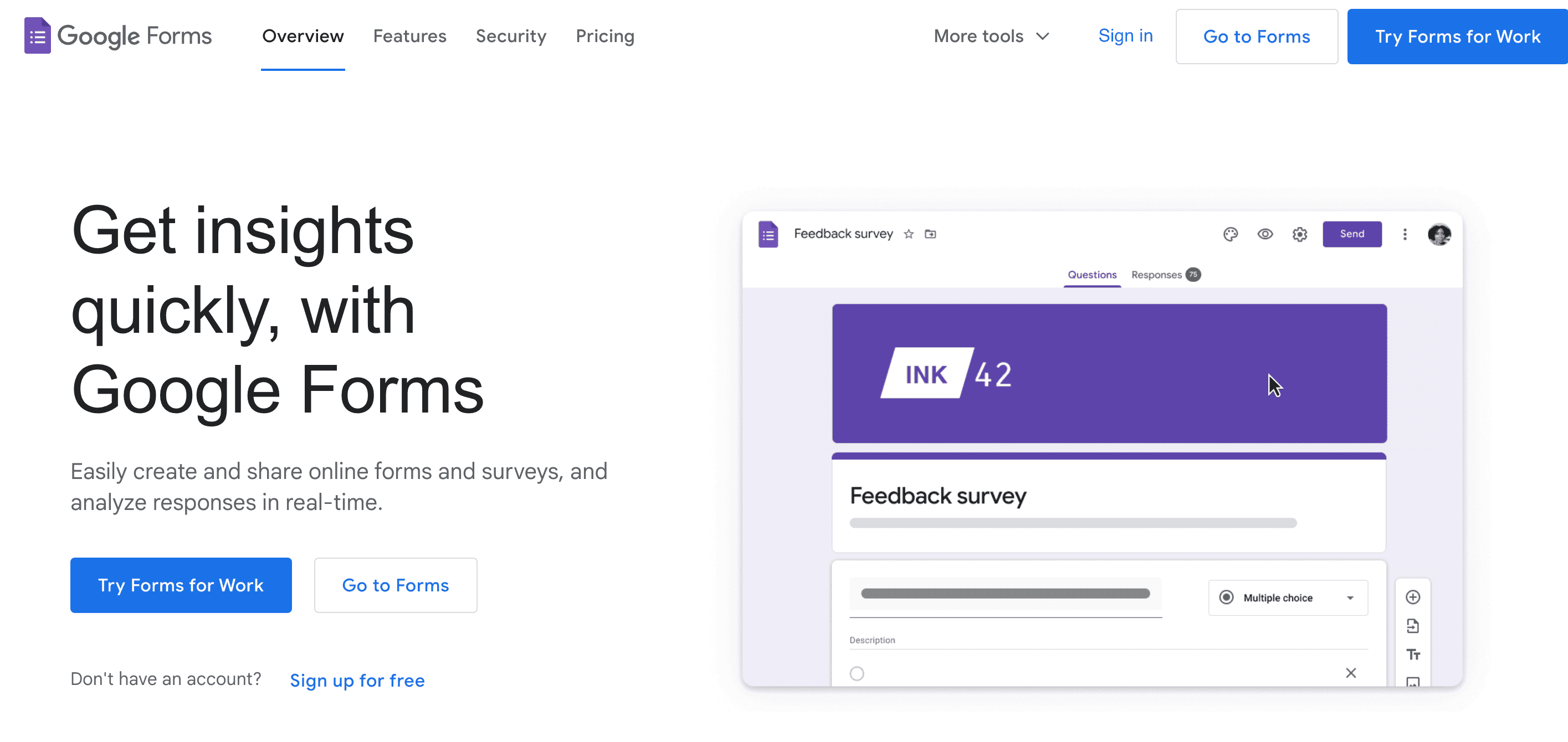
Google Forms is the most accessible free survey tool available. It requires no account setup beyond a Google login, works on any device, and gets a basic survey live in minutes. For teams that need simple data collection without a budget, nothing comes close on price.
Google Forms Features
- Seamless Collaboration and Real-time Editing: Multiple team members can build and edit the same form simultaneously, with changes syncing instantly. Useful for teams putting together quick internal surveys.
- Integration with Google Workspace: Responses feed directly into Google Sheets for real-time analysis. Works seamlessly with Google Drive, Gmail, and Google Calendar.
- Unlimited Surveys and Responses: Unlike SurveyMonkey's free plan, Google Forms places no caps on surveys, questions, or responses -- making it the most generous free option on this list.
Best For: General users, educators, small businesses, and teams that need quick, no-cost surveys without advanced analytics or automation.
Pros
- Completely free with no hidden tiers or response limits
- Minimal learning curve. Anyone can build a form in minutes
- Mobile-friendly for both form builders and respondents
Cons
- No survey scheduling or automation
- No user segmentation or targeted distribution
- Limited design customization and no white-labeling
- Not suitable for in-depth CX programs or NPS tracking
Customer Reviews: One customer on softwareadvice.com cited pricing as the main reason for switching from SurveyMonkey to Google Forms.
“SurveyMonkey was prohibitively expensive for our small team and we did not want to pay the high price for just internal usage.”
G2 Rating: 4.5/5 based on 2600+ reviews
Google Forms Pricing: Free.
If you’re considering Google Forms but are unsure, check out our in-depth blog on Google Forms Alternatives to explore other options.
3. Hubspot – Easily scalable
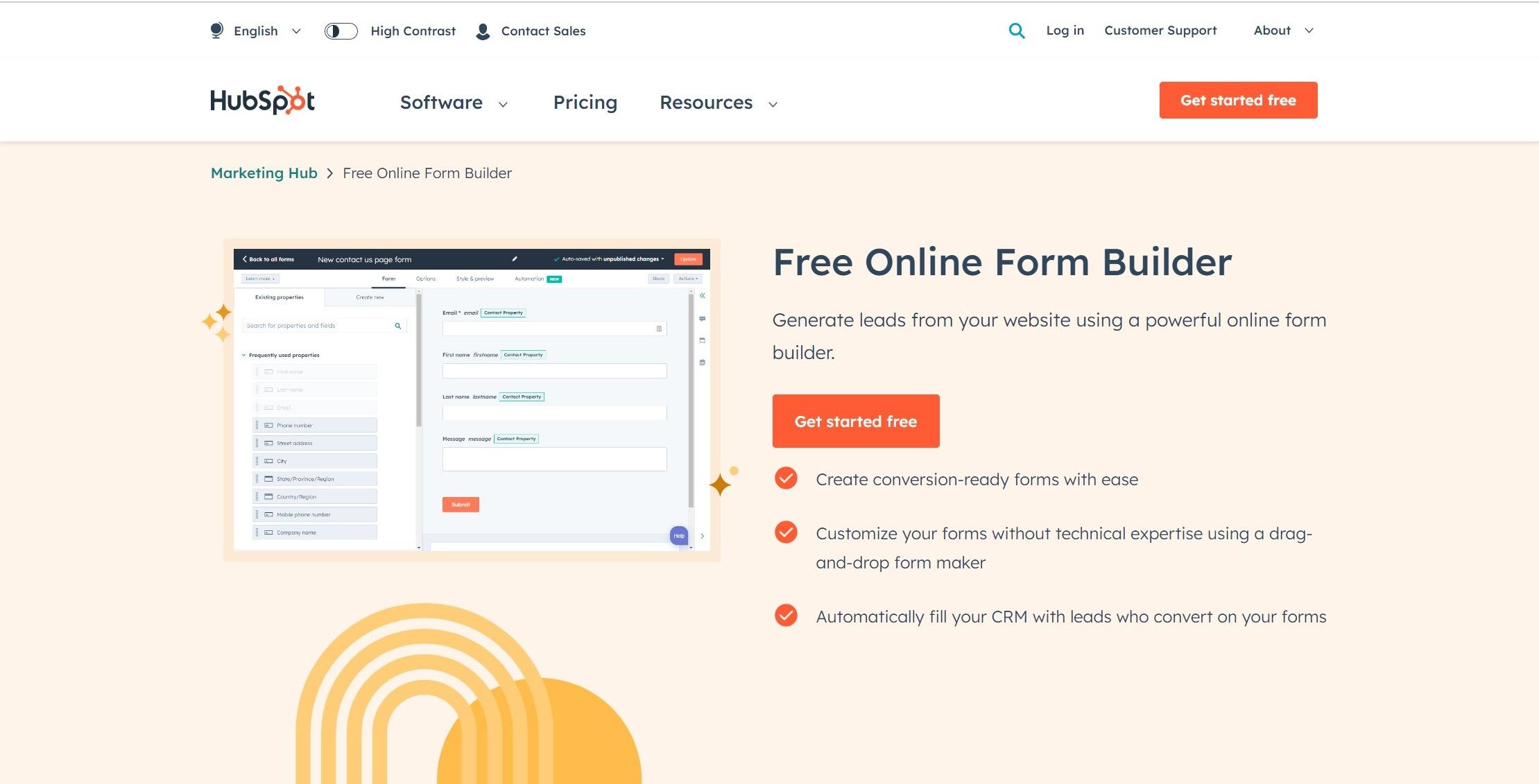
HubSpot is not a dedicated survey tool, it's a full CRM platform that includes survey and feedback capabilities as part of a broader marketing, sales, and customer service suite. For teams that want feedback data connected directly to customer records without managing a separate tool, it's a strong SurveyMonkey alternative.
HubSpot Features
- CRM Integration: Survey responses tie directly to individual contact records in HubSpot's CRM, giving sales and CX teams full context on how customers feel at every stage of the relationship.
- Automated Follow-ups: Trigger automated emails, tasks, or workflows based on survey responses. A low NPS score can automatically create a support ticket or notify a customer success manager.
- Advanced Analytics: Track feedback trends across segments, campaigns, and customer lifecycle stages, all within the same dashboard your marketing and sales teams already use.
Best for: B2B and B2C businesses that want survey and feedback data connected to their CRM without managing a separate platform. Particularly strong for teams already using HubSpot for marketing or sales.
Pros
- Survey data connects directly to CRM contact records
- Automated workflows reduce manual follow-up
- One platform for marketing, sales, service, and feedback
- Large integration library with 1,000+ apps
Cons
- Survey features are secondary to CRM, not built for research-heavy use cases
- Pricing escalates quickly as you add hubs and seats
- Free tools are limited and the jump to paid tiers is steep
G2 Rating: 4.4/5 based on 9940+ reviews
Customer Reviews: While SurveyMonkey is only for conducting surveys, Hubspot Marketing Hub proves to be a holistic marketing tool. A customer on G2 says “Indeed the Simple, Fast, and Flexible tool for all Marketing Initiatives”
HubSpot Pricing: Starts at $45 per month.
4. Alchemer (Previously SurveyGizmo) – Best for Market Research
Alchemer sits between basic survey tools like SurveyMonkey and enterprise platforms like Qualtrics. It offers the advanced logic, branching, and reporting capabilities that serious researchers need, without the complexity and pricing of a full enterprise solution.
Alchemer Features
- Customization: Provides extensive customization options, including custom themes and branding, that may surpass those SurveyMonkey offers, allowing for a more personalized and brand-centric survey experience. Custom themes, branding, and white-labeling options that give surveys a professional, brand-consistent appearance. Audience segmentation and panel services add further research depth.
- Advanced Logic and Branching: Build surveys that adapt dynamically based on how respondents answer. Alchemer's logic engine is one of the most flexible at this price point.
- Robust Reporting: In-depth data analysis and visualization tools that includes cross-tabulation, filtering, and the ability to build custom reports for stakeholders.
Best for: Small to large enterprises that need research-grade survey logic and reporting without moving to a full enterprise platform like Qualtrics. Particularly strong for market research, educational feedback, and corporate survey programs.
Pros
- Best logic engine in the mid-range price bracket
- Strong for market research, educational feedback, and corporate surveys
- More affordable than Qualtrics for teams that need research-grade features
- Audience segmentation and panel services built in
Cons
- Pricing can feel high relative to some alternatives with comparable features
- Customer support quality has been flagged in user reviews as inconsistent
- Can have a steeper learning curve for non-researchers
G2 Rating: 4.4/5 based on 870+ reviews
Customer Reviews: "While the functionality of both platforms is quite similar, I chose Alchemer for its distinct features and pricing model." - TrustRadius
Alchemer Pricing: Starts at $25 per month.
If you’re exploring other possibilities, have a look at Alchemer Alternatives.
5. QuestionPro – Best for Expert Researchers
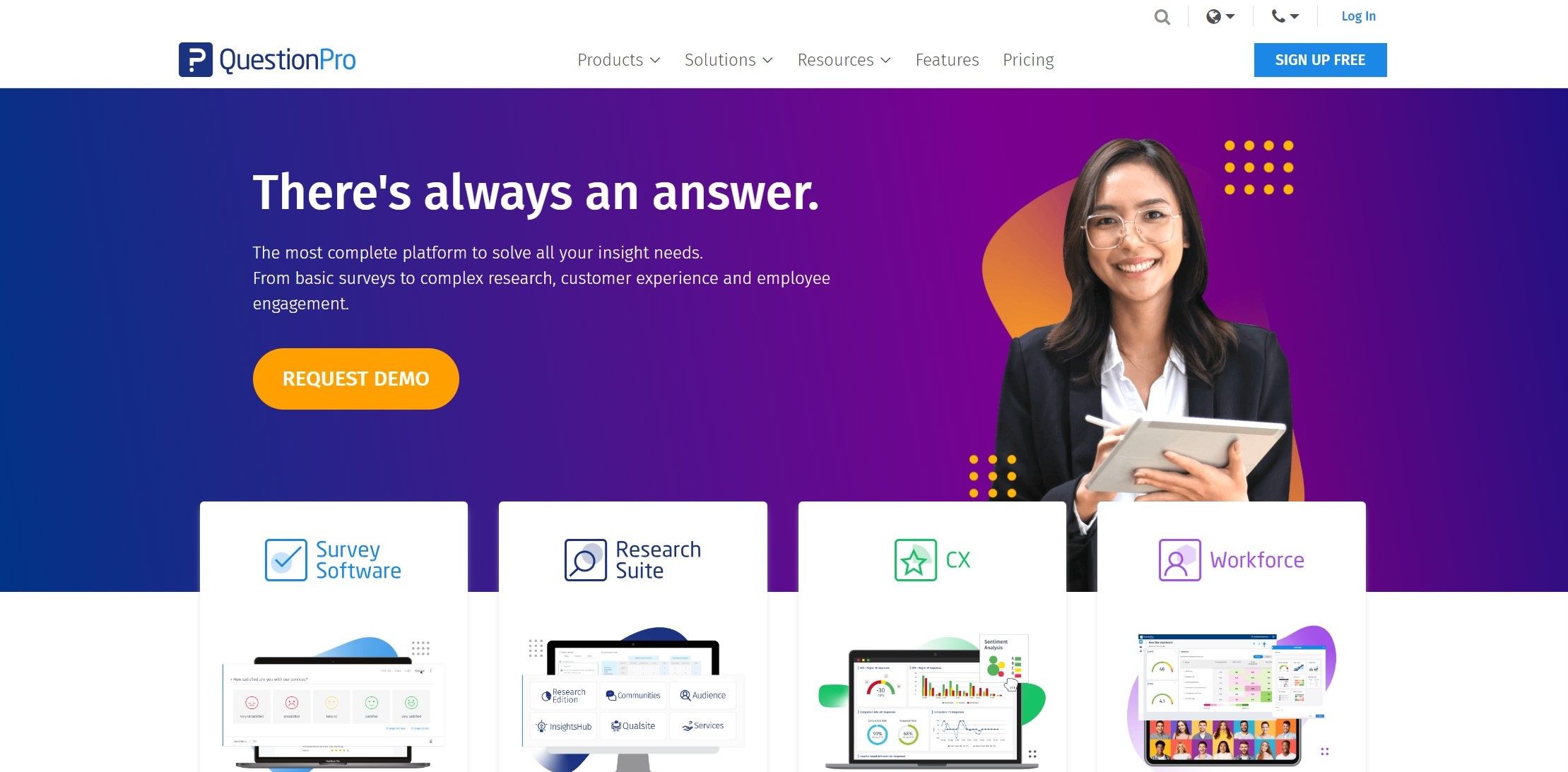
QuestionPro is built for researchers who need more than basic survey creation. It offers advanced question types, a generous free tier, and 24/7 customer support from staff who understand research methodology well. Novice or pro, this platform is exceptionally intuitive to use. With great customer support, this tool also comes with a range of customizable options.
QuestionPro Features
- Unlimited Surveys and Responses: Allows unlimited surveys and responses in the free plan, which can be a plus for those with high-volume data collection needs.
- Advanced Question Types: Includes conjoint analysis, MaxDiff, and a range of specialized research question formats.
- Customer Support: Responsive customer support through live chat and email. While SurveyMonkey also offers support, the speed and accessibility of QuestionPro’s service can be a distinguishing factor for some users.
Best for: Researchers, academics, nonprofits, and market research teams that need advanced question types, methodology support, and responsive customer service. Strong across education, healthcare, and civic organizations.
Pros
- Strongest free tier for research-oriented surveys
- Advanced methodology support including conjoint and MaxDiff
- 24/7 live chat with knowledgeable support staff
- Works for teams ranging from solo researchers to large enterprises
Cons
- Some users have reported pricing inconsistencies and unexpected cost increases
- Integration limitations have been flagged in user reviews
- Advanced plan pricing is higher than several comparable alternatives
G2 Rating: 4.5/5 based on 750+ reviews
Customer Reviews: Users appreciate the platform for its ease in creating surveys quickly and its supportive customer service. The support staff is noted for being excellent, courteous, and available.
“Is easy to learn to use, is effective and customizable and includes the visual, video, audio and upload features you would expect. What makes it stand out particularly is the high quality of its support staff. They are well trained, competent, quick and courteous.” – Capterra review
QuestionPro Pricing: Free plan available. Advanced plan starts at $85 per month.
6. Jotform – Best alternative for versatile templates
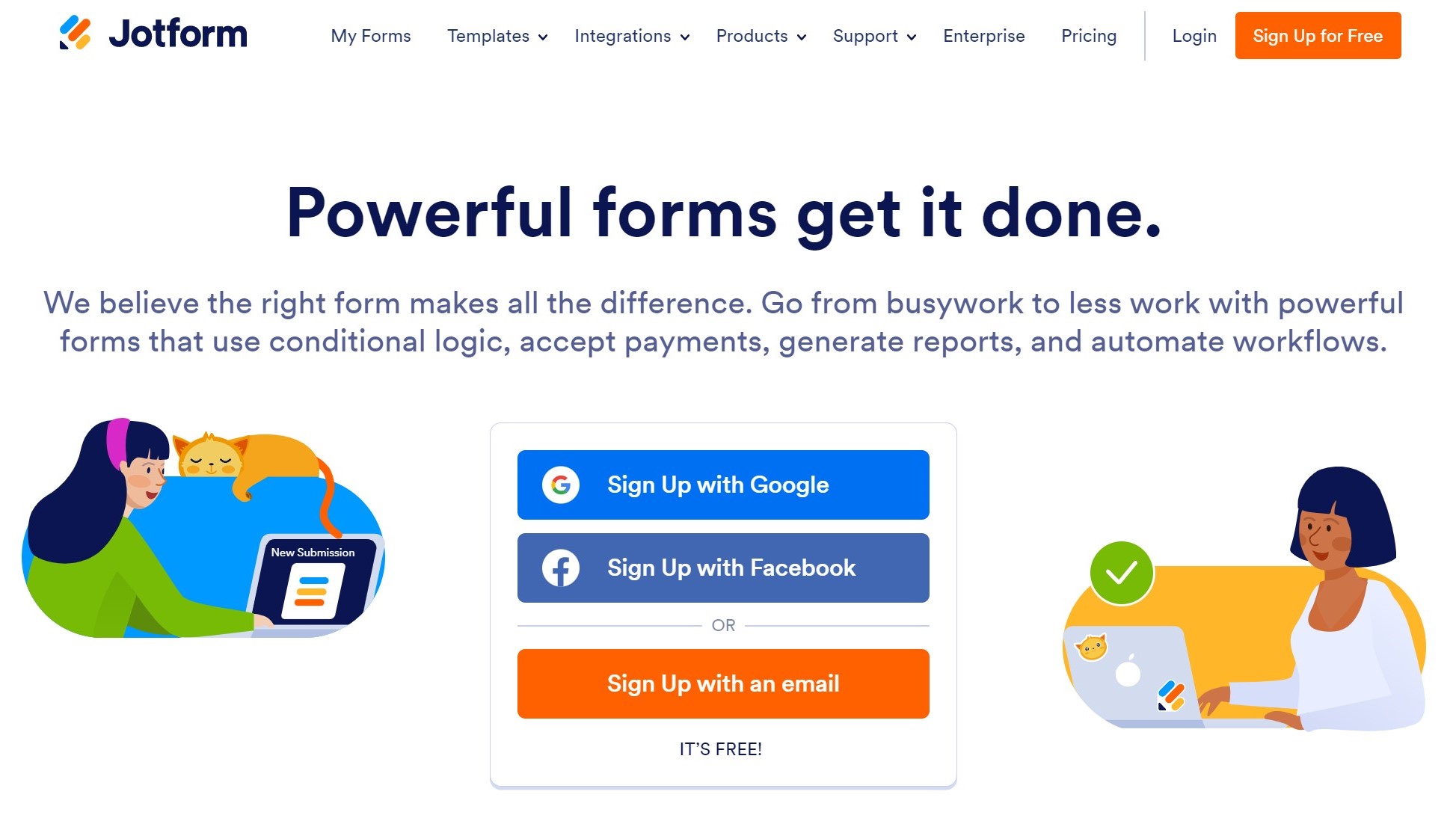
Jotform is a form and survey builder with one of the largest template libraries available, over 10,000 templates covering everything from event registration and payment collection to healthcare and legal forms. For non-technical users who need professional-looking forms without a steep learning curve, it's one of the most accessible SurveyMonkey alternatives on this list.
JotForm Features
- Design Flexibility: With its drag-and-drop form builder, JotForm provides extensive customization options, allowing visually appealing forms tailored to your brand’s aesthetic.
- Payment Integration: Native integration with PayPal, Square, and Stripe allows you to collect payments directly within a form, useful for event registrations, donations, and paid surveys.
- Unlimited Free Forms: The free plan enables the creation of unlimited forms, although responses are limited.
Best for: Non-technical users, nonprofits, event organizers, and teams across healthcare, education, and legal sectors who need versatile, professional forms with payment capabilities and minimal setup time.
Pros
- Highest G2 rating on this list at 4.7/5
- Payment collection built in across plans
- Generous template library covering virtually every industry
- Strong mobile app for on-the-go form management
- Conditional logic available on free plan
Cons
- Users have reported platform bugs and glitches that affect reliability
- Customer support quality falls short of expectations according to multiple reviews
If you are looking for an alternative to JotForm due to these glitches, feel free to check out our blog post on Jotform Alternatives.
G2 Rating: 4.7/5 based on 1900+ reviews
Customer Review: "Jotform is used to collect data using simple and advanced forms. It's a cut above Google Forms and Typeform. The native mobile app is incredible. 100% recommend." - G2
Jotform Pricing: Starts at $39 per month.
7. Zoho Survey – Suitable for Zoho Users
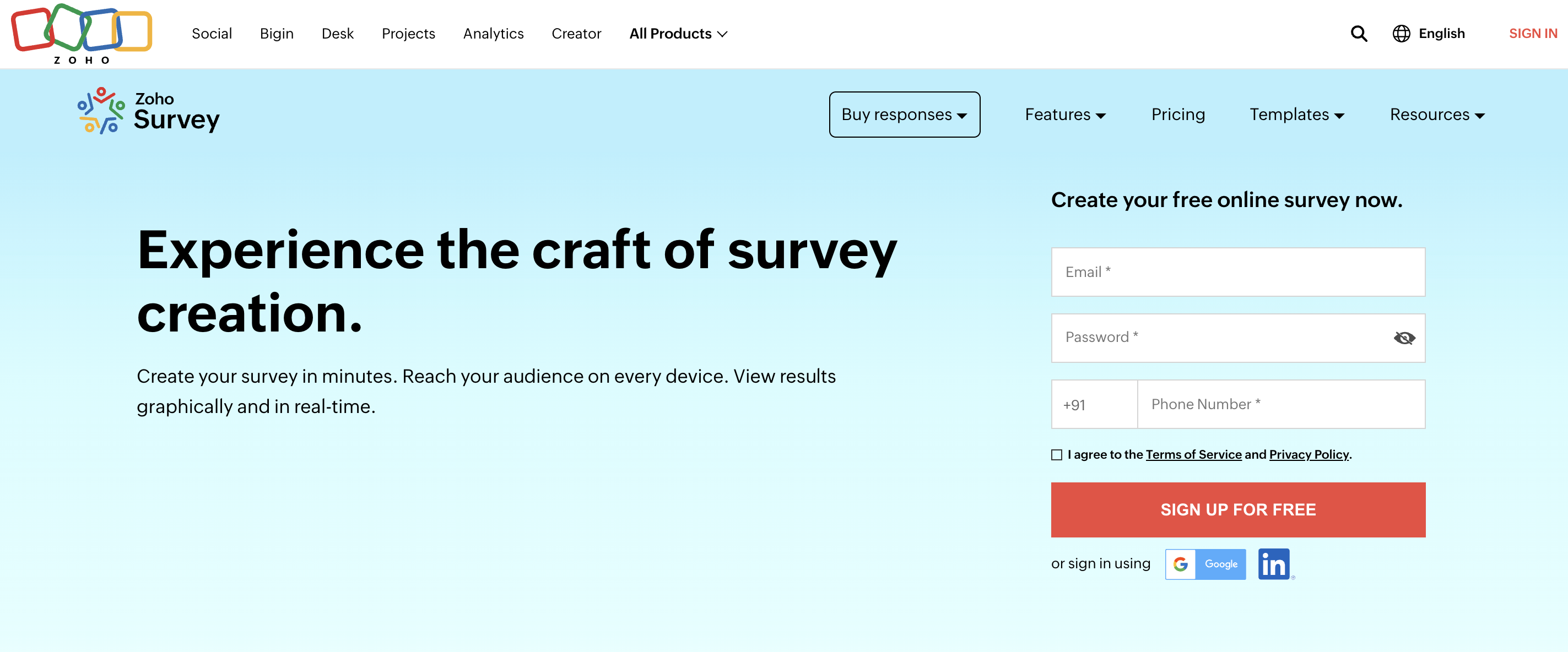
Zoho Survey's strongest argument is native integration with the Zoho ecosystem. For teams already using Zoho CRM, Zoho Desk, or Zoho Analytics, it's the most natural survey tool to add to the stack.
Zoho Survey Features
- Integration with Zoho Suite: Connects natively with Zoho CRM, Zoho Desk, Zoho Analytics, and other Zoho products. Survey responses feed directly into your existing Zoho workflows without third-party connectors or manual exports.
- Price: Starts at $20 per month with a free plan available. It is more affordable than SurveyMonkey, and covers more features than Google Forms for the price point.
- Panel Support: Zoho Survey provides access to a built-in respondent panel, allowing you to reach targeted audiences for your surveys without sourcing respondents separately. A practical feature for teams running market research or customer insight programs.
Best for: Small to mid-sized businesses already using the Zoho ecosystem, and teams across HR, education, healthcare, and nonprofit sectors that need multilingual survey capabilities at an affordable price point.
Pros
- Affordable pricing with a free plan included
- Native Zoho suite integration for existing Zoho users
- Multilingual survey support across 70+ languages
- Built-in respondent panel for targeted research
- Easy to set up with no technical skills required
Cons
- Conditional logic is basic and can be confusing to configure
- Interface is functional but feels dated compared to newer tools
- Limited value for teams not using other Zoho products
For alternatives that overcome these challenges, check out our blog on Zoho Desk Alternatives.
G2 Rating: 4.4/5 based on 800+ reviews
Customer Reviews: “I like the rich features and user-friendliness. It does not require higher IT skills on the side of the users. Easy to set up and easy to use.”– Capterra review
Zoho Survey Pricing: Starts at $20 per month.
8. Qualtrics – Suitable for Academic Research
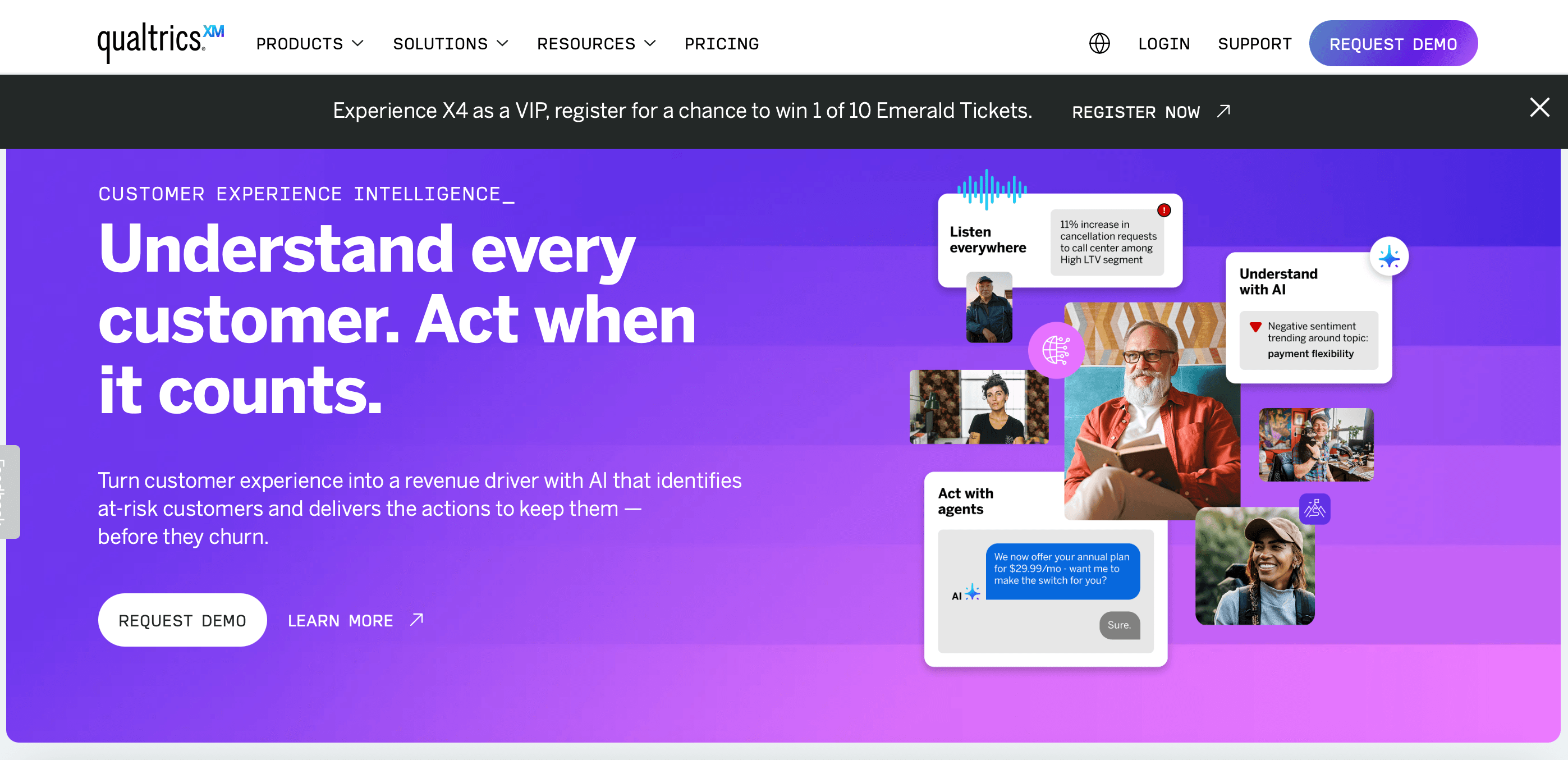
Qualtrics is less a survey tool and more a full experience management platform. It handles customer experience, employee engagement, brand tracking, and academic research in-depth. For organizations that treat research as a core business function rather than an occasional exercise, it's the most capable option on this list.
Qualtrics Features
- Advanced Research Capabilities: Excels in research-oriented features, offering experimental design, complex sampling, and statistical analysis.
- Sophisticated Logic and Branching: Provides advanced logic and branching for intricate, highly customized surveys.
- Text iQ and analytics: AI-powered text analysis that automatically identifies themes, sentiment, and patterns in open-ended responses, turning qualitative data into quantifiable insights at scale.
Best for: Enterprise organizations, academic institutions, and research teams in education, healthcare, financial services, and B2B technology that need the most advanced survey methodology, analytics, and experience management capabilities available.
Pros
- Most advanced research methodology support of any tool on this list
- Text iQ reduces manual analysis time significantly
- Covers customer experience, employee engagement, and market research in one platform
- Trusted across enterprise, academic, and government sectors
Cons
- Steeper learning curve, not suitable for teams that need surveys built quickly
- Pricing is not publicly listed, requiring a sales conversation before you can evaluate cost
- Overkill for teams with straightforward survey needs
Also Consider Reading: The Best Qualtrics alternatives
G2 Rating: 4.4/5 based on 500+ reviews
Customer Review: “It is a much more robust program than what SurveyMonkey appears to be. The ability to create the survey to run on a loop as if at a kiosk is fantastic.” - G2 Crowd review
Qualtrics Pricing: Contact to get a quote.
9. Zonka Feedback – AI-powered advanced feedback programs
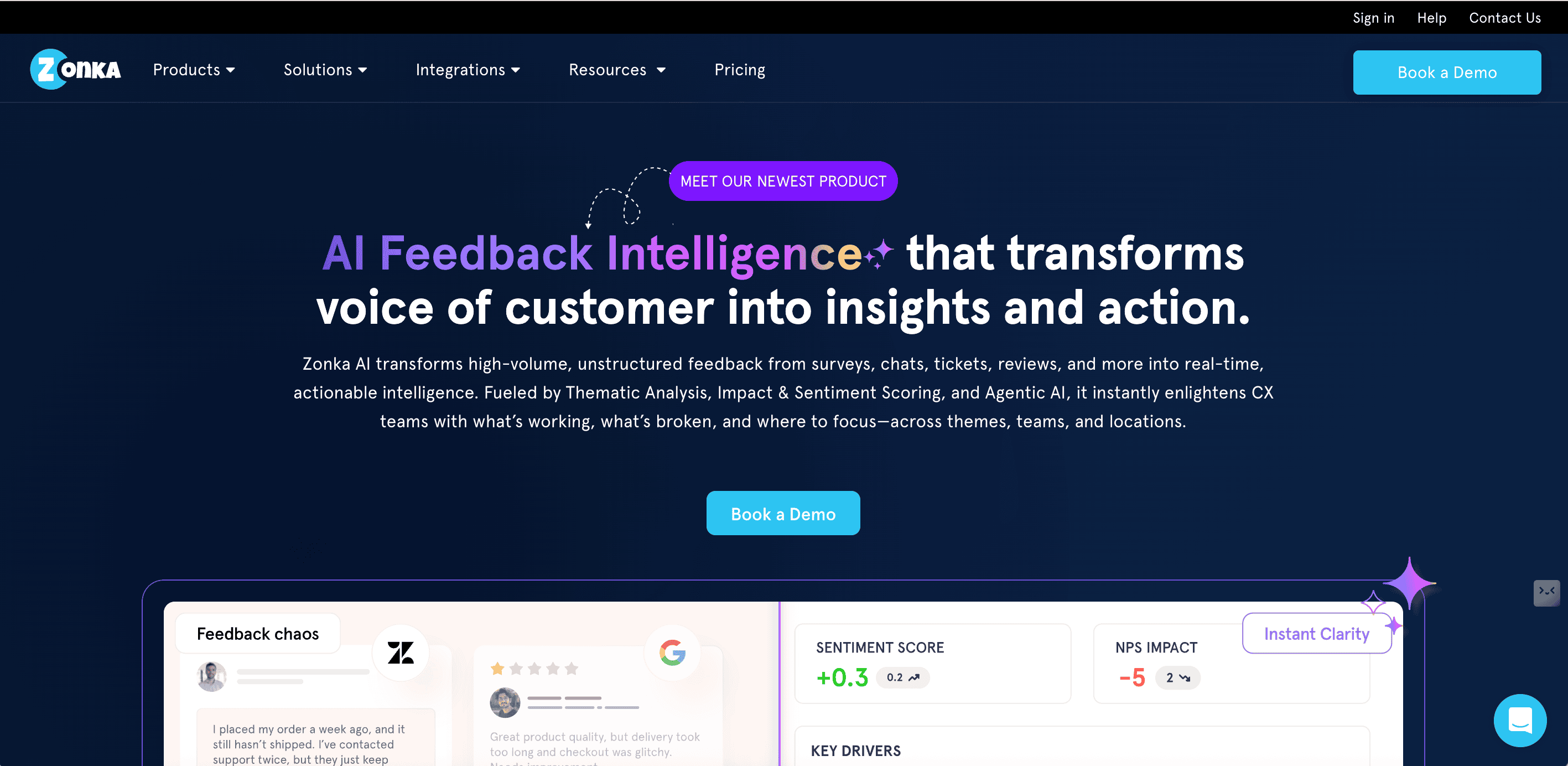
Zonka Feedback is an AI-powered Customer Feedback & Intelligence Platform designed for businesses that need more than basic surveys. It combines omnichannel survey distribution, AI-driven feedback analysis, and closed-loop action workflows in a single platform, covering everything from data collection to resolution without switching tools. For organizations running serious NPS, CSAT, and CES programs, it offers a significantly enough depth and usefulness in its analytics.
Zonka Feedback Features
- Omnichannel Survey Distribution: Collect feedback via email, SMS, WhatsApp, web widgets, in-app surveys, and offline kiosk mode.
- Advanced AI Feedback Intelligence: Analyzes open-text responses using sentiment analysis, theme detection, impact scoring, and entity recognition. Instead of manually reading through hundreds of responses, teams get an immediate picture of why scores are changing.
- Powerful Automation and Workflows: Trigger surveys automatically based on events, set alerts for negative feedback, and route responses to the right teams to close the loop faster.
- Real-time dashboards: Track NPS, CSAT, and CES trends by location, agent, or channel with customizable dashboards and scheduled reports for stakeholders.
Best for: CX teams and customer success managers running omnichannel NPS, CSAT, and CES programs who need AI-powered analytics and automated workflows to act on feedback at scale.
Pros
- Strong AI analysis for open-ended feedback at scale
- Broadest channel coverage on this list including WhatsApp and offline kiosks
- Closed-loop workflows reduce response time on negative feedback
- Responsive customer support highlighted consistently in reviews
Cons
- More feature-rich than necessary for teams with simple, one-off survey needs
- Initial setup and onboarding can require time investment for advanced features
- Pricing is not publicly listed, requiring a direct conversation with the sales team
Customer Reviews: "SurveyMonkey worked for basic surveys, but we needed better insights and faster action on feedback. Zonka gave us that visibility." - G2
G2 Rating: 4.6/5 based on 900+ reviews
Zonka Feedback Pricing: Pricing available on request.
10. LimeSurvey – Best Open-Source SurveyMonkey Alternative
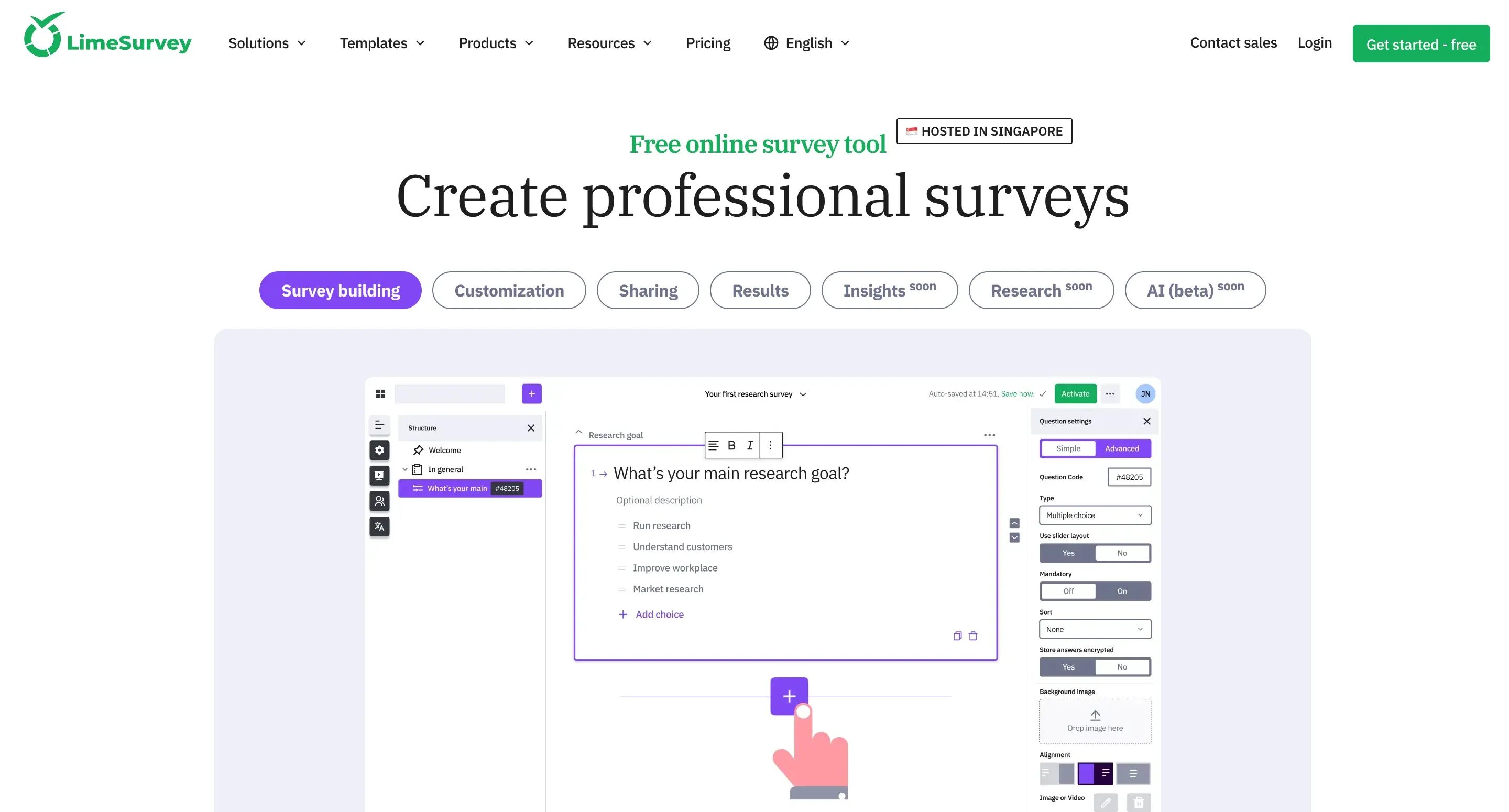
LimeSurvey is the survey tool for teams that want full control over their data. It started in 2003 as a SourceForge project called PHPSurveyor and is now run by LimeSurvey GmbH in Hamburg. You can use it two ways: a free, self-hostable Community Edition licensed under the GPL, or the hosted LimeSurvey Cloud service.
That choice is the big win. If your organization handles sensitive data, you can run surveys on your own servers and never send responses to a third party. If you’d rather skip the IT work, the cloud version gives you the same tool with hosting handled for you.
LimeSurvey Features
- Self Hosting: Keep every response on your own infrastructure. Self-hosting keeps sensitive information in your control, without third-party access risks.
- Multilingual Surveys: Reach respondents in their own language without building separate surveys. One survey can display in multiple languages from 80+ supported options.
- Advanced Question Types and Logic: LimeSurvey offers 28+ question types, including arrays, ranking, file upload, date pickers, and sliders, plus branching logic that shows each respondent only the questions that apply to them.
- Unlimited Surveys When Self Hosted: Scale without watching a response meter. The open-source version has no limits on surveys, questions, or responses, and no per-user fees.
Best for: Universities, researchers, government agencies, and privacy-focused organizations that need full data ownership, multilingual surveys, and research-grade question types. Also a strong fit for teams with in-house IT support who want to avoid per-response pricing.
Pros
- Free, open-source Community Edition with no limits when self-hosted
- Full data control, with EU or US hosting regions on the cloud version
- 80+ languages in a single survey
- Wide range of research question types and logic
- Active open-source community and a professional partner network for support
Cons
- Self-hosting needs server setup and ongoing maintenance from your IT team
- Advanced customization can require web development skills such as CSS, JavaScript, and JSON
- Interface feels more technical than newer, design-first tools like Typeform
G2 Rating: 4.5/5 based on 320+ reviews
Customer Review: One reviewer on Software Advice summed up the main appeal: “It’s free, open-source and I can host in my own server (for free).”
LimeSurvey Pricing: The self-hosted Community Edition is free. LimeSurvey Cloud offers a free plan with 25 responses per month, and discounts for teachers, students, and non-profits. Paid cloud plans start at around $29 per month for the Expert plan billed annually.
11. Survicate – Best SurveyMonkey Alternative for Website Surveys
Survicate is designed for product, UX, and growth teams who want to collect feedback directly within their website, web app, or mobile app through contextual, behavior-triggered surveys.
Survicate triggers surveys based on user behavior, page views, or events, capturing feedback while the experience is fresh. The free plan includes NPS, CSAT, and CES.
Survicate Features
- Behavior-Triggered Surveys: Automatically trigger surveys based on user actions, page views, scroll depth, or custom events. No manual sending required -- the right survey reaches the right user at the right moment.
- Multi-Channel: Deploy surveys as website widgets, in-app popups, email surveys, or shareable links from a single platform.
- NPS, CSAT & CES Built-In: Pre-built CX metric templates that can be deployed without any setup from scratch. No developer involvement needed.
- Integrations: Connects directly with HubSpot, Intercom, Slack, and Google Analytics.
Best for: Product and UX teams collecting in-context feedback on websites and apps.
Pros
- Excellent for contextual, in-moment feedback
- Free plan with 25 responses/month
- No developer needed for setup
- Clean, modern interface
Cons
- Not for complex, multi-page surveys
- Response limits on lower tiers
G2 Rating: 4.6/5 based on 200+ reviews.
Customer Review: "I like Survicate's powerful, no-code behavioral targeting. This precision means I get far more relevant, high-quality feedback than generic surveys. The initial setup was relatively simple and convenient." - G2
Pricing: Starts at $89/month calculated on a yearly basis. The individual monthly plan starts at $69.
12. Formstack – Multi-purpose Form Creator
Formstack, a competitor to SurveyMonkey, balances between offering powerful features and maintaining ease of use. Its intuitive interface allows users to create complex forms without needing extensive technical knowledge.
Formstack Features
- Formstack for Salesforce: Build custom forms and surveys that sync data directly to Salesforce records in real time. One of the tightest Salesforce integrations available in the form builder category.
- Formstack Sync: A bi-directional data sync tool that connects data between separate systems, ensuring consistent and up-to-date information across all platforms. This is particularly useful if you’re using multiple tools for CRM, marketing automation, and email marketing.
- Formstack Documents: Automates document generation by populating custom templates with form submission data. Useful for contracts, onboarding documents, and any workflow where form data needs to produce a formatted output automatically.
Best for: Insurance, HR, financial services, and sales teams that need forms tightly integrated with Salesforce and automated document generation. Particularly strong for small to mid-size businesses running data-heavy operational workflows.
Pros
- Strong Salesforce integration with bi-directional data sync
- Covers forms, documents, and workflow automation in one platform
Easy to integrate with existing tech stacks
- Responsive customer support highlighted in reviews
Cons
- Interface feels dated compared to newer form builders
- Complex forms can take significant time to configure
- Template library is basic and lacks the depth of competitors like Jotform
- Not the right fit for teams without Salesforce or complex workflow needs
For alternatives that overcome these challenges, you can check out our blog on Formstack Alternatives.
G2 Rating: 4.4/5 based on 370+ reviews
Customer Review: “A little difficult to get the initial setup completed, but the customer service was really fast and thorough, so I was able to work through any problems quickly.” G2 Crowd review
Pricing: Starts at $83 per month.
13. TypeForm – Interactive Survey Experience
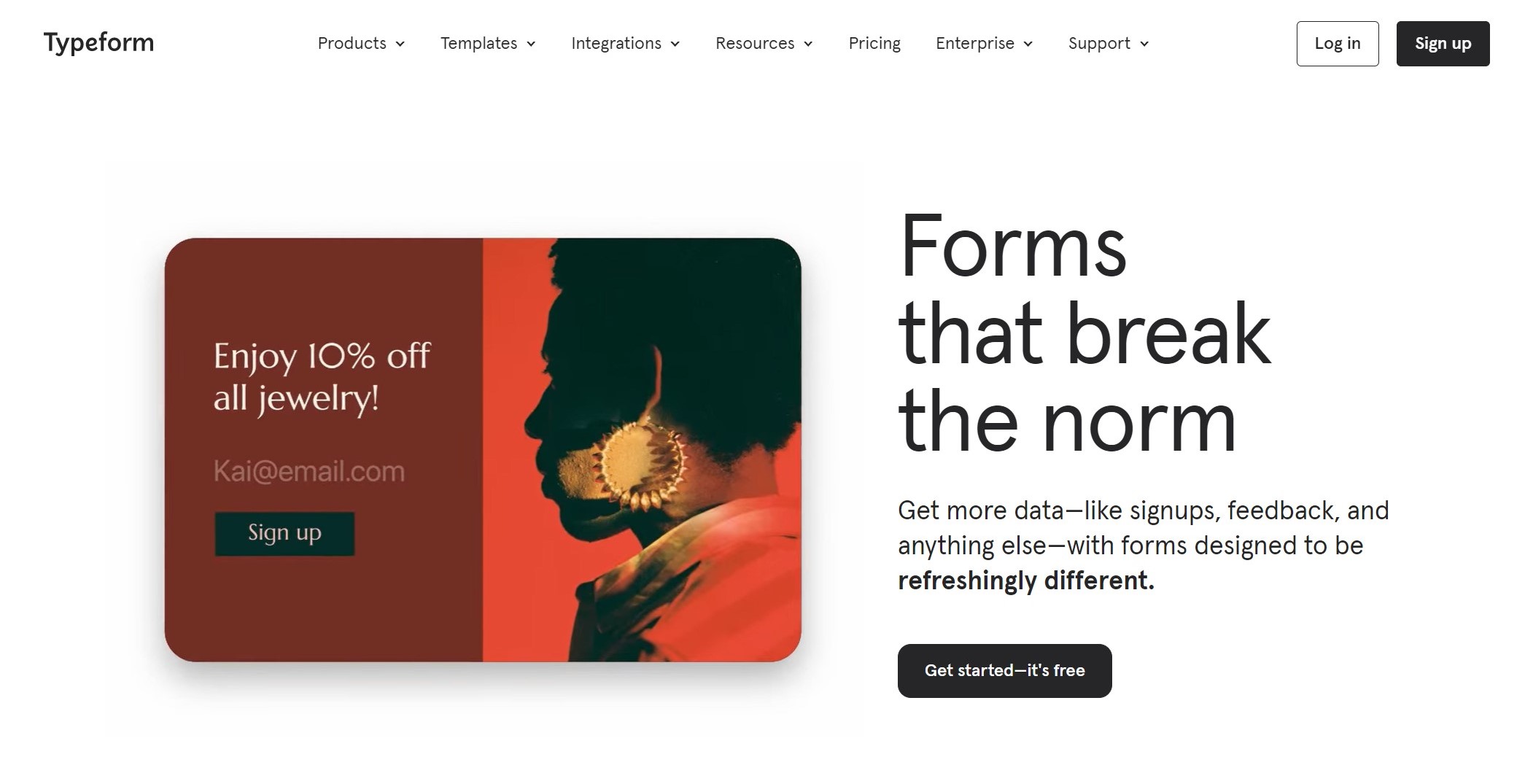
Typeform built its reputation on one thing: making surveys feel less like surveys. Its one-question-at-a-time format and minimalist design create a respondent experience that feels closer to a conversation than a form, which translates directly into higher completion rates for teams where response quality matters as much as volume.
With a clean design and interesting interface, Typeform is one of the most popular SurveyMonkey alternatives. Easy to use, Typeform comes with numerous possibilities.
Typeform Features
- Interactive Surveys: Offers an interactive and conversational survey experience.
- Advanced Question Types and Logic: A broad range of question formats with conditional logic that adapts the survey path based on how respondents answer. Keeps surveys relevant and concise for every individual respondent.
- Design Customization: Extensive branding options including custom fonts, colors, backgrounds, and logo placement. Surveys look polished and on-brand without requiring a designer.
Pros
- Best survey design and respondent experience on this list
- Easy to set up with minimal learning curve
- Strong analysis tools for visualizing and interpreting results
- More engaging customer support than SurveyMonkey according to user reviews
Cons
- Typeform is not what you’d call a feature-rich platform.
- No built-in user segmentation or automated survey scheduling
- No reminder emails or built-in email distribution on standard plans
- Not the right fit for teams that need feature-heavy research capabilities
For alternatives that overcome these challenges, you can check out our blog on Typeform Alternatives.
For a more detailed comparison, check out – Typeform vs SurveyMonkey
G2 Rating: 4.5/5 based on 600+ reviews
Customer Reviews: Users praised Typeform for its beautiful and enjoyable interfaces. Also, Typeform’s customer support was more engaging than SurveyMonkey.
“The interface is great. Very easy to put your survey together…” –G2 Crowd review
Pricing: Starts at $39 per month.
14. Microsoft Forms – Best Free Alternative for Microsoft 365 Teams Users
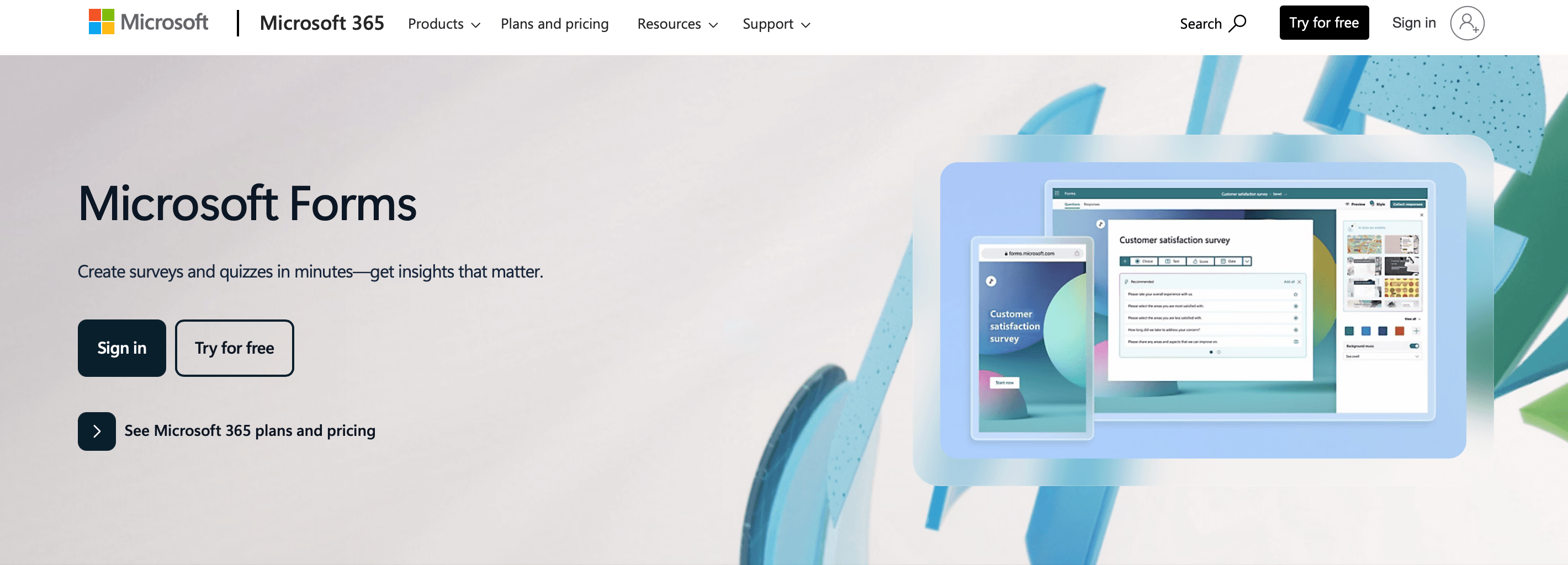
Microsoft Forms is a web-based survey and form builder included free with Microsoft 365. For organizations already in the Microsoft ecosystem, it’s the most natural free survey tool, with tight integration into Excel, Teams, SharePoint, and Power Automate.
Microsoft Forms is free for anyone with a Microsoft account, while SurveyMonkey’s free plan is severely limited. For teams using Microsoft 365, the integration advantage is significant: survey data flows directly into Excel for analysis, forms can be embedded in Teams channels, and Power Automate workflows can trigger actions based on responses.
Key Features
- Free with Microsoft 365: No additional cost for existing Microsoft 365 subscribers. Free basic version for personal Microsoft accounts.
- Excel & Teams Integration: Responses export live to Excel. Forms embed directly in Teams channels and meetings.
- Branching Logic: Create dynamic surveys that adapt based on previous responses.
- Real-Time Response Tracking: Built-in analytics with visual summaries and charts as responses come in.
- 27+ Templates: Pre-built templates for feedback, satisfaction, events, and assessments.
Best for: Organizations already using Microsoft 365 who need free, quick surveys with native Excel and Teams integration.
Pros
- Free with any Microsoft account
- Tight Excel, Teams, and SharePoint integration
- Real-time response analytics
- Familiar interface for Microsoft 365 users
- GDPR compliant
Cons
- Fewer question types than dedicated survey tools
- Limited design customization
- Branching logic is basic compared to Alchemer or Qualtrics
- No payment integration
- Best suited for short, simple surveys
G2 Rating: 4.6/5 based on 317+ reviews (Capterra).
Customer Review: "What I find most helpful about Microsoft Forms is how easy it makes it to create and share surveys, quizzes, and polls. The interface is clean and the setup is quick, so even beginners can get started without any hassle. I also like how seamlessly it integrates with Microsoft 365—especially Excel, Teams, and SharePoint—which keeps response tracking, data analysis, and collaboration smooth and efficient." - G2
Pricing: Free with Microsoft account. Premium features available through Microsoft 365 Business Basic ($6/user/month).
15. Fillout — An Alternative for Modern Forms

Fillout is the newest tool on this list and the one moving fastest. It's built for teams that live in Notion, Airtable, or Google Sheets and want forms that write directly to those databases without Zapier, manual exports, or middleware. Where SurveyMonkey treats data as something to export after the fact, Fillout treats your existing database as the destination from the start.
Fillout Features
- Native Notion & Airtable Integration: Responses flow directly into your databases.
- Conditional Logic: Dynamic forms that adapt based on responses.
- Calculations & Payments: Built-in calculation fields and Stripe payment integration.
- Modern Design: Clean, contemporary form design with customizable themes.
Best for: Teams using Notion or Airtable who want forms and surveys connected directly to their databases.
Pros
- Best Notion and Airtable integration of any form tool
- Generous free plan
- Very fast, modern interface
Cons
- Newer tool with smaller feature set than established players
- Limited advanced survey features (no conjoint, MaxDiff)
- Smaller integration library beyond Notion/Airtable
G2 Rating: 4.6/5.
Customer Review:
Pricing: Starts at $15/month. Free plan available.
Best Free SurveyMonkey Alternatives
Here are 6 free alternatives to SurveyMonkey. These tools offer clean survey capabilities without requiring a credit card or paid plan:
1. Google Forms — Best Completely Free Survey Tool
Google Forms is the most generous free survey tool available. It offers unlimited surveys, unlimited questions, and unlimited responses — all at zero cost. Responses flow directly into Google Sheets for real-time data analysis. The trade-off is limited design customization and no advanced logic, but for straightforward surveys, nothing beats the price.
2. Microsoft Forms — Best Free Option for Microsoft 365 Users
Microsoft Forms is free for anyone with a Microsoft account and comes included with all Microsoft 365 subscriptions. It integrates directly with Excel, Teams, SharePoint, and Power Automate. For organizations already using the Microsoft ecosystem, it’s the natural free survey choice. It supports branching logic, real-time response tracking, and 27+ pre-built templates. Limitations include fewer question types and less design flexibility than dedicated survey tools.
3. SurveySparrow (Forever Free Plan)
SurveySparrow offers a permanent free tier with conversational survey formats, basic reporting, and multi-channel sharing with access of upto 1000 templates. It also includes 3 active classic surveys, 10 questions/survey, 75 responses per quarter, and upto 1000 contacts in the forever free plan. Unlike Google Forms’ static layout, SurveySparrow’s free plan includes its signature chat-like survey experience, which helps improve completion rates.
4. Jotform (Free Plan)
Jotform’s free plan includes 5 forms with 100 monthly submissions, conditional logic, and access to 10,000+ templates. It’s more versatile than Google Forms for complex form needs, with payment integration available even on free plans.
5. Survicate (Free Plan)
Survicate’s free plan includes 25 responses per month with NPS, CSAT, and CES survey types built in. It’s designed for product and UX teams who want to collect in-context feedback on their website or app. Set up requires no developer involvement.
6. QuestionPro Essentials (Free)
QuestionPro’s free tier is one of the most generous: unlimited surveys with up to 200 responses per survey, 50+ question types, basic survey logic, and data export. It’s the strongest free option for research-oriented surveys.
Top SurveyMonkey Competitors by Category
The landscape of SurveyMonkey competitors in 2026 spans several distinct categories. Here’s how the major players break down:
Enterprise & Research Competitors
Qualtrics and Alchemer are the primary SurveyMonkey competitors for enterprise research. Qualtrics offers experimental design, complex sampling, and AI-powered text analysis (Text iQ). Alchemer provides the most flexible logic engine at a mid-range price point. Both handle the advanced research methodologies that SurveyMonkey simply doesn’t support well.
CX & NPS Competitors
SurveySparrow, Zonka Feedback, and Qualtrics compete most directly with SurveyMonkey for customer experience programs. These tools offer closed-loop feedback workflows, NPS/CSAT/CES measurement, and the ability to act on feedback — not just collect it. SurveyMonkey’s CX features are basic by comparison.
Free & Simple Competitors
Google Forms and Microsoft Forms are the primary free alternatives that companies like SurveyMonkey must compete against. For teams that need basic surveys without spending money, these tools have made it increasingly hard for SurveyMonkey to justify its pricing, especially since its own free plan is so restrictive.
Form Builder Competitors
Jotform, Typeform, Formstack, and Fillout compete on the form-building side. These are sites like SurveyMonkey that handle not just surveys but also payment forms, registrations, and applications. Typeform wins on design, Jotform on templates and versatility, and Formstack on Salesforce integration.
Product & In-App Feedback Competitors
Survicate leads the emerging category of behavior-triggered, in-context feedback tools. Unlike SurveyMonkey’s primarily email and link-based distribution, Survicate triggers surveys based on user actions, page views, or scroll depth — capturing feedback while the experience is fresh.
Why Switch from SurveyMonkey?
1. Pricing escalates quickly
SurveyMonkey’s individual plans start at $39/month (Advantage Annual) or $99/month (Standard Monthly). Team plans begin at $30/user/month with a 3-seat minimum billed annually. Once you exceed included response limits, you’re charged $0.15 per additional response. By comparison, SurveySparrow starts at $19/month, Alchemer at $25/month, and Google Forms is completely free.
2. Severely limited free plan
SurveyMonkey’s Basic plan caps you at 10 questions per survey and 25 viewable responses. No data exports, no skip logic, no custom branding. Google Forms offers unlimited everything for free. Microsoft Forms is free with any Microsoft account. SurveySparrow and QuestionPro both offer more generous free tiers.
3. Essential features behind paywalls
Features most teams consider standard — survey logic, CSV exports, removing SurveyMonkey branding — require paid plans. Block randomization and multilingual surveys require even higher tiers. Competitors like Jotform and SurveySparrow include conditional logic in their free plans.
4. Cluttered, outdated interface
SurveyMonkey has added features over the years, but the interface hasn’t kept pace. Users frequently report difficulty finding specific settings. Newer competitors like Typeform and SurveySparrow offer cleaner, more intuitive experiences that reduce the time from survey creation to distribution.
5. Aggressive branding
Even on paid plans, SurveyMonkey branding appears on surveys. The SurveyMonkey logo and URL can reduce respondent trust, particularly for B2B surveys where brand consistency matters. Most alternatives offer white-labeling or logo removal at lower price points.
6. Limited customer support access
Phone support is only available on SurveyMonkey’s highest-tier Enterprise plans. Email support response times vary widely. QuestionPro offers 24/7 live chat. SurveySparrow provides dedicated account managers. The support gap is significant for teams running time-sensitive survey campaigns.
Key Factors to Look For
Before switching from SurveyMonkey, look for features that improve data collection, automate workflows, and integrate with your existing tools.
Easy setup
Choose a platform with a drag-and-drop builder, ready-made templates, and an intuitive interface. This helps teams create and publish surveys quickly without technical expertise.
If your surveys require conditional paths, piping, or complex routing, test the logic builder before committing. Tools like Alchemer and Qualtrics excel here, while simpler tools like Google Forms and Shout are more limited.
Reporting and analytics
Basic tools give you charts and CSV exports. More advanced platforms offer sentiment analysis, trend tracking, cross-tabulation, and AI-driven insights. Match the analytics depth to how seriously your organization treats survey data.
Integrations
Consider what tools your team already uses. If you're on Salesforce, Formstack shines. If you're a Zoho shop, Zoho Survey is the natural fit. If you need broad API connectivity, QuestionPro and SurveySparrow offer extensive integration libraries.
Branding and white-labeling
If surveys go out under your brand, check how much customization each tool allows on free and paid plans. SurveyMonkey is notoriously restrictive with branding, even on premium tiers.
Support quality and availability
When something breaks mid-campaign, responsive support matters. Read the G2 reviews for each tool's support ratings — they vary dramatically across this list.
Data ownership and hosting
If your organization has strict privacy rules, check where each tool stores responses. LimeSurvey lets you self-host on your own servers, while most cloud tools offer regional data centers on higher plans.
SurveyMonkey Audience Alternatives
SurveyMonkey Audience is a separate product that provides access to 335 million+ respondents globally for targeted market research. If you’re specifically looking for SurveyMonkey Audience alternatives, these platforms offer comparable panel access:
- Qualtrics Research Services: Extensive global panels with advanced sampling and targeting.
- SurveySparrow Audience Panel: Precise professional and demographic targeting across 130 countries.
- QuestionPro Audience: 22 million+ panelists across 32 countries. More affordable than SurveyMonkey Audience.
- Pollfish: Mobile-first panel reaching millions through app integrations. Fast turnaround.
- Prolific: Academic-focused panel known for vetted, high-quality participants.
- Zoho Survey Panel: Built-in respondent panel for smaller-scale research.
Which SurveyMonkey Alternative Is Right for You?
The right choice depends on your specific use case:
- Best for conversational feedback: SurveySparrow — affordable, conversational, strong CX features.
- Best free: Google Forms (unlimited) or Microsoft Forms (best for M365 teams).
- Best for research: Qualtrics or QuestionPro.
- Best for Salesforce Integrations: Formstack.
- Best for product teams: Survicate.
- Best for modern forms: Fillout (especially if using Notion/Airtable).
Take advantage of free plans and trials to test each tool with your actual use case before committing. Happy surveying!