Survey & Feedback
15 Best SurveyMonkey Competitors & Alternatives in 2026 (Free & Paid)

Article written by Kate Williams
Product Marketing Manager at SurveySparrow

31 min read
10 March 2026


Looking for SurveyMonkey Alternatives? Whether you’re frustrated by SurveyMonkey’s pricing, limited free plan, or cluttered interface, you’re not alone — and there are plenty of strong SurveyMonkey competitors worth considering.
We evaluated dozens of survey tools and narrowed it down to the best alternatives to SurveyMonkey for 2026. For each tool, we’ve included real pricing, G2 ratings, honest pros and cons, and a clear “best for” recommendation — so you can find the right fit.
Below you’ll find a comparison table with pricing up front, followed by a free SurveyMonkey alternatives section, a category-by-category breakdown of SurveyMonkey’s top competitors, and then detailed reviews of each tool.
TL;DR — Quick Summary
|
SurveyMonkey Alternatives Compared: Pricing, Ratings & Free Plans
| Tool | Best For | Starting Price | Free Plan? | G2 | Free Trial | Key Differentiator | Integrations |
| SurveySparrow | Overall best | $19/mo | Yes | 4.4/5 | 14 days | Conversational surveys | Salesforce, Slack, HubSpot, Zapier |
| Google Forms | Free surveys | Free | Yes (full) | 4.5/5 | N/A | Unlimited everything, $0 | Google Sheets, Drive, Workspace |
| HubSpot | CRM feedback | $45/mo | Limited | 4.4/5 | 7 days | Survey + CRM in one | Salesforce, Slack, 1000+ apps |
| Alchemer | Market research | $25/mo | No | 4.4/5 | 7 days | Best logic engine at this price | Salesforce, Slack, Zapier |
| QuestionPro | Expert research | $85/mo | Yes | 4.5/5 | 14 days | Conjoint, MaxDiff, 24/7 support | Salesforce, HubSpot, Tableau |
| Jotform | Form building | $39/mo | Yes | 4.7/5 | N/A | 10,000+ templates, payments | PayPal, Stripe, Square, Zapier |
| Zoho Survey | Zoho ecosystem | $20/mo | Yes | 4.4/5 | 15 days | Native Zoho integration | Zoho CRM, Desk, Analytics |
| Qualtrics | Enterprise/academic | Custom quote | Free acct | 4.4/5 | Yes | Most advanced research | Salesforce, SAP, Tableau |
| Zonka Feedback | AI-powered CX | On request | No | 4.6/5 | Yes | AI sentiment + omnichannel | HubSpot, Salesforce, Intercom |
| Survicate | In-app surveys | $89/mo | Yes | 4.6/5 | 10 days | Behavior-triggered feedback | HubSpot, Intercom, Slack |
| GetFeedback | Salesforce users | Custom quote | No | 4.5/5 | 7 days | Salesforce-native integration | Salesforce (native) |
| Typeform | Beautiful UX | $39/mo | Yes | 4.5/5 | 14 days | Best conversational design | Zapier, Slack, HubSpot |
| Formstack | Salesforce forms | $19/mo | No | 4.4/5 | 14 days | Bi-directional Salesforce sync | Salesforce, PayPal, Stripe |
| Microsoft Forms | Microsoft teams | Free* | Yes* | 4.6/5 | N/A | Deep Office 365 integration | Excel, Teams, SharePoint, Power Automate |
| Fillout | Modern forms | $15/mo | Yes | 4.9/5 | N/A | Notion + Airtable native | Notion, Airtable, Google Sheets |
*Microsoft Forms is free with any Microsoft account. Premium features require Microsoft 365 subscription (from $6/user/mo).
Best Free SurveyMonkey Alternatives
If you’re looking for a free alternative to SurveyMonkey, these tools offer genuine survey capabilities without requiring a credit card or paid plan:
1. Google Forms — Best Completely Free Survey Tool
Google Forms is the most generous free survey tool available. It offers unlimited surveys, unlimited questions, and unlimited responses — all at zero cost. Responses flow directly into Google Sheets for real-time data analysis. The trade-off is limited design customization and no advanced logic, but for straightforward surveys, nothing beats the price.
2. Microsoft Forms — Best Free Option for Microsoft 365 Users
Microsoft Forms is free for anyone with a Microsoft account and comes included with all Microsoft 365 subscriptions. It integrates directly with Excel, Teams, SharePoint, and Power Automate. For organizations already using the Microsoft ecosystem, it’s the natural free survey choice. It supports branching logic, real-time response tracking, and 27+ pre-built templates. Limitations include fewer question types and less design flexibility than dedicated survey tools.
3. SurveySparrow (Forever Free Plan)
SurveySparrow offers a permanent free tier with conversational survey formats, basic reporting, and multi-channel sharing. Unlike Google Forms’ static layout, SurveySparrow’s free plan includes its signature chat-like survey experience, which improves completion rates.
4. Jotform (Free Plan)
Jotform’s free plan includes 5 forms with 100 monthly submissions, conditional logic, and access to 10,000+ templates. It’s more versatile than Google Forms for complex form needs, with payment integration available even on free plans.
5. Survicate (Free Plan)
Survicate’s free plan includes 25 responses per month with NPS, CSAT, and CES survey types built in. It’s designed for product and UX teams who want to collect in-context feedback on their website or app. Set up requires no developer involvement.
6. QuestionPro Essentials (Free)
QuestionPro’s free tier is one of the most generous: unlimited surveys with up to 200 responses per survey, 50+ question types, basic survey logic, and data export. It’s the strongest free option for research-oriented surveys.
Top SurveyMonkey Competitors by Category
The landscape of SurveyMonkey competitors in 2026 spans several distinct categories. Here’s how the major players break down:
Enterprise & Research Competitors
Qualtrics and Alchemer are the primary SurveyMonkey competitors for enterprise research. Qualtrics offers experimental design, complex sampling, and AI-powered text analysis (Text iQ). Alchemer provides the most flexible logic engine at a mid-range price point. Both handle the advanced research methodologies that SurveyMonkey simply doesn’t support well.
CX & NPS Competitors
SurveySparrow, Zonka Feedback, and GetFeedback compete most directly with SurveyMonkey for customer experience programs. These tools offer closed-loop feedback workflows, NPS/CSAT/CES measurement, and the ability to act on feedback — not just collect it. SurveyMonkey’s CX features are basic by comparison.
Free & Simple Competitors
Google Forms and Microsoft Forms are the primary free alternatives that companies like SurveyMonkey must compete against. For teams that need basic surveys without spending money, these tools have made it increasingly hard for SurveyMonkey to justify its pricing, especially since its own free plan is so restrictive.
Form Builder Competitors
Jotform, Typeform, Formstack, and Fillout compete on the form-building side. These are sites like SurveyMonkey that handle not just surveys but also payment forms, registrations, and applications. Typeform wins on design, Jotform on templates and versatility, and Formstack on Salesforce integration.
Product & In-App Feedback Competitors
Survicate leads the emerging category of behavior-triggered, in-context feedback tools. Unlike SurveyMonkey’s primarily email and link-based distribution, Survicate triggers surveys based on user actions, page views, or scroll depth — capturing feedback while the experience is fresh.
Why Switch from SurveyMonkey? Key Pain Points in 2026
1. Pricing that escalates quickly
SurveyMonkey’s individual plans start at $39/month (Advantage Annual) or $99/month (Standard Monthly). Team plans begin at $30/user/month with a 3-seat minimum billed annually. Once you exceed included response limits, you’re charged $0.15 per additional response. By comparison, SurveySparrow starts at $19/month, Alchemer at $25/month, and Google Forms is completely free.
2. Severely limited free plan
SurveyMonkey’s Basic plan caps you at 10 questions per survey and 25 viewable responses. No data exports, no skip logic, no custom branding. Google Forms offers unlimited everything for free. Microsoft Forms is free with any Microsoft account. SurveySparrow and QuestionPro both offer more generous free tiers.
3. Essential features behind paywalls
Features most teams consider standard — survey logic, CSV exports, removing SurveyMonkey branding — require paid plans. Block randomization and multilingual surveys require even higher tiers. Competitors like Jotform and SurveySparrow include conditional logic in their free plans.
4. Cluttered, outdated interface
SurveyMonkey has added features over the years, but the interface hasn’t kept pace. Users frequently report difficulty finding specific settings. Newer competitors like Typeform and SurveySparrow offer cleaner, more intuitive experiences that reduce the time from survey creation to distribution.
5. Aggressive branding
Even on paid plans, SurveyMonkey branding appears on surveys. The SurveyMonkey logo and URL can reduce respondent trust, particularly for B2B surveys where brand consistency matters. Most alternatives offer white-labeling or logo removal at lower price points.
6. Limited customer support access
Phone support is only available on SurveyMonkey’s highest-tier Enterprise plans. Email support response times vary widely. QuestionPro offers 24/7 live chat. SurveySparrow provides dedicated account managers. The support gap is significant for teams running time-sensitive survey campaigns.
Key factors to evaluate when comparing SurveyMonkey alternatives:
Beyond use case, pay attention to these five dimensions when shortlisting tools:
Survey logic and branching depth. If your surveys require conditional paths, piping, or complex routing, test the logic builder before committing. Tools like Alchemer and Qualtrics excel here, while simpler tools like Google Forms and Shout are more limited.
Reporting and analytics. Basic tools give you charts and CSV exports. More advanced platforms offer sentiment analysis, trend tracking, cross-tabulation, and AI-driven insights. Match the analytics depth to how seriously your organization treats survey data.
Integrations. Consider what tools your team already uses. If you're on Salesforce, GetFeedback and Formstack shine. If you're a Zoho shop, Zoho Survey is the natural fit. If you need broad API connectivity, QuestionPro and SurveySparrow offer extensive integration libraries.
Branding and white-labeling. If surveys go out under your brand, check how much customization each tool allows on free and paid plans. SurveyMonkey is notoriously restrictive with branding, even on premium tiers.
Support quality and availability. When something breaks mid-campaign, responsive support matters. Read the G2 reviews for each tool's support ratings — they vary dramatically across this list.
Best SurveyMonkey Alternatives & Competitors: Detailed Reviews
Here's a detailed review of each SurveyMonkey alternative in 2026 — covering features, pricing, pros, cons, and who each tool is best for.
- SurveySparrow
- Google Forms
- Hubspot
- Alchemer (Previously SurveyGizmo)
- QuestionPro
- Jotform
- Zoho Survey
- Qualtrics
- AskNicely
- Get Feedback
- Survicate
- Formstack
- Typeform
- Microsoft Forms
- Fillout
1. SurveySparrow – Best Overall SurveyMonkey Alternative
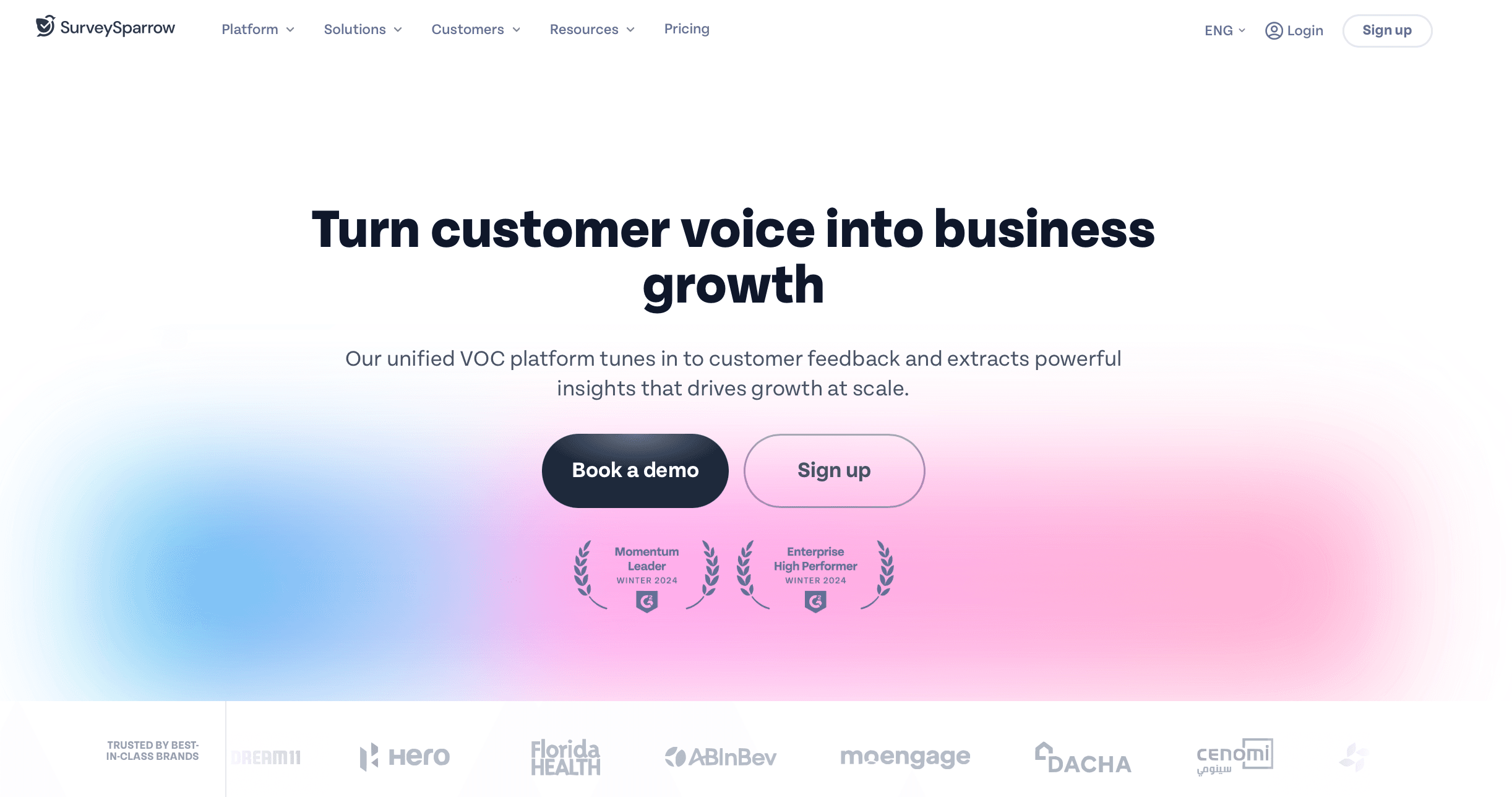
SurveySparrow is a AI-powered, conversational survey platform and one of the strongest SurveyMonkey competitors across the board. Rated as G2’s fastest-growing product three years running, it stands out for its chat-like survey format that delivers a reported 40% higher completion rate.
Why It’s a Good SurveyMonkey Alternative
SurveySparrow is significantly more affordable ($19/month vs. SurveyMonkey’s $39/month Advantage), offers a forever free plan, and includes branded surveys at lower tiers. The conversational survey format is genuinely different from SurveyMonkey’s traditional approach.
SurveySparrow has an engaging UI that promises a 40% higher survey completion rate. With the close-the-feedback-loop system in place, it gives you all the more reasons to consider it as one of the best SurveyMonkey alternatives available.
For a more detailed comparison of features, you can check out SurveySparrow vs SurveyMonkey
SurveySparrow Features:
- AI Surveys: Create complete surveys in seconds. Just describe what you need, and AI generates personalized questions instantly.
- Executive Dashboard: Create multiple dashboards and widgets to visualize survey data with rich insights.

- NPS & 360° Feedback: Lets you run Net Promoter Score surveys and comprehensive performance appraisals. Track employee and customer loyalty with precision.
Echo AI Agent: Echo transforms your website and channels into intelligent conversation hubs that work 24/7.

- Survey Templates: A comprehensive library of more than 1000+ survey templates
In summary: Affordable, attractive, and intuitive survey tool. With an emphasis on being conversational, as it should be. Definitely worth a try!
Who Should Use SurveySparrow?
Those interested in conducting Net Promoter Score (NPS), and CSAT surveys. Its standout feature is its ability to turn ordinary surveys into engaging conversations, making it an ideal choice for those seeking to improve respondent engagement and gather valuable feedback.
G2 Rating: 4.4/5 based on 2000+ reviews
"The UI and UX are extremely polished, a very similar experience to SurveyMonkey’s overall style, and the features they offer are second to none…for a price." – G2 Customer Review
SurveySparrow Pricing
Starts at $19 per month. With 10 different plans, ranging from Basic to Platform, SurveySparrow offers a variety of options to fit different needs.
SurveySparrow also offers a Forever Free Plan with limited features, as well as a free trial for users to test out the product.
14-day free trial • Cancel Anytime • No Credit Card Required • No Strings Attached
Here’s a quick overview of the best SurveyMonkey alternatives and how they compare.
2. Google Forms – Best free SurveyMonkey alternative
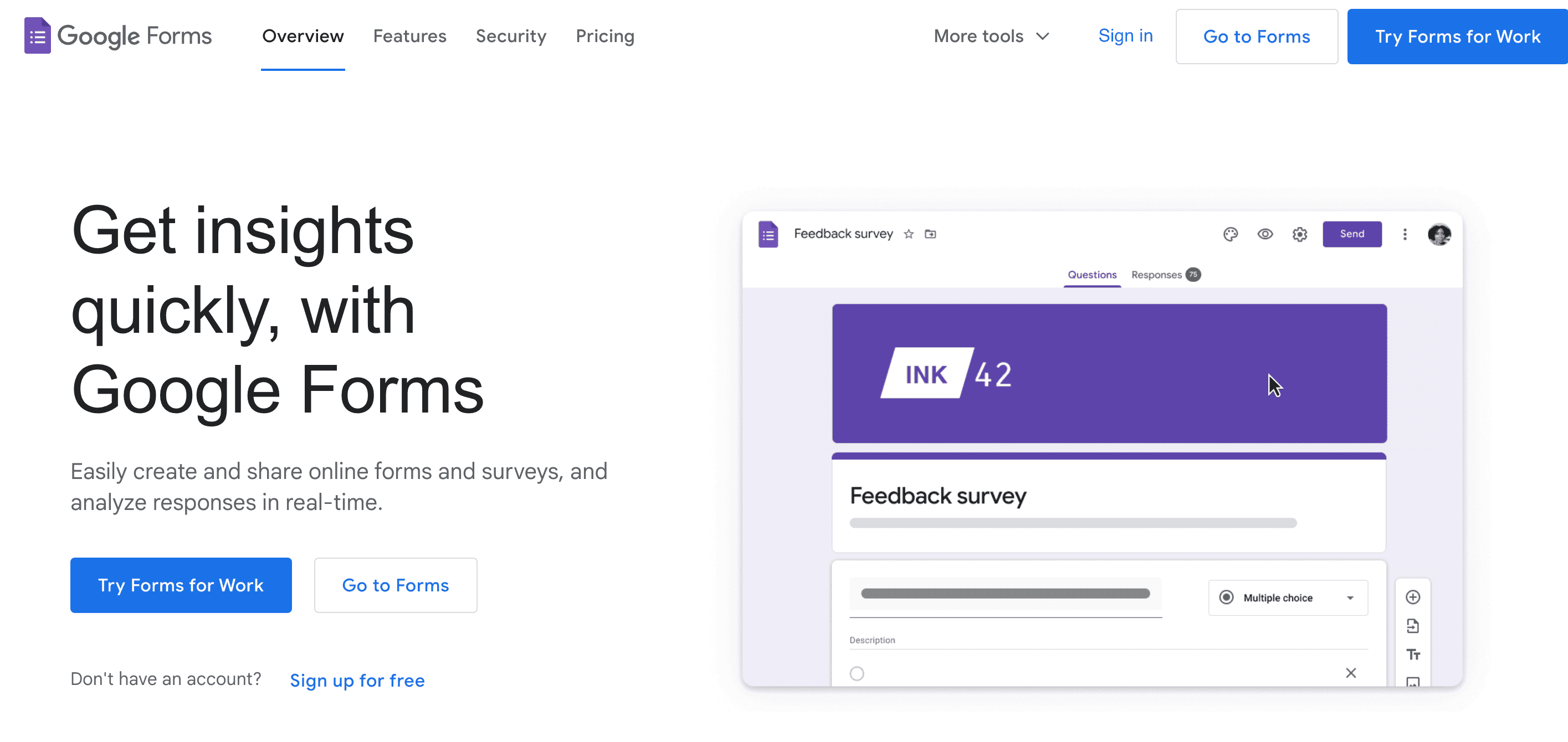
Although Google Forms is a popular platform for creating forms and quizzes, it may not be the best alternative to SurveyMonkey for professionals and corporations due to its limited applications. However, it remains a favorite option for collecting data.
Google Forms Features
- Seamless Collaboration and Real-time Editing: Enables multiple users to simultaneously work on the same survey. This feature is particularly beneficial for team projects. SurveyMonkey has more limited collaboration capabilities, which may hinder efficient teamwork.
- Integration with Google Workspace: Offers seamless integration with other Google Workspace applications, enabling effortless data organization and analysis.
- Unlimited Surveys and Responses: Unlike SurveyMonkey’s free plan, Google Forms allows for unlimited surveys and responses, facilitating unrestricted data collection.
What makes it a good alternative: Free, easy, and simple! Very intuitive that virtually anyone can use the tool effectively. Also, its mobile-friendly nature is why the tool is an instant hit.
Why it may not be all that great: Although its simple aesthetics are refreshingly straightforward, Google Forms lacks the many features that make for in-depth data collection and analysis. It also doesn’t have any feature to schedule and automate surveys, segment users, or email surveys to a mass audience.
Suitable For: General users, educators, small to medium businesses, and organizations of all types. Allows for easy data transfer to spreadsheets for further analysis, making it a useful tool for researchers, analysts, and other professionals.
Customer Reviews: One of the customers mentioned on softwareadvice.com price as a main reason for switching from SurveyMonkey to Google Forms.
“SurveyMonkey was prohibitively expensive for our small team and we did not want to pay the high price for just internal usage.”
G2 Rating: 4.5/5 based on 2600+ reviews
Google Forms Pricing: Free.
If you’re considering Google Forms but are unsure, check out our in-depth blog on Google Forms Alternatives to explore other options.
3. Hubspot – Easily scalable
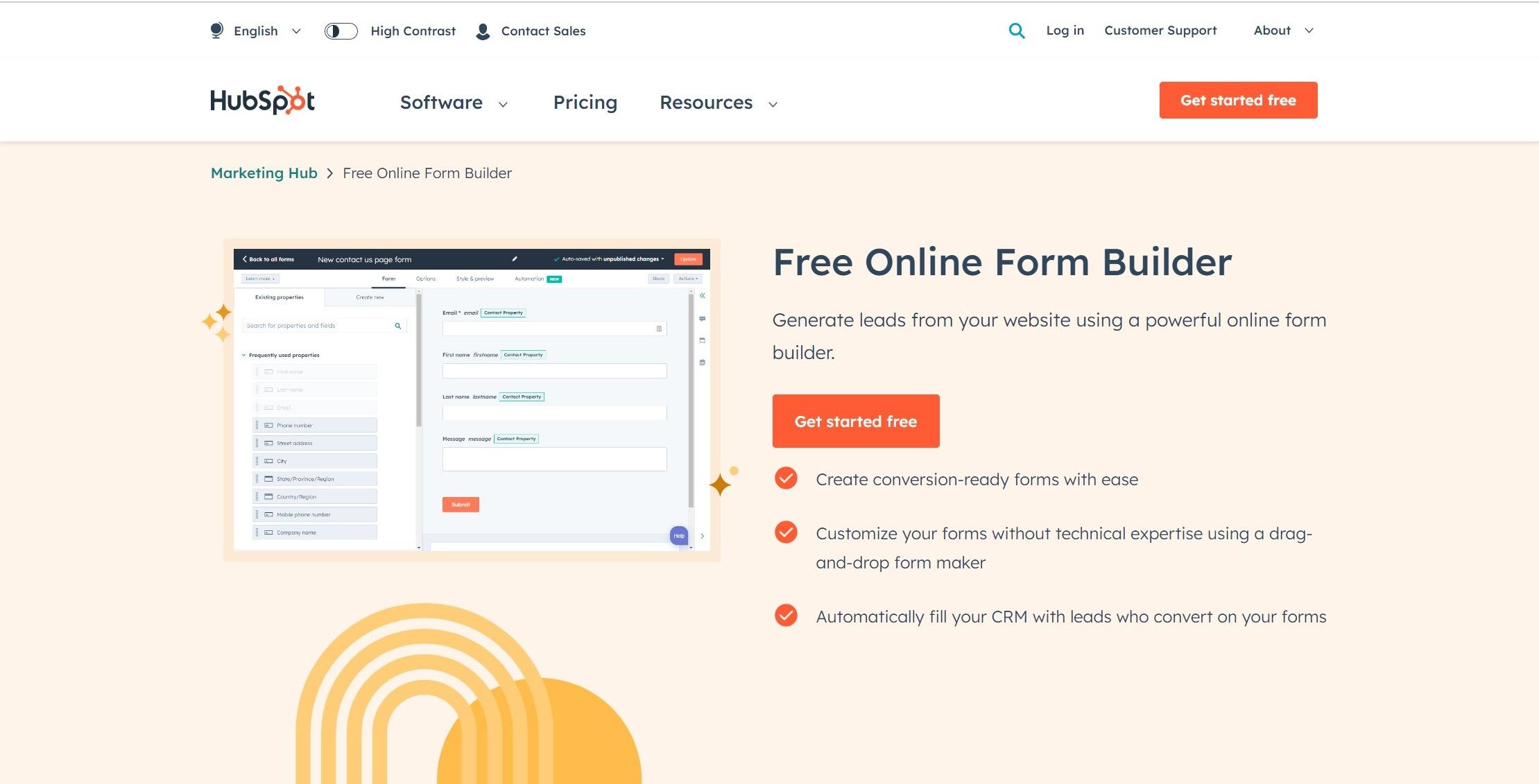
HubSpot is a SurveyMonkey alternative with CRM capabilities. It is an all-in-one CRM software that provides a collection of surveying, customer service, marketing, and sales tools to manage your entire business.
HubSpot Features:
- CRM Integration: Directly integrates with their CRM for seamless data collection and analysis.
- Automated Follow-ups: Allows for automation of follow-ups based on survey responses, enhancing customer engagement.
- Advanced Analytics: Provides comprehensive analytics tools for deeper insights into survey data and feedback patterns.
What makes it a good alternative: HubSpot provides a Marketing Hub of tools along with their surveys, that are all connected through a customer database.
Why it may not be all that great: HubSpot provides free tools but they come with limited access. For premium tools, it can become quite expensive at $45 per month even though they provide additional features.
Suitable For: Both B2B and B2C businesses of any size, from one-person businesses to large enterprises with over 2,000 employees. With its Growth Suite Enterprise package, HubSpot can also cater to enterprise companies with complex operational needs. Even smaller non-profits and organizations with limited budgets can benefit from HubSpot’s offerings, making it a versatile platform for different types of businesses and industries.
G2 Rating: 4.4/5 based on 9940+ reviews
Customer Reviews: While SurveyMonkey is only for conducting surveys, Hubspot Marketing Hub proves to be a holistic marketing tool. A customer on G2 says “Indeed the Simple, Fast, and Flexible tool for all Marketing Initiatives”
HubSpot Pricing: Starts at $45 per month.
4. Alchemer (Previously SurveyGizmo) – Best for Market Research
As we continue exploring SurveyMonkey alternatives, let’s consider another versatile and easy-to-use option. Known for its functionality, Alchemer provides a unique set of features,
Alchemer Features
- Customization: Provides extensive customization options, including custom themes and branding, that may surpass those SurveyMonkey offers, allowing for a more personalized and brand-centric survey experience.
- Logic and Branching: Offers advanced logic and branching capabilities, allowing you to create more dynamic and responsive surveys that adapt based on respondents’ answers.
- Robust Reporting: The reporting features are highly comprehensive, with in-depth data analysis and visualization capabilities that may offer more detailed insights than SurveyMonkey.
What makes it a good alternative: An array of features like audience segmentation, panel services, and robust reporting tools, until recently, weren’t found in many of its contemporaries.
Why it may not be all that great: Their pricing can seem relatively high, particularly when compared to a range of other alternatives offering similar, if not enhanced features. Some users have also expressed concerns about their customer service experiences, indicating there may be room for improvement.
Suitable For: Small to large enterprises. Fills the gap between basic platforms like SurveyMonkey and more complex ones like Qualtrics. Favored for market research, educational feedback, and corporate surveys. Its affordability and robust functionality make it a preferred choice for those looking to gather insightful feedback and data efficiently.
G2 Rating: 4.4/5 based on 870+ reviews
Customer Reviews: A user on TrustRadius mentioned having used both platforms. They noted that while the functionality of both platforms is quite similar, they recalled SurveyMonkey having a few more “bells and whistles,” albeit that was their experience from years ago. They chose Alchemer, possibly for its distinct features or pricing model.
Alchemer Pricing: Starts at $25 per month.
If you’re considering Alchemer but are exploring other possibilities, have a look at our blog on Alchemer Alternatives to explore other options.
5. QuestionPro – Best for Expert Researchers
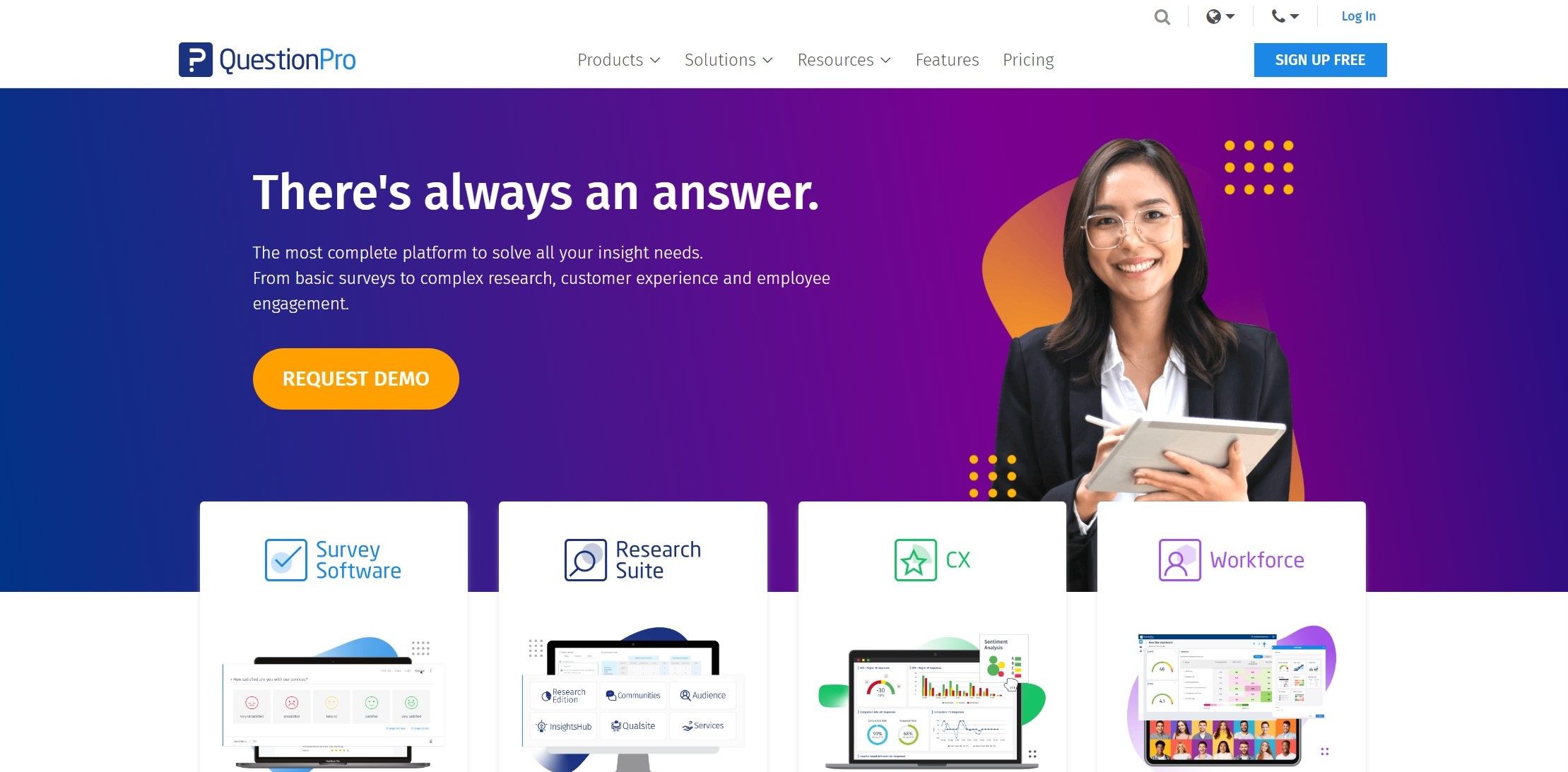
The next in our list of SurveyMonkey alternatives is QuestionPro. Novice or pro, this platform is exceptionally intuitive to use. With great customer support, this tool also comes with a range of customizable options.
QuestionPro Features
- Unlimited Surveys and Responses: Allows unlimited surveys and responses in the free plan, which can be a plus for those with high-volume data collection needs.
- Advanced Question Types: Provides a range of advanced question types, including conjoint analysis, and max diff, offering flexibility and depth in survey creation that may go beyond the standard options in SurveyMonkey.
- Customer Support: Responsive customer support through live chat and email. While SurveyMonkey also offers support, the speed and accessibility of QuestionPro’s service can be a distinguishing factor for some users.
What makes it a good alternative: QuestionPro is a sophisticated product for serious researchers. Tech assistance is available by chat 24/7, and the customer support personnel is thoroughly knowledgeable about the software, which is saying something.
Why it may not be all that great: Users feel the pricing wasn’t consistent and expressed feeling like they were being scammed due to increasing costs and difficulties with specific integrations
Suitable For: Good fit for a wide range of company sizes, from solo operators to large enterprises with over 10,000 employees. Popular among Nonprofit Organization Management, Education Management, Civic/Social Organizations, Health/Wellness/Fitness, and Market Research.
G2 Rating: 4.5/5 based on 750+ reviews
Customer Reviews: Users appreciate the platform for its ease in creating surveys quickly and its supportive customer service. The support staff is noted for being excellent, courteous, and available.
“Is easy to learn to use, is effective and customizable and includes the visual, video, audio and upload features you would expect. What makes it stand out particularly is the high quality of its support staff. They are well trained, competent, quick and courteous.” – Capterra review
QuestionPro Pricing: Advanced plan starts at $85 per month. Free version available.
6. Jotform – Best alternative for versatile templates
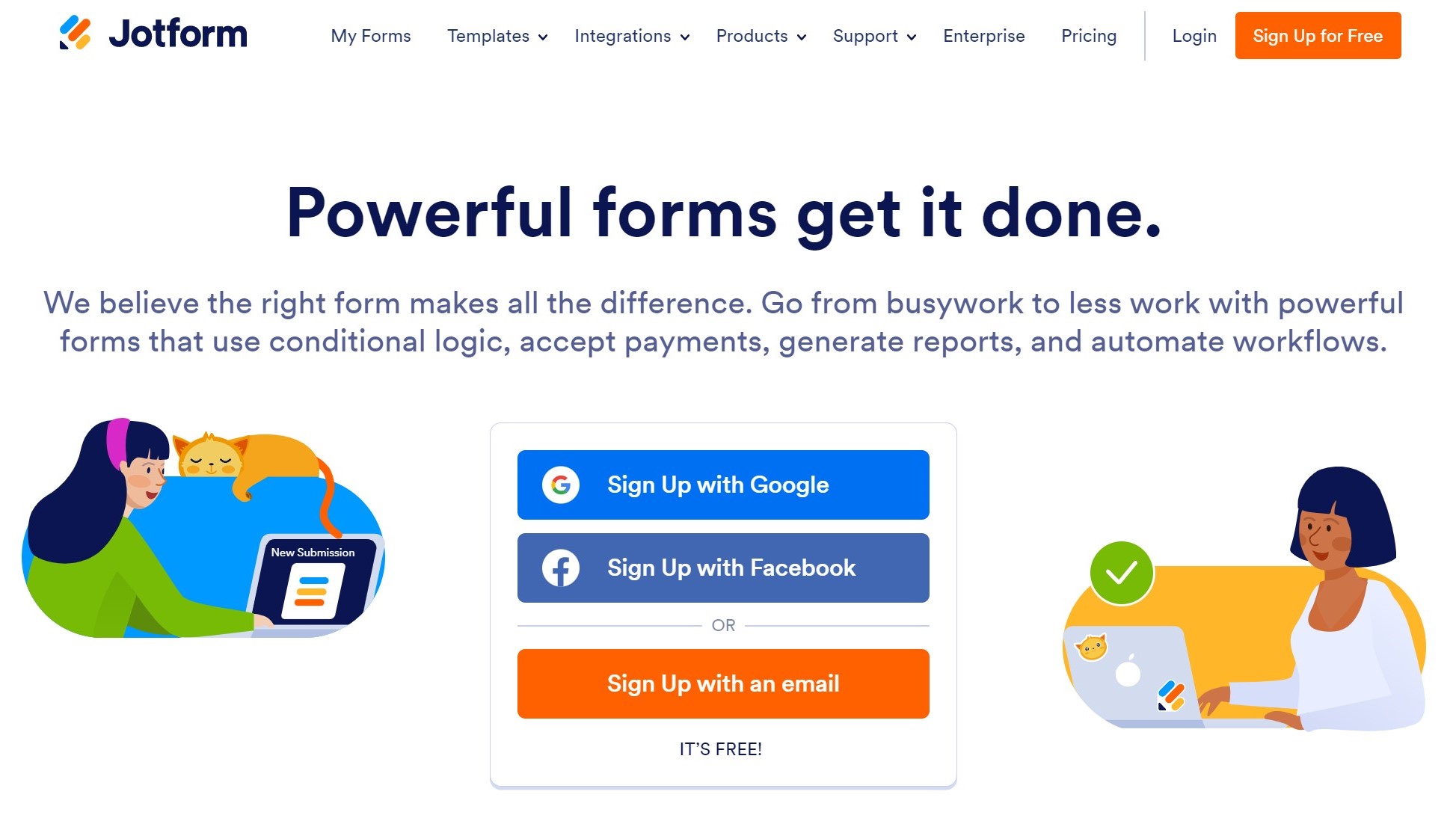
Fairly easy to use and with decent-looking forms that you can embed, JotForm is an attractive alternative to SurveyMonkey indeed. The tool is great for non-technical users with a little learning curve.
JotForm Features
- Design Flexibility: With its drag-and-drop form builder, JotForm provides extensive customization options, allowing visually appealing forms tailored to your brand’s aesthetic, potentially offering more design flexibility than SurveyMonkey.
- Payment Integration: Seamlessly integrates with popular payment gateways like PayPal, Square, and Stripe, facilitating paid surveys or donation collection, a feature that may not be as readily available with SurveyMonkey.
- Unlimited Free Forms: The free plan enables the creation of unlimited forms, although responses are limited. This can be a cost-effective alternative to SurveyMonkey’s free plan, depending on your specific needs.
What makes it a good alternative: Jotform is a neat SurveyMonkey alternative because of its ease of use and affordable pricing that embraces all users. It is especially appealing to non-techies!
Why it may not be all that great: It doesn’t meet the support expectations, which is what most users found. This can get frustrating when you consider that most users have encountered at least minor bugs in it. JotForm tends to have too many glitches for a survey tool. If you are looking for an alternative to JotForm due to these glitches, feel free to check out our blog post on Jotform Alternatives.
G2 Rating: 4.7/5 based on 1900+ reviews
In summary: Combines powerful features and cost-effective plans, if you can discount the glitchy platform.
Suitable For: Diverse industries including event production, architectural audio, nonprofits, and healthcare. Educational and consulting sectors, among others, benefit from its customizability for various purposes like collecting feedback and improving marketing strategies. A wide array of templates further extends its applicability to legal, employment, and membership organizations.
Customer Review: A customer on G2 wrote “Jotform is used to collect data using simple and advanced forms. It’s a cut above Google Forms and Typeform. The native mobile app is incredible. 100% recommend”
Jotform Pricing: Starts at $39 per month.
7. Zoho Survey – Suitable for Zoho Users
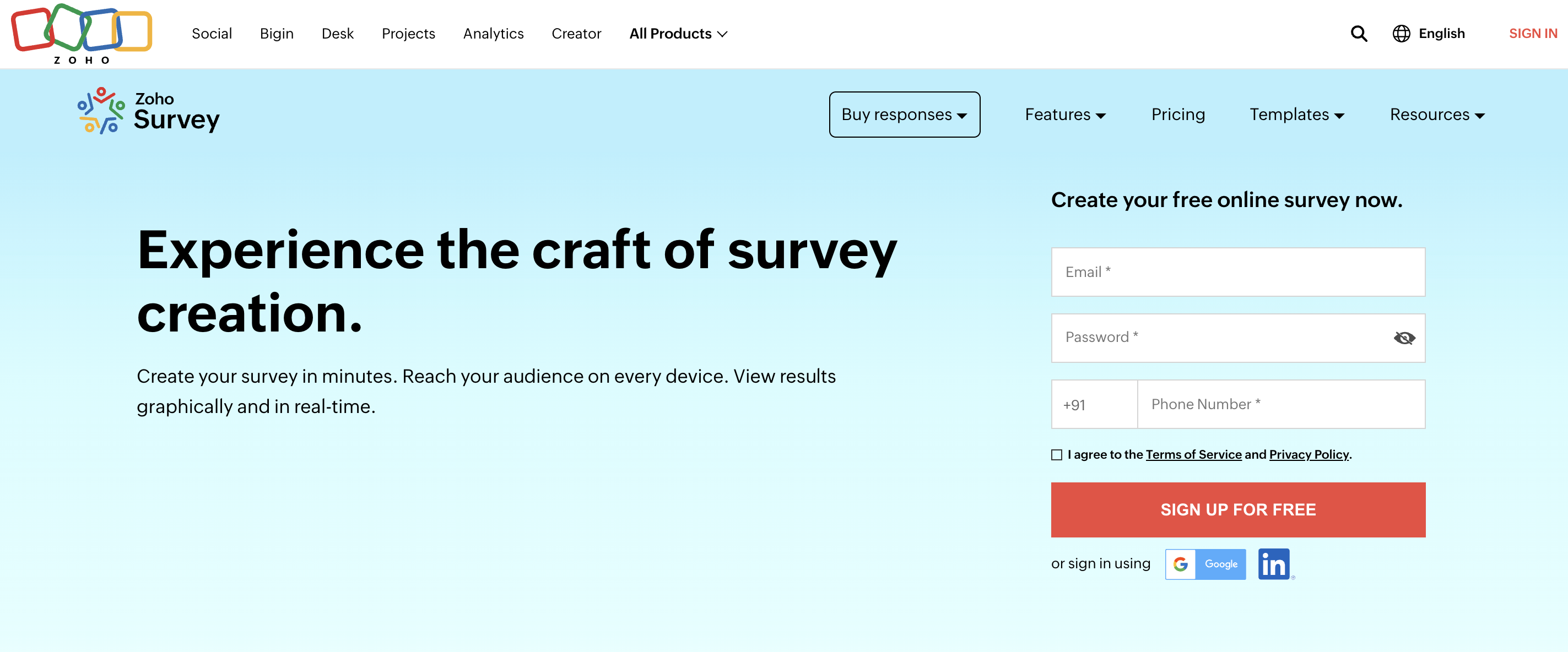
Zoho Survey is a decent SurveyMonkey alternative. The customization option has many fans and the pricing plans are friendly.
Zoho Survey Features
- Integration with Zoho Suite: Integrates seamlessly with other tools in the Zoho ecosystem. This provides a unified experience across different Zoho products, which can benefit existing Zoho users.
- Price: Offers competitive pricing plans, making it a cost-effective alternative to SurveyMonkey, especially for smaller businesses or individual users.
- Panel Support: Offers access to Zoho’s respondent panel, a pool of respondents you can contact for your surveys. While SurveyMonkey also offers panel services, integrating Zoho’s panel within their survey platform could be more convenient for some users.
What makes it a good alternative: With more features than Google Form and easier to use than SurveyMonkey, Zoho surveys strike a desirable balance. Another key feature is the level of flexibility and control it offers its users. To top it all, Zoho Surveys integrates well.
Why it may not be all that great: Zoho Surveys is a fairly friendly tool except for a couple of hiccups. The logic feature is very basic but puzzling. Users tend to find the interface monotonous and boring to use. For alternatives that overcome these challenges, check out our blog on Zoho Desk Alternatives.
Suitable For: A range of industries including Human Resources, Education, Events, Healthcare, Business, Non-profit Organizations, and Government and Political sectors due to its multilingual survey capabilities
G2 Rating: 4.4/5 based on 800+ reviews
Customer Reviews: “I like the rich features and user-friendliness. It does not require higher IT skills on the side of the users. Easy to set up and easy to use.”– Capterra review
Zoho Survey Pricing: Starts at $20 per month.
8. Qualtrics – Suitable for Academic Research
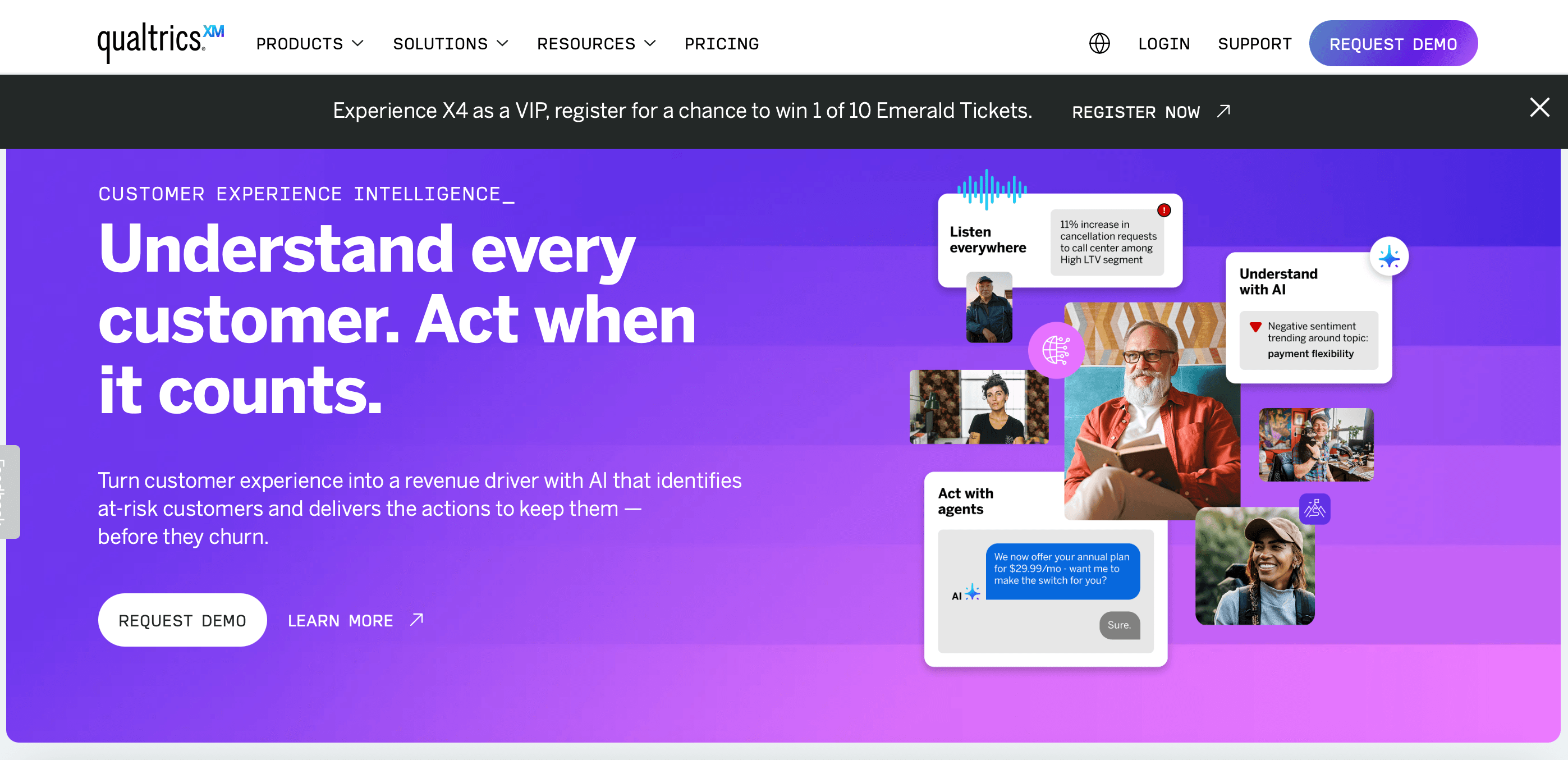
More of a research tool than a survey tool, Qualtrics Research Core is one of a kind. If you are looking for a tool for research purposes, then this tool is the most ideal when compared of any of the SurveyMonkey alternatives.
Qualtrics Features
- Advanced Research Capabilities: Excels in research-oriented features, offering experimental design, complex sampling, and statistical analysis.
- Sophisticated Logic and Branching: Provides advanced logic and branching for intricate, highly customized surveys.
- Robust Reporting and Analytics: Offers comprehensive data analysis, visualization options, and advanced features like Text iQ.
What makes it a good alternative: If you are doing thorough academic research, Qualtrics is your best bet. With an impressive question bank, it’s easy to create a professional-looking survey with Qualtrics. One of the best tools available if you are focusing on research.
Why it may not be all that great: When it comes to simplicity of survey tools, Qualtrics may not be the best option. SurveyMonkey, is generally easier to use and understand for beginners or for those who need to create surveys quickly. Also, Qualtrics is more expensive than SurveyMonkey. Well, since that’s the case, you can check out some Qualtrics alternatives.
Suitable For: Different industries including Education, B2B Technology, Manufacturing, Travel & Hospitality, Financial Services, and Healthcare. The tool is apt for market research, customer and employee engagement, digital experience management, and product development. This broad spectrum of solutions makes Qualtrics a versatile choice for many sectors
G2 Rating: 4.4/5 based on 500+ reviews
Customer Review: “It is a much more robust program than what SurveyMonkey appears to be. The ability to create the survey to run on a loop as if at a kiosk is fantastic.” G2 Crowd review
Qualtrics Pricing: Contact to get a quote.
9. Zonka Feedback – AI-powered advanced feedback programs
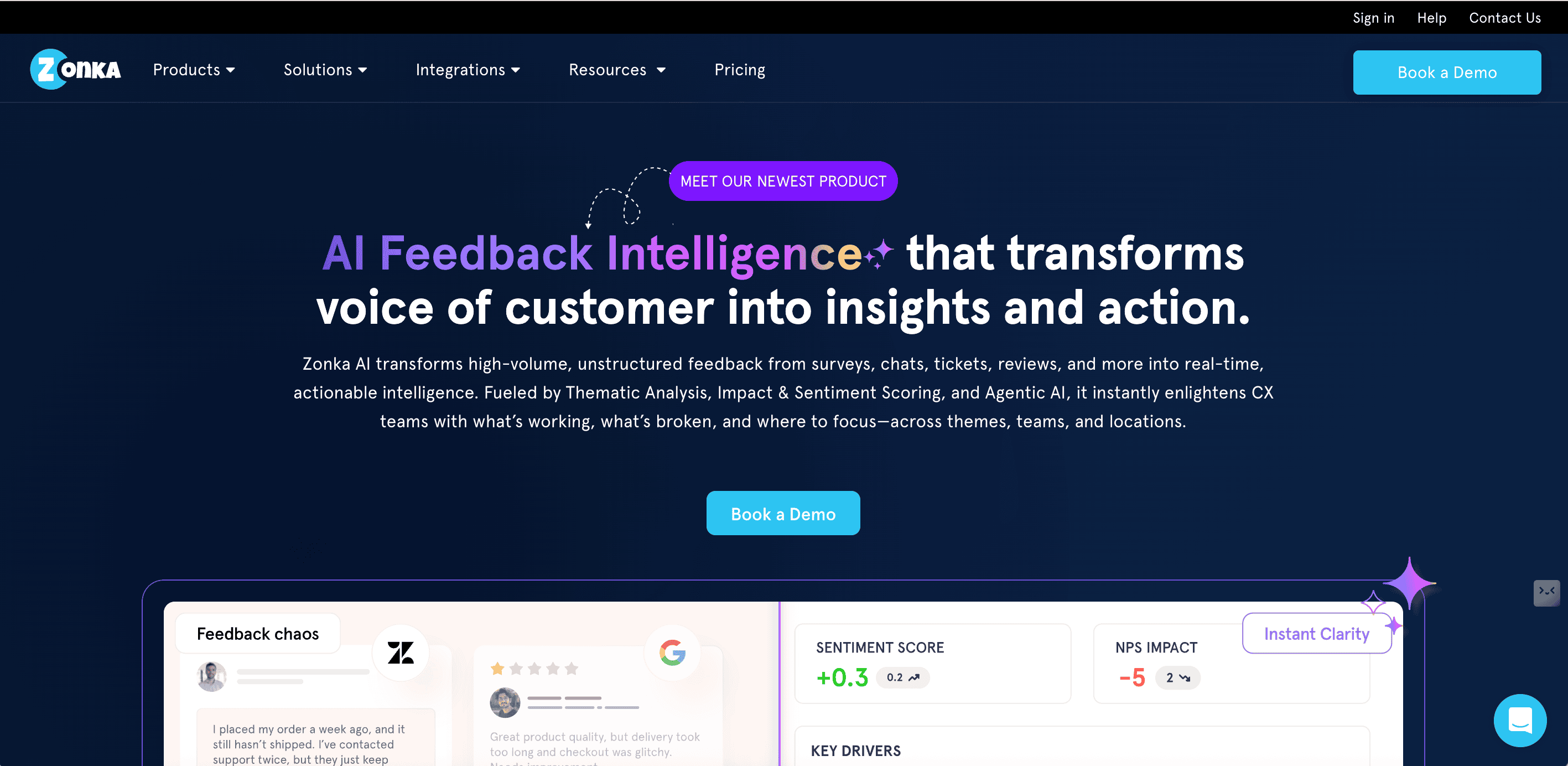
Zonka Feedback is an AI-powered Customer Feedback & Intelligence Platform designed for businesses that need more than basic surveys. It helps teams collect feedback across multiple channels and turn it into actionable insights using advanced analytics and automation.
Unlike SurveyMonkey, which primarily focuses on survey creation, Zonka Feedback combines survey distribution, AI-driven analysis, and closed-loop action in one platform. It is especially suited for organizations running NPS, CSAT, CES, and transactional feedback programs across digital and offline touchpoints.
Zonka Feedback Features
- Omnichannel Survey Distribution: Collect feedback via email, SMS, WhatsApp, web widgets, in-app surveys, and offline kiosk mode, enabling broader reach compared to SurveyMonkey’s largely email and web-based approach.
- Advanced AI Feedback Intelligence: Uses AI to analyze open-text responses with sentiment analysis, themes, impact scoring, and entity detection, helping teams quickly understand why scores change.
- Powerful Automation and Workflows: Trigger surveys automatically based on events, set alerts for negative feedback, and route responses to the right teams to close the loop faster.
Real-time Dashboards and Reporting: Track NPS, CSAT, CES, trends, and performance by location, agent, or channel with customizable dashboards and scheduled reports.
What makes it a good alternative: Zonka Feedback is ideal for teams that want to scale customer feedback programs with automation, deeper analytics, and multi-channel reach. It offers more flexibility, stronger AI insights, and better actionability than SurveyMonkey for CX-focused teams.
Why it may not be all that great: For users who only need simple, one-off surveys or basic data collection, Zonka Feedback may feel more feature-rich than necessary. Advanced capabilities may require initial setup and learning.
Customer Reviews: Customers often highlight Zonka Feedback’s analytics depth and responsiveness of support as key reasons for switching from SurveyMonkey.
“SurveyMonkey worked for basic surveys, but we needed better insights and faster action on feedback. Zonka gave us that visibility.”
G2 Rating: 4.6/5 based on 900+ reviews
Zonka Feedback Pricing: Pricing available on request.
10. GetFeedback – Quick & Efficient
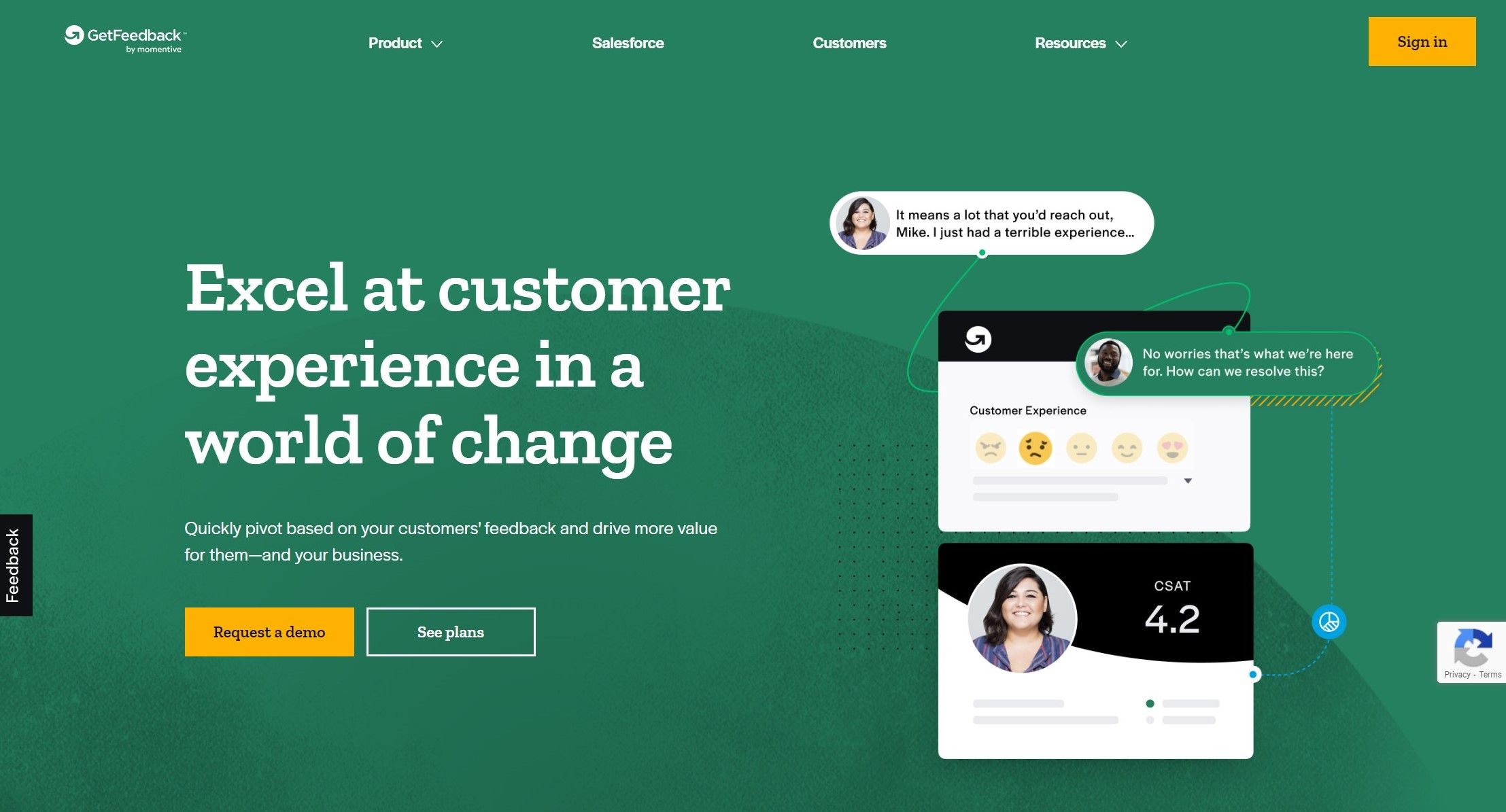
When considering SurveyMonkey alternatives for general survey needs, GetFeedback emerges as a noteworthy option. One of the standout features is its seamless integration with Salesforce, making it an ideal choice for users who rely heavily on this CRM platform.
GetFeedback Features
- Conversational and Mobile-First Surveys: Focuses on interactive, mobile-optimized surveys that resemble natural conversations, resulting in higher engagement compared to SurveyMonkey.
- Customer Experience (CX) and Journey Mapping: Offers features for mapping the customer journey and collecting feedback at different touchpoints, allowing businesses to optimize CX and make data-driven decisions. SurveyMonkey lacks a specific CX focus.
- Real-Time Collaboration and Sharing: Enables real-time collaboration among team members for survey design and analysis and instant sharing of results with stakeholders. While SurveyMonkey has collaboration features, GetFeedback’s emphasis on real-time collaboration sets it apart.
What makes it a good alternative: Quick and easy to integrate. Offers an impressive set of templates to support its users.
Why it may not be all that great: The limited features and question types are a major put-off. Also, users were disappointed with the tech support being ineffective in solving even the basic, continual problems.
G2 Rating: 4.5/5 based on 320+ reviews
Customer Review: “The interface is beautiful and simple. Also, the Salesforce integration is really helpful to keep anything on the track.” – Capterra
GetFeedback Pricing: Contact to get a quote.
11. Survicate – Best SurveyMonkey Alternative for Website Surveys
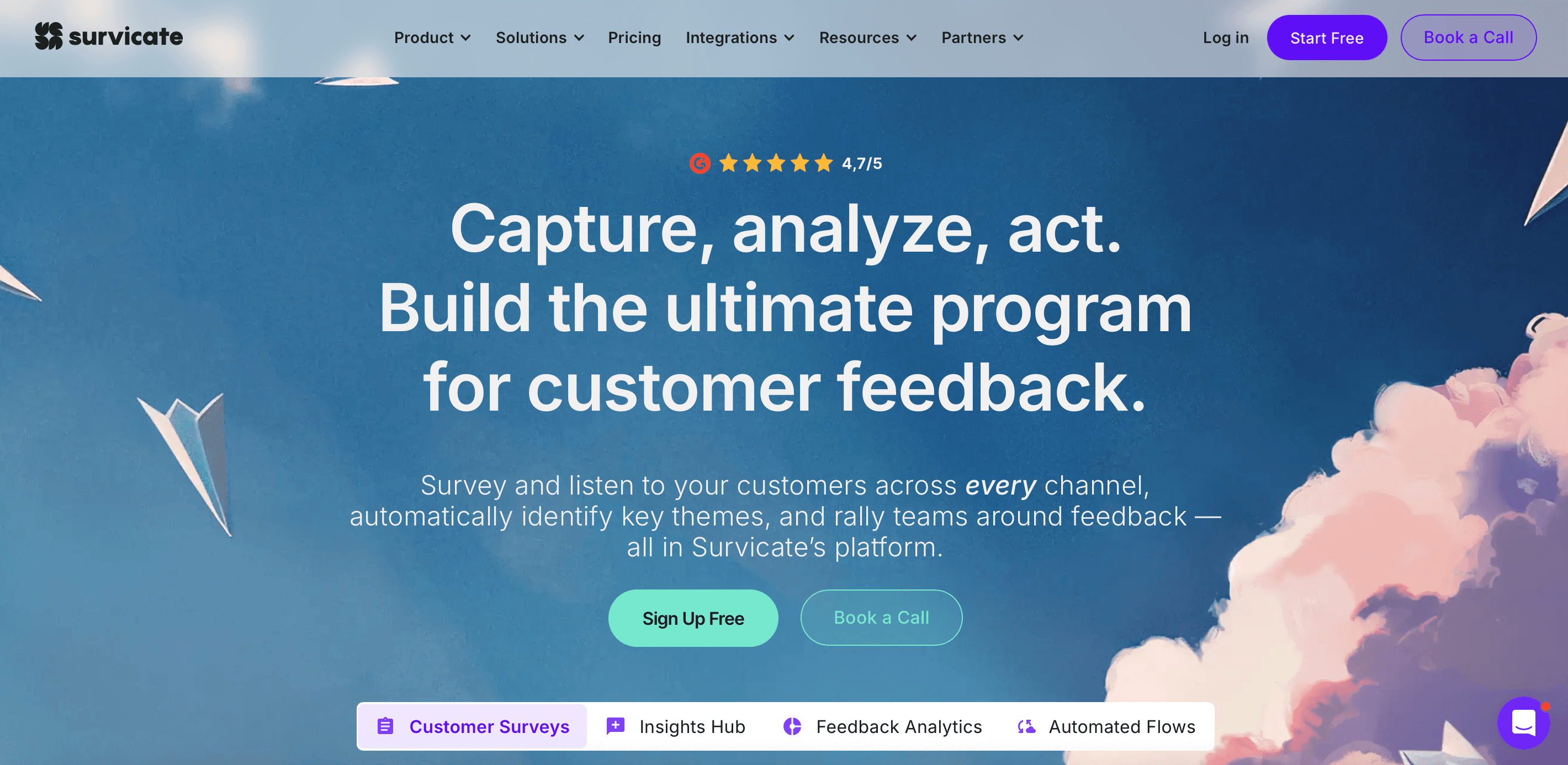
Survicate is designed for product, UX, and growth teams who want to collect feedback directly within their website, web app, or mobile app through contextual, behavior-triggered surveys.
Why It’s a Good SurveyMonkey Alternative
SurveyMonkey distributes primarily via links and email. Survicate triggers surveys based on user behavior, page views, or events — capturing feedback while the experience is fresh. The free plan includes NPS, CSAT, and CES.
Survicate Features
- Behavior-Triggered Surveys: Trigger based on user actions, page views, scroll depth, or custom events.
- Multi-Channel: Website widgets, in-app popups, email, and link surveys.
- NPS, CSAT & CES Built-In: Pre-built CX metric templates.
- Integrations: HubSpot, Intercom, Slack, Google Analytics.
Survicate Pros
- Excellent for contextual, in-moment feedback
- Free plan with 25 responses/month
- No developer needed for setup
- Clean, modern interface
Survicate Cons
- Not for complex, multi-page surveys
- Response limits on lower tiers
Pricing: Starts at $89/month. Free plan with 25 responses/month.
G2 Rating: 4.6/5 based on 170+ reviews.
Best for: Product and UX teams collecting in-context feedback on websites and apps.
12. Formstack – Multi-purpose Form Creator
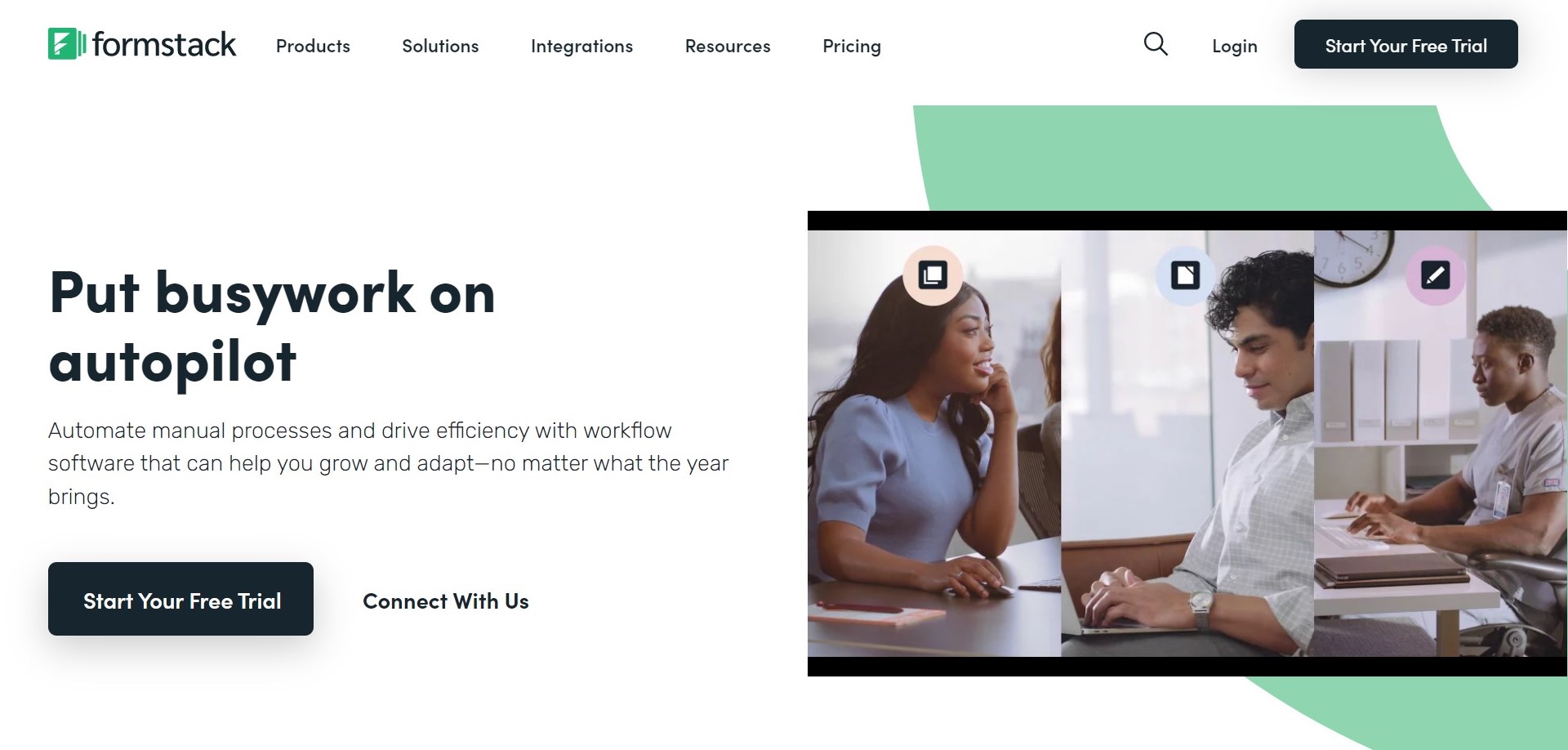
Formstack, a competitor to SurveyMonkey, balances between offering powerful features and maintaining ease of use. Its intuitive interface allows users to create complex forms without needing extensive technical knowledge.
Formstack Features
- Formstack for Salesforce: Seamless integration with Salesforce, one of the world’s leading CRM platforms, allows you to build custom forms and surveys that sync data directly to Salesforce records.
- Formstack Sync: A bi-directional data sync tool that connects data between separate systems, ensuring consistent and up-to-date information across all platforms. This is particularly useful if you’re using multiple tools for CRM, marketing automation, and email marketing.
- Formstack Documents: Automates document creation by populating custom templates with form data or other sources, saving time and reducing manual errors. It supports various formats, delivering automatically generated, personalized documents to various platforms.
What makes it a good alternative: Highly customizable and easy to integrate, Formstack also offers a great FAQ collection to support its users.
Why it may not be all that great: It looks dated and far from sleek. Users also found that intricate forms can take a lot of time to set up. Also, the templates turned out to be barely basic and not of top-notch quality. For alternatives that overcome these challenges, you can check out our blog on Formstack Alternatives.
Suitable For: Insurance, Human Resources, Marketing and sales, Financial Services, Professional Sports, and Real Estate. The majority (77%) of their customer are from small-scale industries
G2 Rating: 4.4/5 based on 370+ reviews
Customer Review: “A little difficult to get the initial setup completed, but the customer service was really fast and thorough, so I was able to work through any problems quickly.” G2 Crowd review
Pricing: Starts at $19 per month.
13. TypeForm – Interactive Survey Experience
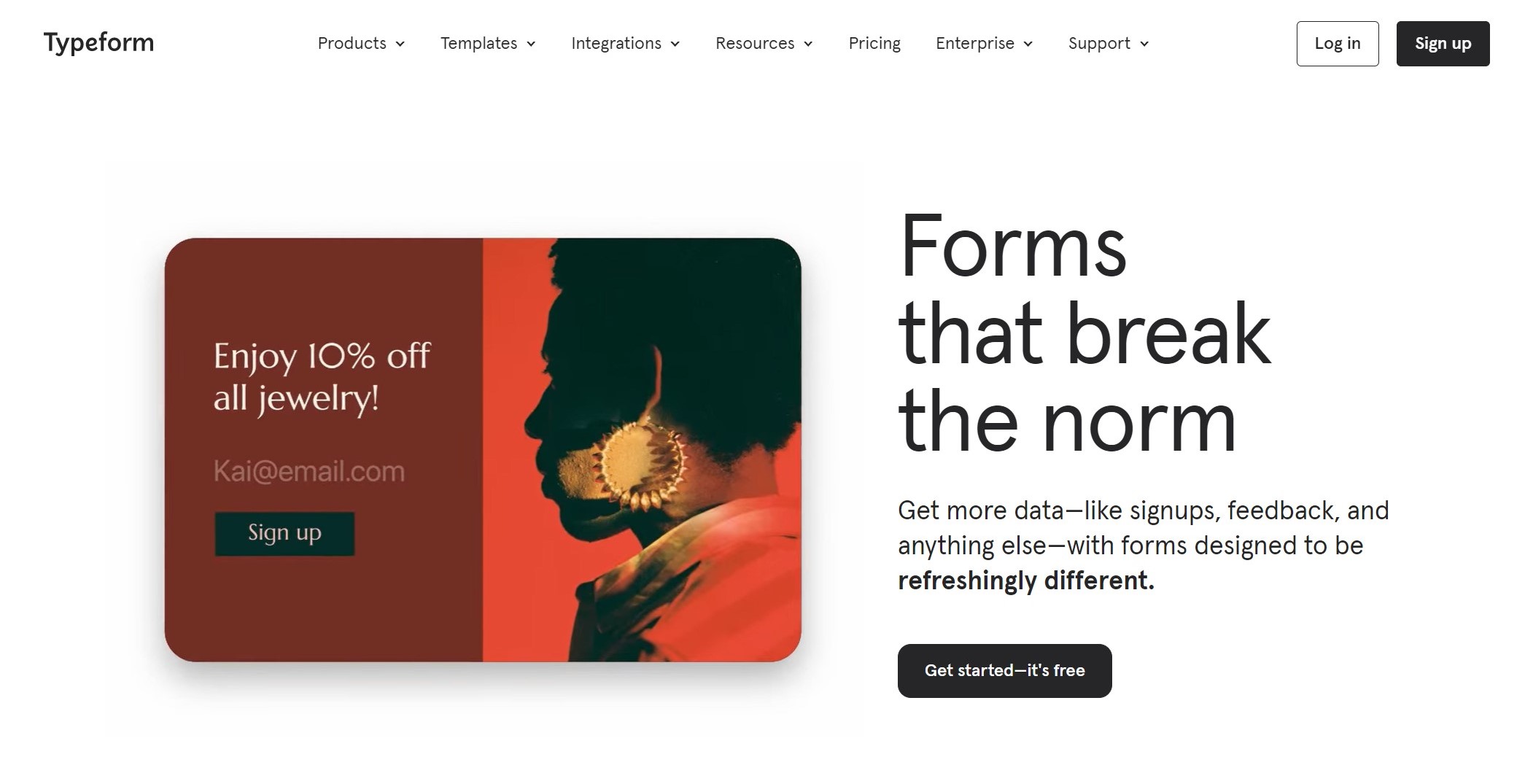
With a clean design and interesting interface, Typeform is one of the most popular SurveyMonkey alternatives. Easy to use, Typeform comes with numerous possibilities.
Typeform Features
- Interactive Surveys: Offers an interactive survey experience, whereas SurveyMonkey follows a more traditional format.
- Advanced Question Types and Logic: Provides a broader range of advanced question types and logic options compared to SurveyMonkey.
- Design Customization: Allows extensive branding and design customization, while SurveyMonkey offers more limited customization options.
What makes it a good alternative: TypeForm offers one of the best UX there is. Easy to set up, and with fantastic analysis tools, Typeform is praised for how neat and clean it looks.
Why it may not be all that great: Typeform is not what you’d call a feature-rich platform. The pricing plans are quite steep and not what you’d call flexible. No scope for user segmentation, automated surveys, reminder emails, and built-in email sharing are other areas where Typeform fails to meet user expectations. For alternatives that overcome these challenges, you can check out our blog on Typeform Alternatives.
For a more detailed comparison, check out – Typeform vs SurveyMonkey
Suitable For: Diverse pricing options make it accessible to small and medium-scale companies. Their customers are predominantly from Computer Software, Information Technology and Services, and Marketing and Advertising sectors.
G2 Rating: 4.5/5 based on 600+ reviews
Customer Reviews: Users praised Typeform for its beautiful and enjoyable interfaces. Also, Typeform’s customer support was more engaging than SurveyMonkey.
“The interface is great. Very easy to put your survey together…” –G2 Crowd review
Pricing: Starts at $39 per month.
14. Microsoft Forms – Best Free Alternative for Microsoft 365 Teams
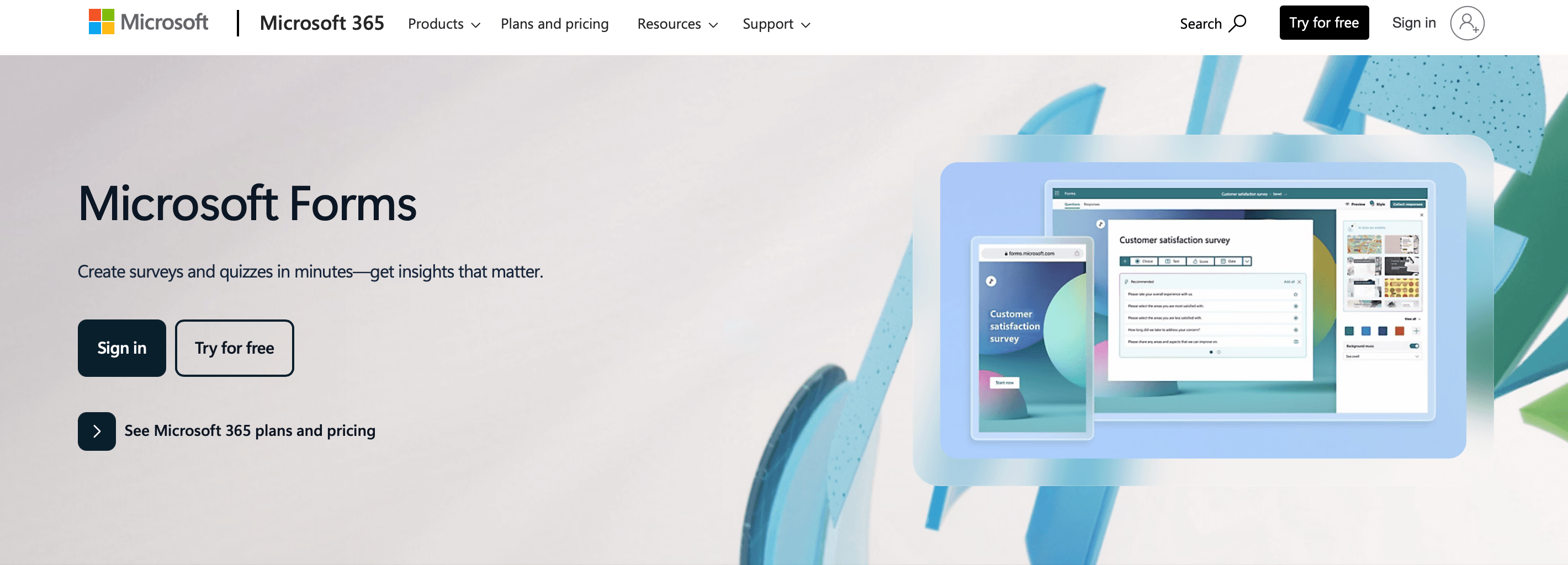
Microsoft Forms is a web-based survey and form builder included free with Microsoft 365. For organizations already in the Microsoft ecosystem, it’s the most natural free survey tool — with tight integration into Excel, Teams, SharePoint, and Power Automate.
Why It’s a Good SurveyMonkey Alternative
Microsoft Forms is free for anyone with a Microsoft account, while SurveyMonkey’s free plan is severely limited. For teams using Microsoft 365, the integration advantage is significant: survey data flows directly into Excel for analysis, forms can be embedded in Teams channels, and Power Automate workflows can trigger actions based on responses.
Key Features
- Free with Microsoft 365: No additional cost for existing Microsoft 365 subscribers. Free basic version for personal Microsoft accounts.
- Excel & Teams Integration: Responses export live to Excel. Forms embed directly in Teams channels and meetings.
- Branching Logic: Create dynamic surveys that adapt based on previous responses.
- Real-Time Response Tracking: Built-in analytics with visual summaries and charts as responses come in.
- 27+ Templates: Pre-built templates for feedback, satisfaction, events, and assessments.
Pros
- Free with any Microsoft account
- Tight Excel, Teams, and SharePoint integration
- Real-time response analytics
- Familiar interface for Microsoft 365 users
- GDPR compliant
Cons
- Fewer question types than dedicated survey tools
- Limited design customization
- Branching logic is basic compared to Alchemer or Qualtrics
- No payment integration
- Best suited for short, simple surveys
Pricing: Free with Microsoft account. Premium features available through Microsoft 365 Business Basic ($6/user/month).
G2 Rating: 4.6/5 based on 317+ reviews (Capterra).
Best for: Organizations already using Microsoft 365 who need free, quick surveys with native Excel and Teams integration.
15. Fillout — SurveyMonkey Alternative for Modern Forms

Fillout is a newer form builder that’s gaining traction fast thanks to native integrations with Notion, Airtable, and Google Sheets. It’s clean, fast, and built for teams that want forms connected directly to their existing databases.
Why It’s a Good SurveyMonkey Alternative
Fillout offers a modern alternative to SurveyMonkey’s traditional approach. Forms connect natively to Notion databases, Airtable bases, and Google Sheets — so responses populate your existing tools without Zapier or manual exports.
Fillout Features
- Native Notion & Airtable Integration: Responses flow directly into your databases.
- Conditional Logic: Dynamic forms that adapt based on responses.
- Calculations & Payments: Built-in calculation fields and Stripe payment integration.
- Modern Design: Clean, contemporary form design with customizable themes.
Pros
- Best Notion and Airtable integration of any form tool
- Generous free plan
- Very fast, modern interface
- Highest G2 rating (4.9/5) on this list
Cons
- Newer tool with smaller feature set than established players
- Limited advanced survey features (no conjoint, MaxDiff)
- Smaller integration library beyond Notion/Airtable
Pricing: Starts at $15/month. Free plan available.
G2 Rating: 4.9/5.
Best for: Teams using Notion or Airtable who want forms and surveys connected directly to their databases.
SurveyMonkey Audience Alternatives
SurveyMonkey Audience is a separate product that provides access to 335 million+ respondents globally for targeted market research. If you’re specifically looking for SurveyMonkey Audience alternatives, these platforms offer comparable panel access:
- Qualtrics Research Services: Extensive global panels with advanced sampling and targeting.
- QuestionPro Audience: 22 million+ panelists across 32 countries. More affordable than SurveyMonkey Audience.
- Pollfish: Mobile-first panel reaching millions through app integrations. Fast turnaround.
- Prolific: Academic-focused panel known for vetted, high-quality participants.
- Zoho Survey Panel: Built-in respondent panel for smaller-scale research.
Which SurveyMonkey Alternative Is Right for You?
The right choice depends on your specific use case:
- Best overall: SurveySparrow — affordable, conversational, strong CX features.
- Best free: Google Forms (unlimited) or Microsoft Forms (best for M365 teams).
- Best for research: Qualtrics or QuestionPro.
- Best for Salesforce: GetFeedback or Formstack.
- Best for product teams: Survicate.
- Best for modern forms: Fillout (especially if using Notion/Airtable).
Take advantage of free plans and trials to test each tool with your actual use case before committing. Happy surveying!


Tired of SurveyMonkey's high prices and hidden features? Try SurveySparrow's free trial!

Kate Williams
Excels in empowering visionary companies through storytelling and strategic go-to-market planning. With extensive experience in product marketing and customer experience management, she is an accomplished author, podcast host, and mentor, sharing her expertise across diverse platforms and audiences.
Frequently Asked Questions (FAQs)
SurveySparrow, Google Forms, QuestionPro, Microsoft Forms, Doodle and Lime Survey – all of these are great free SurveyMonkey alternatives if you’re not ready to commit to a new software just yet.
A survey app is considered easy to use if it offers the ability to create, distribute, and analyze surveys easily and efficiently, with minimal technical knowledge or training. Examples include Google Forms, SurveySparrow, and Typeform.
There are several free survey makers available with no limit on the number of surveys you can create. Some examples include Google Forms, Zoho, QuestionPro and Typeform.
However, while these platforms offer free plans, they may have limitations on features or the number of responses you can collect per month. If you require advanced features or unlimited responses, you need to upgrade to a paid plan.
SurveyMonkey still offers a free Basic plan, but it’s highly restricted: 10 questions per survey, 25 viewable responses, no data exports, no skip logic, and no branding removal. For practical use, most teams find they need a paid plan. The individual Advantage plan starts at $39/month billed annually. Alternatives like Google Forms, Microsoft Forms, and SurveySparrow offer more capable free tiers.
Google Forms is better if you need a free, simple survey tool with unlimited responses and Google Sheets integration. SurveyMonkey is better if you need advanced logic, professional templates, and detailed analytics — but you’ll need a paid plan ($39+/month) to access those features. Many teams find that Google Forms covers 80% of their needs at zero cost.
SurveyMonkey Audience is a panel service providing access to 335 million+ respondents globally for targeted market research. Alternatives include Qualtrics Research Services, QuestionPro Audience, Pollfish, and Prolific. Each offers different panel sizes, targeting options, and pricing.
Related Articles

Survey & Feedback
Top Wufoo Alternatives To Check Out In 2024
17 MINUTES
16 October 2020
Survey & Feedback
Decoding Top 10 Involve.me Alternatives for Enhanced CX
10 MINUTES
3 July 2023

Survey & Feedback
Top 10 LimeSurvey Alternatives In 2024
20 MINUTES
27 July 2021
Survey & Feedback
Top 10 Fillout Forms Alternatives (Low Code/ No-Code)
14 MINUTES
6 July 2023
