Ever stared at a blank survey form wondering “What kind of question should I ask to actually get useful answers?” Well, that happens a lot more than you think. Whether you're running a quick feedback poll or conducting in-depth market research, the way you ask questions can make or break your results.
Should you go with a multiple-choice question? A rating scale? Or throw in a few open-ended ones to hear your audience in their own words? The truth is, picking the right type of question is all about strategic thinking.
It all stems from one thing, clarity. Clarity on what you really want to know from your respondents? What insights are you hoping to walk away with? Once you’re clear on that, choosing the right question format to conduct a successful survey becomes much simpler and much more effective.
In this guide, we’ll break down the 12 essential types of survey questions—what they are, when to use them, and how they help you gather the information you actually need. Plus, we’ll give you real-world examples you can plug into your next survey right away.
Because better questions lead to better answers and better answers drive better decisions.
Want to use AI to write your survey questions?
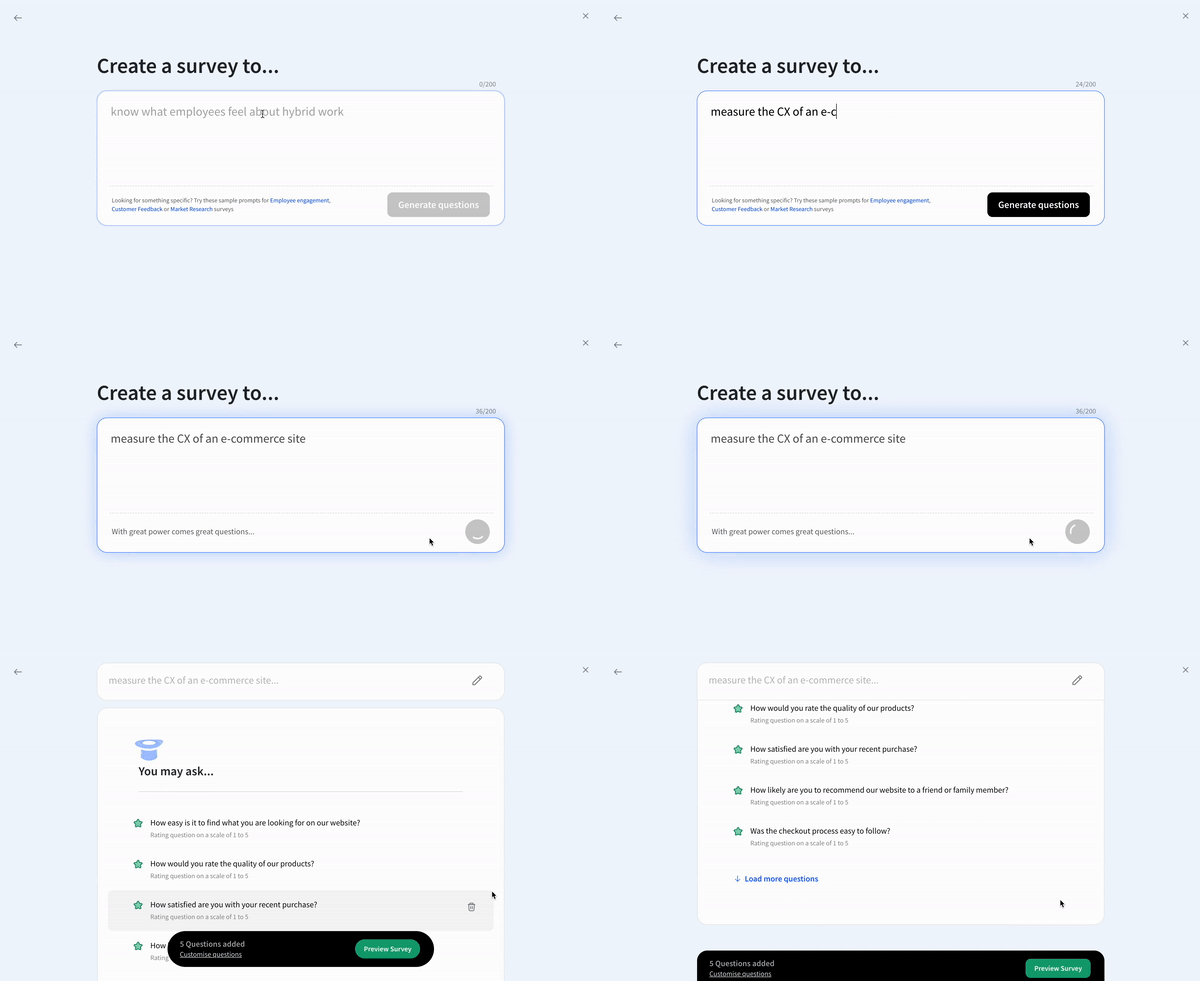
AI is everywhere and yes, it’s revolutionizing the way we build surveys too. Tools like SurveySparrow are offering a dedicated AI feature to help you come up with survey questions in a matter of seconds. Whether you're short on time, feeling uninspired, or simply want to streamline your process, AI has your back.
It makes it super-easy to ask a variety of survey questions with its AI-powered survey maker and 1000+ survey templates. Here's how:
- With pre-built templates for various industries (like customer satisfaction, employee feedback, market research), you can easily choose the one that fits your needs.
- Creating questions can sometimes be difficult, especially if you're tired and if there’s no creative juice flowing. So whatever question type you have, you can easily create it using the AI survey feature from SurveySparrow.
Our Wings AI automatically suggests the best types of questions based on your goals, whether it's multiple-choice, rating scales, open-ended, or NPS.
Pretty cool, right?
Sign up below to use our AI survey maker for free. Get started.

Explore how SurveySparrow can transform your feedback process.
TRUSTED BY BEST-IN-CLASS BRANDS


Now, let's explore the types of survey questions!
12 Types of Survey Questions
There are 12 different types of survey questions you can use to get more survey responses.
- Multiple Choice Questions
- Opinion Scale Questions
- Likert Scale Questions
- Rank Order Questions
- Dichotomous Questions
- Rating Questions
- Slider Questions
- Demographic and Firmographic Questions
- Open-Ended Questions
- Dropdown Questions
- Matrix Questions
- Picture Choice Questions
Let's discuss each in detail, along with a few examples of questions.
1. Multiple Choice Questions
Multiple choice questions are the most widely used question type in surveys. You present respondents with a predefined list of answer options and ask them to select one or more. Because the answers are already provided, they're quick to complete and easy to analyze at scale.
There are two variations:
Single-answer: Respondents pick one option only. Best for mutually exclusive choices like age range, location, or preference.
Multi-answer: Respondents can select all that apply. Best when behaviors or preferences can include more than one option.

Typically, you’d want your respondents to pick only one option. This kind of multiple-choice question is called a single-answer multiple-choice question.
However, in some cases, you might want them to give you multiple answers. This kind of question is called a multi-answer multiple choice question.
Since you already provide them with all the options, this type of survey question is easier to answer. Also, the data you collect with this kind of question is easier to analyze.

Always include an "Other (please specify)" option with a text field when your list might not cover every possible answer. This prevents respondents from abandoning the question or answering inaccurately.
When to use:
- You need structured, quantifiable data
- You want to segment respondents into groups
- Your answer options are finite and well-defined
- You need high response rates - multiple choice is the easiest format to answer
2. Opinion Scale Questions
An opinion scale survey question provides respondents with a scale of numbers as answer options. These options range from 1 to 10, 0 to 100, 1 to 5, etc.
The most widely used example is the NPS question:
"On a scale of 0 to 10, how likely are you to recommend us to a friend or colleague?"
NPS is an essential survey question that lets you check your customers’ pulse and sentiments about your products/services. An NPS question helps you measure your customers’ willingness to recommend your product or service to their friends or colleagues.
You simply ask: “How likely are you to recommend us to your friends or colleagues?” and provide them with a numerical rating scale that ranges from 0 to 10. Here’s an NPS survey question example.

Want to roll out NPS surveys with ease? SurveySparrow‘s NPS survey software is designed to help you decode customer sentiments with ease.
Moreover, you can compare your score with our NPS benchmarking tool to get a sense of where you stand. Create your account below to try SurveySparrow for free.
Explore how SurveySparrow can transform your feedback process.
TRUSTED BY BEST-IN-CLASS BRANDS
One thing to keep in mind is that it ain’t enough to just display a set of numbers. You also need to explain the value of the numbers that you ask them to choose.
If you ask "How much do you like our product?" on a scale of 1 to 10, make it clear that 1 means "not at all" and 10 means "extremely." Without labels, respondents interpret the scale differently and your data becomes unreliable.
When to use:
- You want to measure intensity, likelihood, or degree of opinion
- You need a trackable metric you can benchmark over time, like NPS or CSAT
- You want quantitative data that's easy to average and compare across groups
3. Likert Scale Questions
It’s likely you’ve seen a Likert scale question before. Remember those “do you agree or disagree” questions you answered the last time you took a survey?
You probably “strongly agreed/disagreed” or “neither agreed nor disagreed” with a survey question. That’s a Likert scale survey question!
The most common format looks like this:
"The onboarding process was easy to follow."
|
This kind of question is a reliable survey question to ask your respondents to measure their attitudes, perceptions, and opinions about a certain topic. Here’s a Likert scale survey question example:

You'll typically see Likert scales used to measure:
Agreement — Strongly Disagree to Strongly Agree
Satisfaction — Very Dissatisfied to Very Satisfied
Frequency — Never to Always
Importance — Not Important to Extremely Important
Likelihood — Very Unlikely to Very Likely
When to use:
- You want to measure attitudes, opinions, or perceptions on a defined topic
- You need consistent, comparable data across multiple respondents or time periods
- You're running employee engagement, product satisfaction, or customer experience surveys
4. Rank Order Questions
A rank-order question provides your respondents with a list of answer options. This survey question type allows them to compare the options and rank them in order of priority, importance, or value.
For example,
"Please rank the following factors in order of importance when choosing a survey tool."
- Ease of use
- Pricing
- Question variety
- Reporting and analytics
- Customer support

This survey question type is quite different from a rating question; it asks you to rank one option against another option. With this question, you’ll be able to understand the relative importance of each option.
Only, use this survey question sparingly, as they take more time to answer.
When to use:
- You need to understand the relative priority of options, not just individual ratings
- You're making product, marketing, or feature decisions that require clear prioritization
- You want to avoid the "everything is important" problem that rating scales often produce
5. Dichotomous Questions (Yes/No Questions)
A dichotomous question (or a yes or no question) requires only two possible answers from your survey respondents: yes/no, agree/disagree, or true/false.

This survey question type is typically used to easily filter out (or screen out) the respondents who don’t fit the research criteria. Also, you can use these questions to segment your respondents into different groups.
While you could use a simple multiple-choice survey question to get a yes or no from your audience, a dichotomous question provides answer options that come with appropriate icons, these icons serve as a visual cue and help your respondents quickly provide accurate answers.
Here’s a Yes/No survey question example with icons.

When to use:
- You need a quick, definitive answer to a specific question
- You want to screen or segment respondents before asking deeper questions
- You're using survey logic to branch respondents into different question paths
- You need to confirm a fact. Did something happen or not
6. Rating Questions
Rating scale survey questions allow your survey respondents to quickly rate something on a scale of 1 to 5. This is often used as a quick survey question to ask your respondents how they feel about a particular thing.
The visual format makes rating questions faster and more intuitive to answer than numerical scales, which is why they're one of the most popular question types for quick feedback collection.
"How would you rate your overall experience with our product?"
⭐ ⭐ ⭐ ⭐ ⭐ (1 to 5 stars)
Or:
"How satisfied are you with our customer support?"
😞 😕 😐 🙂 😄 (1 to 5 smileys)

They help you measure your respondents’ opinions and attitudes toward a certain topic.
You can quickly find out what they really think about your product, marketing, support, or any other aspect of your business.
SurveySparrow’s survey tool lets you add all kinds of icons and emojis to your rating questions. In other words, you can create rating questions with stars, thumbs, high-voltage emojis, crowns, and smileys. Here are some good survey questions and examples of rating scales.


Rating questions are commonly used to measure CSAT (Customer Satisfaction Score) where customers rate a specific interaction immediately after it happens.
When to use:
- You want a quick read on satisfaction, quality, or experience at a specific touchpoint
- You need data that's easy to average, track, and benchmark over time
- You want to make the survey more engaging and visually appealing
- You're measuring CSAT after a support interaction, purchase, or onboarding session
7. Slider Questions
With a slider question, you ask your survey respondents to evaluate something on a numerical scale. But they pick a number by dragging a slider control.
For example:
"How would you rate the usability of our app?"
[slider from 0 to 5]

In some cases, a slider question is fun to answer and makes more sense than other similar kinds of questions.
When to use:
- You want a more engaging, interactive alternative to a standard rating or opinion scale
- You need a wide range of values 0 to 100 for more precise measurement
- You're measuring continuous variables like budget range, satisfaction intensity, or likelihood
- You want to add variety to a survey that already contains multiple rating or scale questions
8. Demographic and Firmographic Questions
You can ask these kinds of questions to gather insights into your target audience.
Demographic questions collect background information about your respondents, not to measure satisfaction or opinion, but to provide context that makes the rest of your survey data more meaningful.
They're the questions that tell you who answered, so you can segment, compare, and analyze responses across different groups.
Here’s a quick demographic survey question example:

Firmographic questions, on the other hand, include those set of survey questions to ask your audience to gather firmographic information related to a business, such as company size, annual revenue, etc.
For example:
"What is your current role?" Individual contributor |
Let's say you ran an NPS survey, and asked a few follow-up demographic and firmographic questions. Out of that, 80% of your detractors are enterprise customers, and promoters skew toward SMBs.
This is the kind of insight that changes product and go-to-market decisions entirely. Without demographic or firmographic context, satisfaction scores and feedback data are harder to act on.
When you better understand who they are and where they come from, you can segment them, easily analyze data that’s relevant to a particular group, and get better results from your surveys.
When to use:
- You need to segment your data by audience type to identify patterns
- You're conducting market research and need to understand who your respondents are
- You want to compare satisfaction or feedback scores across different customer groups
- You're building buyer personas or customer profiles
9. Open-Ended Questions
Open-ended questions have no predefined options, no scales, and no constraints.
This survey question type provides respondents with a text field so they can give an answer in their own words.
For example:
- "What was the main reason you chose us over competitors?"
- "If you could change one thing about our product, what would it be?"
- "Describe your experience with our support team in your own words."

It’s commonly used to gather in-depth, qualitative data on a certain topic, they can't be averaged or graphed the way a rating score can.
But they reveal the context, emotion, and reasoning behind every number in your survey. A customer who rates their experience 3 out of 5 tells you something is wrong. An open-ended follow-up tells you exactly what.
Although you will get a ton of insights this way, you may have a hard time analyzing the data you acquire with this kind of question.
Open-ended questions are particularly valuable in event surveys where you want to capture specific feedback about sessions, speakers, or the overall attendee experience.
When to use:
- You want to understand the reasoning behind a rating or score
- You're in early-stage research and don't yet know what answer options to offer
- You want to capture customer language — the exact words your audience uses to describe your product are invaluable for marketing and positioning
- You're collecting feedback on a complex or nuanced experience that a scale can't capture
- At the end of a survey as a catch-all: "Is there anything else you'd like to share?"
10. Dropdown Questions
If you’ve got a multiple choice question that has a long list of answer options, you can use a dropdown question instead if you wish to not overwhelm your respondents.
A dropdown question is functionally similar to a single-answer multiple choice question. Your respondents have the option to select one choice from a predefined list.
All your answer options will be hidden in a dropdown menu. Respondents will have to click on the dropdown button to reveal the list of answers.

That said, there are some cases where displaying all the answers upfront helps provide the information your respondents need to give you an answer quickly.
When to use:
- Your list of answer options is long, typically more than 7 or 8 items
- The options are well-known and don't need to be seen all at once to make a decision. For example, countries, states, languages, and industries
- You want to keep the survey visually clean and uncluttered
- You're collecting demographic or firmographic data with standardized categories
11. Matrix Questions
Got a bunch of questions that seem to give the same answer options? You need a matrix question. This survey question type is a series of Likert scale questions.
A matrix question presents multiple related questions in a single grid format with the questions listed as rows and a shared set of answer options displayed as columns. It's essentially a series of Likert scale or rating questions combined into one compact table, allowing respondents to evaluate multiple items using the same scale in a single view.

Matrix questions are popular in employee engagement surveys, product feedback surveys, and event feedback surveys, anywhere you need to evaluate multiple dimensions of an experience using a consistent scale.
While a matrix question can help you simplify and shorten your surveys, it’s quite difficult to take, especially on a mobile device, and most people find it confusing and hard to answer. That’s when checking out matrix question types can help.
When to use:
- You need to evaluate multiple related items using the same scale
- You want to condense several Likert scale questions into a single, compact block
- Your survey is for a desktop audience, matrix questions render well on larger screens
- You're measuring employee engagement, event feedback, or product experience across multiple dimensions
12. Picture Choice Questions
Image choice or picture choice questions are similar to multiple-choice survey questions but allow you to use pictures as answer options.
For example:
"Which of these website designs do you prefer?"
[Image A] [Image B] [Image C] [Image D]

Typically, picture survey questions are used to get feedback on visuals such as logos or product concepts. You can also use them to make things more engaging and give your audience a break from reading.
When to use:
- You're testing visual assets — logos, product designs, UI mockups, packaging, color schemes, or brand concepts
- You want to make a survey more engaging and visually varied
- The answer options are easier to understand as images than as text descriptions
- You're conducting concept testing or A/B preference research
- (Optional) You want to reduce the reading load for respondents, as images communicate faster than words
Now that you have a clear picture of the types of survey questions that you can use, it's time to start creating your own! Let's get started:
Customer Feedback Survey Template
Use This TemplateHow to Choose the Right Survey Question Type?
Choosing the wrong question type doesn't just produce bad data, it frustrates respondents, increases abandonment, and wastes the goodwill of everyone who took the time to respond. Here's a simple framework to help you pick the right format every time.
1. Start with what you want to know
Every question type exists to answer a different kind of question. Before you choose a format, ask yourself: what do I actually need from this response?
- I need a measurable number I can track over time → Opinion scale, rating, or Likert scale
- I need to understand priorities between options → Rank order
- I need a quick yes or no confirmation → Dichotomous
- I need to know who my respondents are → Demographic or firmographic
- I need to understand the reasoning or emotion behind something → Open-ended
- I need to choose between visual options → Picture choice
- I need respondents to pick from a long standardized list → Dropdown
- I need to evaluate multiple items on the same scale → Matrix
- I need to measure overall loyalty → NPS
2. Consider your respondents
The best question type for your data isn't always the best question type for your audience. Always factor in:
- Mobile vs desktop
- Survey length
- Cultural context (Glocalize your survey)
3. Match the question type to the data you need
| If you want to measure.. | Use this question type |
| Overall Satisfaction | Rating or CSAT Scale |
| Customer Loyalty | NPS (Opinion Scale 0-10) |
| Attitudes and Perceptions | Likert Scale |
| Priorities Between Options | Rank Order |
| Quick Facts or Screening | Dichotomous (Yes/No) |
| Who your Respondents are | Demographic/Firmographic |
| Reasoning or Context | Open-ended |
| Visual Preferences | Picture choice |
| Long List Selections | Dropdown |
| Multiple Items, Same Scale | Matrix |
| Precise Continuous Values | Slider |
4. Mix question types strategically
No single question type tells the full story. The most effective surveys combine:
- Closed-ended questions for measurable, comparable data
- One or two open-ended questions to capture the reasoning behind the numbers
- Demographic or firmographic questions at the end to provide context for segmentation
A good rule of thumb: lead with your most important closed-ended questions, follow up with an open-ended question when you need context, and always end with demographics. Never start with them.
Survey Question Best Practices
Choosing the right question type is only half the job. How you write and structure your questions determines whether you get honest, useful responses, or data you can't trust. Here are the practices that consistently produce better surveys.
1. Ask one thing at a time
One of the most common mistakes are asking double-barreled questions. These questions are those that ask about two things in a single question. They force respondents to give one answer to two different questions, making both answers unreliable.
For example, if the question is: "How satisfied are you with our product quality and customer support?"
What if the product is great but the support is poor? There's no accurate way to answer. Split every double-barreled question into two separate ones.
2. Use simple, clear language
Write every question as if you're speaking to someone who has never heard of your product, industry, or company before. Avoid jargon, abbreviations, and technical terms unless you're certain every respondent understands them.
Instead of: "How would you rate our omnichannel CX delivery?"
Write: "How satisfied are you with your experience across our website, app, and support channels?"
3. Avoid leading questions
A leading question nudges respondents toward a particular answer before they've had a chance to form their own opinion.
It feels subtle but it significantly skews your data.
Leading: "How much did you enjoy working with our friendly support team?"
Neutral: "How would you rate your experience with our support team?" ✅
The first assumes friendliness. The second lets the respondent decide.
4. Keep surveys as short as possible
Every question you add reduces your completion rate. Keep surveys under 10 questions for post-interaction surveys and under 5 minutes for relationship surveys. If you have more to ask, run a follow-up survey rather than cramming everything into one.
As a rule of thumb if a question doesn't directly serve your survey's goal, remove it.
5. Don't make every question mandatory
Forcing respondents to answer every question produces one of two outcomes, abandoned surveys or inaccurate answers from people who just want to finish. Keep mandatory questions to a minimum and let respondents skip what they're not comfortable answering. You'll get more honest data on the questions that matter most.
6. Order your questions logically
Question order affects how respondents think and answer. Follow this structure for best results:
- Start with easy, engaging questions, multiple choice or rating questions
- Move to more complex or sensitive questions in the middle
- Place open-ended questions toward the end, when respondents are warmed up
- Always put demographic questions last, they feel intrusive upfront
7. Always label your scales
Never display a numerical scale without explaining what the numbers mean. If you ask "How satisfied are you?" on a scale of 1 to 10, make it explicit that 1 means Very Dissatisfied and 10 means Very Satisfied. Without labels, different respondents interpret the scale differently and your data becomes unreliable.
8. Test your survey before sending
Always pilot your survey with 5–10 people before launching it to your full audience. Ask them to note any questions they found confusing, any answer options that didn't apply to them, and how long it took to complete. Even a quick pilot catches issues that seem obvious in hindsight but are invisible to the person who wrote the questions.
9. Close the feedback loop
Collecting feedback without acting on it, or communicating what you've done with it erodes trust and reduces future response rates. Even a brief message saying "here's what we changed based on your feedback" dramatically improves engagement next time you survey the same audience.
10. Use logic and branching
Survey logic showing or hiding questions based on previous answers keeps surveys relevant to each respondent and significantly reduces abandonment. A customer who says they haven't contacted support shouldn't be asked to rate the support experience. Use branching to route respondents through only the questions that apply to them.
How Can SurveySparrow Help You?
If you’re eager to try out conversational surveys, SurveySparrow is a great choice. It’s a user-friendly platform that makes surveys interesting and effective, helping you get valuable information for your business decisions.
Here’s why SurveySparrow is a good option:
Use a Mix of Question Types: Variety keeps respondents engaged. SurveySparrow offers a range of question types, including multiple-choice, rating scales, and open-ended questions. This diversity allows you to gather different types of information effectively.
Random Question Generator: If you can’t find the inspiration to construct your own questionnaire, select your desired category and let the tool do the job!
Easy to Use: SurveySparrow makes it simple to create your surveys, making them more interesting and efficient.
Get Better Insights: It allows you to collect detailed and nuanced data, helping you discover insights that you might have missed otherwise.
Smarter Decision-making: The accurate and comprehensive data you gather on the platform enables you to make informed and smarter decisions for your business.
1000+ Templates: You get pre-designed survey templates.
Why not take it for a spin?
Explore how SurveySparrow can transform your feedback process.
TRUSTED BY BEST-IN-CLASS BRANDS
Final Thoughts
We know one thing for sure, the type of survey questions you ask can make or break your results. From multiple-choice to open-ended and everything in between, each question format serves a reason and choosing the right one usually starts with knowing your survey goals.
There might be a type of survey question that’s better than the one you’ve chosen for the data you need, so think hard before choosing a survey question type.
Looking for some survey question examples? Here are articles from us that can help you with that:
- 12 Product Survey Questions for Insightful Product Feedback
- 6 Employee Pulse Survey Questions You Should Be Asking
- 12 Amazing Customer Support Survey Questions
- Top Diversity and Inclusion Survey Questions to Ask
Got any questions on picking the right types of survey questions? Any interesting tips or techniques you use to find the right types of survey questions? Let us know about them in the comment section below.
Looking to create surveys that people love to answer? Feel free to check out SurveySparrow