What is guest experience management?
Guest experience (GX) management is the process of maintaining the satisfaction of guests and future ones to a level that they expect from hotels, resorts, and other luxury and entertainment industries. GX management is not limited to just this. It also caters to travellers especially in cruises and flights.
Guest experience management involves improving every interaction a guest has with any one of the business types above.
In other words, guest experience management is the process of understanding, managing, and improving every interaction a guest has with a business.
A guest may forgive a slow check-in if the rest of their stay is excellent. But several small problems across the journey can add up to a poor overall experience.
Guest experience management helps businesses look at that entire journey instead of treating each interaction as a separate event.
What Does Guest Experience Management Include?
A guest experience management program typically covers six areas:
Guest expectations: Understanding what guests expect before they arrive.
Guest journey: Mapping the different stages and touchpoints guests move through.
Feedback: Asking guests for their opinions at relevant points in the journey.
Service improvement: Using feedback and operational data to identify problems and make changes.
Personalization: Using relevant guest information to provide more useful and appropriate experiences.
Measurement: Tracking experience metrics to understand whether changes are working.
Together, these areas give businesses a clearer picture of what guests experience and why.
Why is guest experience management important?
Guest experience has a direct relationship with how people perceive a business.
A guest who receives a good service is more likely to return for more experiences, recommend the business to their circle, and leave a positive review. A guest who encounters repeated problems may choose another business next time.
Guest experience management helps businesses understand what drives those outcomes.
1. Improves guest satisfaction
Guest satisfaction depends on more than whether a product or service meets basic expectations.
A guest may be satisfied with a hotel room but frustrated by the booking process. They may enjoy a restaurant's food but dislike the service. Looking at the complete experience helps you find these gaps.
Regularly collecting feedback like this can show where satisfaction is strong and where improvements are needed, giving you opportunities to act on them before the next customer interaction.
2. Builds guest loyalty
A positive experience can influence whether guests return to you.
You can use feedback to understand what your guests value most, then improve those parts of the experience. Over time, this can help create stronger relationships with returning guests.
3. Encourages positive reviews and recommendations
Reviews should often reflect the overall guest experience rather than one isolated interaction. But that's not always the case.
Any poor interaction can cause a guest to get frustrated and give an alarming review.
Guest experience management gives your business a way to identify the factors that influence those experiences and address problems before they become recurring complaints.
It can also help you understand what guests value enough to mention in reviews or recommend to others.
For example, CogniVue groups feedback and review sentiment into themes, letting you understand what needs to be fixed now, or later.
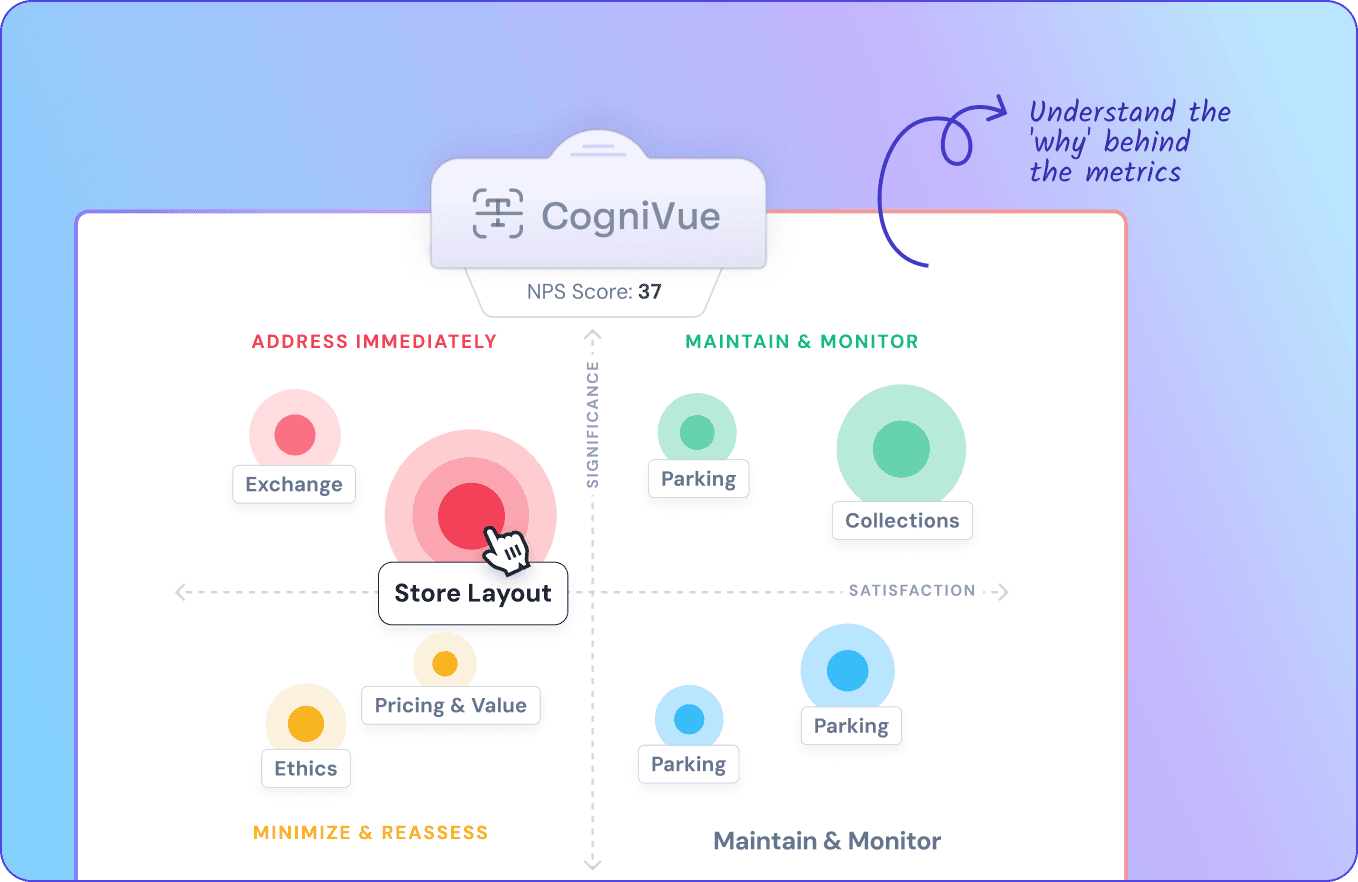
Explore examples of positive reviews and recommendations.
4. Helps in identifying service problems
Guest feedback can reveal problems that internal teams may not see.
For example, a hotel might discover that guests regularly struggle to find information about parking.
These may seem like small issues, but repeated friction across many guests can affect the overall experience.
5. Supports revenue growth
Better experiences can contribute to repeat business, referrals, and stronger customer relationships.
Guest experience management does not replace revenue management or operational planning. It gives those teams another source of information when making decisions about how to improve the guest journey.
How to build a guest experience management strategy?
A guest experience strategy does not need to begin with a large technology implementation.
Start by understanding the current experience and identifying where improvement will have the greatest impact.
1. Map the guest journey
List the major stages of the guest journey from discovery to post-visit communication.
Identify the main touchpoints at each stage and the teams responsible for them.
2. Define guest expectations
Look at what guests are promised through your website, marketing, booking process, staff communication, and other channels.
Then compare those expectations with the actual experience. Work towards maintaining that same level of expectations at the ground level.
3. Collect guest feedback
To ensure your efforts are exceeding your guests' expectations, start collecting feedback, and choose the feedback methods that fit each stage of the journey.
For example:
- Post-booking surveys can measure the booking experience.
- Post-check-in surveys can identify arrival issues.
- In-stay surveys can uncover problems while they can still be resolved.
- Post-visit surveys can measure the overall experience.
4. Identify experience gaps
Look for recurring problems. A negative response may highlight an unusual situation, but a recurring complaint across many guests could signify a process or service problem.
5. Prioritize improvements
Not every issue needs to be fixed at the same time.
Prioritize problems based on factors such as frequency, impact on guests, business impact, and how practical the solution is.
CogniVue lets you prioritize problems based on impact. Explore how CogniVue works.
6. Take action
Assign each priority issue to the appropriate team.
An experience problem might require changes to staffing, training, communication, technology, facilities, or internal processes.
7. Measure the results
After making changes, collect feedback again.
Compare the results with previous measurements to determine whether the change improved the experience.
This creates a continuous feedback loop instead of a one-time improvement project.
How to measure the guest experience? 6 ways
A business can track how the guest experience changes over time with measurable indicators.
The most common guest experience metrics include:
1. Customer satisfaction score (CSAT)
CSAT measures how satisfied a guest was with a specific interaction or experience. It is a useful metric to measure specific parts of the guest journey. Low CSAT scores indicate that a certain part of the experience didn't meet guest expectations.
2. Net promoter score (NPS)
NPS measures how likely guests are to recommend your hotel to their network. High NPS scores are indicators of highly successful businesses. A good NPS score for your business determines the amount of satisfaction and loyalty your past guests have.
3. Customer effort score (CES)
CES measures how easy or difficult it was for a guest to complete a specific task.
This can be useful for measuring processes such as booking, contacting support, or making a request. A high CES score for any one of these interactions could mean that anybody could be facing a lot of friction, and have difficulty getting through a particular task. Check the parts of the journey where CES scores are high, and figure out how to smoothen the experience.
And then, you'll need to monitor reviews and ratings as well.
4. Reviews and ratings
Online reviews can provide qualitative information alongside numerical ratings.
You can analyze these reviews by grouping them into themes, which will help in identifying recurring strengths and weaknesses of your business services.
5. Repeat visits or bookings
Repeat visiting and booking behavior is another indication of guest loyalty.
We advise against using this alone to measure loyalty as repeat visits can also be influenced by factors such as location, price, availability, or business necessity.
6. Complaint resolution
Businesses can also measure how quickly and effectively they resolve guest complaints.
The objective is not simply to reduce complaints. It is to understand why they happen and whether the resolution process works.
Working towards an ideal 'no-complaint atmosphere' is what any hospitality business should aim and strive for, as that is the best strategy in and of itself.
Guest experience management examples
Guest experience management can be applied across the following industries.
1. Hotel guest experience management
Hotels can collect feedback across booking, arrival, room quality, amenities, housekeeping, dining, staff interactions, and departure.
For example, a hotel could send a short hotel satisfaction survey during their stay or afterwards asking whether the they liked the hotel experience. If several guests report problems, the team can investigate the process while the issue is still current.


2. Restaurant guest experience management
Restaurants can measure experiences related to reservations, wait times, food, service, atmosphere, ordering, payment, and overall satisfaction.
Feedback can help restaurant teams identify whether problems are related to food quality, service, speed, or another part of the experience.
Here's our restaurant satisfaction survey template.
3. Resort and travel experience management
Travel businesses often have longer and more complex guest journeys.
Feedback can cover booking, transportation, arrival, activities, accommodation, support, and departure.
Mapping these interactions can help teams understand where the experience is good, and where it breaks down.
4. Events and entertainment
Event managers can use guest feedback to evaluate registration, ticketing, arrival, seating, facilities, staff interactions, activities, and post-event communication.
This information can then inform improvements for future events.
Guest experience management best practices
A few practices can make guest experience programs more effective.
- Collect feedback at the right time. Ask about an experience while it is still relevant to the guest.
- Keep surveys focused. Long surveys can reduce completion rates and make it harder to identify the most important issues.
- Combine ratings with open-ended questions. Combining a Likert scale question with a comment can help get qualitative feedback. Always include an open-ended question in all your guest experience surveys.
- Close the feedback loop. Let guests know when their feedback leads to a change or resolution.
- Connect feedback to action. Assign recurring problems to the teams that can address them.
- Look for patterns. Individual comments matter, but recurring themes can reveal larger experience problems.
- Give employees access to feedback. The teams interacting with guests should understand what guests are saying.
- Measure changes over time. A single survey result does not tell you whether an experience is improving.
Guest experience management vs. customer experience management
Guest experience management and customer experience management are closely related, but the terms are often used in different contexts.
Customer experience management (CXM) usually refers to managing the complete experience customers have with a business across industries.
Guest experience management (GXM) focuses specifically on guests and is commonly used in hospitality, travel, restaurants, entertainment, events, and similar industries.
The underlying principles are similar:
- Understand expectations
- Map the journey
- Collect feedback
- Identify experience gaps
- Improve interactions
- Measure results
Common challenges with guest experience management
Building a guest experience program can come with several challenges such as:
1. Collecting too much feedback
More feedback does not automatically mean better insight.
If businesses ask guests too many questions or send surveys too frequently, response quality can suffer.
2. Focusing only on scores
A CSAT or NPS score can tell you whether an experience is performing well, but it may not explain why.
Open-ended feedback, person-to-person interactions and operational data can reveal hidden context behind the scores.
3. Looking at departments instead of the full journey
The guest does not experience the business in departments.
They experience one journey.
A hotel guest may interact with reservations, reception, housekeeping, food and beverage, and customer support during one stay. So each department may perform well individually, but the overall experience could still feel inconsistent and lacking.
4. Treating Every Guest the Same
Different guests have different expectations, needs, and reasons for visiting.
A useful guest experience strategy accounts for relevant differences without making personalization complicated.
Build a better guest experience with feedback
Guest experience management gives businesses a structured way to understand what guests experience and improve it over time.
A better guest experience starts with knowing what guests actually experience. With the right survey and feedback tools, teams can collect guest feedback across the journey, analyze responses, and use those insights to improve the experience.
SurveySparrow helps hospitality and service teams collect feedback across the guest journey, from booking and check-in to the stay, checkout, and post-visit follow-up. You can create surveys, collect responses across channels, and analyze feedback to understand what guests value and where they face problems.
Use CSAT, NPS, and other survey metrics to track the experience, while open-ended responses help you understand the reasons behind the scores. With real-time reporting and automated workflows, teams can turn guest feedback into actions without managing the process manually.
Whether you want to measure satisfaction after a stay, identify service gaps, or understand what brings guests back, SurveySparrow gives your team a way to collect and act on guest feedback.
Start collecting guest feedback with SurveySparrow.

Create an experience for your guests with right kind of insights
TRUSTED BY BEST-IN-CLASS BRANDS





![Hotel Guest Questionnaire: Questions, Examples & Free Templates [2025]](/_next/image/?url=https%3A%2F%2Fsurveysparrow.com%2Fwp-content%2Fuploads%2F2022%2F05%2Fhotel-customer-questionnaire.png&w=3840&q=75 "Hotel Guest Questionnaire: Questions, Examples & Free Templates [2025]")