Trying to decide between Venmo and Cash App? You are not alone. These two peer-to-peer payment apps dominate the mobile payments space in the United States, and each brings something different to the table.
Venmo now has over 105 million users, while Cash App serves roughly 57.8 million monthly active users as of 2026. Both let you send money, receive payments, and manage finances from your phone. But the similarities end there.
In this guide, we break down Venmo vs Cash App across every category that matters: fees, security, features, business tools, investment options, and more. By the end, you will know exactly which app fits your needs.
TL;DR
|
Venmo vs CashApp: An Overview
Here is a side-by-side snapshot of the most important differences between the two apps. This comparison table covers the features most users care about.
| Feature | Venmo | Cash App |
|---|---|---|
| Owner | PayPal Holdings | Block, Inc. (formerly Square) |
| Launched | 2009 | 2013 |
| Users (2026) | ~105 million | ~57.8 million monthly |
| Availability | US only | US and UK |
| P2P Transfer Fee | Free (bank/debit) | Free (bank/debit) |
| Credit Card Fee | 3% | 3% |
| Instant Transfer Fee | 1.75% (min $0.25, max $25) | 0.5%-1.75% (min $0.25) |
| Business Fee | 1.9% + $0.10 per transaction | 2.75% flat per transaction |
| Debit Card | Yes (Mastercard) | Yes (Visa) — customizable |
| Credit Card | Yes (Visa, up to 3% cashback) | No |
| Stock Investing | No | Yes (fractional shares) |
| Cryptocurrency | Buy/sell BTC, ETH, LTC, BCH | Buy/sell Bitcoin only |
| Direct Deposit | Yes | Yes (up to 2 days early) |
| Tax Filing | No | Yes (Cash App Taxes, free) |
| Social Features | Yes (social feed, likes, comments) | No |
| ATM Access | Free at MoneyPass ATMs | $2.50 (waived with $300+ DD) |
| Sending Limit (verified) | $25,000/week (business) | $7,500/week |
Venmo vs Cash App fees: complete 2026 breakdown
Understanding fees is one of the most important factors when choosing between Venmo and Cash App. The good news is that both apps are free for basic peer-to-peer transfers when you use a linked bank account, debit card, or your in-app balance.
Where fees start to differ is in instant transfers, business transactions, and credit card usage.
Personal transfer fees
Standard bank transfers are free on both platforms and take 1 to 3 business days. If you need the money faster, both offer instant transfers at a cost. Venmo charges a flat 1.75% fee with a minimum of $0.25 and a maximum cap of $25. Cash App's instant transfer fee ranges from 0.5% to 1.75%, also with a $0.25 minimum. Both apps charge 3% when you send money using a credit card.
Business transaction fees
For businesses, Venmo has a clear advantage. Venmo charges 1.9% plus $0.10 per transaction for standard business payments. Cash App charges a flat 2.75% on every business transaction with no per-transaction fee. For a business processing $10,000 per month, Venmo would cost roughly $200 in fees versus $275 on Cash App. That difference adds up quickly.
ATM withdrawal fees
Venmo debit card holders can use MoneyPass ATMs for free. Out-of-network withdrawals cost $2.50. Cash App also charges $2.50 per ATM withdrawal, but waives the fee if you receive $300 or more in direct deposits each month.
Is Venmo or Cash App safer? Security comparison
Security is a top concern when any app handles your money. Both Venmo and Cash App take security seriously, but they approach it differently.
Encryption and authentication
Both apps use bank-level encryption to protect financial data in transit and at rest. Both support two-factor authentication and biometric login options like fingerprint and face recognition. Cash App holds a Level 1 PCI Data Security Standard certification through Block, Inc., which is the highest level of accreditation for secure data handling.
Privacy differences
One key difference is privacy. Venmo features a social feed that shows your transactions to friends by default, though you can set transactions to private. Cash App keeps all activity private by default with no social component. If privacy matters to you, Cash App has the edge here.
Fraud protection and FDIC coverage
Neither app offers traditional buyer protection for peer-to-peer transfers. Once you send money, it is difficult to get back if you sent it to the wrong person or fell for a scam. However, both apps have fraud detection systems that monitor for suspicious activity.
For FDIC insurance, Cash App balances are eligible for pass-through FDIC coverage up to $250,000 through partner banks Wells Fargo and Sutton Bank when certain conditions are met. Venmo also offers FDIC pass-through insurance through partner banks for eligible balances.
Data breach history
Both apps have faced security incidents. In early 2024, a massive data breach exposed records of millions of Venmo users. That same year, a Cash App breach affected more than 8 million users. These incidents highlight the importance of enabling all available security features on whichever app you choose.
Which is more popular: Cash App or Venmo?
In terms of raw user numbers, Venmo leads with approximately 105 million users projected for 2026, compared to Cash App's 57.8 million monthly active users. Venmo processes over $325 billion in annual payment volume.
However, the demographics tell a more nuanced story. Cash App has a dominant share among Gen Z users, with 45% of its user base aged 18 to 29. Venmo skews slightly older, with millennials (aged 25 to 34) making up 54% of its active users.
Geographically, Cash App adoption is particularly strong in the southern and midwestern United States, with over 21 million active users in those regions. Venmo's strongest adoption is in high-density urban areas like California, New York, and Texas.
Cash App also leads in engagement metrics, with an average session time of 6.7 minutes compared to Venmo's 4.9 minutes, and a 30-day retention rate of 68% versus Venmo's 62%.
Venmo vs Cash App for business
If you run a small business or freelance operation, both apps offer business features, but they differ in scope and cost.
Venmo launched business accounts in 2021. You create a business profile linked to your personal account, accept customer payments, and manage transactions. Venmo charges 1.9% plus $0.10 per transaction. The platform also recently introduced basic accounting software integrations. Venmo's advantage is its massive user base, which means more potential customers already have the app.

Cash App for Business has been available since 2015. It offers real-time sales tracking, the ability to create invoices, and integration with Square's point-of-sale system (both are owned by Block, Inc.). Cash App charges 2.75% per transaction. One notable perk: instant deposits to your linked debit card are free for business accounts.

For businesses focused on keeping transaction fees low and reaching the largest possible audience, Venmo is the stronger choice. For businesses that need invoicing, sales tracking, and integration with Square POS, Cash App offers more robust tools.
how to collect payments from customers →
Debit card comparison: Cash Card vs Venmo debit card
Both apps offer debit cards, but they work differently.
The Cash Card from Cash App is a free, customizable Visa debit card linked to your Cash App balance. You can design it with your own colors and patterns. One of its best features is "Boosts," which give you instant discounts at select retailers like Starbucks, DoorDash, and Walmart. Cash App also lets you use the card at ATMs, with fees waived if you have qualifying direct deposits.
The Venmo debit card is a Mastercard linked to your Venmo balance. It offers limited-time cashback rewards at specific merchants. While you cannot customize it as much as the Cash Card, it works anywhere Mastercard is accepted and provides free ATM access at MoneyPass locations.
Venmo also offers a credit card (Visa), which provides up to 3% cashback on your highest spending category, 2% on the next, and 1% on everything else. Cash App does not offer a credit card.
Investment and crypto features
Cash App leads here. You can buy and sell fractional shares of stocks for as little as $1, with no commission fees. Cash App also supports Bitcoin trading directly within the app. Over 12 million users actively invest through Cash App, and Bitcoin-related revenue accounts for more than 50% of the app's total revenue.
Venmo offers cryptocurrency trading for Bitcoin, Ethereum, Litecoin, and Bitcoin Cash, giving it more variety than Cash App's Bitcoin-only approach. However, Venmo does not offer stock trading at all.
If investing in stocks matters to you, Cash App is the clear winner. If you want broader crypto selection without stock trading, Venmo handles that.
How to transfer money from Cash App to Venmo
There is no direct transfer option between Cash App and Venmo. However, you have a few workarounds available.
Method 1: Use your bank as an intermediary
Transfer funds from one app to your linked bank account, wait for the deposit (1 to 3 business days for free, or pay for instant transfer), then transfer from your bank to the other app.
Method 2: Use your debit card
If you have a debit card linked to both apps, you can do an instant transfer from one app to your bank via the debit card, then load the funds into the other app.
Method 3: Pay yourself through a second account
If you have separate phone numbers or email addresses for each app, send a payment request from the receiving app and pay it from the sending app.
None of these methods are instant or seamless. If you frequently need to move money between platforms, consider consolidating to one app or keeping a shared bank account linked to both.
Venmo vs Cash App vs Zelle vs PayPal: quick comparison
While Venmo and Cash App are the two most popular peer-to-peer payment apps, Zelle and PayPal are also worth considering depending on your needs.
Zelle is built into most major banking apps and offers free, instant transfers directly between bank accounts. It has no social features, no debit card, and no investment options, but it is the fastest option for bank-to-bank transfers. The downside is limited fraud protection and no purchase protection.
PayPal is the most established digital wallet globally, supporting over 200 markets and 100 currencies. It offers the strongest buyer and seller protection programs but charges higher fees for merchant transactions (3.49% + $0.49 for standard US checkout). PayPal owns Venmo, so the two platforms share some backend infrastructure.
For casual personal transfers in the US, Venmo or Cash App are your best bets. For international payments, PayPal wins. For fast bank-to-bank transfers with no fees, Zelle is unbeatable.
Customer support comparison
Cash App offers customer support through phone, email, and in-app chat. Their help center includes detailed articles and troubleshooting guides. Cash App's customer service score improved to 4.3 out of 5 in recent ratings.
Venmo provides support via email, in-app chat, and live phone agents available during extended hours. They also maintain a comprehensive help center. Venmo has more direct contact options overall, giving it a slight edge if you prefer talking to a real person.
Both apps have historically received complaints about response times, so patience may be required regardless of which platform you choose.
Pros and cons of Venmo vs Cash App

Venmo pros
- Largest user base (105M+ users) means more people you can pay
- Social feed makes splitting bills and group payments fun and easy
- Lower business transaction fees (1.9% + $0.10)
- Offers both debit and credit cards with cashback rewards
- Backed by PayPal infrastructure and accepted at 2M+ merchants
Venmo cons
- US only — no international availability
- Social feed creates potential privacy concerns if not set to private
- No stock investing option
- Higher instant transfer fee (1.75% flat) compared to Cash App's range
Cash App pros
- Full financial ecosystem: banking, investing, Bitcoin, and tax filing
- Available in US and UK for international transfers
- Customizable Cash Card with Boost discounts at popular retailers
- Free instant deposits for business accounts
- Private by default — no social feed or public transactions
Cash App cons
- Higher business transaction fees (2.75% flat)
- Smaller user base than Venmo (57.8M vs 105M)
- No credit card option
- Has faced account freezing issues without prior warning
How SurveySparrow helps you research payment preferences
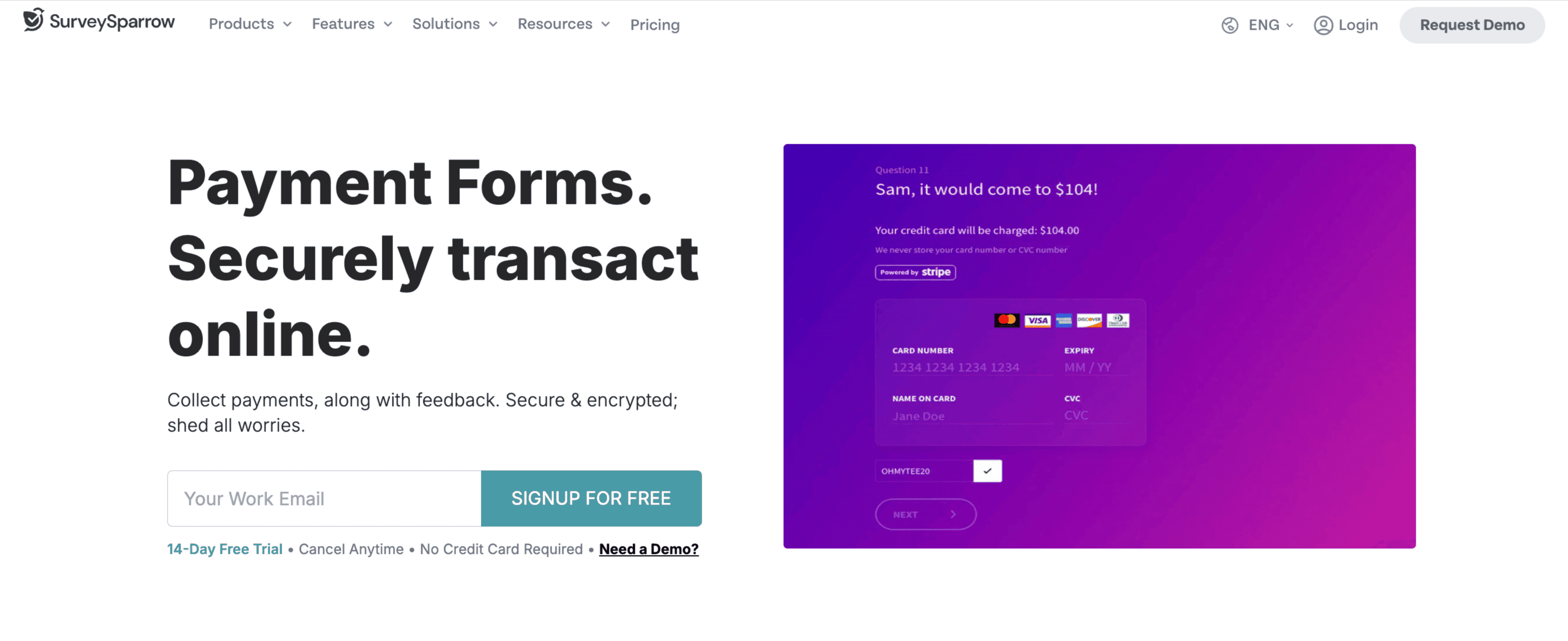
Choosing between Venmo and Cash App is not just a personal decision. If you run a business, you need to know what your customers actually prefer. That is where SurveySparrow comes in.
SurveySparrow is a survey and feedback platform that helps businesses collect insights through conversational forms and interactive surveys. Here is how it connects to the Venmo vs Cash App decision:
- Run a payment preference survey to find out which app your customers use most. Build it in minutes with the drag-and-drop form builder or AI survey creator.
- Collect payments directly through survey forms using Stripe integration. Test both payment workflows and see which converts better.
- Measure customer satisfaction with your current payment process using NPS, CSAT, or CES surveys.
- Share surveys via WhatsApp, email, SMS, Slack, or embed them on your website for maximum reach.
Want to know what your customers prefer? Create a payment preference survey in 2 minutes with SurveySparrow — try it free.
14-day free trial • Cancel Anytime • No Credit Card Required • No Strings Attached