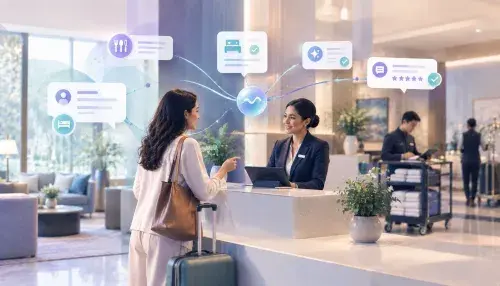
The hospitality industry has always run on the quality of its human interactions. But the volume and complexity of those interactions has grown faster than most operations can staff for.
People can now discover a property on social media, asks a question on WhatsApp, book through a website, request a late checkout through a mobile app, and later leave feedback through an email. Each touchpoint is a moment where the experience either holds together or falls apart — and each one requires a timely, accurate response.
As the volume of these interactions increase, the problem is not staff motivation or customer intent anymore, it is scale.
For front desk teams and concierges, it takes a significant portion of their working hours on repetitive, low-complexity inquiries such as WiFi passwords, checkout times, parking directions, amenity information — that require no judgment but consume the time that should be going to the interactions that do.
During peak hours, the response times could stretch, and delayed support could lead to satisfaction drops.
So the answer to this are AI agents. Nowadays, they're heavily depended upon for guest experience management.
They're not a solution to every problem in this picture. But they are the most practical answer to a specific and growing one: how do you maintain consistent, personalized, responsive guest communication at a scale that no team can deliver manually?
In this guide, we'll look at how AI agents can support guests across the hospitality journey, from pre-arrival communication to post-stay feedback, along with top agentic platforms to consider for your customer service operations.
What are AI agents in hospitality?
AI agents in hospitality are AI-powered systems that can understand guest requests, use information from connected systems, and take actions based on those requests.
AI agents in hospitality are systems that understand guest intent, make context-based decisions, and take actions across connected tools and systems with no or less human intervention.
Booking records, property management systems, service request logs, and feedback platforms are few of the things that can be automated via AI agents.
For example, a chatbot can only tell a guest. that the pool closes at 10 PM. But an AI agent for hospitality can do much more. It can make a dinner reservation for them on your behalf and schedule gym and spa appointments as well.
These agents can also retain information from previous chats, and perform contextual handoffs, so customers don't have to repeat their inquiry every time.
How AI agents can be used in a hospitality context?
AI agents can support guests at several points in their journey:
Pre-arrival communication
In-stay guests
Real-time feedback collection
Post-stay review management
Guest personalization
1. Automate pre-arrival communication
The guest experience starts before check-in.
Once a booking is confirmed, guests may have questions about check-in times, transportation, parking, dining, accessibility, room preferences, or hotel facilities.
Most hotels already send booking confirmations and pre-arrival messages. The problem is that these messages are often one-way.
An AI agent can turn pre-arrival communication into a conversation.
For example, a few days before arrival, an agent could ask whether the guest needs:
- Airport transportation
- An early check-in
- A restaurant reservation
- Accessibility arrangements
- Dietary accommodations
- Help planning activities
- A special setup for an occasion
The guest can respond in the same conversation instead of calling the front desk.
The agent can then handle simple requests or pass more complex ones to the appropriate team.
This also gives hotel staff useful information before the guest arrives.
If a guest mentions that they are celebrating an anniversary, for example, the hotel can prepare for it before check-in rather than discovering it at the front desk.
The result is a smoother arrival and fewer last-minute requests for staff to coordinate.
2. Handle in-stay guest requests
This is one of the clearest use cases for AI agents in hospitality.
During a busy evening, the front desk may receive several requests at once:
- "Can I get two extra towels?"
- "What time does the restaurant close?"
- "Can someone fix the air conditioning?"
- "Can you recommend a nearby restaurant?"
- "Can I get a late checkout?"
- "Can you book a taxi for 6 AM?"
Individually, these requests are simple. Together, they can create a significant workload.
An AI agent can handle the first layer of these interactions.
It can answer routine questions, capture service requests, route tasks to the right department, and update the guest when the request is complete.
For example:
Guest: "The air conditioning in my room isn't working."
AI agent: "I'm sorry about that. I've logged the issue for maintenance. A technician will check your room. I'll let you know when the request is updated."
The important part is what happens next.
The request should become a task for the appropriate employee rather than simply disappearing into a chatbot conversation.
That creates a closed loop:
Guest request → AI understands it → Request is routed → Staff completes it → Guest receives an update
This is where AI agents can have a practical operational impact. Current hospitality AI implementations are increasingly focused on connecting guest conversations with actual hotel workflows rather than keeping them inside a standalone chatbot.
When should a request go to a human?
Not every guest interaction should be handed off. There are some that can be deflected automatically.
For example, a guest asking for the WiFi password probably does not need a staff member. But a guest who is angry about a serious service failure probably does. In that case, the agent can create a ticket and escalate to a human.
As a hotelier, you should define clear escalation rules for situations involving:
- Complaints
- Safety concerns
- Billing disputes
- Special or sensitive requests
- Requests outside hotel policy
- Situations where the AI is uncertain
The AI can handle the routine work. Staff can take over when judgment, empathy, or authority is required.
3. Collect and analyze guest feedback in real-time
Hotels already collect a lot of feedback.
The bigger problem is often turning that feedback into useful information.
A guest might complete a post-stay survey and give the hotel a rating of 3 out of 5. But the rating alone does not explain why.
An AI agent can follow up conversationally.
For example, if a guest rates anything below 3 on a rating scale, the AI agent follows up like this:
"What could we have done to make your stay better?"
And then, the guest might respond:
"The room was great, but housekeeping didn't replace the towels on the second day."
That response contains much more useful information than a score alone.
The agent then takes this up into consideration and assigns a ticket, all while assuring the guest that it won't happen again.
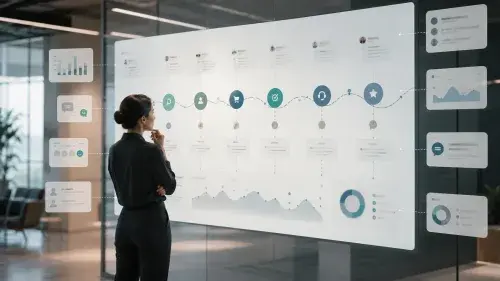
AI can also analyze large volumes of open-ended feedback and identify recurring themes.
Imagine a hotel receives 50 guest responses a day.
That's more than 18,000 responses in a year.
A team may track the average satisfaction score, but reading every written response manually becomes difficult. Important patterns can get buried in the volume.
AI text analysis can group feedback into themes such as:
- Room cleanliness
- Staff service
- Check-in experience
- Food quality
- Noise
- Maintenance
- WiFi
- Value for money
It can then help teams see which issues appear repeatedly and which parts of the guest journey are generating positive feedback.
This changes feedback from something that gets stored in a dashboard into something teams can use to decide what to fix.
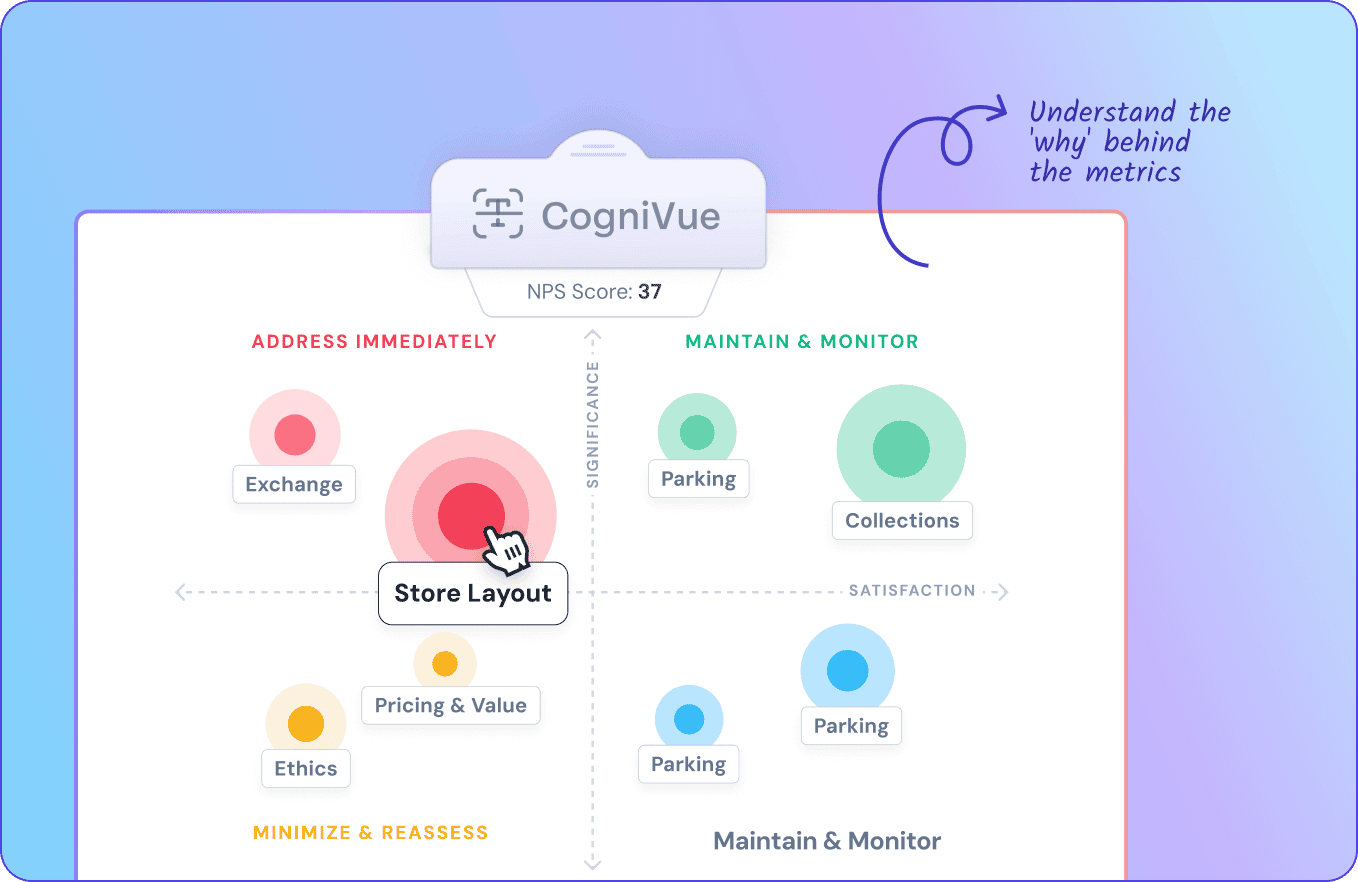
CogniVue is a tool that excels at consolidating feedback into themes, making it easy for hoteliers to prioritize what to act on.
4. Manage post-stay reviews
Guest feedback does not stop when the guest completes a survey.
Public reviews on platforms such as Google, TripAdvisor, and Booking.com can influence future guests.
Responding to those reviews takes time, especially for hotel groups managing multiple properties.
An AI agent can help by:
- Monitoring incoming reviews
- Identifying the main topic of each review
- Detecting positive and negative sentiment
- Drafting a response
- Flagging serious complaints
- Routing issues to the appropriate team
For example, if a guest complains about a long check-in process, the system can identify the issue and prepare a response that addresses the specific complaint.
A staff member can then review and publish the response.
That human review is important.
AI can help hotels respond faster, but the final response still needs to reflect the hotel's brand voice and judgment.
Review data can also be combined with survey feedback.
If guests repeatedly mention slow check-in in both private surveys and public reviews, then it is an issue that hoteliers must act on.
5. Personalize the guest experience
Personalization sounds simple until you consider how much information hotel teams need to remember.
For example, a returning guest may have stayed at the property several times, or might gave reported an issue during a previous stay.
The information may exist somewhere in the hotel's systems, but that does not mean the right employee sees it at the right time.
AI agents can help connect guest information with the relevant workflow.
Before arrival, the agent can surface useful preferences to the team preparing the room.
During the stay, it can use the guest's history to make relevant recommendations.
After the stay, new feedback can be added to the guest profile for future interactions.
Over time, each interaction can provide more context for the next stay.
This helps make the experience more useful. Hotels should also establish clear rules around what data can be used, who can access it, and when human review is required.
What are the benefits of AI agents in hospitality?
The value of AI agents is not limited to answering more guest messages.
When implemented properly, they can help hotels improve several parts of their operation.
Faster responses
AI agents can respond to routine requests at any time, including during periods when front-desk teams are busy.
Less repetitive work
Staff spend less time answering the same questions and manually routing simple requests.
Better feedback analysis
Hotels can process large volumes of written feedback and identify recurring issues without relying entirely on manual analysis.
More consistent service
Guests can receive consistent answers to common questions based on the hotel's approved information and policies.
Better use of staff time
Employees can spend more time on complex requests, service recovery, and face-to-face interactions.
A more connected guest journey
When the agent connects guest conversations, requests, feedback, and profiles, information does not have to remain isolated in different systems.
Challenges of implementing AI agents in hospitality businesses
AI agents can create operational value, but implementation requires more than choosing an AI platform.
Data integration
An agent cannot provide useful, personalized answers if it cannot access the information it needs.
Hotels may have booking information in one system, guest profiles in another, service requests somewhere else, and feedback in a separate platform.
Before implementing an AI agent, identify where important guest information lives and which systems need to connect.
Human handoffs
Hotels need clear rules for when an AI agent should stop and involve an employee.
Without these rules, an agent may attempt to handle situations that require human judgment.
A good implementation defines escalation triggers before the system goes live.
Accuracy and permissions
An AI agent should only provide information it can verify.
If a guest asks for a late checkout, the agent should check the hotel's actual availability and policy rather than make an assumption.
The same applies to bookings, payments, room availability, and other actions that can affect the guest or the hotel's operations.
Guest privacy
Hospitality businesses handle sensitive information, including booking details, contact information, travel patterns, dietary requirements, and accessibility needs.
Hotels need clear policies for how guest data is stored, accessed, used, and retained.
Staff adoption
AI should fit into existing hotel workflows.
If an agent creates requests in a system that nobody on the operations team checks, automation has simply created another place for information to get lost.
The technology needs to work with the way staff already manage guest requests.
The future of AI agents in hospitality
The biggest opportunity for AI agents in hospitality is not replacing the human side of the industry.
It is giving hotel teams more time for it.
A guest should not need a staff member to answer a question about pool hours. But a guest who has had a serious problem during their stay should be able to reach someone who can actually help.
That distinction is at the heart of useful hospitality automation.
AI agents can handle the repetitive requests, connect information across systems, collect feedback, and surface patterns that teams might otherwise miss.
People can then focus on the interactions that require judgment and empathy.
The goal is simple:
Use AI to make routine service easier, so people can focus on delivering better hospitality.
SurveySparrow's Echo reinforces your guest experience strategies with the right set of tools to enable hoteliers and restauratiers like you, provide a luxury experience for your guests like no other.

Become renowned for your hospitality by staying ahead with signals of nearing churn and detractors
TRUSTED BY BEST-IN-CLASS BRANDS