


Most businesses report strong CSAT performance between 75% and 85%, while scores in the 60–70% range are often considered acceptable minimums depending on industry and touchpoint.
Your business needs to calculate CSAT score to measure customer satisfaction with your products or services. This customer satisfaction score (CSAT) helps you understand and improve your offerings in a systematic way. CSAT stands out because of its simplicity – you ask customers "How satisfied were you with your experience?" using a survey scale from 1–3, 1–5, or 1–10.
The calculation of this significant metric is straightforward. Take the number of satisfied customers (those who rated 4 or 5 on a 5-point scale), divide by the total survey responses, then multiply by 100 for your percentage. To name just one example, sending 500 surveys might get you 200 responses. If 160 customers rate their experience as satisfied, your CSAT score would be 80%.
The calculation of customer satisfaction score goes beyond numbers – it helps you learn about ways to enhance your customer experience strategy. CSAT scores range from 0 to 100, with higher scores showing greater customer satisfaction.
This piece walks you through everything about calculating and leveraging CSAT as we head into 2026, from traditional methods to AI-assisted analysis tools that are increasingly being adopted across customer experience teams.
How to Calculate CSAT Score: Manual vs AI-Based Methods
As we move into 2026, customer satisfaction measurement is no longer limited to post-interaction surveys alone. Businesses today typically rely on two complementary approaches: traditional survey-based CSAT and AI-assisted analysis of customer interactions.
Traditional survey-based CSAT methods
Your CSAT calculation relies on surveys that customers fill out after interactions. Customers rate their satisfaction on a scale of 1-5 or 1-10. The math is simple - take the number of happy customers (4s and 5s on a 5-point scale), divide by total responses, multiply by 100 for your percentage.
Traditional CSAT measurement has its limits. Survey response rates sit between 5-15%, which means you make big decisions based on a tiny slice of customer feedback. The responses usually come from customers with strong feelings - either really happy or really upset - while most stay quiet.
These surveys come with clear benefits:
- You and your customers find them user-friendly
- Rating scales are flexible (stars, emojis, or numbers)
- People complete them quickly
All the same, some downsides exist. Low participation can skew results, cultural differences affect scoring, and surveys only capture short-term feelings.
AI-driven sentiment analysis and automation
AI-powered CSAT analysis evaluates customer interactions across channels such as chat, email, calls, and social media to estimate satisfaction levels at scale, especially where survey responses are limited.
Modern AI sentiment analysis works through these steps:
- Text preprocessing and tokenization of customer messages
- Polarity detection to determine positive, negative, or neutral tone
- Contextual understanding to identify emotions like anger, joy, or confusion
- Action mapping that links detected emotions to specific responses
AI looks at voice tone, text, word choices, emojis, punctuation, resolution quality, response time, and conversation flow. This complete analysis creates a satisfaction score similar to traditional CSAT scales.
Some organizations report operational efficiency gains after adopting AI-assisted customer feedback analysis, based primarily on internal case studies and vendor-reported outcomes. The impact on CSAT varies significantly by implementation, data quality, and use case.
Platforms like SurveySparrow combine AI sentiment analysis with conversational surveys, giving you both automated insights and structured feedback in one solution.
14-day free trial • Cancel Anytime • No Credit Card Required • No Strings Attached
When to use each method
Your choice between surveys and AI analysis depends on what you need. Traditional CSAT surveys work well for simple comparisons against industry standards or direct customer opinions.
AI-based CSAT calculation works best when you need to analyze all customer interactions, find what drives satisfaction levels, or deal with survey-tired customers. AI spots conversation patterns that lead to bad experiences - something surveys rarely catch.
Smart companies now use both approaches together. They match survey scores against AI-generated ones, dig deeper into context, and act fast on fresh data.
Customer expectations keep changing, and your CSAT measurement must keep up. Traditional surveys offer simplicity, but AI methods give you the complete picture needed to understand and boost your customer experience in 2026.
How to Calculate CSAT Score Using Traditional Survey-Based Methods
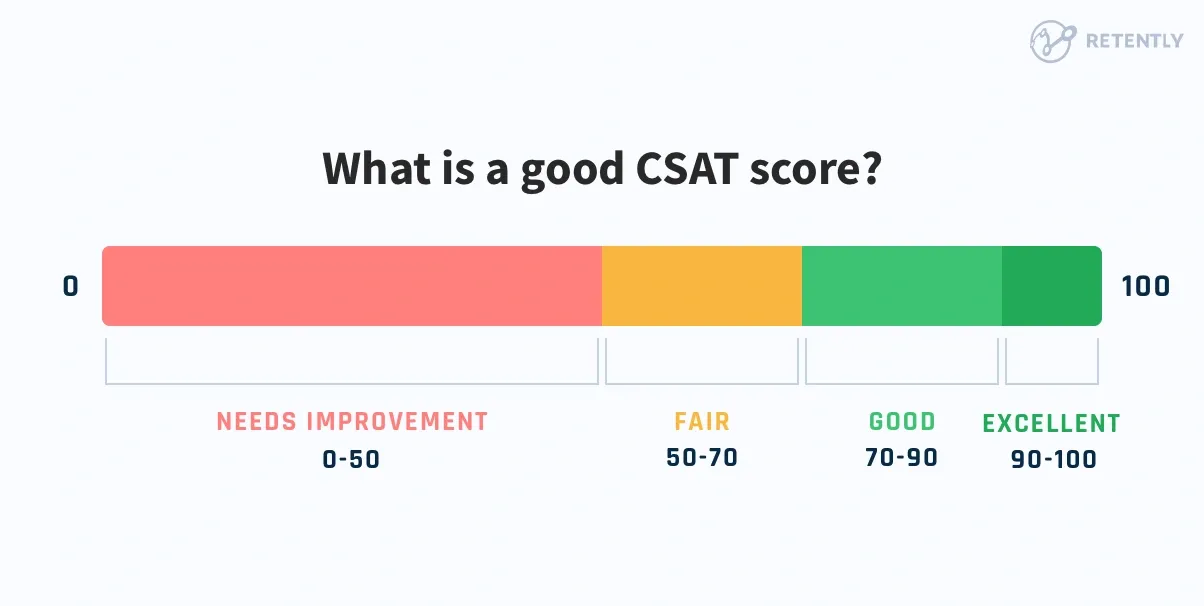
Image Source: Retently
You need a systematic approach to calculate CSAT scores manually so you can gather and analyze customer feedback well. These four steps will help you create a reliable system that gives you useful insights about your customers' satisfaction levels.
Step 1: Select a survey type (binary, scale, emoji)
Pick a survey format that best captures your customers' feelings. Each type comes with its own benefits:
Binary surveys give just two options like Yes/No or Thumbs Up/Down. These work great for quick feedback after interactions and get high response rates, though they lack detail.
Numeric scale surveys (1-5 or 1-10) give you numbers you can measure against standards. When using a 5-point scale, customers who respond with 4 and 5 count as "satisfied".
Likert scale surveys let customers choose from options ranging from "Very Satisfied" to "Very Dissatisfied." This captures more detailed emotional responses.
Emoji surveys use smileys or visual ratings (😄 🙂 😐 🙁 😠) that show emotions directly. Visual feedback works really well because everyone understands it. Emoji-based surveys offer a fast, intuitive way for customers to express sentiment, particularly in mobile and in-app experiences.
Step 2: Choose a survey tool (SurveySparrow, Google Forms, etc.)
Your next step is picking a platform to send out surveys. Simple tools like Google Forms can handle basic needs, but specialized platforms offer more features.
SurveySparrow stands out because its conversational surveys boost response rates. The platform's user-friendly design helps you create engaging surveys that customers want to complete. You also get strong analytics to understand your data better.
You could also try Typeform for conversational forms, Qualtrics for detailed analytics, or Zendesk for support-integrated CSAT.
Step 3: Apply the CSAT score formula
After collecting responses, you can calculate your CSAT score with a simple formula:
CSAT Score = (Number of Satisfied Customers ÷ Total Number of Responses) × 100
Here's an example: If 200 people responded to your survey and 160 rated their experience as 4 or 5 on a 5-point scale:
CSAT Score = (160 ÷ 200) × 100 = 80%
This shows that 80% of your surveyed customers were happy with their experience.
A 5-point scale typically works this way: 1/5 and 2/5 mean negative feedback, 3/5 is neutral, while 4/5 and 5/5 count as positive.
Step 4: Analyze results and segment by channel
Your score needs proper context for interpretation. CSAT scores above 80% show strong satisfaction, 70-79% mean good performance with room to improve, 50-69% point to problems that need attention, and scores below 50% suggest urgent issues that need immediate fixes.
Your CSAT dashboard should show these key metrics:
- CSAT scores by channel and touchpoint
- Scores by customer segment and product area
- Volume and response rate
- Top drivers identified from comments and tags
- Trend lines week-over-week and month-over-month
Text analysis of open-ended responses helps identify specific themes and patterns. Combining number scores with detailed feedback gives you a complete picture of customer satisfaction.
How to Calculate CSAT Score Using AI-Driven Sentiment Analysis
AI technology has revolutionized CSAT score calculations in 2025. Companies can now analyze all customer interactions instead of depending on the typical 5-15% survey response rate. This new approach gives more accurate insights into customer satisfaction without traditional survey limitations.
How AI captures and analyzes conversations
AI systems use multiple technologies to process customer interactions from all channels. These systems combine speech-to-text conversion, large language models (LLMs), and natural language processing (NLP) to turn conversations into useful information. The system captures interactions from:
- Voice calls and transcriptions
- Chat and email conversations
- Social media messages
- Support tickets
The natural language processing then learns about patterns and nuances that show customer sentiment throughout each conversation.
Using sentiment, tone, and resolution quality
The AI processes each conversation and assesses several aspects that affect customer satisfaction:
Sentiment analysis spots positive, negative, or neutral tones in customer language and detects emotional signals like frustration or delight. Advanced AI goes beyond simple sentiment and looks at conversation dynamics such as resolution quality, response time, and interaction flow.
Some systems assess specific categories like agent communication, empathy, professionalism, and knowledge. This gives a better picture of the customer experience. These layered analyzes help understand satisfaction better than any single-question survey.
Assigning scores without surveys
AI assigns CSAT scores through smart processes that match traditional survey results. Many systems use predictive models trained with millions of previous customer interactions and their survey responses. These models find mathematical connections between conversation elements and satisfaction levels and generate scores on familiar 1-5 or 1-10 scales.
Some AI-based CSAT models show strong alignment with historical survey results in controlled implementations, though accuracy varies by data quality, industry, and use case.
Top tools for AI-based CSAT calculation
Several leading solutions now dominate AI-based CSAT calculation in 2025:
Insight7 excels at assessing customer calls by detecting sentiment, empathy, and resolution effectiveness. SQM's Post-Call CSAT Prediction model combines speech-to-text, LLM technology, and natural language processing to predict CSAT scores with exceptional accuracy. Crescendo.ai calculates AI CSAT scores across multiple channels, while Dialpad AI CSAT explains why customers feel satisfied or frustrated.
Each tool has its strengths, but they all share one advantage - they analyze every customer interaction rather than depending on limited survey responses.
Best Practices for Deploying CSAT Surveys
The quality and quantity of feedback you collect depends on how well you deploy CSAT surveys. You need to become skilled at these fundamental best practices to calculate CSAT scores accurately.
Timing your surveys for maximum accuracy
Your CSAT survey should go out right after a customer interaction. Sending CSAT surveys shortly after an interaction generally improves response quality and recall compared to delayed surveys. B2B audiences respond better before noon or between 3-6 PM on weekdays. Tuesdays show the highest response rates, especially between 10-11 AM.
Choosing the right channel (SMS, in-app, email)
Your choice of distribution channels affects response rates by a lot:
- In-app surveys get more detailed and honest responses when customers' experience remains fresh
- SMS surveys achieve a 98% open rate within three minutes
- Dynamic email surveys let users complete feedback without leaving their inbox, which reduces dropouts
The right survey channel should match specific customer touchpoints for a smooth experience. Email works best for post-purchase feedback. In-app surveys capture product experience feedback better.
Balancing short and open-ended questions
Busy respondents prefer brief CSAT surveys. Keep your survey limited to 1-3 questions. A Likert scale question paired with an optional open-ended follow-up works well. This approach captures qualitative insights without overwhelming participants.
Avoiding survey fatigue
Your response rates will stay high with the right survey frequency. B2B audiences prefer quarterly surveys. B2C companies should double their typical customer interaction frequency for surveys (monthly interactions need bi-monthly surveys). Personalization boosts engagement when you target specific groups with relevant questions instead of sending similar surveys to everyone.
Using CSAT Data to Improve Customer Experience
CSAT scores become valuable when businesses turn them into practical improvements. Studies show that smart use of customer feedback can significantly boost your bottom line.
Linking CSAT to customer lifetime value
Research from Bain & Company shows that a 5% increase in customer retention can increase profits by 25% to 95%. CSAT is commonly used as a leading indicator of customer satisfaction and potential retention risk, not a direct driver of profit. Customers who report positive experiences tend to show higher repeat purchase and loyalty over time, reinforcing the business value of improving satisfaction.
Creating a feedback loop for continuous improvement
A well-designed feedback loop helps CSAT insights lead to better results. Success depends on sharing customer feedback with all departments. Teams should focus on changes that matter most. Customers need to know when their ideas create positive change. This strategy turns simple feedback into valuable business insights.
Training agents based on CSAT insights
Customer comments make excellent training material. Good feedback helps recognize top performers. Critical comments point to specific training needs. CSAT scores generated automatically help staff identify areas they need to work on. This leads to custom growth plans for each team member.
Combining CSAT with NPS and CES for full picture
CSAT works best when used with Net Promoter Score (NPS) and Customer Effort Score (CES) to show the complete customer experience. These metrics reveal useful patterns. To name just one example, high CSAT with low CES might show skilled agents working with complex systems. This helps identify where changes will make the biggest difference.
Conclusion
CSAT scores help businesses learn about and enhance customer experiences in 2025. You can choose between traditional surveys or innovative AI analysis. This metric gives practical insights that affect your bottom line.
Traditional CSAT calculation is simple and familiar but suffers from low response rates. AI-driven approaches analyze every customer interaction and deliver detailed insights without survey fatigue. Many successful companies now use both methods together to achieve maximum accuracy.
Whatever approach you choose, CSAT measurement works best with the right timing, channels, and well-designed questions. Note that collecting feedback is just half the process. Real value comes when you create effective feedback loops, train your team based on findings, and combine CSAT with other metrics like NPS and CES.
Companies that properly employ CSAT data see amazing results. Small improvements in customer retention have been shown to significantly impact profitability, according to long-standing retention research. Tools like SurveySparrow substantially increase response rates while offering user-friendly analytics to interpret your data.
CSAT calculation exceeds mere numbers—it shows your dedication to understanding customer needs and improving their experience. Your measurement methods must adapt as customer expectations change to stay connected with your audience's true priorities.
Put your CSAT insights to work with the free 14-day trial.
14-day free trial • Cancel Anytime • No Credit Card Required • No Strings Attached