UMost teams collect plenty of customer feedback. Surveys, support tickets, reviews, chats — it all adds up fast.
The problem is what happens next.
Feedback gets stored in different tools, skimmed when there’s time, and slowly forgotten as new issues come in. Important patterns get missed as there’s simply too much to keep up with.
Customers experience this gap. They talk about problems long before they leave — in reviews, in tickets, in casual comments — but those signals are easy to miss when you’re reading feedback one message at a time.
AI can solve that exact problem. Not by replacing people, but by helping teams understand feedback at a scale that’s no longer realistic to handle manually.
This guide explains what AI customer feedback analysis actually is, how it works in practice, and how teams use it to make better decisions without adding more work to their plate.
What Is AI Customer Feedback?
AI customer feedback refers to the use of artificial intelligence to collect, analyze, and interpret customer feedback from sources like surveys, reviews, support tickets, and conversations. It helps teams understand sentiment, identify recurring issues, and surface insights at a scale that isn’t possible with manual review.
Customer feedback typically focuses on four things:
- What customers are talking about
- How they feel about it
- How often the same issues show up
- Whether certain comments signal urgency or risk
Feedback can come from surveys, support conversations, reviews, social media, or internal tickets. The value isn’t just processing all of it — it’s seeing how the same issue shows up in different places, described in different ways.
For example, a complaint “confusing checkout” in a survey, “payment didn’t work” in a ticket, and “gave up trying to buy” in a review might all be pointing to the same underlying problem. AI gives you a faster way to connects those dots.
Traditional vs AI Customer Feedback
The main difference between traditional methods and AI customer feedback is scale — AI reviews everything, while manual analysis relies on sampling.
How This Differs From Traditional Feedback Review
Most teams start with manual review. Someone scans responses, filters low ratings, or searches for keywords.
That works until feedback volume grows.
At a certain point:
- Not everything gets read
- Teams start sampling instead of reviewing everything
- Patterns depend on memory rather than data
- Feedback takes too long to turn into action
AI changes this by reviewing all incoming feedback consistently and quickly. It doesn’t get tired, it doesn’t prioritize only the loudest complaints, and it doesn’t miss quieter but recurring issues.
It also recognizes meaning, not just exact wording. Different phrasing doesn’t hide the same problem anymore.
Traditional feedback analysis | AI-powered feedback analysis |
|---|---|
| Manual categorization | Automated categorization |
| Time-consuming | Faster processing |
| Difficult to scale | Handles large feedback volumes |
| Manual pattern discovery | AI-assisted pattern detection |
| Manual summaries | Automated summaries |
| Periodic analysis | More continuous analysis |
| Heavy analyst involvement | Analysts focus more on interpretation |
How AI helps in customer feedback analysis
Incorporating AI in processes such as feedback analysis has a lot of benefits.
1. Understands and interprets language well, not just keywords
AI uses natural language processing (NLP) to understand how people actually write. Like the old days, it doesn't just understand by keywords and pre-defined rules.
For example, when a customer provides feedback into a support chat,
“Checkout was frustrating and I almost gave up”
The system understands:
- What they’re talking about
- That the experience was negative
- That the issue was serious enough to nearly stop the purchase
The chatbot, or nowadays, with the advent of Agentic AI, the chatbot can either ask follow-up questions and assign a ticket based on the severity of the issue.
When an AI assistant or an agentic bot like this is rolled out across different channels like surveys, chats, emails, reviews, and transcripts, it makes things easier by collating feedback into one place, and groups feedback by themes or sentiment.
2. Interprets sentiment and emotion
Sentiment analysis identifies the emotional tone of customer feedback.
A response might be classified as:
- Positive
- Negative
- Neutral
Some tools look only at whether feedback is positive or negative. More advanced systems go further and identify emotions like frustration, disappointment, or appreciation. Those systems are either agentic bots or AI-assistants.
Customers often express mixed emotions in the same message, and those nuances matter when you’re deciding what to fix or prioritize.
Modern AI-powered systems can interpret the tone, emotion, and intent of feedback, and groups them by themes, allowing for prioritization of critical issues that need solving.
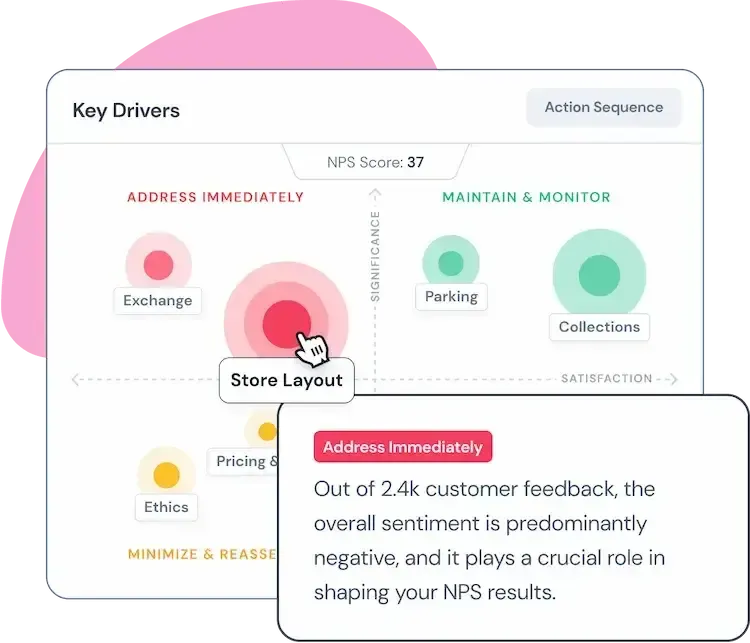
Tracking sentiment over time can also help teams understand whether customer experience is improving or deteriorating.
3. Finds patterns over time
Where AI really helps is in spotting trends that aren’t obvious message by message.
For example:
- A certain issue shows up more often after a new release
- Customers in one segment raise the same concern repeatedly
- Small complaints slowly increase before churn follows
These patterns are hard to track manually, especially across multiple tools and months of data.
A single negative comment may not indicate a widespread problem.
But if hundreds of customers suddenly start mentioning the same issue, it deserves attention.
AI can monitor feedback for changes in the frequency of topics and sentiment.
For example, after releasing a new version of a product, a company might discover that mentions of "slow loading" have increased significantly.
That could give the product team an early signal that something needs investigation.
AI can spot hidden trends and previously missed topics of conversations helping you stay informed, especially during high volume conversations.
4. Generates skimmable summaries
Sometimes the biggest problem isn't finding feedback. It's understanding thousands of individual responses as a whole.
AI can summarize large collections of feedback and provide a concise overview.
Instead of presenting a CX leader with thousands of individual comments, an AI system might identify the three most common complaints, the most requested improvement, and the overall sentiment.
The original responses still matter, but the summary gives teams a starting point.
Generative AI makes feedback easier to share. Instead of forwarding spreadsheets or long exports, teams get short summaries explaining:
- The main themes customers are talking about
- What’s getting worse or better
- Which issues deserve attention now
This makes feedback usable for people who don’t live in dashboards all day.
Why People Are Still Part of the Process
AI is good at organizing and highlighting feedback. It’s not perfect at judgment.
Sarcasm, cultural nuance, or edge cases still benefit from human review. The best setups let AI handle the heavy lifting while people make the final calls on priorities and next steps.
Some teams are turning to new tools that do more than just collect feedback — they respond to it. For example, intelligent agents can follow up to clarify answers, send alerts when urgent issues appear, or push important customer concerns directly into your support workflow. One such approach is through AI agents that work in your brand voice and connect back to the tools your team already uses — so feedback isn’t just recorded, it gets acted on, often instantly.
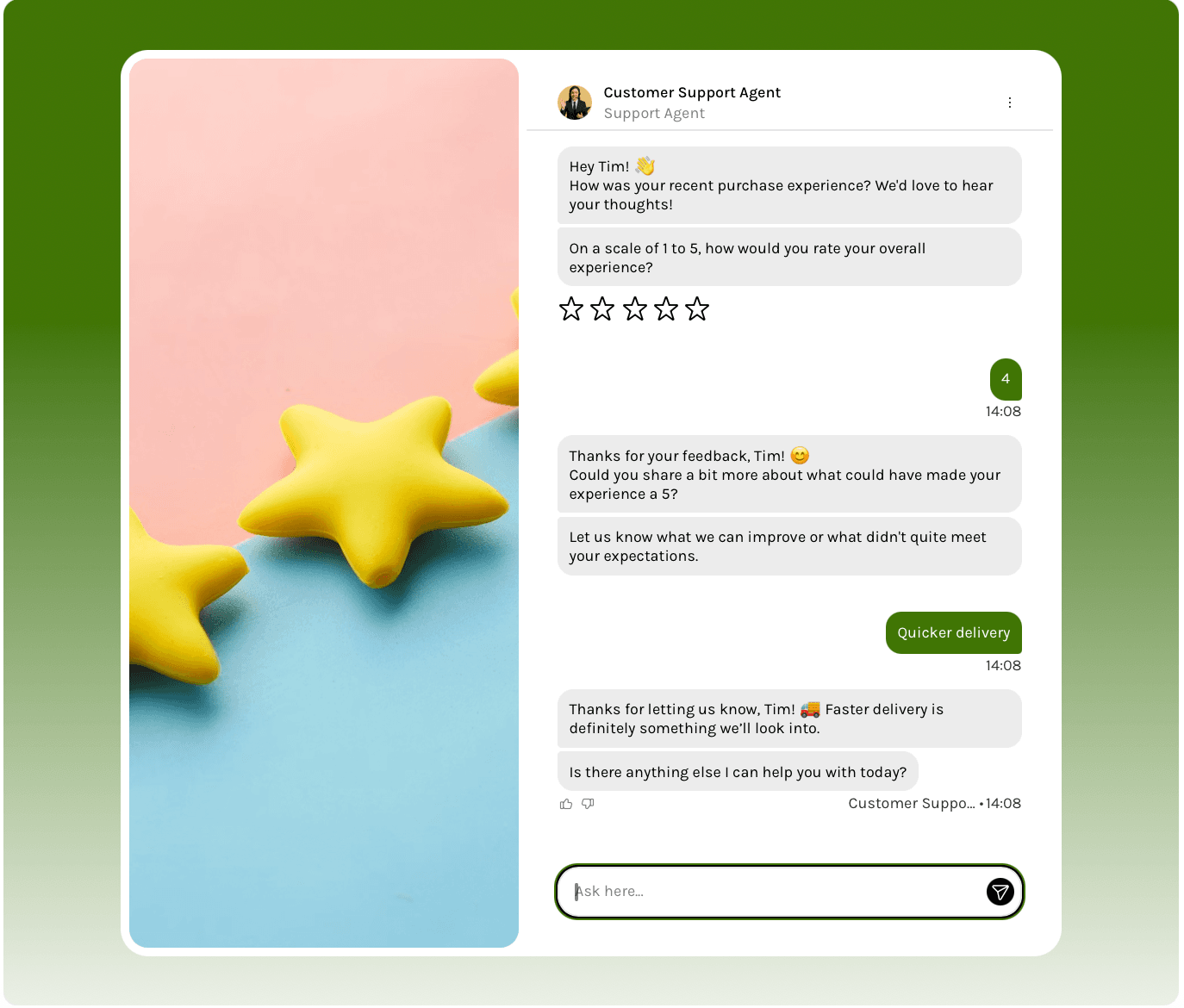
This is where tools like Echo by SurveySparrow come into play.
Instead of stopping at analysis, Echo can ask follow-up questions, understand sentiment as responses come in, and route issues to the right teams automatically — all in your brand’s voice.
It’s designed for teams that want feedback to lead to action while it still matters, without adding more manual work.
Why AI assistance matters more as teams grow
When teams are small, it’s possible to read almost all the feedback. As customer numbers grow, the amount of feedback grows faster than headcount.
Without enough resources:
- Issues get noticed later than they should
- Decisions rely more on anecdotes
- Teams react instead of anticipating
AI helps teams eliminate these issues even as volume increases. Therefore feedback doesn’t pile up waiting for someone to have time to read it — it’s continuously analyzed as it comes in.
AI also helps different teams work from the same understanding. Product, support, marketing, and leadership see the same themes instead of forming separate interpretations from partial data.
Understanding feedback is only half the work, and that's when AI excels.
That’s where CX AI agents come in. Instead of just analyzing feedback, these agents can follow up with customers, route issues to the right team, and trigger workflows automatically. If you want to go deeper into how these systems work and how teams are using them in practice, we break it down in our complete guide to CX AI agents for 2026.
What teams use AI for customer feedback analysis?
There isn’t a single team that doesn't from AI-powered customer feedback.
1. Support teams
Support teams are usually the first to feel the pressure when the volume of feedback rises.
AI helps them:
- Spot urgent or sensitive conversations sooner
- Identify recurring issues driving ticket volume
- Review conversation quality without reading every ticket
Instead of reacting to the loudest complaints, teams can focus on what actually needs attention.
2. Product teams
For product teams, feedback is everywhere — but rarely organized.
AI makes it easier to:
- Group feature requests automatically
- Detect bugs and usability issues early
- Understand which problems affect which customer segments
This helps product decisions feel grounded in real usage, not just internal opinions.
Marketing and reputation managers
For marketing and reputation teams, AI is a boon. It can collate feedback from multiple channels and warn us of any threats or risk to the company's reputation. This way, teams can stay ahead and reduce risks before they arise.
And,
- Learn how customers describe value in their own words
- Track shifts in brand perception
- Pull real language for messaging and positioning
It’s often the fastest way to sanity-check whether messaging matches reality.
Leadership
For leadership, feedback needs to roll up into something actionable.
What they see with AI in Customer Feedback:
- A clear view of how customer experience is changing over time
- Early signals when feedback starts to affect retention or churn
- A shared understanding of customer priorities, without relying on anecdotes
Instead of scattered reports, they get a consistent picture of what customers are actually experiencing.
7 ways businesses can use AI in customer feedback
AI-powered feedback analysis can support teams across the customer lifecycle.
1. Analyze open-ended survey responses
Open-ended questions can produce some of the most useful customer insights.
The problem is that they're also some of the hardest responses to analyze at scale.
AI can identify themes, sentiment, and recurring issues across thousands of open-ended responses.
This allows teams to get more value from qualitative feedback without relying entirely on manual analysis.
2. Identify common customer pain points
Customer complaints often contain clues about where the experience is breaking down.
AI can group related complaints and identify the issues that appear most frequently.
For example, a CX team might discover that customers aren't primarily unhappy with a product's features. Instead, they're struggling with setup and onboarding.
That distinction matters because the solution isn't necessarily a new feature. It could be better documentation, onboarding, or customer education.
3. Discover product feature requests
Customers frequently describe feature requests in different ways.
One customer might ask for "a Salesforce connection," while another asks to "sync my Salesforce data automatically."
Using NLP and ML (machine learning) technologies, AI can recognize that these responses are related and group them together.
Product teams can then use the volume and context of these requests to inform their roadmap.
4. Monitor customer sentiment
Customer sentiment can provide an additional layer of context to traditional feedback metrics.
A company might have a stable CSAT score while seeing an increase in negative comments around a particular issue.
Analyzing both quantitative and qualitative feedback can provide a more complete picture.
Teams can also compare sentiment across:
- Customer segments
- Products
- Regions
- Customer lifecycle stages
- Time periods
5. Analyze feedback at scale
One of the biggest advantages of AI is scale.
A team doesn't have to limit its analysis to a small sample of responses simply because there are too many to read manually.
AI can process large datasets and surface the patterns worth investigating.
This is particularly useful for businesses receiving feedback from thousands or millions of customers.
6. Close the feedback loop faster
Feedback loses value when customers don't see action.
AI can help teams identify feedback that requires follow-up and route it to the appropriate department.
For example, a customer reporting a serious product problem could be flagged for support, while a recurring feature request could be added to a product feedback workflow.
The goal is to shorten the distance between what customers say and what the business does.
7. Support customer experience decisions
AI-generated insights can help CX teams answer questions such as:
- What are customers most frustrated about?
- Which parts of the customer journey create the most friction?
- What improvements do customers want?
- Has sentiment changed since our last survey?
- Which problems are mentioned most frequently?
- Are certain customer segments experiencing different problems?
These insights can inform decisions across CX, product, support, marketing, and operations.
What are the limitations of AI in customer feedback?
AI can make feedback analysis easier, but it isn't perfect.
1. AI can misinterpret context
Sarcasm, cultural references, slang, and nuanced language can be difficult to interpret.
For example, a customer saying "Great, another update that broke everything" may technically contain a positive word, but the underlying sentiment is clearly negative.
Human review is still important when the context matters.
2. AI doesn't replace human judgement
AI can tell you that a particular issue appears frequently.
It can't always tell you what the business should do about it.
A frequently mentioned feature request may not be strategically important. A relatively rare complaint from a high-value customer segment might deserve more attention.
Businesses still need people to interpret feedback within the broader business context.
3. Privacy and data security matter
Customer feedback can contain personal information and other sensitive data.
Businesses should understand how customer data is processed, stored, and used by any AI system they adopt.
Data governance and access controls should be part of the implementation from the beginning.
4. Poor feedback produces poor insights
AI cannot fix fundamental problems with your feedback strategy.
If your survey questions are biased, your sample is unrepresentative, or you aren't collecting feedback from the right customers, AI may simply analyze flawed data faster.
Good AI analysis starts with good feedback collection.
Read more: How to avoid survey bias
Best practices for using AI in customer feedback
1. Start with a clear business question
Don't analyze customer feedback simply because you have the technology to do it.
Start by defining what you want to understand.
For example:
- Why are customers giving us low CSAT scores?
- What are the biggest onboarding problems?
- Which features do customers want most?
- Why are customers cancelling?
A clear question makes the resulting analysis much more useful.
2. Combine quantitative and qualitative feedback
A rating tells you what happened.
A customer comment can help explain why.
For example, a CSAT score of 2 tells you a customer was dissatisfied. Their written response might explain that the reason was a long support response time.
Use both types of feedback together.
3. Use AI to find patterns, not just summarize
Summarizing feedback is useful, but it shouldn't be the end goal.
The real value comes from identifying patterns, understanding their significance, and turning them into action.
4. Keep humans in the loop
Use AI for scale and speed, but have people validate important findings.
This is especially important when feedback will influence major product, customer experience, or business decisions.
5. Segment your feedback
Averages can hide important differences.
A product might have strong overall satisfaction while performing poorly among new customers.
Segment feedback by factors such as:
- Customer type
- Product
- Geography
- Lifecycle stage
- Plan
- Industry
This can reveal problems that disappear when all customers are treated as one group.
Turn insights into action
The purpose of feedback analysis isn't to create another dashboard.
It's to improve the customer experience.
Once AI identifies an important issue, assign ownership, decide what action to take, and track whether the change actually improves the customer experience.
The Future of AI in customer feedback
AI-powered feedback analysis is likely to move beyond simply telling businesses what customers said.
The next stage is helping organizations understand what those comments mean and what should happen next.
AI systems can increasingly connect feedback from multiple channels, detect emerging issues, monitor changes in sentiment, and recommend actions.
AI agents could eventually monitor customer feedback continuously, identify significant changes, notify the appropriate teams, and trigger workflows without requiring someone to manually review a dashboard every day.
That changes the role of customer feedback.
Instead of being something businesses collect periodically and analyze afterward, feedback can become a continuous source of intelligence about the customer experience.
The goal isn't to collect more feedback for the sake of it.
It's to make better use of the feedback customers are already giving you.
Choosing the Right AI Feedback Tool
The best tool depends less on advanced features and more on the fit.
Start with a few practical questions:
- Where does most of your feedback come from today?
- Who needs to act on the insights?
- How quickly do you need answers?
- What tools does your team already use?
Look for something your team can actually adopt without training sessions or long setup projects. Customer feedback tools only help if people check them and trust what they see.
Integration matters too. Insights are more useful when they show up where teams already work, not in yet another dashboard.
Feedback management simplified
Most teams aren’t ignoring customer feedback on purpose. They’re overwhelmed by it.
AI-powered customer feedback analysis helps turn large volumes of comments and reviews into something manageable and useful. It doesn’t replace judgment or strategy, but it removes the bottleneck that keeps teams from acting sooner.
It can analyze large volumes of responses, identify themes, detect sentiment, summarize feedback, and surface patterns that might otherwise go unnoticed.
But AI isn't the strategy.
The real value comes from combining AI's ability to process information at scale with human judgment and customer experience expertise.
Businesses that do this well won't simply collect more customer feedback. They'll be better equipped to understand it, prioritize it, and turn it into meaningful improvements.
And that's where AI in customer feedback can make a real difference.
If customer feedback feels overwhelming today, it doesn’t have to stay that way.

Automate customer feedback at stages of the customer journey you choose
TRUSTED BY BEST-IN-CLASS BRANDS