Most teams collect plenty of customer feedback. Surveys, support tickets, reviews, chats — it all adds up fast.
The problem is what happens next.
Feedback gets stored in different tools, skimmed when there’s time, and slowly forgotten as new issues come in. Important patterns get missed, not because people don’t care, but because there’s simply too much to keep up with.
Customers notice this gap. They talk about problems long before they leave — in reviews, in tickets, in casual comments — but those signals are easy to miss when you’re reading feedback one message at a time.
AI customer feedback analysis exists to solve that exact problem. Not by replacing people, but by helping teams understand feedback at a scale that’s no longer realistic to handle manually.
This guide explains what AI customer feedback analysis actually is, how it works in practice, and how teams use it to make better decisions without adding more work to their plate.
What Is AI Customer Feedback Analysis?
AI customer feedback refers to the use of artificial intelligence to collect, analyze, and interpret customer feedback from sources like surveys, reviews, support tickets, and conversations. It helps teams understand sentiment, identify recurring issues, and surface insights at a scale that isn’t possible with manual review.
What AI Customer Feedback Does
AI customer feedback typically focuses on four things:
- What customers are talking about
- How they feel about it
- How often the same issues show up
- Whether certain comments signal urgency or risk
Feedback can come from surveys, support conversations, reviews, social media, or internal tickets. The value isn’t just processing all of it — it’s seeing how the same issue shows up in different places, described in different ways.
A complaint about “confusing checkout” in a survey, “payment didn’t work” in a ticket, and “gave up trying to buy” in a review might all be pointing to the same underlying problem. AI connects those dots automatically.
Traditional vs AI Customer Feedback
The main difference between traditional methods and AI customer feedback is scale — AI reviews everything, while manual analysis relies on sampling.
How This Differs From Traditional Feedback Review
Most teams start with manual review. Someone scans responses, filters low ratings, or searches for keywords.
That works until feedback volume grows.
At a certain point:
- Not everything gets read
- Teams start sampling instead of reviewing everything
- Patterns depend on memory rather than data
- Feedback takes too long to turn into action
AI changes this by reviewing all incoming feedback consistently and quickly. It doesn’t get tired, it doesn’t prioritize only the loudest complaints, and it doesn’t miss quieter but recurring issues.
It also recognizes meaning, not just exact wording. Different phrasing doesn’t hide the same problem anymore.
How AI Customer Feedback Is Analyzed
Understanding Language, Not Just Keywords
AI uses natural language processing to understand how people actually write.
When someone says, “Checkout was frustrating and I almost gave up,” the system understands:
- What they’re talking about
- That the experience was negative
- That the issue was serious enough to nearly stop the purchase
This happens across surveys, chats, emails, reviews, and transcripts, all at once.
Sentiment and Emotion
Some tools look only at whether feedback is positive or negative. More advanced systems go further and identify emotions like frustration, disappointment, or appreciation.
That nuance matters. A customer might be unhappy about one thing but still loyal overall. Knowing the difference helps teams decide what needs fixing versus what’s working well.
Most teams think they understand customer sentiment because they glance at ratings or skim comments. In reality, sentiment is rarely that simple. Customers often express mixed emotions in the same message, and those nuances matter when you’re deciding what to fix or prioritize.
If you want a deeper look at how modern AI interprets tone, emotion, and intent — and where sentiment analysis is headed next — we’ve covered that in our 2026 guide to AI sentiment analysis for customer feedback.
Finding Patterns Over Time
Where AI really helps is in spotting trends that aren’t obvious message by message.
For example:
- A certain issue shows up more often after a new release
- Customers in one segment raise the same concern repeatedly
- Small complaints slowly increase before churn follows
These patterns are hard to track manually, especially across multiple tools and months of data.
Summaries That People Actually Read
Generative AI makes feedback easier to share. Instead of forwarding spreadsheets or long exports, teams get short summaries explaining:
- The main themes customers are talking about
- What’s getting worse or better
- Which issues deserve attention now
This makes feedback usable for people who don’t live in dashboards all day.
Why People Are Still Part of the Process
AI is good at organizing and highlighting feedback. It’s not perfect at judgment.
Sarcasm, cultural nuance, or edge cases still benefit from human review. The best setups let AI handle the heavy lifting while people make the final calls on priorities and next steps.
Some teams are turning to new tools that do more than just collect feedback — they respond to it. For example, intelligent agents can follow up to clarify answers, send alerts when urgent issues appear, or push important customer concerns directly into your support workflow. One such approach is through AI agents that work in your brand voice and connect back to the tools your team already uses — so feedback isn’t just recorded, it gets acted on, often instantly.
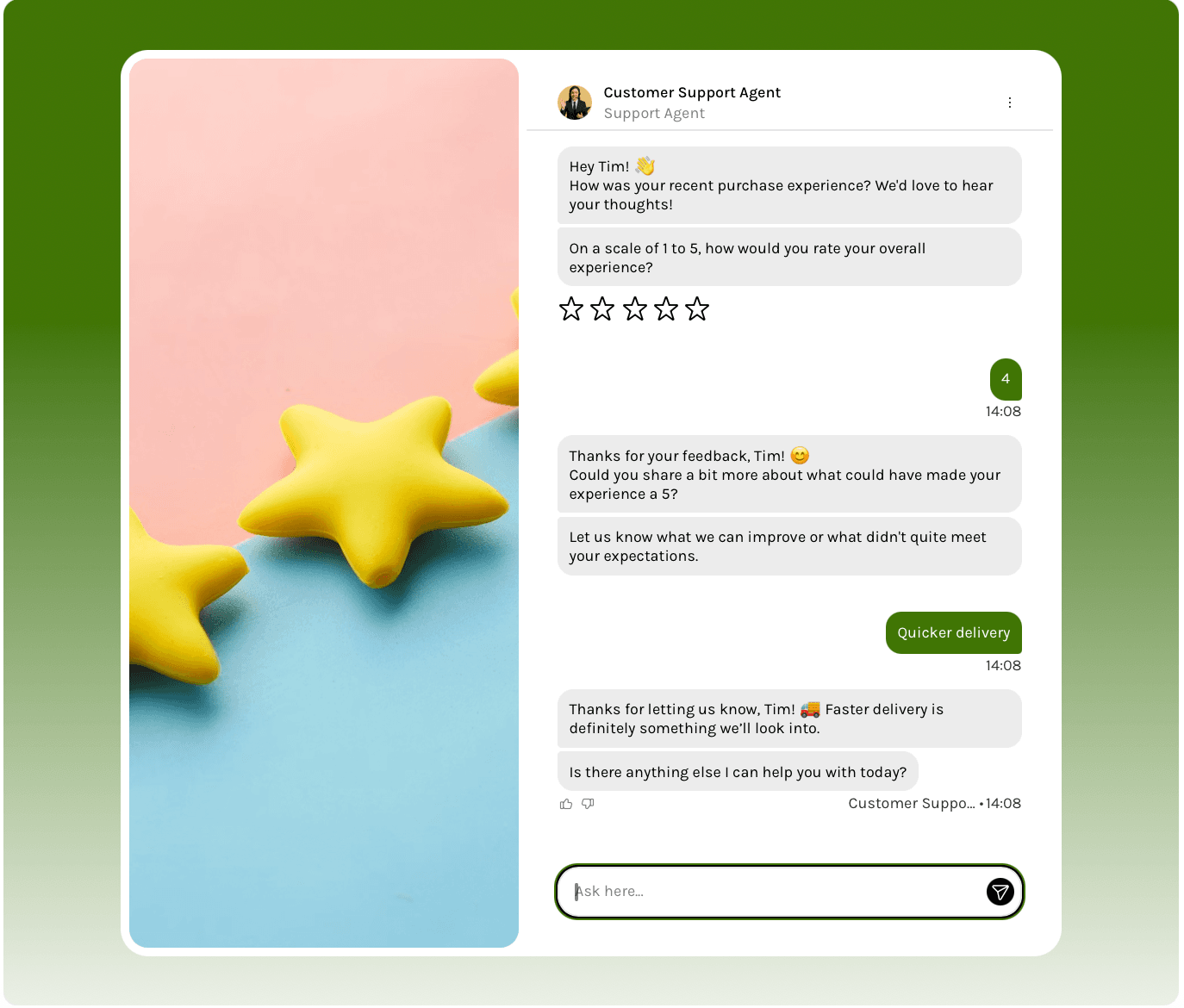
This is where tools like Echo by SurveySparrow come into play.
Instead of stopping at analysis, Echo can ask follow-up questions, understand sentiment as responses come in, and route issues to the right teams automatically — all in your brand’s voice.
It’s designed for teams that want feedback to lead to action while it still matters, without adding more manual work.
Why This Matters More as Teams Grow
When teams are small, it’s possible to read almost everything. As customer numbers grow, feedback grows faster than headcount.
Without help:
- Issues get noticed later than they should
- Decisions rely more on anecdotes
- Teams react instead of anticipating
AI helps teams stay close to customers even as volume increases. Feedback doesn’t pile up waiting for someone to have time to read it — it’s continuously analyzed as it comes in. It also helps different teams work from the same understanding. Product, support, marketing, and leadership see the same themes instead of forming separate interpretations from partial data.
Understanding feedback is only half the work. Someone — or something — still needs to act on it.
That’s where CX AI agents come in. Instead of just analyzing feedback, these agents can follow up with customers, route issues to the right team, and trigger workflows automatically. If you want to go deeper into how these systems work and how teams are using them in practice, we break it down in our complete guide to CX AI agents for 2026.
What Teams Use AI Customer Feedback
If acting on feedback in real time sounds useful, this is worth exploring.

Explore how SurveySparrow can transform your feedback process.
TRUSTED BY BEST-IN-CLASS BRANDS


There isn’t a single team that benefits from AI customer feedback — it really depends on where feedback is piling up and where decisions tend to slow down. That said, some teams feel the impact much sooner than others.
Support Teams
Support teams are usually the first to feel the pressure when feedback volume grows.
AI helps them:
- Spot urgent or sensitive conversations sooner
- Identify recurring issues driving ticket volume
- Review conversation quality without reading every ticket
Instead of reacting to the loudest complaints, teams can focus on what actually needs attention.
Product Teams
For product teams, feedback is everywhere — but rarely organized.
AI makes it easier to:
- Group feature requests automatically
- Detect bugs and usability issues early
- Understand which problems affect which customer segments
This helps product decisions feel grounded in real usage, not just internal opinions.
Marketing Teams
Marketing teams care less about individual comments and more about patterns in perception.
Customer Feedback AI helps them:
- Learn how customers describe value in their own words
- Track shifts in brand perception
- Pull real language for messaging and positioning
It’s often the fastest way to sanity-check whether messaging matches reality.
Leadership
For leadership, feedback needs to roll up into something actionable.
What they see with AI in Customer Feedback:
- A clear view of how customer experience is changing over time
- Early signals when feedback starts to affect retention or churn
- A shared understanding of customer priorities, without relying on anecdotes
Instead of scattered reports, they get a consistent picture of what customers are actually experiencing.
Choosing the Right AI Feedback Tool
The best tool depends less on advanced features and more on fit.
Start with a few practical questions:
- Where does most of your feedback come from today?
- Who needs to act on the insights?
- How quickly do you need answers?
- What tools does your team already use?
Look for something your team can actually adopt without training sessions or long setup projects. Feedback tools only help if people check them and trust what they see.
Integration matters too. Insights are more useful when they show up where teams already work, not in yet another dashboard.
Where AI Customer Feedback Is Headed
Feedback analysis is moving closer to real time.
Instead of reviewing feedback days later, teams are starting to see signals while interactions are still happening. Over time, this leads to systems that don’t just explain what went wrong, but help prevent issues before customers complain.
The goal isn’t automation for its own sake. It’s keeping customer insight close enough that teams can respond while it still makes a difference.
Closing Thoughts
Most teams aren’t ignoring customer feedback on purpose. They’re overwhelmed by it.
AI customer feedback analysis helps turn large volumes of comments into something manageable and useful. It doesn’t replace judgment or strategy, but it removes the bottleneck that keeps teams from acting sooner.
If customer feedback feels overwhelming today, it doesn’t have to stay that way.
Explore how SurveySparrow can transform your feedback process.
TRUSTED BY BEST-IN-CLASS BRANDS