Employee Experience
50+ Self Evaluation Examples to Nail Your Performance Review
Master your performance review with 50+ powerful self-evaluation examples that reveal how to showcase achievements, address weaknesses, and align with company goals effectively.

TRUSTED BY BEST-IN-CLASS BRANDS


Watch Customer Stories

A self evaluation is one of the most consequential documents you write all year. It feeds directly into decisions about compensation, career progression, and development planning.
This guide gives you 50+ self evaluation examples organized by competency, so you can find the right phrase for your situation and adapt it to your own experience. If you want guidance on how to write your self evaluation from scratch, that section follows the examples.
- What is a Self-Evaluation?
- 50+ Examples for Your Self-Evaluation
- How to Write a Strong Self-Evaluation
- Impactful Sentence Starters for Writing Self-Assessments
- Preparing for Your Performance Review
What is a Self-Evaluation?
A self-evaluation is a structured written assessment where you reflect on your own performance over a defined period, typically a quarter or a year. It's submitted as part of a broader performance review process, giving your manager visibility into how you see your own contributions, growth areas, and goals.
Most self-evaluations cover some combination of the following:
- What you accomplished and how it contributed to team or company goals
- How effectively you collaborated with colleagues and stakeholders
- Areas where you've grown since the last review
- Weaknesses or development areas you're actively working on
- Goals and priorities for the next review period
50+ Examples for Your Self-Evaluation
Every performance review starts with a 360-degree evaluation of an employee’s performance. When the assessment period starts, a self-assessment questionnaire and a peer feedback questionnaire is sent to the subject’s direct reports, peers, and reportees.
In order for you to position yourself well in this review process, you’ll need to use the right phrases, or else, your impact won’t be communicated properly.
Here are 50 examples of phrases that you can use to comment on your own performance.
A performance review measures individual performance by a set of core competencies. The questionnaire used contains a set of questions for each competency. Keeping that in mind, we have organized useful comments and phrases organized by competencies that you can tailor to your needs.
- Communication & Collaboration
- Technical Expertise
- Accountability
- Leadership
- Work Ethic
- Adaptability
- Time Management
1. Self-Evaluation Examples Discussing Communication and Collaboration
Strong communication is rarely about saying more. It is about saying the right thing, to the right person, at the right time. The phrases below reflect what effective communication looks like in practice — not as an abstract skill but as a daily habit that affects how your work is perceived, how decisions get made, and how much trust you build with the people around you.
Strengths
- This year I made it a point to never let a stakeholder be surprised. If something was shifting, I flagged it early, even when the news was uncomfortable to deliver
- In our cross-functional sprint reviews, I started summarizing decisions in writing within 24 hours. It cut follow-up questions by more than half
- I have a habit of checking in with quieter team members after group discussions. Some of the best ideas this year came from those one-on-one conversations
- When our Q3 campaign ran into scope issues, I pulled three teams together for a 30-minute alignment call rather than letting email threads spiral. We resolved it the same day
- I received feedback from two colleagues this year that my written updates were clear and easy to act on. I take that seriously and try to maintain that standard consistently
Improvement Areas
- I have a tendency to over-explain in written updates. I am working on cutting my project emails down so the key ask is visible in the first two lines, not buried in paragraph three
- Earlier this year I avoided a difficult conversation with a vendor for longer than I should have. By the time I addressed it, it had already caused a delay. I am working on having those conversations earlier
- In larger group meetings I sometimes jump in before others have finished their point. I have been consciously pausing before responding and it is making a difference
- I do not always volunteer updates unless asked. I am working on sharing progress more proactively, especially on work that has dependencies for other people
2. Technical Expertise
Technical skills are table stakes. What separates strong performers is the ability to apply those skills to real problems, share knowledge in a way that raises the team's capability, and maintain a standard of output that others can depend on. Use these phrases to communicate not just what you know but what you have done with it.
Strengths
- This year I built an automated reporting process that replaced a manual task our team had been doing for two hours every Monday morning. That time is now spent on actual analysis
- When a critical integration broke the night before a client presentation, I diagnosed and resolved it without escalating. The presentation went ahead without the client knowing anything had gone wrong
- A junior colleague came to me repeatedly with the same type of problem. Instead of just solving it each time, I spent two hours walking them through the underlying logic. They have not needed to come back since
- I delivered every technical output this year without a single rework request from the team. That is not an accident — I build in a review step before anything leaves my hands
- I proactively flagged a security vulnerability in our reporting pipeline that no one had noticed. It had been there for months. Catching it early prevented what could have been a significant issue
Improvement Areas
- There are two tools my team uses regularly that I still rely on colleagues to handle. I have started a structured learning program to close that gap over the next quarter
- I gave a technical walkthrough in a cross-functional meeting earlier this year that clearly lost half the room. I am working on translating what I know into language that people without my background can actually use to make decisions
- A lot of how our systems work currently exists only in my head. If I were unavailable for a week, it would cause real problems. I am building documentation that would allow anyone on the team to pick up where I left off
- I escalate technical problems too quickly rather than sitting with them long enough to work through them independently. I am giving myself a minimum of two hours on a problem before I ask for help
3. Accountability
Accountability shows up in the small moments — the email you send before someone has to chase you, the deadline you protect even when no one is watching, the mistake you own without deflecting. The phrases below capture what genuine accountability looks like across a full review period, not just during high-visibility moments.
Strengths
- Earlier this year one of my projects hit an unexpected blocker two weeks before the deadline. I flagged it immediately, proposed two alternative approaches, and we delivered on time with a modified scope
- I track every commitment I make in a shared document. If something is at risk of slipping, the relevant person hears it from me before they have to chase
- When a miscommunication on my end caused a client deliverable to be delayed, I owned it directly, explained what happened, and put a new process in place to make sure it would not happen again.
I do not wait to be reminded. If I said I would do something, I do it or I come back to say why the timeline has changed - This year I took on three projects simultaneously and delivered all of them on time. That required constant prioritization and a willingness to have honest conversations about capacity
Improvement Areas
- I tend to say yes before I have fully thought through what the commitment requires. There were two instances this year where I had to revise a deadline I had set too optimistically. I am working on building more assessment time before I commit
- On a complex project earlier this year I sat with a blocker for almost a week before flagging it. By then, the window to resolve it cleanly had passed. I am working on surfacing problems within 48 hours of identifying them
- I am better at tracking my primary deliverables than the smaller commitments that come up in meetings. I am building a habit of capturing those in the moment so nothing slips
- I am working on identifying risks at the planning stage rather than when they have already started affecting delivery
Here’s a free, customizable self-evaluation template by SurveySparrow. Simply create a free account below to start using this plus hundreds of other free survey templates.


4. Leadership
Leadership is not defined by title. It shows up in the clarity you create for others, the decisions you make under pressure, and the investment you make in the people around you. Whether you manage a team or lead through influence, these phrases help you articulate the impact you have had on the people and projects you touched this year.
Strengths
- At the start of every project I run a 30-minute kickoff that covers goals, roles, and what success looks like. The team has told me it makes a real difference to how aligned everyone feels from day one
- During a period when two of our team members were on leave simultaneously, I restructured the workload, communicated clearly about what would and would not be delivered, and we hit our critical deadlines without burning anyone out
- One of my direct reports was passed over for a project they were ready for. I made the case to leadership, backed it with specific examples of their work, and they got the opportunity. They delivered exceptionally
- Last quarter I made a call to halt a campaign that was not performing rather than letting it run to completion. It was not a popular decision in the moment but the data supported it and we redirected the budget more effectively
- Two people on my team this year told me in their own reviews that working with me had helped them grow. That is the feedback I value most
Improvement Areas
- I held onto a piece of work for three weeks that I should have delegated in the first three days. The person I eventually handed it to did it better than I would have. I am working on trusting my team earlier
- There was a performance issue on my team that I addressed in a quarterly review rather than in the week it became visible. That gap was not fair to the person involved. I am working on having those conversations in the moment
- My work is not well understood two levels above me. I am building relationships with senior stakeholders so the people making decisions about my team's resources and direction actually know what we do and how well we do it
- My development conversations with direct reports tend to happen reactively rather than on a consistent schedule. I am moving to monthly structured check-ins so those conversations happen whether or not there is a pressing issue
5. Work Ethic
Work ethic is one of the hardest things to describe without sounding either boastful or vague. The phrases below are grounded in specific behaviors and outcomes; the kind of evidence that gives your manager something concrete to point to when advocating for your performance in conversations you are not in the room for.
Strengths
- I delivered every project commitment this year on time. There were weeks where that required significant personal effort but I did not let deadlines become someone else's problem
- When a gap appeared in our team's coverage earlier this year, I stepped in without being asked and managed both workstreams for six weeks until we had the right resource in place
- My manager has never had to chase me for a status update. I proactively share what is happening, what is at risk, and what I am doing about it
- I set a personal standard for my work that is higher than what the role strictly requires. I think that gap is where growth happens
- Three colleagues asked to work with me again this year on follow-up projects. I take that as a signal that the way I work makes things easier rather than harder for the people around me
Improvement Areas
- During Q3 I was working at a pace that was not sustainable and it started affecting the quality of my output in the final two weeks. I am working on recognizing that pattern earlier and adjusting before it affects the work
- I have a habit of picking up tasks that are not strictly mine when I see them going undone. That is sometimes valuable and sometimes a distraction from my actual priorities. I am working on being more deliberate about which gaps are mine to fill
- Two deliverables this year required more revision cycles than they should have. In both cases I submitted before I had really finished. I am building in a hard review step before anything leaves my hands
- When there is no immediate deadline I work at a slower pace than I am capable of. I am working on applying the same focus and urgency to longer-horizon work that I naturally bring to short-term deadlines
6. Adaptability
The ability to adapt is easy to claim and hard to demonstrate. The phrases below describe what adaptability actually looked like in practice, how you responded when plans changed, how you performed when clarity was limited, and how you showed up for the people around you during periods of uncertainty.
Strengths
- Midway through Q2 our entire project roadmap was reprioritized at 48 hours notice. I had a new plan to the team within a day and we lost less than a week of productive output
- When I joined a new cross-functional team earlier this year I had to learn a completely different way of working. Within six weeks I was contributing at the same level as people who had been there for months
- I genuinely enjoy working on problems where the answer is not obvious. Some of my best work this year came from situations where no one was quite sure what the right approach was
- When a key tool we relied on was discontinued mid-project, I found and onboarded an alternative in three days without stopping the work
- Three colleagues approached me during our restructure earlier this year to talk through how they were processing the changes. I was glad to be someone they felt they could come to
Improvement Areas
- When priorities shift without much context, my first instinct is to want more information before I act. There was a situation earlier this year where that instinct cost us time we did not have. I am working on making a provisional call and adjusting as more becomes clear
- During our reorg I was visibly unsettled in a couple of team meetings. I do not think it was helpful for the people around me. I am working on processing that kind of uncertainty more privately and showing up with more steadiness
- I adapt well once I have made the shift but the initial adjustment takes longer than it should. I am working on shortening that window
- I am working on being more proactive about flagging when I think a change of direction is needed rather than waiting for someone else to call it
7. Time Management
Time management is not about being busy. It is about ensuring your effort consistently goes toward the work that matters most, that your commitments are reliable, and that the people depending on you never have to wonder where things stand. These phrases capture what strong time management looks like as a professional habit.
Strengths
- I manage three ongoing workstreams simultaneously and have not missed a deadline across any of them this year. That requires a level of planning and prioritization I have built deliberately over time
- When two urgent requests arrived on the same day as a major deliverable, I triaged quickly, communicated clearly about what was and was not possible, and delivered the highest-priority item on time
- I block my calendar every morning for two hours of focused work. My output during that window is consistently higher quality than anything I produce reactively during the rest of the day
- I identified early in Q2 that a project was going to run long and flagged it four weeks before the deadline. That gave the team enough time to adjust without it becoming a crisis
- I have not missed a self-imposed deadline this year. The commitments I make to myself carry the same weight as the ones I make to others
Improvement Areas
- I attend six recurring meetings every week. I recently audited them and identified two that I could either leave or replace with a five-minute async update. I am in the process of making that change
- I plan my weeks at close to full capacity which means any unexpected request immediately creates pressure. I am working on protecting at least 20% of my week as unallocated time for exactly those situations
- I find it genuinely difficult to say no to requests from colleagues even when saying yes compromises my existing commitments. I am working on reframing that as a planning conversation rather than a personal one
- Without a deadline creating urgency I tend to work more slowly than I am capable of. I am experimenting with setting internal deadlines on longer-horizon work to maintain consistent momentum
Read related: Performance review examples by competency
How to Write a Strong Self-Evaluation

Writing a self-evaluation that actually influences how your performance is perceived requires more than listing what you did. Here are five principles that show you how to comment on your performance properly.
1. Be specific
Vague statements like "I contributed to team success" or "I improved my communication skills" tell your manager nothing they didn't already know. Replace every general claim with a specific example. What did you contribute? To which project? What was the outcome?
The more precisely you can describe your work, the more credible and memorable it becomes. If you can attach a number, attach one.
Use the Situation-Behavior-Impact (SBI) framework to structure your examples:
- Situation: Provide the who, where, when, and why of the situation.
Example: During the run-up to Christmas this past December, I asked to lead the team's brainstorming session for campaign ideas. - Behavior: How did you respond?
Example: I took the initiative to schedule the meetings and coordinated with the media and sales ops teams for our campaign promotion. - Impact: How did your response contribute to the result?
Example: We generated three campaign ideas, one of which was produced in-house and got over 150,000 shares, 1 million views, and a 30% increase in footfalls.
2. Balance accomplishments with development areas
A self-evaluation with no weaknesses signals one of two things — overconfidence or dishonesty.
Neither serves you well.
Acknowledging a genuine development area, paired with the specific steps you are taking to address it, demonstrates the kind of self-awareness that managers trust and that organizations invest in.
Aim for roughly a 70/30 split between strengths and development areas.
Use positive language to describe your struggles. Compare these two examples:
- Before: "I frequently failed to reach my monthly targets."
- After: "Several missed targets helped me identify my time management struggles. I've started creating daily task lists with timelines to stay on track."
3. Connect your work to team and company goals
The most effective self-evaluations do not just describe individual output. They show how that output contributed to something larger. A manager reading your self-evaluation wants to see that you understand the bigger picture and that your priorities were aligned with the team's direction. Frame your contributions in terms of their impact, not just their activity.
Example: "We reduced customer returns/rejects by 60% as part of Z Corp's quality improvement program."
4. Write in the first person and use strong action verbs
Your self-evaluation is the one document in the review process where you are expected to advocate for yourself. Write with confidence. Start sentences with strong verbs such as led, delivered, built, improved, initiated, and resolved.
"A project was completed" is not the same as "I led the project to completion."
5. Gather your evidence before you write
The biggest mistake most people make is writing their self-evaluation from memory. Memory is selective and incomplete. Before you write a single sentence, pull together your calendar, your project notes, your emails, and any metrics or feedback you received during the review period. The evidence should drive the writing, not the other way around.
A practical way to avoid this problem is to note down your accomplishments as they happen throughout the year — what the goal was, how you addressed it, and what the outcome was. Set aside a few minutes each week to log notable moments. When the review arrives, you will have a record to draw from rather than a blank page.
- What were the goals for that week/month? How did you go about achieving them?
- How have you tried to improve yourself?
- If there was a challenging situation, how did you respond to it?
Before you hit submit, chart your improvement plan
Before turning in your self-review, think about what you are going to improve and how you will do it. Follow these four steps to address development areas effectively:
- Acknowledge your development areas honestly.
- Set a SMART goal to address each one — Specific, Measurable, Achievable, Relevant, and Time-bound.
- Make a plan. Identify the specific resources, courses, or changes in working habits that will address the gap.
- Track your progress. If your organization uses 360-degree software such as SurveySparrow, progress tracking and reporting are built into the process automatically.
Impactful Sentence Starters for Writing Self-Assessments
The examples in this guide are designed to be used directly or adapted to your situation. But if you prefer to write your own phrases from scratch, the starters below give you a confident opening for any part of your self-evaluation.
Here are the sentence starters tailored to each competency:
Communication and Collaboration
- This year I made it a point to...
- When our team hit a communication breakdown, I...
- I noticed that stakeholders were struggling to stay aligned, so I...
- One habit I built this year that changed how my team works is...
- After receiving feedback about my communication style, I...
Technical Expertise
- When the team ran into a technical problem no one had solved before, I...
- This year I took ownership of...and delivered...
- I identified a gap in our technical process and addressed it by...
- A colleague came to me with a recurring problem and instead of just fixing it, I...
- I proactively upskilled in... which allowed me to...
Accountability
- When things did not go as planned on..., I...
- I flagged a risk early on... which gave the team enough time to...
- Rather than waiting to be asked, I...
- When I made a mistake on..., I owned it by...
- I took full responsibility for... and the outcome was...
Leadership
- When the team needed direction on..., I stepped in and...
- I made a call that was not popular at the time but...
- I created an opportunity for a colleague by...
- During a period of uncertainty, I helped the team by...
- I advocated for... and the result was...
Work Ethic
- When a gap appeared in our team's coverage, I...
- I held myself to a higher standard than required on... because...
- There was a point this year where the pressure was significant and I responded by...
- Without being asked, I took on... and delivered...
- I set a personal benchmark for... and maintained it consistently by...
Adaptability
- When our priorities shifted overnight, I...
- In a situation where no one had a clear answer, I...
- I was asked to take on something completely outside my experience and I...
- When a tool we depended on disappeared mid-project, I...
- During the restructure, I helped my colleagues by...
Time Management
- When two competing deadlines landed on the same day, I...
- I identified early that... was going to run long and I...
- I restructured my week to protect time for... which resulted in...
- When I realized I was at capacity, I...
- I built a system for tracking... that ensured nothing slipped across...
Preparing for Your Performance Review
The phrases and examples above give you the language to describe your performance effectively. But the most impactful self-evaluations are not written in the week before the review — they are built over the period leading up to it.
Here is how to approach that preparation thoughtfully.
Document as you go
The biggest mistake most people make is trying to recall a full year of work from memory. Memory is selective. It favors recent events, forgets quiet contributions, and overlooks the moments that did not feel significant at the time but added up to something meaningful.
Keep a running record of your work throughout the year. Note completed projects, feedback received, problems solved, and outcomes achieved. It does not need to be formal — a simple document updated weekly is enough. When review time arrives, you will have a comprehensive record to draw from rather than a blank page.
Seek feedback before the review, not during it
Most people wait for their performance review to find out how they are doing. By that point, there is little time to act on what they hear.
Asking for informal feedback from your manager and trusted colleagues in the weeks or months before your review gives you two things. First, clarity on where you stand. Second, the opportunity to address any gaps while there is still time to demonstrate progress. A manager who has seen you act on feedback before the review begins reads your self-evaluation very differently from one who has not.
Identify your three to five most significant contributions
A self-evaluation that tries to cover everything ends up communicating nothing with real impact. Before you write, identify the contributions that best represent your performance for the period — the work that moved something forward, solved a real problem, or delivered a measurable outcome.
Build your self-evaluation around those. Everything else is context.
Connect your work to what the organization cares about
The most effective self-evaluations do not just describe what you did. They show why it mattered. Before you write, spend a few minutes reviewing your team's goals and your organization's priorities for the period. Then ask yourself how your contributions supported those priorities.
That connection — between your individual work and the organization's direction — is what elevates a self-evaluation from a list of activities to a compelling case for your value.
Make Every Performance Review Count
A self-evaluation is not a formality. It is a direct input into how your performance is perceived, how your contributions are understood, and how decisions about your pay rate, compensation, and career are made. The phrases, examples, and frameworks in this guide give you the tools to approach that document with intention rather than anxiety. Before you submit your next self-evaluation, run through these final principles.
Do’s
- Talk about your assigned metrics and KPIs. They would give a clear idea about your work.
- Use numbers to your advantage. Convert these numbers into percentages. It sheds a better light on the difference your work made.
- Keep a diary for your “daily achievements”, however big or small, and use it during self-evaluation. You’ll thank us later!
- Talk about how you’re not perfect and a work in progress who’s constantly learning.
- State all team and personal achievements. It always leaves a positive impression.
- Talk about how you helped better the company values, too – not just achieving company targets.
Don’ts
- Never write your self-assessment hastily. Take your time, collect all thoughts, prepare a draft, edit, synchronize, and only then hit the submit button.
- Don’t make the self-evaluation only about yourself. Talk about your team, manager, and family’s contribution, too.
- Self-evaluation over 3 paragraphs or 250 words is a big no-no.
- Don’t write your achievement in a boastful manner. Write it as a consequence of your positive work.
- Don’t use jargon. Simple words and small sentences work best.
You're Ready to Ace Your Performance Review
Writing a strong self-evaluation is one part of a well-run performance review process. The other part is ensuring the broader review (peer feedback, manager assessments, and 360-degree evaluations) is structured, consistent, and free from the bias that informal processes tend to introduce.
SurveySparrow's 360-degree assessment platform gives HR teams and managers the tools to run performance reviews that are fair, comprehensive, and genuinely useful.
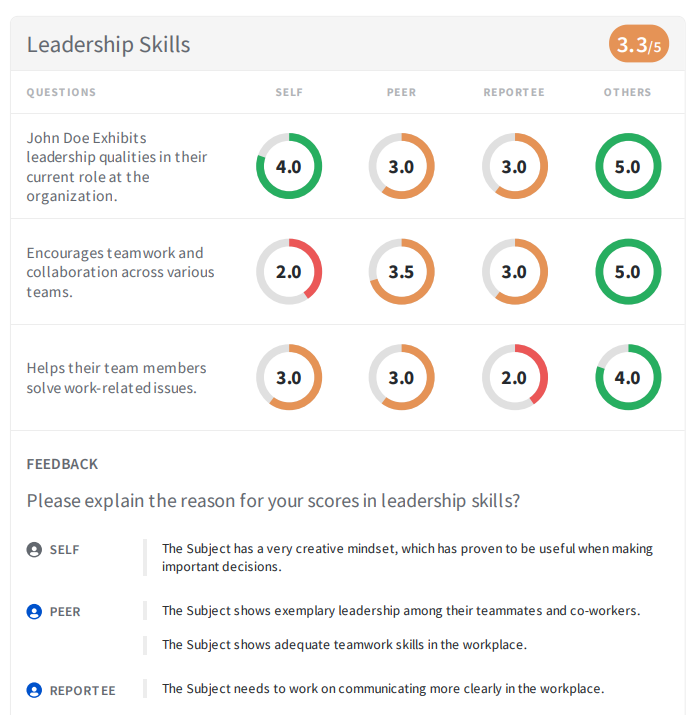
Customizable competency frameworks let you align assessments with the specific skills and behaviors your organization values. Automated feedback collection from peers, direct reports, and managers ensures every perspective is captured without the administrative burden of managing the process manually.
Real-time dashboards surface patterns across the organization identifying high performers ready for development opportunities and flagging areas where team-wide support may be needed.
The goal of a performance review is not to evaluate the past. It is to build the foundation for what comes next.
Start your free trial today and see how SurveySparrow can make that process more accurate, more meaningful, and more useful for everyone involved.

Identify Employee Strengths and Weaknesses
TRUSTED BY BEST-IN-CLASS BRANDS
Watch Customer Stories