VoC
Customer Feedback Surveys Made Simple: Expert Guide + Free Templates
Master customer feedback surveys with this expert guide that reveals proven strategies, question types, and templates to collect meaningful insights and transform customer experiences.

TRUSTED BY BEST-IN-CLASS BRANDS


Watch Customer Stories

Most businesses think they know what their customers think. Research consistently shows they are wrong.
You’re not alone. Around 80% of companies think they’re delivering a “superior” customer experience. But the truth is far from it because only 8% of customers agree.
A customer feedback survey is one of the few tools that closes that gap directly — by going to the source.
What Are Customer Feedback Surveys?
A customer feedback survey is a structured process made up of two parts: a questionnaire and an analysis.
The questionnaire captures your customers' experience, opinions, and expectations. The analysis is what happens after response collection, obtaining patterns, insights, and decisions.
Neither part works without the other. A questionnaire without analysis is just data. Analysis without a well-designed questionnaire produces unreliable conclusions. Together, they give businesses something genuinely useful — a direct, structured view of how customers experience their product, service, or brand.
When is a Customer Feedback Survey Used?
Customer feedback surveys are most effective when deployed at specific moments in the customer journey.
Here are the key touchpoints where they add the most value:
After a purchase. When a customer has just bought something, their impression of the experience is still fresh. This is the moment to ask how the purchase process felt, whether expectations were met, and what could have been better. An e-commerce brand might send a one-question CSAT survey within 24 hours of delivery confirmation.
After a support interaction. Someone contacted your team with a problem. Whether it was resolved well or badly, their experience of that interaction shapes how they feel about the brand going forward. A SaaS company, for example, typically sends a short satisfaction survey within minutes of a support ticket closing.
During onboarding. The first few weeks are the highest-risk period in any customer relationship. A new customer who fails to get value from a product/service is a churned customer waiting to happen. In-app feedback surveys triggered after specific onboarding milestones help identify exactly where the experience is breaking down, before the customer decides to leave.
At renewal or key milestones. This is the moment to take the temperature of the overall relationship. An NPS survey sent at a contract renewal point tells you whether a customer is loyal, neutral, or quietly looking for an alternative. It also gives you a natural opportunity to address concerns before they become a decision.
After a negative experience. If a delivery was late or a call went badly, reaching out with a survey in the immediate aftermath signals that the business is paying attention, and gives the customer a channel to share what happened before they think of heading straight to a public review platform.
Why customer feedback matters?
The honest answer is simple. Without feedback, you are guessing.
Internal teams (however talented) cannot fully replicate the perspective of a customer using a product in the real world, under real conditions, with real expectations. Hence, making assumptions on a product/service capability can create a widening gap between what the business believes is true and what customers actually experience.
When feedback is collected efficiently,
Problems surface earlier. A recurring complaint in open-ended responses is a warning sign that would have taken months to show up in churn data. Catching it in survey responses is cheaper, faster, and significantly less damaging.
Decision-making improves. Product roadmaps built on customer feedback tend to be prioritized differently than those built on internal intuition. Features that seemed important on assumption get deprioritized. With customer feedback, the actual pain points and wants serve as good inputs for product development.
Customer relationships strengthen. The act of asking customer for feedback signals that the business values the relationship beyond the transaction. Customers who feel heard are more loyal, more forgiving when things go wrong, and more likely to recommend a product to their network.
According to Microsoft, 77% of customers view brands more favorably when they proactively seek and act on feedback. So, the survey itself is not just a data collection exercise. It is a relationship touchpoint.
How surveys help improve customer experience?
Today, nearly 80% of customers say their experience with a company is just as important as its products or services. That’s why customer feedback surveys are so essential—they give you a way to continuously measure satisfaction and improve it.
Feedback surveys help measure satisfaction and more than that, they make your customers feel heard. Customers trust your brand more and recommend it to others when you ask for their opinion and act on it.
Surveys create chances for what experts call "closing the feedback loop." This means collecting insights, making changes based on them, and telling customers about these improvements. This shows your steadfast dedication to their satisfaction and builds trust with your customers.
We’ve seen our retail clients use quick post-purchase or in-store surveys to identify pain points. One retail brand discovered their checkout process was frustrating customers. They made some small process tweaks and saw their satisfaction score jump 27% in just three months.
Clearly, customer feedback surveys do more than find problems. They help you understand what’s working and making your customers happy so you can copy, apply, and extend successful parts of your business. It’s about building a cycle of continuous improvement, staying in sync with your customers, and growing in the right direction.
Don’t just guess what your customers think—ask them. Use our expert-built customer feedback survey template to start collecting meaningful insights today.
Types of Customer Feedback Questionnaires
Not every feedback questionnaire is designed the same way. The type you use depends on what you need to measure.
1. Customer Satisfaction Score (CSAT) Questionnaire
A CSAT questionnaire measures satisfaction with a specific interaction or experience. Typically a 5-point scale, it is best used immediately after a defined touchpoint like a purchase, or a delivery. Fast to complete, easy to analyze, immediately actionable.
1. How satisfied are you with your experience today?
Very satisfied / Satisfied / Neutral / Dissatisfied / Very dissatisfied
2. How would you rate the quality of the service you received?
Excellent / Good / Average / Below average / Poor


2. Net Promoter Score (NPS) Questionnaire
An NPS questionnaire measures customer loyalty, and the likelihood that the customer would recommend the product/service to another.
NPS questionnaires usually consist of a single 0 to 10 scale question, followed by an open-ended "why." Best used at relationship milestones (quarterly, at renewal, or after onboarding), this questionnaire produces a score that can be tracked over time and benchmarked against industry averages.
- On a scale of 0 to 10, how likely are you to recommend us to a friend or colleague?
- What is the primary reason for your score?
3. Customer Effort Score (CES) Questionnaire
CES is a metric used to gauge how much effort a customer had to expend to complete a task. According to Gartner, reduced effort is one of the strongest predictors of customer loyalty available. CES questionnaires are best used after support interactions and any process where friction is likely, during checkout, onboarding, and account management.
How a CES question looks like:
How easy was it to resolve your issue today?
Very easy / Easy / Neutral / Difficult / Very difficult
4. Product Feedback Questionnaire
This is a more detailed questionnaire focused on a specific product or feature. A product feedback questionnaire covers usage patterns, satisfaction with individual capabilities, and what customers would most like to see improved or added. Best deployed 7 to 14 days after onboarding or after a major product update, it gives customers enough time to form a genuine opinion.
1. How well does our product meet your current needs?
Extremely well / Very well / Somewhat well / Not very well / Not at all
2. What is the one thing you would most like to see improved or added to our product?
(open-ended)
How to Conduct a Customer Feedback Survey?
Start with a clear objective. Before writing a single question, ask yourself what decision this survey needs to inform. Every question should connect to that answer. The ones that don't — cut them.
Your objective should be specific enough to act on. "Understand why customers are dropping off during onboarding" is a useful objective. "Get customer feedback" is not. The difference determines whether your survey produces insight or just data.
Create the right type of goals and objectives using the SMART framework.
Know who you are asking. Different customer segments give you different kinds of insight. A customer in their first week has a very different perspective from one who has been with you for two years. Once you know who you are targeting, the right question types, appropriate length, and best distribution channel all become much clearer.
Pick the right survey type for the moment. Use a CSAT survey after a support interaction or purchase, an NPS at renewal or quarterly relationship check-ins, and a CES survey after any process where friction is likely.
Choose your question types deliberately. Use multiple choice and Likert scales for structured, comparable data. Open-ended questions can be used when you need the reasoning behind a score.
Yes/no questions when you need a fast, unambiguous answer, and incorporate ranking questions when you need to understand relative preferences.
Keep it short. Three questions is enough for a post-interaction survey. For relationship surveys, here are a few pointers.
New customers: 5 to 7 questions
Loyal customers: 10 to 15 questions
Deep research: 15 to 20 questions maximum
Most people will not spend more than five minutes on a survey from a brand they are not deeply invested in. Beyond that threshold, completion rates fall and response quality drops.
Instead, send that questionnaire while the experience is still fresh. A form sent within minutes of a support interaction closing captures how the customer actually felt. Wait 48 hours and you are asking them to reconstruct a memory — which is a different thing entirely.
Choose the right distribution channel. Email works well for existing customers where a personal touch matters. SMS gets opened 98% of the time compared to 20% for email — making it the stronger choice for post-interaction surveys where speed matters. In-app surveys work best for product feedback triggered by specific user behavior. Social media works for reaching broader audiences or running quick polls. Use the channel where your audience already is — not the one that is easiest for your team to manage.
Analyze the responses. Start with your core metric — CSAT percentage, NPS score, CES average — then break it down by segment. An overall score of 4.1 might mask a score of 2.8 among customers in their first 90 days. Aggregate numbers like this hide the stories that matter most.
Then read the open-ended responses.
Look for phrases that appear repeatedly across different customers. One person mentioning a confusing onboarding flow is a data point. Eight people describing the same thing independently is a signal worth acting on immediately.
Prioritize by frequency and business impact. Issues that appear often and correlate with churn or low renewal rates deserve attention first. Not everything needs fixing — but the things at that intersection do.
If you are running feedback programs at any meaningful scale, doing this manually becomes the bottleneck. Reading through hundreds of open-ended responses, tagging themes, identifying sentiment shifts — it is time-consuming work that most teams either rush or skip entirely.
This is what CogniVue is built for. SurveySparrow's AI-powered text analytics engine automatically analyzes open-ended responses at scale — surfacing recurring themes, detecting sentiment patterns, and identifying the key drivers behind your scores without anyone having to read every response manually. What would take a team hours takes CogniVue minutes.
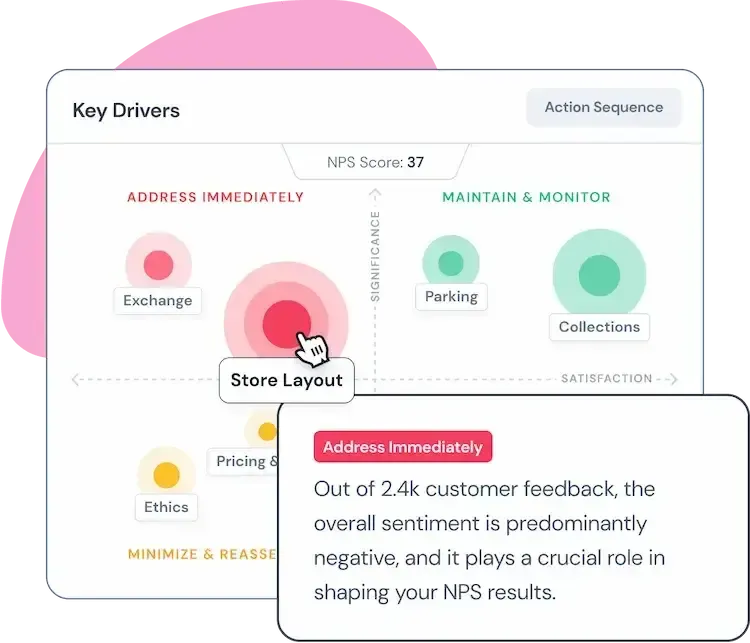
Faster analysis means faster action. Faster action means problems get resolved before they show up in churn.
Start your free trial today and see what your customers are actually telling you.
Close the loop. Tell customers what changed as a result of their feedback. A brief message saying "you told us X, so we changed Y" does more for customer loyalty than most retention campaigns. It is also what turns a one-time survey into a program customers actually want to participate in again.
Best Practices for Writing Survey Questions
The quality of survey responses and insights greatly depend on the survey questions asked. A simple change in words could drastically affect the context of answers that respondents give.
Let's look at some best practices to create questions that will get you accurate and practical feedback from your customers.
Keep questions short and clear
Your customer feedback survey questions need to be crystal clear and brief. Research shows that people often quit surveys or give wrong answers when questions get too complex.
The quickest way to improve is to use simple, direct language that anyone can understand right away. A good rule of thumb is to write at a 9th-11th grade reading level. This helps everyone give better answers, no matter their background.
One big mistake to avoid is asking about two things at once. Don't ask "How satisfied are you with our product quality and customer service?" Break it into two questions instead.
Be direct about what you want to know. Fuzzy questions get fuzzy answers. Here's a better way to ask:
❌ "How was your experience?"
✓ "How helpful was our support team during your recent service call?"
Avoid leading or biased language
Survey bias can twist your results and make your feedback data less trustworthy. Questions that nudge people toward certain answers won't give you their real opinions.
Here's what not to do: "We think our customer service representatives are really awesome. How awesome do you think they are?". This clearly shows what answer you want.
A better way to ask would be: "How helpful or unhelpful do you find our customer service representatives to be?". This gives customers room to share honest feedback without feeling pushed one way or another.
Watch out for these common traps:
- Questions that assume things about your customers
- Words that might stir up emotions and lead to biased answers
- Questions that hint at what the "right" answer should be
Use consistent rating scales
Your rating scales should stay the same throughout the survey. This helps people answer quickly and gives you better data. Changing scale formats can confuse people and mess up your results.
Balanced scales give you the most accurate data. These have equal positive and negative options with a neutral middle ground. A good 5-point scale might be: Strongly Disagree, Disagree, Neutral, Agree, Strongly Agree.
Unbalanced scales can push people toward certain answers. Take this scale: "Excellent, Very Good, Good, Poor, Very Poor." It has three positive choices but only two negative ones.
Most rating scales work best with 5-7 options. Too many choices overwhelm people, while too few miss important details.
Test your survey before sending
Testing is vital, yet many people skip this step. One survey expert puts it well: "There's no worse feeling than finding mistakes in your survey once it's already sent to respondents".
Here's how to test your survey properly:
- Ask colleagues to check for clarity and bias
- Try it on different devices (desktop, tablet, mobile)
- Read questions out loud to catch awkward wording
- Test with a small group like your target audience
Good testing catches problems early, before your survey reaches customers. This saves time and prevents decisions based on bad data.
These tips will help you create surveys that people can complete easily and accurately. You'll get better insights that actually help your business grow.
Real-World Customer Feedback Survey Examples
The best way to shape your feedback strategy is to look at how leading companies run their customer surveys. These real-life examples show you how companies get customer opinions through different channels.
Starbucks post-visit survey
Starbucks asks about 1 in 20 customers to tell them about their store visits. They keep it simple with a few questions about orders and service from their partners (employees). The company works with SMG Limited, a leading experience management provider, to run these surveys. This outside partnership helps them get unbiased data about product quality, customer service, and store atmosphere.
Amazon delivery feedback
Amazon's feedback system gets specific details about deliveries without asking too many questions. Customer security comes first—their surveys never ask for sensitive details like passwords, account information, or social security numbers. They want you to report any suspicious requests to reportascam@amazon.com. Amazon gives customers 90 days to rate third-party sellers on packaging, shipping, and overall satisfaction. This well-laid-out system helps them fine-tune their huge delivery network.
Slack in-app feedback prompt
Slack keeps their in-app feedback collection simple. Their "Feedback report template" lets users create forms to collect ideas, feedback, or requests right inside Slack. Users can customize questions, check forms before sending them out, and share responses to specific channels automatically. The system works even better with Google Sheets integration that puts all responses in one place. This setup makes getting feedback almost effortless.
Hilton guest experience survey
Hilton changed the game in hospitality feedback by going beyond regular post-stay surveys with their continuous listening program. Their Stay Experience Platform, built with Qualtrics, lets them get guest feedback at every stage of their stay. Guests can text their concerns in natural conversations while they're still at the hotel. This quick feedback system helped Hilton learn something unexpected—towel quality and quantity had a big effect on how happy guests were, something they hadn't asked about before. This led them to improve their towel program across all hotels.
Common Mistakes to Avoid in Feedback Surveys
Your best-designed customer feedback surveys might not work if you make these common mistakes. Let's look at what to avoid when you gather customer feedback.
Asking too many questions
Survey fatigue exists! People spend half the time answering questions in surveys that have more than 30 questions compared to shorter ones. Response rates drop 5-20% for surveys that take over 7-8 minutes. A survey that runs longer than 25 minutes loses three times more participants than a five-minute survey. Open-ended questions tend to cause fatigue faster than other types, so don't use too much of either.
Sending surveys at the wrong time
Your response rates depend on timing. People complete 78% of surveys during the work week, while weekend submissions account for just 22%. B2B audiences respond best before noon or between 3-6 PM. Weekdays get better responses than weekends, and many studies point to Monday as the best day. You should avoid major holidays when people focus on celebrations.
Ignoring negative feedback
Negative feedback helps you improve. Leaders who ask for critical feedback get higher ratings from peers and superiors than those who only want positive comments. Customer complaints are a great way to get product improvement ideas. The most important company improvements often come from negative feedback.
Failing to follow up
Organizations often stop after collecting survey data. This misses a vital step. Customers stay almost as engaged when you handle their problems well after they give feedback as those who never had issues. A simple thank-you note shows you care about their opinion.
Guide Your Business With the Right Feedback
A customer feedback survey is not a form you send because you are supposed to. At its best, it is a systematic way of listening.
The businesses that do this well do not just collect better data. They make better decisions, build stronger relationships, and catch problems before they become expensive.
Closing the feedback loop is where trust is built. When customers see their input leads to real change, they’re more likely to stick around, spend more, and share your brand with others. As one of our clients put it, “We thought our checkout process was smooth—until our CES survey told us otherwise. After just a few tweaks, our conversions jumped 15%.”
Ready to build yours? SurveySparrow makes it straightforward to create, distribute, and analyze customer feedback surveys across every channel.

Explore how SurveySparrow can transform your feedback process.
TRUSTED BY BEST-IN-CLASS BRANDS
Watch Customer Stories