

Your quarterly NPS score says customers are happy. But three weeks ago, a support interaction went badly for a mid-tier account, and nobody on your team knows about it. The customer hasn't complained. They've just started evaluating your competitor.
This is the blind spot that relational NPS creates. It measures the big picture, but the big picture is made of dozens of small interactions, and each one can quietly tip someone toward leaving.
A transactional NPS survey fixes this. It asks the right question at the right moment: immediately after a specific interaction, while the experience is still clear in the customer's mind. The result is feedback you can actually act on — tied to a specific touchpoint, a specific team, and a specific window of time.
This guide covers everything you need to run transactional NPS surveys well: what they measure, how to calculate tNPS, when to send them, 15+ ready-to-use questions, industry benchmarks, common mistakes, and how to automate the whole process. Let's get into it.
Want to see what conversational tNPS surveys look like in action?
14-day free trial • Cancel Anytime • No Credit Card Required • No Strings Attached
What is a transactional NPS survey?
A transactional NPS survey is a short feedback survey sent immediately after a specific customer interaction — such as a purchase, support call, or onboarding session. It uses the standard NPS question ("How likely are you to recommend...") but ties the response to that particular experience rather than the customer's overall relationship with your brand.
The "transactional" part is what matters here. Instead of asking "how do you feel about us in general?" — which is what relational NPS does — a tNPS survey asks "how did that specific experience just go?"
This distinction has practical consequences. When a customer gives you a 4 out of 10 on a transactional survey after a support call, you know exactly which interaction caused the score. You know which agent handled it. You know the date, the channel, and (if your systems are connected) the ticket number. That's actionable in a way that a quarterly score of 32 simply isn't.
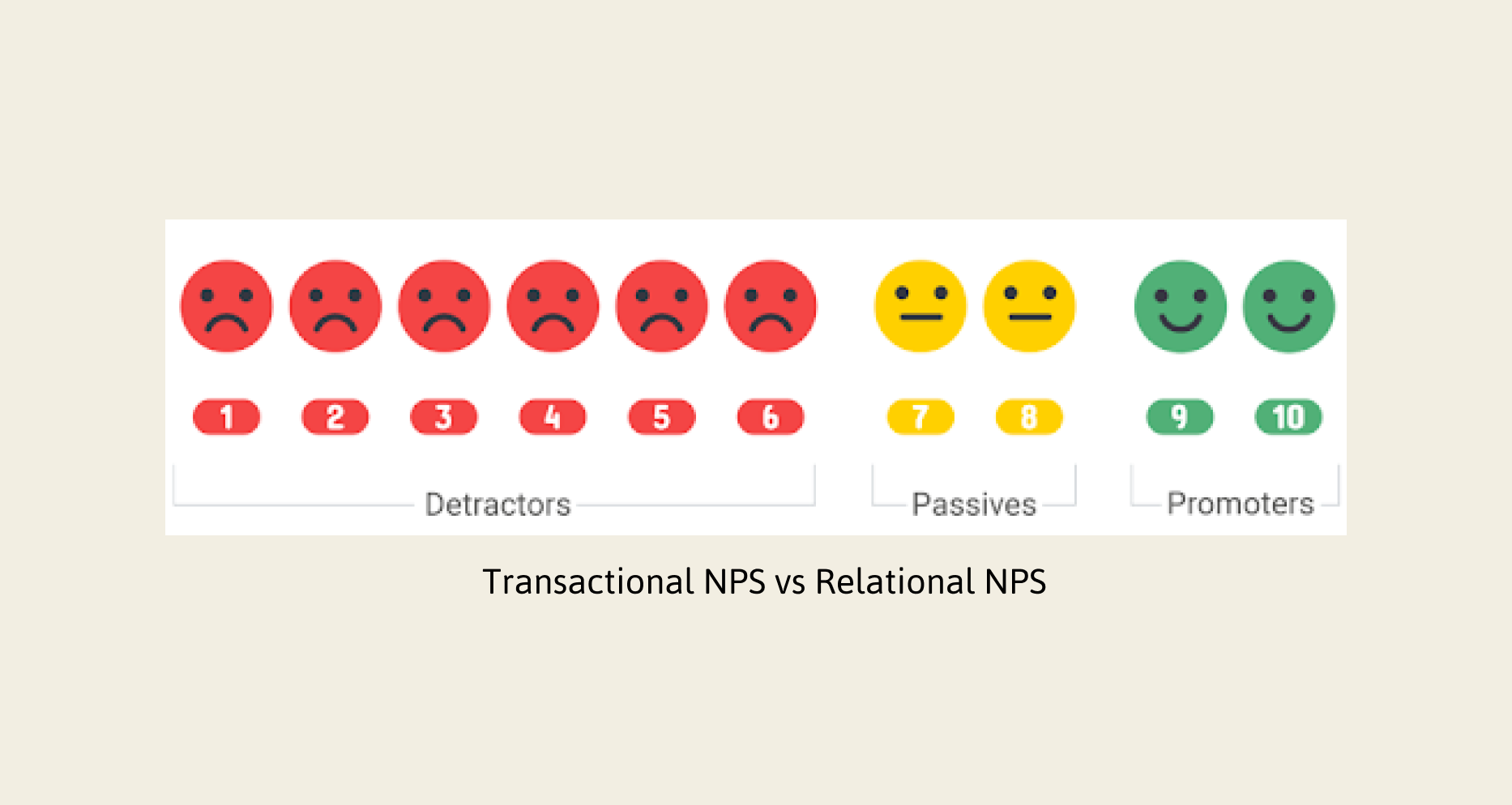
The NPS question itself stays the same: "On a scale of 0 to 10, how likely are you to recommend [company/product/service] based on your recent [interaction type]?" Respondents are grouped into Promoters (9–10), Passives (7–8), and Detractors (0–6). The math doesn't change. The timing does.
What is Net Promoter Score? A complete breakdown →
Transactional NPS vs. relational NPS: key differences
Most companies need both. But they answer different questions, run on different schedules, and tell you different things. Here's how they compare.
| Aspect | Transactional NPS (tNPS) | Relational NPS (rNPS) |
| Purpose | Measures satisfaction with a specific interaction | Measures overall brand loyalty and sentiment |
| Timing | Sent immediately after a touchpoint (within 24–48 hours) | Sent on a fixed schedule (quarterly, semi-annually, annually) |
| Frequency | Event-triggered — as often as interactions happen | Time-triggered — typically 2–4 times per year |
| Question framing | "Based on your recent [purchase/support call/onboarding]..." | "Overall, how likely are you to recommend [company]..." |
| Actionability | High — tied to a specific team, process, or moment | Moderate — shows trends but not root causes |
| Scope | Narrow — one touchpoint at a time | Broad — the entire customer relationship |
| Best used by | Support teams, product teams, operations | CX leadership, executive reporting, board-level metrics |
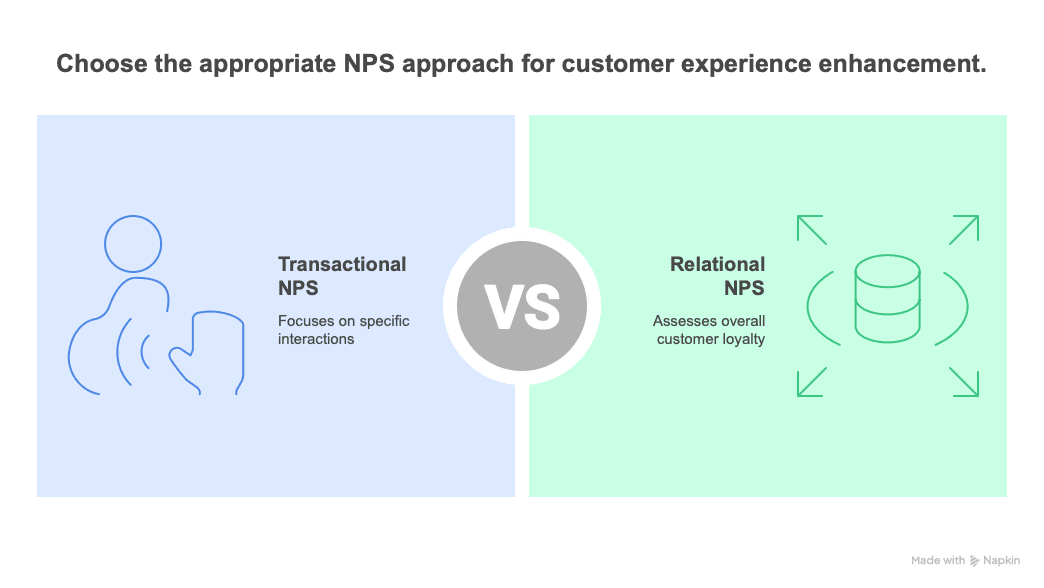
When to use both together: Start with relational NPS to understand your overall customer health. Then use transactional NPS to investigate the touchpoints that relational surveys flag as problems. A hotel chain, for example, might see relational NPS drop across a region — then use transactional surveys after check-in, room service, and checkout to find out where the experience breaks down.
Alaska Communications, a major internet provider, took exactly this approach. They started with relational surveys alone, realized they were missing recurring issues, and added transactional surveys. The tNPS data surfaced problems with installation quality and technician knowledge that never appeared in their quarterly scores.
Why transactional NPS surveys matter (and the data to prove it)
Bain & Company — the firm that co-created NPS — found that companies with the highest Net Promoter Scores in their industry grow more than twice as fast as competitors. That stat gets cited a lot, but here's what it means in practice for transactional NPS specifically:
Real-time issue detection. A quarterly NPS survey tells you something went wrong three months ago. A transactional survey tells you something went wrong this morning. That speed difference is the gap between losing a customer and saving one.
Touchpoint-level accountability. When you know that post-support tNPS is 22 but post-purchase tNPS is 61, you know where to invest. You can tie scores to specific teams, agents, or processes and make targeted improvements instead of launching broad, unfocused initiatives.
Churn prevention through closed-loop follow-up. Research from CustomerGauge shows that companies responding to detractors within 48 hours see a 6-point NPS lift. Transactional surveys make that timeline possible — you catch the dissatisfaction while the customer still cares enough to tell you about it.
Revenue impact. Companies that close the feedback loop have 3x more promoters at their next survey, according to CustomerGauge's 2025 data. Promoters buy more, stay longer, and refer others. The math works.
Reduced survey fatigue (counterintuitively). Because transactional surveys are short (one NPS question plus one follow-up) and contextually relevant (tied to something the customer just did), response rates tend to be higher than generic quarterly surveys. People are more willing to answer when the question is specific and the timing makes sense.
Bain & Company's research on NPS and growth →
| tNPS = % Promoters − % Detractors |
|---|
Here's a worked example:
You send a transactional NPS survey after customer support interactions. Out of 200 responses:
- 120 score 9–10 → Promoters (60%)
- 50 score 7–8 → Passives (25%)
- 30 score 0–6 → Detractors (15%)
tNPS = 60% − 15% = +45
Passives don't factor into the calculation directly, but don't ignore them. A passive is one bad experience away from becoming a detractor — and one good experience away from becoming a promoter.
What counts as a good transactional NPS score?
General benchmarks:
- Above 0 — More promoters than detractors. You're net positive.
- 0 to 30 — Decent. Room for improvement at specific touchpoints.
- 30 to 50 — Strong. Your interactions are generating loyalty.
- 50 to 70 — Excellent. Your customers are actively recommending you.
- Above 70 — World-class. Only about 3% of companies reach this level.
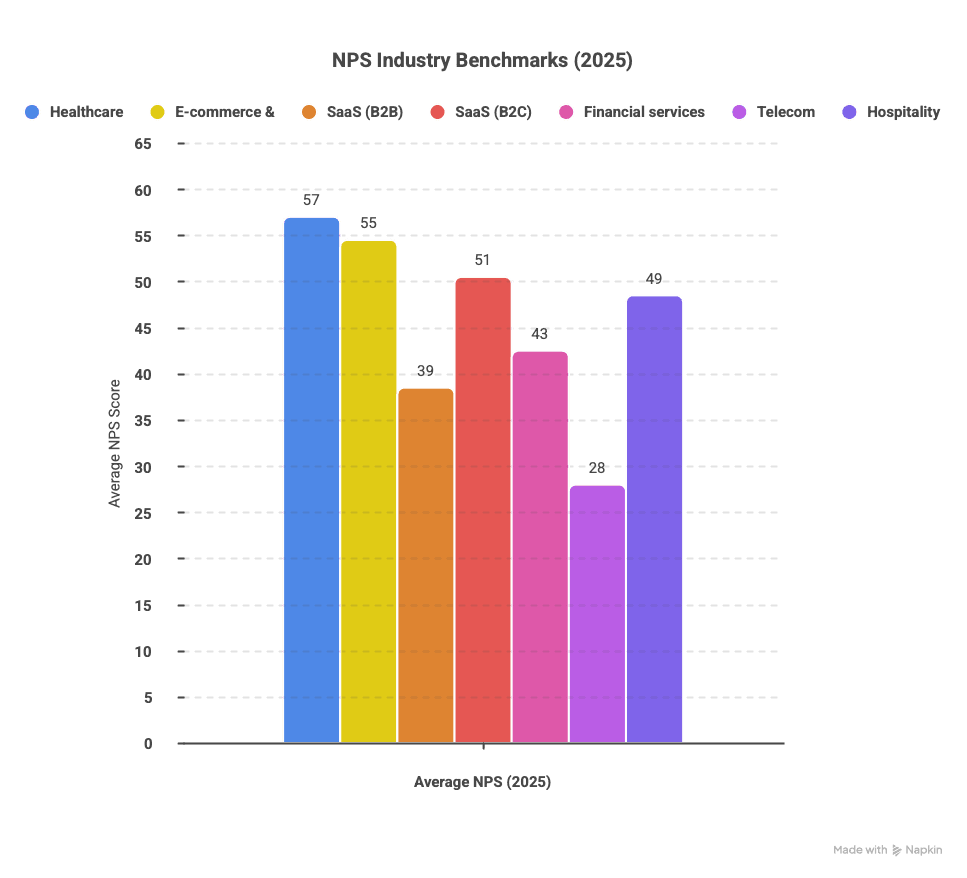
Industry NPS benchmarks (2025 data)
These are overall NPS benchmarks — your transactional scores will vary by touchpoint. Use these as directional context.
| Industry | Average NPS (2025) | Notes |
| Healthcare | 53–61 | Surpassed 50 threshold in 2025; strong growth trend |
| E-commerce & Retail | 54–55 | Steady; B2B and B2C scores nearly identical |
| SaaS (B2B) | 36–41 | Multi-stakeholder complexity suppresses scores |
| SaaS (B2C) | 47–54 | Simpler purchase decisions lift scores |
| Financial services | 41–44 | Trust, security, and pricing transparency are key drivers |
| Telecom | 25–31 | Pricing and service reliability remain pain points |
| Hospitality | 44–53 | Personalized experiences drive higher scores |
Sources: Retently 2025, Survicate 2025, CustomerGauge 2025, NPSpack 2025
NPS score interpretation: what your number actually means →
When to send transactional NPS surveys (7 key touchpoints)
Timing is the difference between useful feedback and noise. Here are seven touchpoints where transactional NPS surveys deliver the most value — with specific timing windows for each.
1. After a purchase or transaction
When to send: Within 24–48 hours of purchase confirmation (after delivery for physical goods).
Sample question: "Based on your recent purchase experience, how likely are you to recommend [company] to a friend or colleague?"
What it tells you: Whether your checkout flow, payment process, and initial delivery experience meet expectations. If this score is low but your product NPS is high, the problem is in the buying experience, not the product itself.
2. After a customer support interaction
When to send: Immediately after ticket closure or within 1 hour of a live chat/phone call ending.
Sample question: "Based on your recent support experience, how likely are you to recommend [company] to a friend?"
What it tells you: How well your support team resolves issues. This is one of the highest-impact touchpoints — a bad support experience can undo months of positive product experience. Compare scores across agents, channels, and issue types to spot patterns.
3. After onboarding or account setup
When to send: Within 24 hours of completing onboarding or guided setup.
Sample question: "Based on your onboarding experience, how likely are you to recommend [product] to a colleague?"
What it tells you: Whether your onboarding process sets customers up for success. Low tNPS here is an early warning: customers who struggle during onboarding are significantly more likely to churn within the first 90 days.
4. After a product update or feature release
When to send: 3–7 days after a major update (give customers time to use the new features).
Sample question: "After experiencing our latest update, how likely are you to recommend [product] to someone in your role?"
What it tells you: Whether product changes land well with your user base. This is particularly valuable for SaaS companies shipping frequent updates — it catches regressions before they show up in your quarterly scores.
5. After a plan upgrade or renewal
When to send: Within 48 hours of upgrade/renewal completion.
Sample question: "Based on your recent upgrade experience, how likely are you to recommend [product]?"
What it tells you: Whether the upgrade process was smooth and whether customers feel the new plan delivers on its promise. A low score here can signal pricing concerns or feature-expectation mismatches.
6. After delivery or fulfillment
When to send: 1–2 days after delivery confirmation (for e-commerce and logistics).
Sample question: "Based on your delivery experience, how likely are you to recommend [company] to a friend?"
What it tells you: Whether your fulfillment and shipping partners meet the standard your brand promises. Delivery is the last touchpoint before the customer uses your product — and first impressions from unboxing can shape the entire relationship.
7. After a demo or free trial experience
When to send: At the end of the trial period (or when the trial is 75% complete).
Sample question: "Based on your trial experience so far, how likely are you to recommend [product] to a colleague?"
What it tells you: Whether your trial experience demonstrates enough value to convert. Low tNPS at this stage predicts low conversion. High tNPS predicts both conversion and referral potential.
15+ transactional NPS survey questions (with templates)
The core NPS question is your anchor. But the follow-up questions are where the real insight lives. Here are 15+ questions grouped by touchpoint, each with the NPS question and 2–3 follow-ups.
Post-purchase questions
- "Based on your recent purchase, how likely are you to recommend [company] to a friend?" (0–10 scale)
- "What was the primary reason for your score?" (open-ended)
- "How would you rate the ease of our checkout process?" (1–5 scale)
- "Was there anything that almost stopped you from completing your purchase?" (open-ended)
Post-support questions
- "After your recent support interaction, how likely are you to recommend [company]?" (0–10 scale)
- "Was your issue fully resolved?" (Yes / No / Partially)
- "What could we have done differently?" (open-ended)
- "How would you rate the speed of our response?" (1–5 scale)
Post-onboarding questions
- "Based on your onboarding experience, how likely are you to recommend [product]?" (0–10 scale)
- "How confident do you feel using [product] after onboarding?" (1–5 scale)
- "What was the most confusing part of getting started?" (open-ended)
Post-update questions
- "After experiencing our latest update, how likely are you to recommend [product]?" (0–10 scale)
- "Which new feature is most valuable to you?" (multiple choice)
- "Is there anything the update broke or made harder?" (open-ended)
Post-renewal / upgrade questions
- "Based on your recent renewal/upgrade, how likely are you to recommend [product]?" (0–10 scale)
- "What was the main factor in your decision to renew/upgrade?" (open-ended)
- "Is there anything you expected from this plan that you haven't found yet?" (open-ended)
Post-delivery questions
- "Based on your delivery experience, how likely are you to recommend [company]?" (0–10 scale)
- "Did your order arrive in the expected condition?" (Yes / No)
- "How would you rate the packaging quality?" (1–5 scale)
Pro tip: Keep each transactional survey to 1 NPS question + 1–2 follow-ups maximum. Anything longer kills your response rate. If you need deeper insight on a specific touchpoint, run a separate, targeted survey for a smaller segment.
20+ NPS survey questions for every use case →
Transactional NPS survey best practices
Nail the timing
The ideal window varies by touchpoint, but the principle is the same: survey while the experience is still fresh. For support interactions, that means within an hour. For purchases, within 24–48 hours. For product updates, give it 3–7 days so customers have actually used the new features.
Keep it short
One NPS question. One open-ended follow-up. That's the sweet spot. CustomerGauge's research across thousands of NPS programs consistently shows that 2–3 questions produce the best combination of response rate and actionable data. Going beyond 6 questions drops response rates significantly.
Personalize the survey
Use the customer's name. Reference the specific interaction ("Based on your support call with Sarah on March 2nd..."). Personalized surveys feel less like mass blasts and more like genuine requests for feedback, which lifts both response rates and the quality of open-ended responses.
Deploy across multiple channels
Don't limit yourself to email. In-app surveys catch customers while they're using your product. SMS reaches mobile-first audiences. WhatsApp works well in markets where it's the dominant messaging platform. Web intercepts capture feedback from visitors who might not check email. The goal: reach customers on the channel they prefer, at the moment the experience is fresh.
Close the loop — and do it fast
This is the most important practice and the one most companies skip. When a detractor flags a problem, someone on your team needs to follow up within 24–48 hours. Not with a template email — with a genuine attempt to understand and fix the issue. Companies that do this see a 6-point NPS lift and 3x more promoters over time.
Cap survey frequency to avoid fatigue
If a customer interacts with your brand five times in a week, don't survey them five times. Set rules: maximum one tNPS survey per customer per 30 days (or per 14 days for high-frequency businesses). Prioritize surveying after the touchpoints that matter most.
A/B test delivery details
Test subject lines, send times, and channels. Small changes — like switching from "We'd love your feedback" to "How did we do today?" — can move response rates by 5–15%. Track what works for each segment and iterate.
- Failing to segment results by touchpoint. Blending all your transactional scores into one number defeats the purpose. The whole point of tNPS is touchpoint-level visibility. Report scores separately for each interaction type, and compare them over time.
- Not benchmarking over time. A tNPS of 35 means nothing without context. Is it up from 28 last quarter? Down from 42? Trending sideways? Set a baseline, track monthly, and watch the trajectory — not just the snapshot.
How to automate transactional NPS surveys (with SurveySparrow)
Running tNPS manually — creating surveys, sending them at the right time, routing responses, following up with detractors — doesn't scale. Once you're surveying across 3+ touchpoints with any real volume, you need automation.
Here's how it works in SurveySparrow:
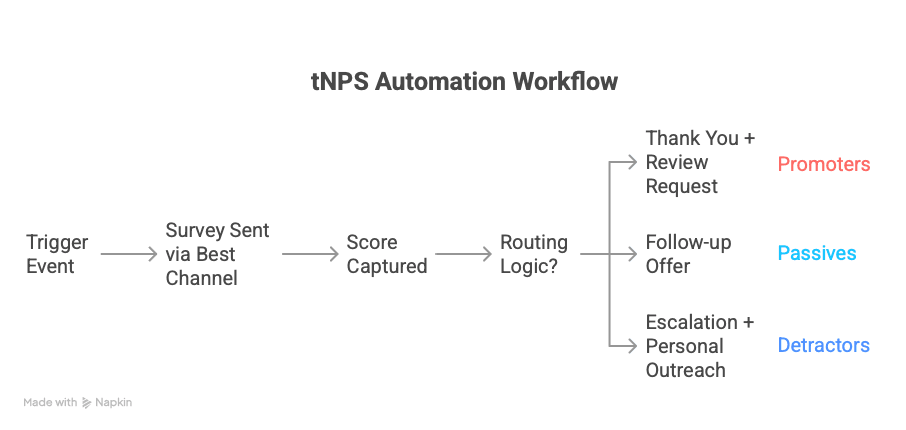
Trigger-based deployment. Connect SurveySparrow to your CRM (Salesforce, HubSpot), help desk (Zendesk, Freshdesk), e-commerce platform (Shopify), or any tool via Zapier. When a ticket closes, a purchase completes, or an onboarding flow finishes, the tNPS survey fires automatically — delivered through the channel the customer prefers.
SmartReach AI for timing and channel optimization. Instead of blasting every customer by email at 9 AM, SmartReach AI picks the right channel (email, SMS, WhatsApp, web) and the right moment for each customer. This alone moves response rates — because a survey that arrives on the right channel at the right time gets answered.
CogniVue for open-ended analysis. The NPS score tells you how customers feel. The open-ended follow-up tells you why. CogniVue scans all your open-text responses for sentiment, recurring themes, and the specific drivers behind your scores. No manual reading through hundreds of comments.

Automated action routing. Set rules: detractors (0–6) trigger an immediate alert to the account manager and create a ticket in your help desk. Passives (7–8) get a follow-up email with a specific offer or resource. Promoters (9–10) receive a thank-you and a prompt to leave a review. Every score drives an action, automatically.
Real-time dashboards. Track tNPS by touchpoint, by team, by time period. Spot drops the week they happen, not the quarter they compound. Share dashboards with the teams that own each touchpoint so they have direct visibility into how their work affects customer sentiment.
The result: a feedback loop that actually closes — where customer input becomes insight, insight becomes action, and action becomes improvement. That's the system, not just the survey.
Ready to automate your tNPS program?
14-day free trial • Cancel Anytime • No Credit Card Required • No Strings Attached
Transactional NPS survey templates you can use today
Here are three ready-to-use tNPS survey frameworks. Each one includes the NPS question, follow-up questions, and recommended delivery settings.
Template 1 — Customer NPS Survey Template

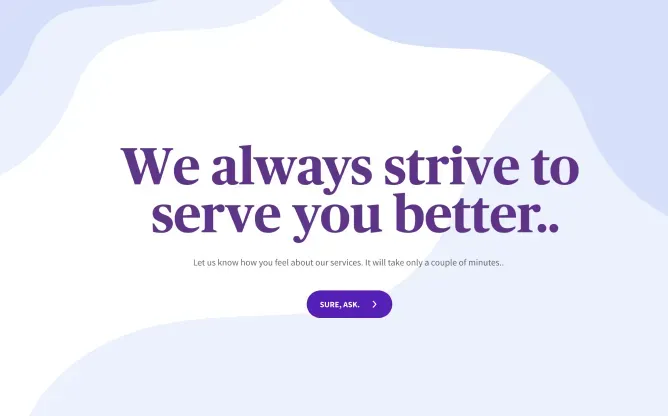
Trigger: Customer completes an interaction such as a purchase, service request, or support conversation
Timing: Within 24 hours of the interaction
Channel: Email, SMS, or in-app
Questions
- Based on your recent experience with [interaction], how likely are you to recommend [company] to a friend or colleague? (0–10)
- What was the primary reason for your score? (open-ended)
- What could we improve to make your experience better? (open-ended)
Template 2 — Product NPS Template
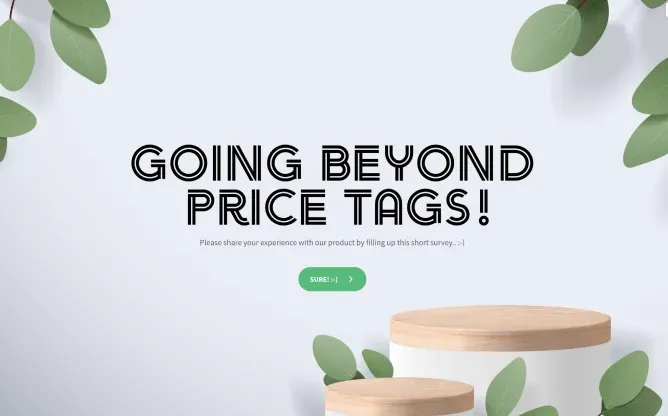
Trigger: User completes onboarding, finishes a trial period, or actively uses a product feature
Timing: After onboarding completion or meaningful product usage
Channel: In-app or email
Questions
- Based on your experience using [product], how likely are you to recommend it to a friend or colleague? (0–10)
- What is the main reason for your score? (open-ended)
- Which feature do you find most valuable in [product]? (open-ended)
Template 3 — Retail NPS Survey Template

Trigger: Customer completes a purchase, checkout, or store visit
Timing: 24–48 hours after purchase or delivery
Channel: Email or SMS
Questions
- Based on your recent shopping experience with [company], how likely are you to recommend us to a friend? (0–10)
- What part of your shopping experience stood out the most? (open-ended)
- How would you rate your overall purchase experience? (1–5)
Create your transactional NPS survey in minutes. SurveySparrow gives you conversational surveys, AI-powered analysis, and automated follow-up — all in one platform.
14-day free trial • Cancel Anytime • No Credit Card Required • No Strings Attached