What is SWOT analysis?
A SWOT analysis is a method to find a business’ position in the market in comparison with its competitors. It is commonly used when launching a new product, researching the market, and staying relevant and planning ahead during evolving market needs and landscape changes.
Definition: SWOT is a strategic management process of identifying a company’s competitive positioning in the market.
A SWOT analysis comprises 4 parts: strengths, weaknesses, opportunities, and threats - which helps a person understand a business’ position in the market compared to its competitors.
In other words, SWOT analysis helps identify an organization’s strengths, weaknesses, opportunities and threats for better decision-making.
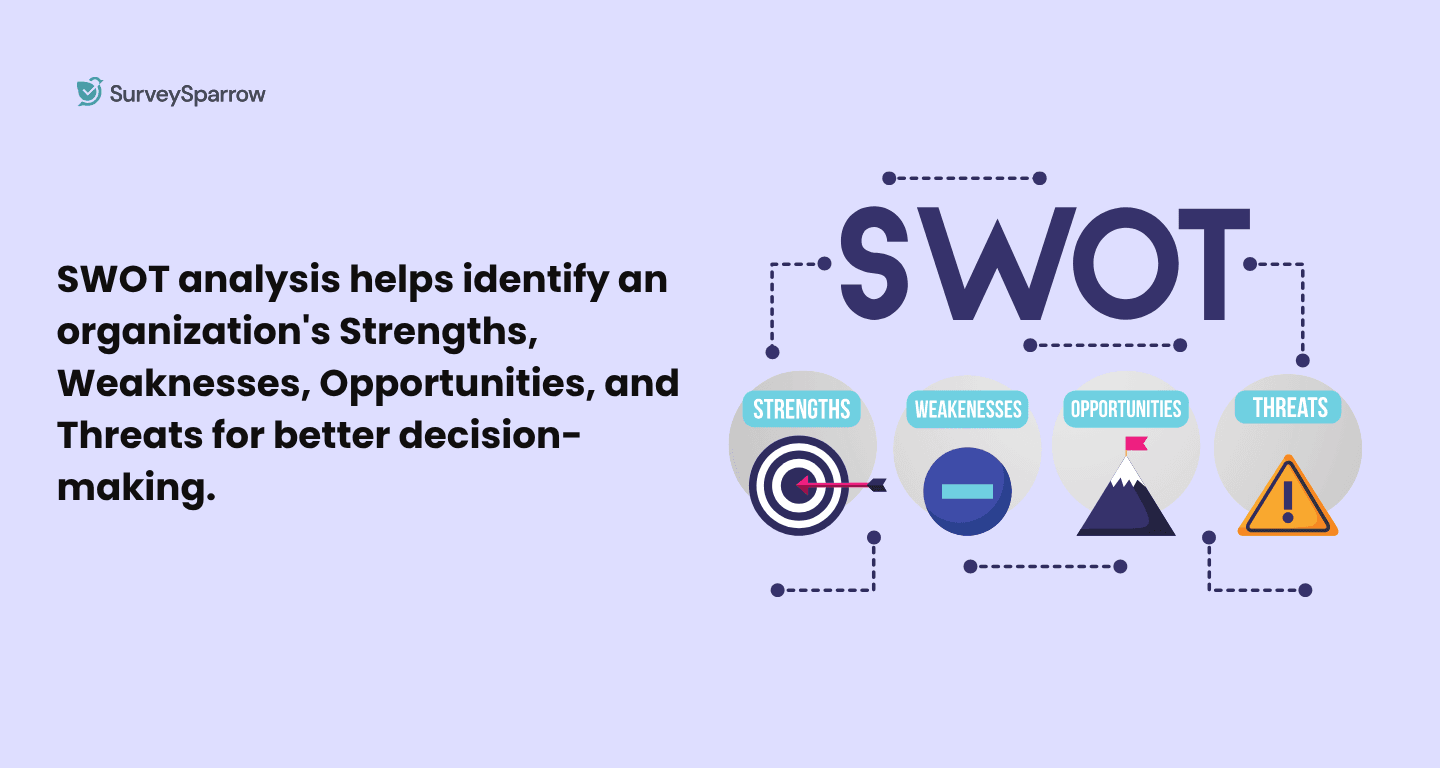
SWOT is not just used for organizations, but also for plans, strategies, and other business activities.
What does SWOT stand for?
SWOT stands for Strengths, Weaknesses, Opportunities, and Threats. Nowadays, it is also called situational analysis.
Source: https://en.wikipedia.org/wiki/SWOT_analysis
What are the 4 parts of a SWOT analysis?
The 4 parts of a SWOT analysis are:
- Strengths
- Weaknesses
- Opportunities, and
- Threats
These 4 parts comprise the SWOT method of understanding a company’s position in the market, and are influenced by internal and external factors.
Strengths and weaknesses are a company’s internal attributes, whereas opportunities and threats are influenced by external factors.
Strengths and opportunities help an organization achieve its objectives, whereas, weaknesses and threats are those that can prevent an organization from achieving them.
1. Strengths
Strengths are the best features and areas of a product/service that a company does well. In most cases, it consists of the USP or unique value proposition that a business offers.
To find your company’s strengths, you could ask yourself the following questions,
- What are we good at?
- What do we do best?
- What do our customers like best about us?
- What features of ours perform well in-comparison with our competitors?
For example: Most of our clients achieved 40% higher survey response rates using our platform.
2. Weaknesses
Weakness are the internal factors in a company that aren’t doing so well. It also consists of processes or features that are performing poorly and aren’t contributing to the business’ goals, and would need improvements to make them better.
In order to find your company’s weaknesses, you can begin by asking the following questions,
- What can be improved?
- Which processes or initiatives are not performing as expected?
- What reasons are causing these underperformance issues?
For example: Our website has less traffic and visibility because of a dysfunctional design, which provides a poor experience to users, and causes them to bounce. Engagement time on our site is less than 30 seconds.
3. Opportunities
Opportunities part of the SWOT analysis represents the area of scope that a company can see potential opportunities in, to grow, expand, or increase initiatives the benefit it.
In order to discover opportunities, begin by asking itself the following questions:
- What resources do we need to improve our processes?
- Are there any gaps in our business that our competition is doing and we aren’t?
- What is our current market share, and how can we increase it?
- What does our competition offer that is mediocre and we can capitalize on?
For example: Our digital marketing initiatives for our retail stores across the state aren’t getting as many leads. We can run ad campaigns, and offer a 30% discount for purchases above $100.
4. Threats
Threats are external factors that could negatively affect your business, project, or objectives.
These can include new competitors, changing customer behavior, economic conditions, regulatory changes, rising costs, technological shifts, or negative market trends.
To find threats, ask yourself the following questions:
- Who are our biggest competitors?
- What changes in our industry could affect us?
- What technologies could make our offering less relevant?
- What economic or regulatory changes could create risk?
For example: A new competitor offering a similar product at a significantly lower price could be a threat.
What is the purpose of a SWOT analysis?
A SWOT analysis gives companies a clear process about their position in the market, allowing for better decision making.
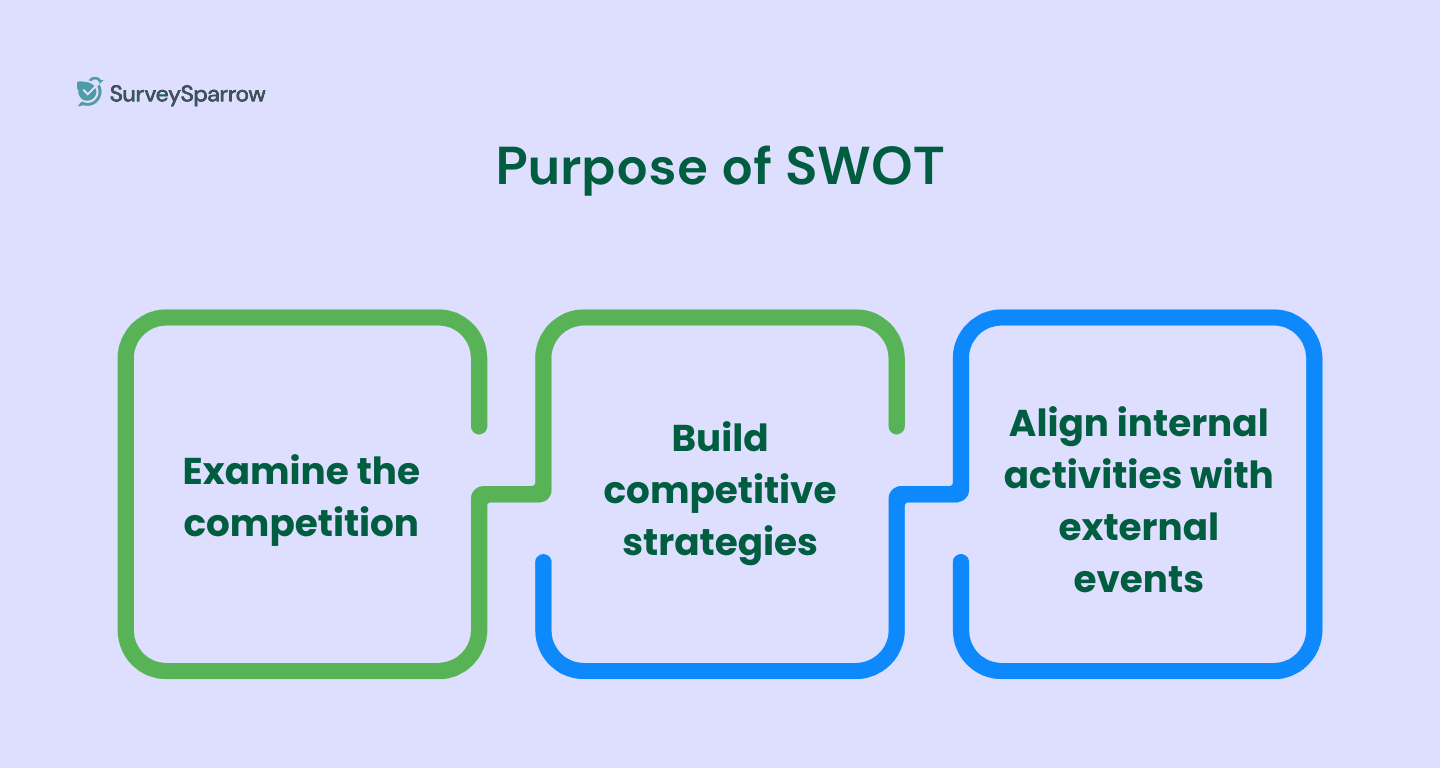
1. To examine the competition
A SWOT analysis maps your strengths and weaknesses against the opportunities and threats present in your competitive environment. This comparison reveals where you have an advantage over competitors, where you are vulnerable, and where gaps in the market exist that your business is positioned to fill.
2. Build competitive strategies
The output of a SWOT analysis is not just a list of internal and external factors, but a decision framework. Strengths, weakness, opportunities, and threats together gives leadership a factual basis for setting priorities and allocating effort.
3. Align internal activities with external events
Markets change all the time. A strategy built without awareness of external conditions (regulatory shifts, competitive moves, economic changes) risks investing internal resources in directions the environment no longer supports. A SWOT analysis connects what is happening inside the organization to what is happening outside it, so internal priorities stay relevant to the conditions the business actually operates in.
The purpose of SWOT in strategic planning
Strategic planning requires decisions — about where to invest, what to prioritize, and how to respond to market changes. The challenge is that those decisions are often made with incomplete information or internal bias. A SWOT analysis addresses that by giving teams a structured way to assess their position before committing to a direction.
In a strategic planning context, a SWOT analysis serves three specific functions. It surfaces the internal capabilities the organization can build a strategy around. It identifies the external conditions the strategy needs to account for. And it creates a shared understanding across teams — so leadership, product, marketing, and operations are all working from the same picture of where the business stands.
Without that shared picture, different teams build different strategies based on different assumptions. A SWOT analysis is what aligns them before the planning begins.
How to do a SWOT analysis?
SWOT can be done in 3 simple steps.
Step 1: Define your objective
Start with a specific question the analysis is meant to answer. For example, determining whether a company should launch a new product line in Q3 is a good objective. Focusing on a specific objective such as this keeps the analysis useful and ensures every finding connects to a real decision.
Step 2: Gather your resources
A SWOT analysis is only as reliable as the data behind it. Before you begin, identify what information you have access to, where the gaps are, and how reliable your external sources are.
This also means involving the right people. Different teams hold different information. A customer success team, for example, has direct visibility into recurring complaints, churn reasons, and unmet customer needs. Identifying who holds what information before you start ensures the right people are involved from the beginning.
A. Map out internal and external factors
Internal factors are things within your control — your team's capabilities, your technology, your processes, and your finances. External factors are things outside your control — competitor moves, market trends, regulatory changes, and shifts in customer behavior. You can identify the external factors using the PESTLE analysis.
Internal factors:
- Team skills and capabilities
- Existing technology and tools
- Business processes and workflows
- Financial position and budget
- Brand reputation and customer relationships
- Product or service quality
External factors:
- Competitor activity and positioning
- Market trends and shifts in customer behavior
- Regulatory or legal changes
- Economic conditions
- Emerging technologies
- New market opportunities
For example, a SaaS company preparing for a product launch might identify a strong existing customer base as an internal strength, and an increasing number of new competitors entering the market as an external threat. Mapping both sets separately before combining them keeps the analysis organized and clear.
B. Run a brainstorming session
Invite people from across the business — product, sales, marketing, customer success, and operations. A SWOT analysis built by one team alone could produce many blind spots. It is best to obtain input from multiple teams, helping surface factors that would otherwise be missed.
C. Compile and prioritize ideas
Collect every idea raised without filtering during the brainstorm. Once everything is on the table, evaluate each factor as a group. Ask two questions: how significant is the impact, and how confident are we in the evidence?
Prioritize the factors that score well on both. A short list of well-evidenced findings is more useful than a long list of uncertain ones. Then identify the best working ideas to support your main objective.
Step 3: Use your findings to develop a strategy
The four quadrants of a SWOT analysis point to four strategic directions:
- Strengths + Opportunities — where to invest and grow
- Strengths + Threats — where to use existing advantages to manage risk
- Weaknesses + Opportunities — where to improve internally to capture available opportunity
- Weaknesses + Threats — where you are most exposed and need to act first
For example, a company with strong brand recognition that spots a new competitor targeting its customers might use that combination to invest in a loyalty program.
Example of SWOT on Apple Inc.
Strengths
- World's most recognized brand. Apple is the world's most valuable brand in 2026, with a brand value of $608 billion, up approximately 11% from the previous year.
- Tightly integrated ecosystem. Apple's ecosystem lock-in has been one of its defining strengths, creating durable competitive advantages across hardware, software, and services.
- Strong financial position. Apple posted record revenue of $111.2 billion in Q2 fiscal 2026, up 17% year over year, with iPhone revenue hitting $57.99 billion and Services reaching an all-time high of $30.98 billion.
Weaknesses
- iPhone revenue dependence. iPhone remains Apple's largest revenue segment by far, creating significant concentration risk.
- Premium pricing limits market reach. Apple's premium pricing strategy limits accessibility for a significant portion of potential customers.
- Manufacturing concentration risk. Apple faces heavy dependence on China for manufacturing, creating supply chain vulnerability.
- Leadership transition risk. Apple is undergoing its first CEO change in 15 years, with Tim Cook stepping down and John Ternus named as the next CEO — a transition that carries execution risk during a period of regulatory pressure and AI competition.
Opportunities
- Services revenue expansion. Apple's annual revenue reached $435.62 billion, with services emerging as a key growth driver alongside hardware.
- Emerging markets. Apple has promising growth opportunities in emerging markets where smartphone penetration is still growing.
- Spatial computing and AR. Apple has the opportunity to establish a market standard in spatial computing before competitors dominate the category.
- Engineer-led AI acceleration. The new CEO John Ternus, a 25-year Apple hardware veteran, brings a mandate to accelerate Apple Intelligence and fix Siri 2.0 — positioning Apple to compete more effectively in the AI era.
Threats
- Regulatory pressure. Regulators are forcing Apple to allow sideloading and third-party app stores in the EU, switch to USB-C, and let developers point users to outside payment options — each change chipping away at the ecosystem lock-in that has been one of Apple's defining strengths.
- AI competition. In January 2026, Apple signed a roughly $1 billion-per-year deal to license Google's Gemini models to power a rebuilt Siri — a rare admission that it could not build the capability itself.
- Regional competition. Huawei has resurged in China and overtaken Apple in global smartwatch shipments, with strong domestic appeal presenting a real headwind for Apple in that market.
- Geopolitical risk. Currency fluctuations impact Apple's revenue, as the company earns over 60% of its revenue from international markets.
Sources:
- rankred.com/apple-swot-analysis
- boardmix.com/analysis/what-is-apple-swot-analysis
- marketing91.com/swot-analysis-apple
- invetso.com/swot-analysis/aapl
- pitchgrade.com/companies/apple
- swotpal.com/examples/apple
- swotpal.com/blog/apple-swot-analysis-2026
- companieshistory.com/apple-swot-analysis
- businessmodelanalyst.com/apple-swot-analysis
What are common mistakes in a SWOT analysis?
A SWOT analysis is most useful when it is honest, specific, and focused on a real business decision. Here are some common mistakes that can make a SWOT analysis less useful.
Listing too many factors
A SWOT matrix with 20 items in each section is not necessarily better. It can make the analysis difficult to understand and use.
Focus on the factors that matter most to the decision you are trying to make. As a general rule, aim for five to seven of the most important points in each section and remove anything that is less relevant.
Being too vague
Avoid using broad statements that do not provide enough information.
For example, saying "Good customer service" is too vague. A more useful entry would be "92% customer satisfaction across 10,000 support interactions in the last quarter."
Specific information makes it easier to understand what the strength or weakness actually is and decide what to do about it.
Confusing internal and external factors
It is easy to mix up the four parts of a SWOT analysis.
Strengths and weaknesses are internal. They are factors within the business's control, such as skills, resources, processes, or technology.
Opportunities and threats are external. They come from outside the business, such as changes in customer needs, competitors, regulations, or the market.
Keeping this distinction clear makes the analysis more accurate.
Only including positive points under strengths
Teams may be tempted to highlight their strengths and downplay their weaknesses, especially when the SWOT analysis will be shared with leadership.
But a useful SWOT analysis needs to be honest. Identifying weaknesses does not make the business look bad. It helps the team understand where problems may exist and what needs attention.
Ignoring a weakness does not make it go away. It may simply become a bigger problem later.
Treating the SWOT analysis as the strategy
A SWOT analysis helps inform a strategy, but it is not the strategy itself.
The findings should be used to make a specific decision, set priorities, or decide what the business should do next.
For example, if a SWOT analysis shows that a new market is a strong opportunity, the next step could be to research that market and create a plan to enter it.
Running it with only one team
A SWOT analysis created by one department may only show one side of the business.
For example, a sales team may focus heavily on new market opportunities, while a finance team may focus more on costs and financial risks.
Including people from different teams gives you a broader view of the business. Sales, marketing, finance, product, customer support, and leadership may all identify different strengths, weaknesses, opportunities, and threats.
Using outdated data
A SWOT analysis is only as useful as the information behind it.
Using last year's sales numbers, an old list of competitors, or outdated customer feedback can lead to conclusions that no longer reflect the current situation.
Before starting the analysis, make sure you are using recent and relevant data. This could include current sales figures, customer feedback, market research, competitor information, and other recent business data.
When is the best time to conduct a SWOT analysis?
A SWOT analysis is most useful when you are facing an important decision or a change in direction.
Here are some situations where a SWOT analysis can help:
Before launching a new product or service.
A SWOT analysis can help you determine whether your business has the people, skills, technology, and resources needed to support the launch. It can also help you understand market conditions and identify competitors or other risks you should prepare for.
Before entering a new market.
Entering a new country, targeting a new customer group, or expanding into a new market comes with unknowns. A SWOT analysis helps your team identify what you already know, what you still need to learn, and what risks you should consider before making the investment.
At the start of annual planning.
Doing a SWOT analysis at the beginning of your annual planning process gives everyone a shared view of where the business stands. Different teams may have different ideas about the company's strengths, weaknesses, and challenges. A SWOT analysis brings these views together and gives the team a common starting point for planning.
When a major competitor makes a move.
A new competitor entering the market, a competitor launching a major product, or a competitor suddenly lowering its prices can change the competitive landscape. A focused SWOT analysis can help your team understand what has changed and decide how to respond.
When business performance is declining.
If sales, customer retention, or another important business metric is falling and you are not sure why, a SWOT analysis can help uncover possible causes. It can highlight internal weaknesses or external threats that may be contributing to the problem.
When should you not use a SWOT analysis?
A SWOT analysis is not useful for every decision.
If a decision has already been made and the team is only using a SWOT analysis to justify it, the exercise is unlikely to provide much value.
It is also not the best tool for small, tactical decisions, such as choosing which marketing campaign to run or which vendor to use. These decisions are usually too narrow to require a full strategic analysis.
Use a SWOT analysis when you need to step back, understand the bigger picture, and make a meaningful strategic decision.
How do you turn a SWOT analysis into an action plan?
A SWOT matrix shows where your business stands. An action plan turns those findings into specific next steps.
Step 1: Connect the four areas
Look for connections between the quadrants:
- Strengths + Opportunities: Use your strengths to pursue growth opportunities.
- Strengths + Threats: Use your strengths to reduce or respond to risks.
- Weaknesses + Opportunities: Fix weaknesses that could prevent you from capturing opportunities.
- Weaknesses + Threats: Address areas where your business is most vulnerable.
Turn each important connection into a specific action with an owner and deadline.
Step 2: Prioritize your actions
You cannot act on everything at once. Rank each action based on:
- Impact: How much value or risk reduction could it create?
- Feasibility: Can you realistically do it with your current resources?
Focus first on actions that are both high-impact and achievable.
Step 3: Assign ownership and deadlines
Give every action a clear owner and a deadline or review date. This makes someone accountable for moving it forward and gives the team a way to track progress.
For example, if strong brand recognition is a strength and a new competitor targeting your customers is a threat, an action could be:
"Launch a customer loyalty program by Q4, owned by the Head of Customer Success, with a progress review at the end of Q3."
That is an action plan. "Use our brand strength to respond to the competition" is not.
The goal is to turn SWOT findings into specific actions the business can take.
What is a TOWS matrix and how is it different from SWOT?
A TOWS matrix builds on a completed SWOT analysis. While SWOT identifies your strengths, weaknesses, opportunities, and threats, TOWS helps you turn those findings into strategic actions.
TOWS looks at four types of strategies:
| Opportunities (O) | Threats (T) | |
|---|---|---|
| Strengths (S) | SO strategies: Use strengths to capture opportunities | ST strategies: Use strengths to defend against threats |
| Weaknesses (W) | WO strategies: Improve weaknesses to capture opportunities | WT strategies: Reduce weaknesses and protect against threats |
SWOT vs. TOWS
The simplest way to remember the difference is:
- SWOT: Where do we stand?
- TOWS: What should we do about it?
SWOT is used to understand the current situation. TOWS uses those findings to develop strategic options.
The TOWS matrix is particularly useful in strategic planning sessions where the team needs to move from analysis to decision quickly. It gives every factor in the SWOT matrix a strategic role.
In other words, SWOT comes first. TOWS comes next.
In conclusion
A SWOT analysis is most useful when it is specific, evidence-based, and connected to a decision.
SWOT gives the leadership of a company a structured basis for making strategic decisions with confidence.
The four quadrants of SWOT do not make the decision for you. They organize what you already know, surface what you have been overlooking, and make the right path forward more visible than it was before you started.
If you are running a SWOT analysis as part of a broader research or planning effort, gathering reliable customer and market data is often the hardest part. SurveySparrow makes that step easier — use it to collect customer feedback, run market research surveys, and gather the data your SWOT analysis needs to be credible.

Get the market insights your SWOT analysis is missing.
TRUSTED BY BEST-IN-CLASS BRANDS




![11 Best Live Chat Software for CX And CS Teams [2026]](/_next/image/?url=https%3A%2F%2Fsurveysparrow.com%2Fwp-content%2Fuploads%2F2020%2F03%2F10-Best-Live-Chat-Software-in-2020.png&w=3840&q=75 "11 Best Live Chat Software for CX And CS Teams [2026]")