

Market research has always been resource-intensive.
Designing questionnaires, collecting responses, analyzing data, and translating findings into decisions. When this is done manually, it could takes weeks and consume a huge budget.
AI has changed that calculus in ways that are now measurable and well-documented.
AI-powered analytics generates insights 5x faster than traditional methods. (Tableau, 2025)
The ability to analyze large datasets in real time, detect sentiment patterns across thousands of responses, and generate predictive models without a team of data scientists has made AI market research tools one of the most consequential investments available to research, marketing, and strategy teams in 2026.
This guide covers 15 of the most capable AI tools for market research available today. For each tool, we cover key features, ideal use cases, and pricing, so you can make a decision based on what your team actually needs.
What is an AI Market Research Tool?
An AI market research tool is a software platform that uses artificial intelligence capabilities like machine learning, natural language processing, and predictive analytics, to collect, process, and interpret market data faster and at greater scale than traditional research methods allow.
Where conventional market research relies on manual survey design, data cleaning, and analyst-led interpretation, AI tools automate the time-consuming parts of that process. They can identify patterns across thousands of responses, detect sentiment shifts in real time, flag emerging trends before they become mainstream, and generate predictive models based on historical and live data without requiring a dedicated data science team to operate them.
The AI-based market research tool category however, is broad. Some tools focus specifically on survey automation and response analysis, whereas others specialize in social listening, competitive intelligence, web scraping, qualitative data analysis, or predictive modeling.
Most businesses use a combination of these tools depending on their research objectives.
What they share is the ability to compress the distance between raw data and actionable insight, giving research, marketing, and strategy teams the information they need to make better and faster decisions.
Top 15 AI Tools For Market Research
Here’s a table for a quick sneak peek
| Tool | Unique Feature | Suitable For | Starting Price | Free Version |
|---|---|---|---|---|
| SurveySparrow | AI Survey, AI-Text analytics | Global Surveys | $19/month | Yes |
| Hotjar | Heat maps | Website Analysis | $32/month | Yes |
| Appen | Data Annotation | AI Training | Contact for Quote | Yes |
| Consensus | Integrated Data Fusion | Comprehensive Insights | $8.99/month | Yes |
| ChatGPT | Conversational Analytics | Dynamic Interaction | Contact for Quote | Yes |
| Poll The People | Crowdsourced Decision Making | Instant Feedback | $50/month | No |
| Speak | Sentiment Analysis | Customer Conversations | $17/month | No |
| Pecan | Predictive Analytics | Future-focused Analysis | $50/month | No |
| Crayon | Real-time Market Monitoring | Competitor Analysis | Contact for Quote | No |
| Wevo | AI-Powered Testing | Quick Insights | Contact for Quote | No |
Brandwatch | Social Listening & Sentiment Analysis | Real-Time Sentiment Tracking | Contact for Quote | No |
Quantilope | Automated Survey Research & Predictive Insights | AI-Assisted Study Design | Contact for Quote | No |
Zappi | Concept Testing & Ad Performance Evaluation | AI Quick Reports, Creative Testing, Audience Targeting | Contact for Quote | No |
| Perplexity AI | Secondary Research & Competitive Intelligence | Real-Time Web Search With Cited Sources | $20/month | Yes |
Attest | Consumer Research With Built-In Quality Controls | AI-Automated Survey Analysis, Demographic Filtering | Contact for Quote | No |
Now, let’s get started with the first in the lot…
1. SurveySparrow: For Customer Feedback and XM

Most survey tools collect data. SurveySparrow helps you understand it. The platform combines conversational survey design with AI-powered analytics, giving research and customer experience teams the ability to collect high-quality feedback and surface the insights behind it — without switching between tools.
SurveySparrow's conversational survey format consistently achieves completion rates up to 40% higher than traditional form-based surveys. For market research teams, that difference is significant. A 40% lift in completion rates on a sample of 1,000 respondents means 400 more data points — without expanding the sample size or the budget.
Key Features
- AI Survey Builder: Generate a complete survey from a single prompt using Wings AI. The builder suggests question types, structures the flow, and optimizes for completion — reducing design time from hours to minutes.
- CogniVue: SurveySparrow's AI-powered text analytics engine automatically analyzes open-ended responses at scale, identifying recurring themes, sentiment patterns, and key drivers behind scores. Manual coding of qualitative data becomes unnecessary.
- Echo: SurveySparrow's conversational AI agent understands the reasoning behind every customer rating and autonomously probes deeper, so you always get the complete story rather than a surface-level score.
- Omnichannel Distribution: Deploy surveys across email, SMS, in-app, web, QR code, and WhatsApp from a single platform. Response data aggregates automatically regardless of channel.
- CSAT, NPS, and CES Built In: Run satisfaction, loyalty, and effort surveys at every stage of the customer journey with pre-built templates and automated scheduling.
- Real-Time Dashboards: Monitor response patterns, sentiment shifts, and key metrics as data comes in with customizable dashboards that surface what matters most to your specific research objective.
- Integrations: Connects natively with Salesforce, HubSpot, Slack, Microsoft Teams, Intercom, and 1,500+ other tools via Zapier.
Best Use Cases
- Customer satisfaction and NPS research at scale
- Product feedback collection and feature prioritization
- Employee engagement surveys with qualitative follow-up
- Market research studies requiring high completion rates and deep open-ended analysis
- Ongoing voice of customer programs that need automated insight generation
Pricing
SurveySparrow offers a free plan with core features. Paid plans start at $19/month for the Basic plan. The CX Suite, which includes CSAT, NPS, and CES capabilities starts at $249/month. Enterprise and custom pricing is available for larger teams.

All-in-one research tool. Conduct Conjoint, MaxDiff and Pricing Analyses with Ease.
TRUSTED BY BEST-IN-CLASS BRANDS


2. Hotjar: For Website Behavior and UX Research

Hotjar is an all-in-one analytics and feedback tool that helps businesses understand and analyze user website behavior. It gives you insights into what users click on, where they move their mouse, and how they scroll through your web pages.
This information helps businesses improve their websites to make them more user-friendly.
Key Features
- Heatmaps: Hotjar generates visual heatmaps showing where users click, move, and scroll on your website. This helps identify the most engaging and problematic areas of your pages.
- Session Recordings: Record and play back videos of real users interacting with your website so you can see how they navigate it. This feature helps uncover usability issues and understand user journeys.
- Feedback Polls and Surveys: This lets you create simple surveys on your website to ask users about their experiences or preferences. You can gather direct feedback from users to understand their preferences, pain points, and opinions.
- User Recruitment and Testing: With Hotjar, you can recruit and test users for feedback on new features, designs, or prototypes.
- Conversion Funnels: This shows users’ steps on your website before completing a goal (like making a purchase), helping you understand where they might drop off. This feature is essential for optimizing the user journey and increasing conversion rates.
G2 Rating: 4.3 (300+ Reviews)
Capterra Rating: 4.7 (500+ Reviews)
Best Use Cases
- UX research and website optimization
- Conversion rate optimization informed by real behavioral data
- Identifying friction points in checkout and lead generation flows
- Complementing survey-based market research with behavioral context
- Product teams validating design decisions before and after release
Pricing
- Free Forever Plan: 35 daily sessions
- Paid plan starts at $32 /month
3. Appen: For High-Quality AI Training Data and Annotation

Appen helps organizations build and maintain the high-quality labeled datasets that AI models require to function reliably. For companies developing proprietary AI research tools, building machine learning models for consumer behavior prediction, or requiring large volumes of accurately annotated data, Appen provides the human-in-the-loop data quality that automated annotation alone cannot consistently deliver.
Key Features
- Data Annotation: Label text, image, audio, and video data across a wide range of annotation types including sentiment classification, named entity recognition, image segmentation, and speech transcription. Annotation workflows are configurable to match the specific requirements of each AI model or research application.
- Data Collection: Gather original data at scale across languages, regions, demographics, and device types. Particularly valuable for organizations building multilingual NLP models or requiring regionally diverse training datasets that a single-market panel cannot provide.
- Quality Assurance: Appen applies multiple layers of quality control including contributor skill assessments, inter-annotator agreement measurement, and automated anomaly detection. Data quality is validated before delivery rather than corrected after.
- Crowd Management: Access a pre-vetted global contributor network with documented expertise across languages, industries, and annotation specializations. Contributors are matched to tasks based on demonstrated competency rather than availability alone.
- Model Evaluation: Test and evaluate existing AI models against human judgment at scale. Identify where models are underperforming across demographic groups, languages, or edge cases before deployment.
- Appen Platform: A centralized interface for managing annotation projects, tracking contributor performance, monitoring quality metrics, and integrating labeled data directly into AI development pipelines.
G2 Rating: 4.2/5 (20+ Reviews)
Capterra Rating: 4.8/5 (30+ Reviews)
Best Use Cases
- Building and maintaining training datasets for proprietary AI market research models
- Multilingual data collection for global consumer research applications
- Evaluating AI model performance against human judgment before production deployment
- Organizations requiring large volumes of precisely labeled data across diverse demographic groups
- Companies developing speech recognition, sentiment analysis, or computer vision capabilities for research applications
Pricing
- Free Version: No
- You can request a consultation with their team
4. Consensus: For Comprehensive Insights

Market research frequently requires grounding in published science, understanding what peer-reviewed literature says about consumer behavior, psychological drivers of decision-making, or the documented effects of pricing strategies. Doing that manually means hours of searching, reading, and synthesizing across academic databases. Consensus automates that process using AI trained specifically on scientific literature.
The platform searches across more than 200 million peer-reviewed papers, extracts the relevant findings, and synthesizes them into clear, cited answers to natural language questions.
Key Features
- AI-Powered Paper Search: Ask a research question in natural language and Consensus searches its database of peer-reviewed papers to surface the most relevant findings. Results are ranked by relevance and scientific credibility rather than recency alone.
- Consensus Meter: For questions with a body of scientific evidence behind them, Consensus displays the degree of agreement or disagreement across published studies — giving researchers an immediate read on how settled or contested a topic is in the academic literature.
- Study Snapshots: Each paper in the results set is accompanied by an AI-generated summary of its key findings, methodology, and conclusions — eliminating the need to read full papers to determine relevance.
- Copilot Integration: Consensus integrates with Microsoft Copilot, allowing researchers to surface peer-reviewed insights directly within their existing Microsoft 365 workflow without switching platforms.
- Citation Export: Export citations in standard academic formats for use in research reports, presentations, and literature reviews.
- GPT-4 Powered Synthesis: Premium users access GPT-4-powered synthesis that aggregates findings across multiple papers into a single, coherent summary — compressing what would otherwise be a multi-hour literature review into minutes.
G2 Rating: 5/5 (2 Reviews)
Capterra Rating: 4.9/5 (180+ Reviews)
Best Use Cases
- Validating research hypotheses against published scientific evidence
- Building evidence-based frameworks for consumer behavior analysis
- Literature reviews supporting market research reports and strategy documents
- Understanding the academic consensus on psychological or behavioral drivers relevant to your market
- Research teams that need to cite peer-reviewed sources rather than secondary industry reports
Pricing
- Free Plan: Yes, 20 AI credits per month
- The Premium Plan costs $8.99 / month
5. ChatGPT: for Conversational Analytics

ChatGPT is a cutting-edge market research tool transforming how businesses engage with data. It uses the power of conversational AI to facilitate insightful interactions, making market research more accessible and dynamic.
Key Features
- Language Adaptability: It’s more like talking to a language expert. ChatGPT understands and adapts to different ways people ask questions. This versatility makes it easier for users to communicate and extract precise information.
- Data Pattern Analysis: Paste structured data, survey results, or qualitative feedback directly into the interface and ask ChatGPT to identify patterns, summarize themes, or generate insights. Effective for smaller datasets where a dedicated analytics platform is not available or necessary.
- Report Drafting: Generate first drafts of research reports, executive summaries, competitive analyses, and presentation narratives based on data and findings you provide. Significantly reduces the time between analysis and communication.
- Persona Development: Describe your target market and ChatGPT generates detailed consumer personas including demographic profiles, behavioral patterns, motivations, and pain points. Useful for early-stage research and briefing creative teams.
- Competitive Analysis Frameworks: Generate structured frameworks for analyzing competitors, market positioning, pricing strategies, and product differentiation based on information you provide or publicly available data.
- GPT-4o with Web Browsing: ChatGPT Plus users access real-time web browsing through GPT-4o, enabling the tool to pull current information from the web and cite sources — extending its usefulness for secondary research and competitive intelligence gathering.
G2 Rating: 4.7/5 (500+ Reviews)
Capterra Rating: 4.6/5 (50+ Reviews)
Best Use Cases
- Generating survey question drafts and research briefs quickly
- Synthesizing large volumes of qualitative feedback into themes
- Drafting research reports, executive summaries, and presentations
- Exploratory competitive analysis and market landscape mapping
- Consumer persona development for briefing creative and strategy teams
- Brainstorming research hypotheses before designing formal studies
An Important Limitation
ChatGPT generates responses based on its training data, which has a knowledge cutoff date. It does not access real-time market data, proprietary consumer databases, or verified research panels. Treat its outputs as a starting point for research and analysis, not as verified, citable findings. For research requiring current data, verified sources, or statistically reliable consumer insights, pair ChatGPT with specialist tools like Brandwatch, Attest, or SurveySparrow.
Pricing
ChatGPT offers a free tier with access to GPT-4o at limited capacity. ChatGPT Plus costs $20 per month, providing priority access to GPT-4o, web browsing, image generation, and access to the GPT Store. Team plans start at $25 per user per month. Enterprise pricing is available on request.
6. Poll The People: For Instant Feedback

Speed is the defining advantage of Poll the People. For marketing and product teams that need directional consumer input before committing to a campaign, a product launch, or a significant creative investment, Poll the People provides a fast, accessible alternative to full-scale research studies.
The platform is built around simplicity; researchers without formal market research training can design and launch a study in minutes and receive actionable results the same day.
Key Features
- AI-Powered Analysis: Once responses are collected, Poll the People's AI automatically analyzes results and generates a written summary of key findings, patterns, and recommendations. Researchers receive not just data but an interpreted narrative they can act on immediately.
- Concept Testing: Test product concepts, brand names, taglines, pricing structures, and campaign ideas against a real consumer panel before committing resources to development or production. Results arrive within hours rather than days.
- Demographic Targeting: Filter your panel by age, gender, location, income, education, and other demographic variables to ensure responses reflect your actual target audience rather than a generic population sample.
- A/B Testing: Compare two versions of a creative asset, message, or concept directly against each other to determine which performs better with your target demographic before launch.
- Ad and Creative Testing: Evaluate advertising concepts, visual assets, and campaign messaging against consumer panels to identify which elements resonate and which create friction — before media spend is committed.
- Qualitative Follow-Up: Supplement quantitative poll results with open-ended questions that capture the reasoning behind consumer preferences — adding depth to directional data.
G2 Rating: 4.5/5 (10 Reviews)
TrustRadius: 8.5/10 (10+ Review)
Best Use Cases
- Rapid concept testing before product development or campaign launch
- A/B testing of creative assets, messaging, and positioning statements
- Early-stage market validation for new product ideas or brand extensions
- Marketing teams needing fast consumer input without a formal research team
- Agencies testing creative work before presenting to clients
Pricing
- Free version: No
- Lite Plan for $1 per response (pay-as-you-go)
- The Plus Plan is priced at $50/Month
7. Speak: For Sentiment Analysis

Speak automatically transcribes audio and video files, applies natural language processing to extract themes, sentiment, and key topics, and organizes findings into searchable, shareable repositories, compressing what would otherwise be weeks of manual analysis into hours of automated processing.
For market research teams that conduct customer interviews, focus groups, usability studies, or any research that generates spoken or recorded data, Speak converts raw qualitative material into structured, analyzable insight without requiring a dedicated analyst to process every session manually.
Key Features
- Automated Transcription: Upload audio or video files in any format and Speak generates accurate transcripts automatically. The platform supports bulk uploads, allowing research teams to process large volumes of recorded material simultaneously rather than sequentially.
- NLP Insight Extraction: Once transcribed, Speak's natural language processing engine automatically identifies key themes, sentiment patterns, named entities, and topic trends across the full dataset. Researchers receive a structured analysis of the content rather than a raw transcript that still requires manual coding.
- Magic Prompts: Ask the dataset questions in natural language without writing your own analysis framework from scratch. Magic Prompts allow researchers to query their qualitative data conversationally, effectively interviewing the dataset rather than manually reviewing every transcript.
- Web Scraping: Extend analysis beyond internally collected data by scraping web pages, news articles, online reviews, and competitor content for text analysis. Useful for competitive intelligence and brand sentiment research that goes beyond owned customer data.
- Visual Research Repositories: Organize transcripts, audio files, and analytical outputs into interactive repositories with deep search, media playback, and visualization capabilities — making qualitative findings accessible and shareable across the organization.
- Zoom and Vimeo Integration: Connect directly with Zoom and Vimeo to import recorded sessions automatically without manual file management. Particularly useful for teams conducting regular customer interviews or remote usability studies.
- Sentiment Analysis: Identify not just what respondents said but how they felt when they said it — surfacing emotional patterns across large volumes of qualitative data that manual analysis consistently underestimates.
G2 Rating: 4.9/5 (15+ Reviews)
Speak has no reviews on Capterra
Best Use Cases
- Scaling qualitative research without scaling the analyst headcount required to process it
- Customer interview and focus group analysis at volume
- Usability study transcription and theme extraction
- Brand sentiment research using scraped online content
- UX and product research teams processing large volumes of recorded user sessions
- Organizations building searchable repositories of customer interview data for ongoing reference
Pricing
- Free Version: No
- A Pay-as-you-go plan is there
- The Pricing Plan starts at $17/month
8. Pecan: For Predictive Analytics & Consumer Behavior Forecasting

Pecan is an AI tool for market research that’s all about looking ahead with its Predictive GenAI.
Pecan's SQL-based interface and automated modeling pipeline make predictive analytics achievable for analysts with standard data skills, without requiring Python proficiency, machine learning expertise, or a dedicated engineering resource to help produce models.
Key Features
- Automated Predictive Modeling: Pecan's AI automatically selects the most appropriate modeling approach for each prediction task, trains models against historical data, validates performance, and generates production-ready predictions without requiring manual feature engineering or model selection by the research team.
- SQL-Based Notebooks: Analysts interact with the platform using SQL, a language already familiar to most data and research teams rather than requiring Python or R proficiency. This lowers the technical barrier to predictive analytics substantially without reducing model sophistication.
- Churn Prediction: Identify customers at risk of churning before they leave, with enough lead time to intervene. Pecan models churn probability at the individual customer level, allowing retention teams to prioritize outreach based on predicted risk rather than reactive signals.
- Conversion Prediction: Score prospects and leads by their probability of converting, enabling sales and marketing teams to concentrate effort on the opportunities most likely to close rather than treating all prospects as equally valuable.
- Demand Forecasting: Model future demand for products, services, or market categories based on historical patterns, seasonal signals, and behavioral indicators; supporting inventory planning, pricing decisions, and go-to-market timing.
- Marketing Mix Optimization: Forecast the expected return on different marketing investment scenarios before committing budget, based on historical performance data and predictive modeling of channel effectiveness.
- Model Monitoring: Track the ongoing performance of deployed predictive models in production, with automated alerts when model accuracy degrades, ensuring predictions remain reliable as market conditions and consumer behavior evolve.
G2 Rating: 4.8/5 (10+ Reviews)
There is only one review on Capterra for Pecan.
Best Use Cases
- Customer churn prediction and proactive retention strategy
- Lead scoring and conversion probability modeling for sales teams
- Demand forecasting for product and inventory planning
- Marketing budget allocation based on predicted channel return
- Market segmentation based on predicted future behavior rather than past behavior alone
- Organizations with substantial historical transaction or behavioral data seeking to convert it into forward-looking insight
Pricing
- Free plan: No
- You can use the calculator and pay-as-you-go
- The Starter plan is priced at $950/month
9. Crayon: For Real-Time Market Monitoring

Crayon is a premier AI market research tool that delivers profound insights to businesses seeking clarity. It is a comprehensive solution, decoding market trends and providing real-time intelligence to drive informed decision-making. It is a go-to tool to get a sense of the market.
Key Features
- Real-Time Competitor Tracking: Crayon monitors competitor digital footprints continuously across websites, social media, review platforms, job boards, and news sources. Changes are detected and surfaced as they happen rather than discovered weeks later during a scheduled competitive review.
- AI-Powered Insight Summaries: Crayon's AI synthesizes activity into actionable intelligence, summarizing what changed, why it might matter, and what response it may warrant. Analysts receive interpreted insight rather than a feed of unprocessed signals.
- Competitive Battlecards: Generate and maintain dynamic competitive battlecards that sales teams can use in live deals, covering competitor strengths, weaknesses, positioning, pricing, and common objections. Battlecards update automatically as Crayon detects relevant competitive changes rather than requiring manual maintenance.
- Win/Loss Analysis: Connect competitive intelligence with deal outcome data to understand which competitor moves correlate with wins and losses in your pipeline. This closes the loop between market monitoring and revenue impact in a way that most competitive intelligence programs never achieve.
- Customizable Alerts: Configure alerts for specific competitor activities, a pricing page change, a new product announcement, a significant shift in messaging, so the right people receive relevant intelligence without having to monitor the platform manually.
- Market Trend Tracking: Monitor broader market signals beyond direct competitors, industry publications, analyst reports, regulatory developments, and category-level trends to maintain a complete picture of the competitive environment rather than just direct rival activity.
- Integrations: Connects with Salesforce, HubSpot, Slack, Microsoft Teams, and Highspot, delivering competitive intelligence directly into the workflows where sales, marketing, and product teams are already operating.
G2 Rating: 4.6/5 (300+ Reviews)
Capterra: 4.6/5 (6 reviews)
Best Use Cases
- Sales enablement through dynamic, automatically updated competitive battlecards
- Marketing teams monitoring competitor messaging, positioning, and campaign activity
- Product teams tracking competitor feature releases and roadmap signals from public sources
- Strategy teams conducting ongoing competitive landscape analysis without manual monitoring
- Win/loss analysis programs connecting competitive intelligence to deal outcomes
- Organizations in fast-moving markets where competitor activity changes frequently and response speed matters
Pricing
- Free Plan: No
- You can request the team for a detailed quote
10. Wevo: For AI-Powered Testing

Getting consumers to a landing page, a product page, or a checkout flow is one challenge. Understanding why they convert or abandon once they arrive is another. Wevo addresses the second problem, combining AI-powered UX analysis with a human panel of real respondents to evaluate digital experiences before they go live, when changes are still cheap to make rather than after launch, when fixing problems costs significantly more.
Key features
- AI-Powered Page Analysis: Wevo's AI analyzes digital experiences against a database of UX best practices and consumer behavior patterns, identifying friction points, clarity issues, and conversion barriers before a single real user sees the page.
- Human Panel Validation: AI findings are validated by a panel of real respondents drawn from Wevo's managed research panel — adding the human context and nuance that automated analysis cannot reliably produce on its own. Panel responses are collected and analyzed within days rather than weeks.
- Sentiment Mapping: Respondents annotate specific elements of the page with sentiment indicators, showing which sections generate positive reactions and which create confusion, hesitation, or disengagement. The resulting sentiment map gives design and copy teams precise, element-level feedback rather than general impressions.
- Competitive Page Benchmarking: Compare your digital experience against competitor pages using the same respondent panel and evaluation framework, producing a benchmarked assessment of where your experience leads and where it falls short relative to direct alternatives.
- Journey Testing: Evaluate multi-step user journeys - onboarding flows, checkout sequences, sign-up processes. Identify where drop-off occurs across the full journey rather than optimizing individual pages without understanding the flow between them.
- Diagnostic Question Sets: Wevo's research framework includes pre-validated diagnostic questions developed to surface UX issues consistently across different types of digital experiences, reducing the research design burden on teams without dedicated UX research expertise.
- Prioritized Recommendations: Findings are delivered as a prioritized list of improvements ranked by expected impact on conversion and experience quality, giving design and product teams a clear, actionable starting point rather than a comprehensive list of observations with no indication of where to begin.
G2 Rating: 4.7/5 (70+ Reviews)
Wevo does not have reviews on Capterra or Trust Radius.
Best Use Cases
- Pre-launch UX testing of landing pages, product pages, and conversion flows
- Competitive benchmarking of digital experiences against direct alternatives
- Onboarding and sign-up flow optimization before release
- Marketing teams evaluating campaign landing pages before media spend is committed
- Product teams validating redesigns against original experiences with real respondents
- Organizations without dedicated UX research teams that need structured, expert-validated insights
Pricing
- Free Plan: No
- Request the team for a quote
11. Brandwatch: For Social Listening and Brand Sentiment Analysis at Scale
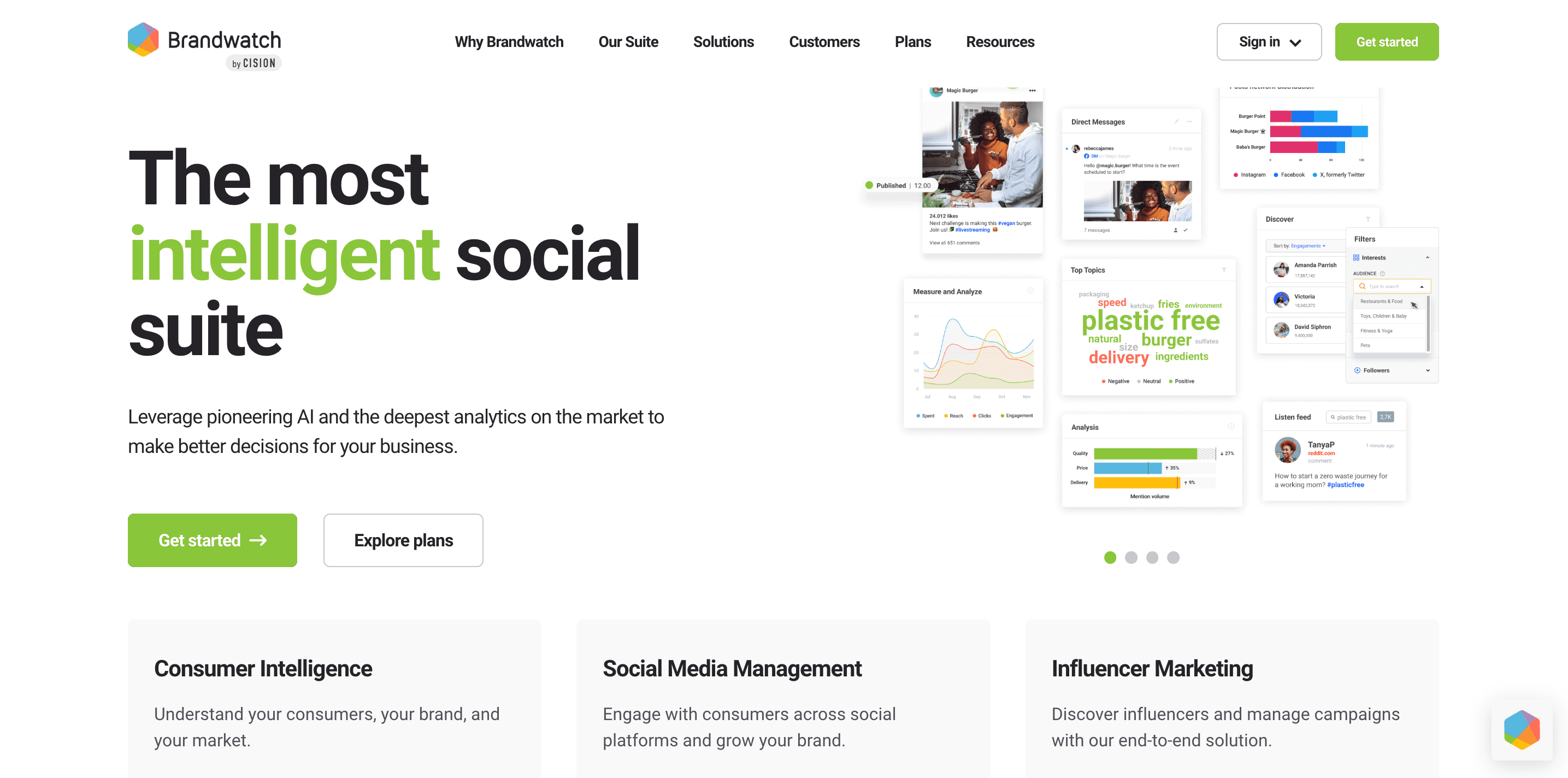
Consumer conversations about your brand, your competitors, and your category happen continuously across social media, forums, review sites, news publications, and blogs, most of them outside any channel your organization directly monitors.
Brandwatch tracks all of it.
Brandwatch processes over 500 million online sources in real time, applying AI to identify brand mentions, detect sentiment shifts, surface emerging topics, and flag potential crises before they reach the scale that makes them difficult to contain.
Key Features
- Real-Time Social Listening: Monitor brand mentions, competitor activity, industry conversations, and emerging topics across 500 million+ sources simultaneously. Coverage spans social media platforms, forums, review sites, news publications, blogs, and online communities, updated in real time.
- AI-Powered Sentiment Analysis: Brandwatch's AI classifies the sentiment behind every mention, positive, negative, or neutral, and goes beyond simple classification to identify the specific topics, emotions, and themes driving sentiment in each direction.
- Consumer Intelligence: Brandwatch's consumer research capabilities extend beyond brand monitoring to broader audience intelligence, understanding the demographics, interests, behaviors, and values of specific consumer segments based on their organic online activity
- Crisis Detection and Alerting: Automated alerts notify relevant teams when mention volumes, sentiment scores, or specific keywords cross defined thresholds, providing early warning of emerging issues before they reach mainstream media coverage or viral scale.
- Competitive Intelligence: Monitor competitor brands, campaigns, and products with the same analytical depth applied to your own brand. Track share of voice, sentiment comparison, and campaign performance against direct competitors across all monitored channels simultaneously.
- Trend Analysis: Identify emerging consumer trends, topics, and conversations before they reach mainstream awareness — giving product, marketing, and strategy teams early signals that inform positioning and investment decisions before competitors identify the same opportunities.
- Image and Visual Analytics: Detect brand logo appearances in images and videos across social media, capturing brand exposure in visual content where text-based monitoring would produce no signal. Particularly valuable for brands with strong visual identity in user-generated content.
- Integrations: Connects with Salesforce, HubSpot, Slack, Microsoft Teams, Tableau, and major marketing and analytics platforms delivering social intelligence into the workflows where decisions are made rather than keeping it siloed in a standalone research tool.
G2 Rating: 4.2/5 (1700+ Reviews)
Capterra Rating: 4.2/5 (200+ Reviews)
Best Use Cases
- Brand health monitoring and ongoing reputation management
- Crisis detection and early warning systems for reputation risk
- Competitive intelligence through share of voice and sentiment benchmarking
- Consumer trend identification and early signal detection
- Campaign performance measurement across earned and social media
- Audience intelligence for market segmentation and persona development
- Product research through analysis of unsolicited consumer feedback about category products
Pricing
Brandwatch does not offer a free plan or publicly listed pricing. The platform is positioned as an enterprise solution with pricing reflecting the scale of data access and analytical capability it provides. Industry sources indicate pricing typically begins in the range of $1,000 to $3,000 per month for mid-market implementations and scales significantly for enterprise deployments requiring broader data access, additional users, and dedicated support.
Contact Brandwatch directly for a custom quote.
12. Quantilope: Best for Automated Survey Research and Predictive Consumer Insights
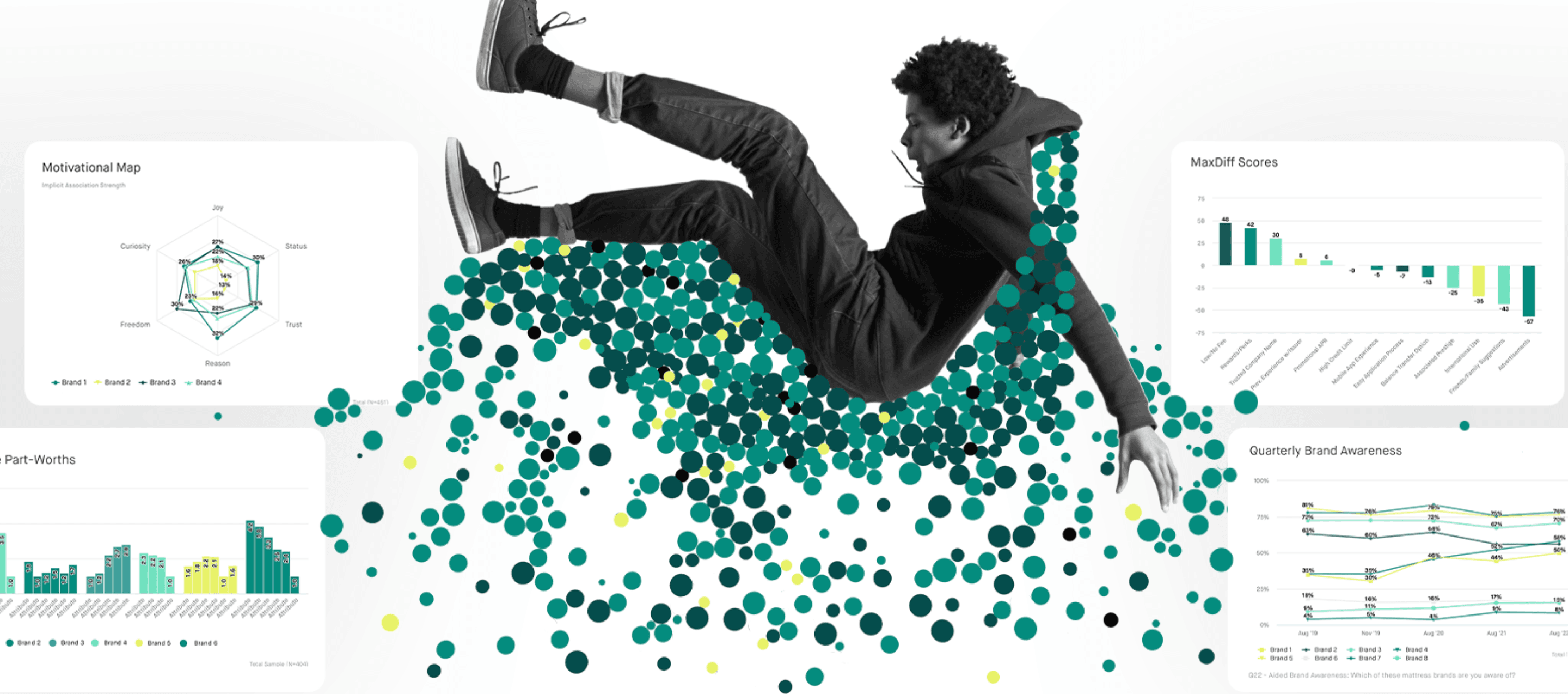
Traditional quantitative market research involves a sequence of manual steps, study design, questionnaire development, sample sourcing, fieldwork management, data processing, statistical analysis, and report production, each requiring specialist expertise and collectively consuming weeks of calendar time. Quantilope automates the majority of that sequence, compressing the time from research question to validated consumer insight from weeks to days without requiring a team of research specialists to operate it.
Key Features
- Automated Research Methodologies: Quantilope's library of pre-validated research methodologies covers the most common quantitative market research applications including conjoint analysis, MaxDiff, TURF analysis, implicit association testing, and standard survey research.
- AI-Assisted Study Design: Quantilope AI guides researchers through study design decisions; question wording, response option structure, logical sequencing, and sample size recommendations, reducing the risk of methodological errors that compromise data quality.
- Automated Reporting: Once fieldwork closes, Quantilope automatically generates research reports with pre-populated charts, statistical outputs, and insight summaries.
- Real-Time Dashboards: Monitor fieldwork progress, response quality, and emerging data patterns in real time during data collection, enabling researchers to identify and address quality issues during fieldwork rather than discovering them during analysis.
- Panel Access: Quantilope integrates with major consumer research panels, providing access to representative samples across key markets without requiring researchers to source and manage panel relationships independently.
- Brand Tracking: Deploy continuous brand health studies that track awareness, perception, and competitive positioning over time with automated analysis that identifies statistically significant changes without requiring manual comparison of wave-by-wave results.
- Concept and Product Testing: Test new product concepts, packaging designs, pricing structures, and positioning statements against consumer panels using validated methodologies that produce comparable, benchmarkable results across studies.
- Collaboration Tools: Share live dashboards, draft studies, and research outputs across teams with role-based access controls, enabling research, marketing, and product teams to engage with findings directly.
G2 Rating: (4.3/5 40 reviews)
No Capterra Ratings
Best Use Cases
- Brand health tracking and competitive positioning measurement over time
- Concept testing and product validation before development investment
- Pricing research using conjoint and MaxDiff methodologies
- Market segmentation studies requiring statistically robust consumer profiling
- Organizations conducting regular quantitative research that want to reduce time-to-insight without reducing methodological quality
- Research teams scaling their output without proportionally scaling headcount
Pricing
Quantilope does not offer a free plan or publicly listed pricing. Pricing is based on study volume, methodology complexity, sample size, and the number of markets covered. Contact Quantilope directly for a custom quote. The platform is positioned for mid-market and enterprise research teams running multiple studies per year rather than organizations with occasional, one-off research needs.
13. Zappi: For Concept Testing and Ad Performance Evaluation
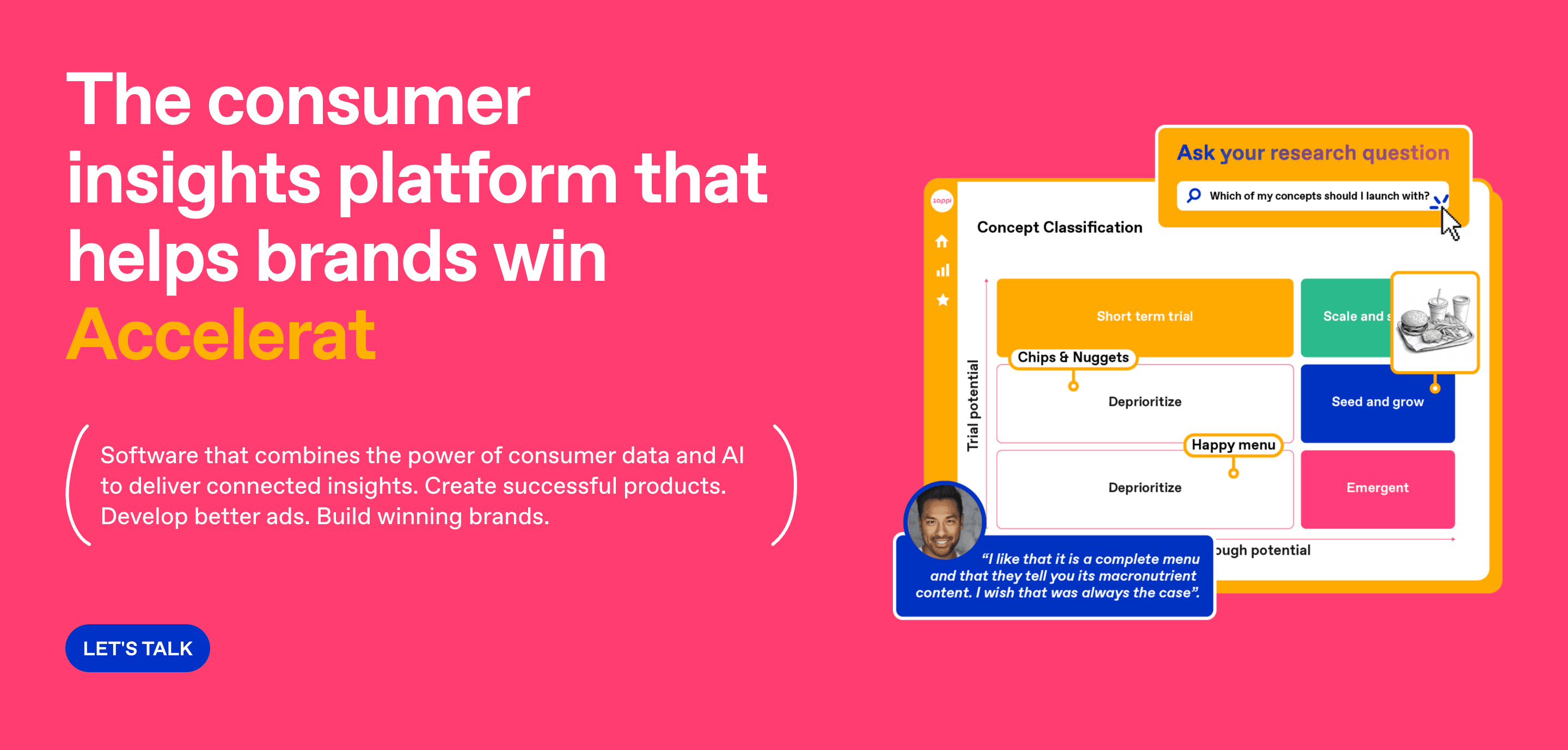
Zappi reduces the financial risk of failed campaigns by testing creative assets, product concepts, and advertising ideas against real consumer panels before resources are committed, delivering validated consumer feedback at a speed that fits into modern marketing and product development timelines.
Best Features
- AI Quick Reports: Zappi's AI automatically analyzes study results and generates a written report summarizing key findings, consumer reactions, and improvement recommendations. Research teams receive interpreted insight immediately after fieldwork closes.
- Ad Testing: Evaluate advertising concepts, scripts, and finished creative assets against consumer panels before media spend is committed. Zappi measures emotional response, message clarity, brand linkage, and purchase intent, producing a multi-dimensional assessment of ad effectiveness.
- Concept Testing: Test new product concepts, brand extensions, packaging designs, and positioning statements against targeted consumer panels. Results identify which concepts generate the strongest purchase intent and what specific elements drive or undermine consumer enthusiasm.
- Audience Targeting: Access consumer panels segmented by demographic, behavioral, and psychographic variables, ensuring study respondents match the actual target audience for the concept or creative being tested.
- Normative Benchmarking: Compare study results against Zappi's database of historical ad and concept tests to understand whether a concept is performing above or below category norms. Benchmarking converts absolute scores into relative assessments of competitive strength.
- Iterative Testing: Test multiple versions of a concept or creative asset in rapid succession, using early results to inform refinements before committing to a final direction. The platform's speed makes iterative testing practical within standard campaign development timelines.
- System 1 and System 2 Measurement: Zappi measures both fast, intuitive consumer reactions and slower, deliberate evaluations, capturing the full spectrum of consumer response to creative and concept stimuli.
G2 Rating: 4.6/5 (15 Reviews)
Not enough review on Capterra
Best Use Cases
- Pre-launch advertising effectiveness research across TV, digital, and social formats
- Product concept validation before development investment
- Packaging and design testing with targeted consumer panels
- Brand extension testing to evaluate consumer fit with the parent brand
- Iterative creative development using rapid consumer feedback loops
- Marketing teams that need consumer-validated creative decisions within campaign development timelines
Pricing
Zappi does not offer a free plan or publicly listed pricing. Pricing is based on study volume, sample size, and the methodologies required. Contact Zappi directly for a custom quote.
14. Perplexity AI: Best for Secondary Research and Competitive Intelligence Gathering
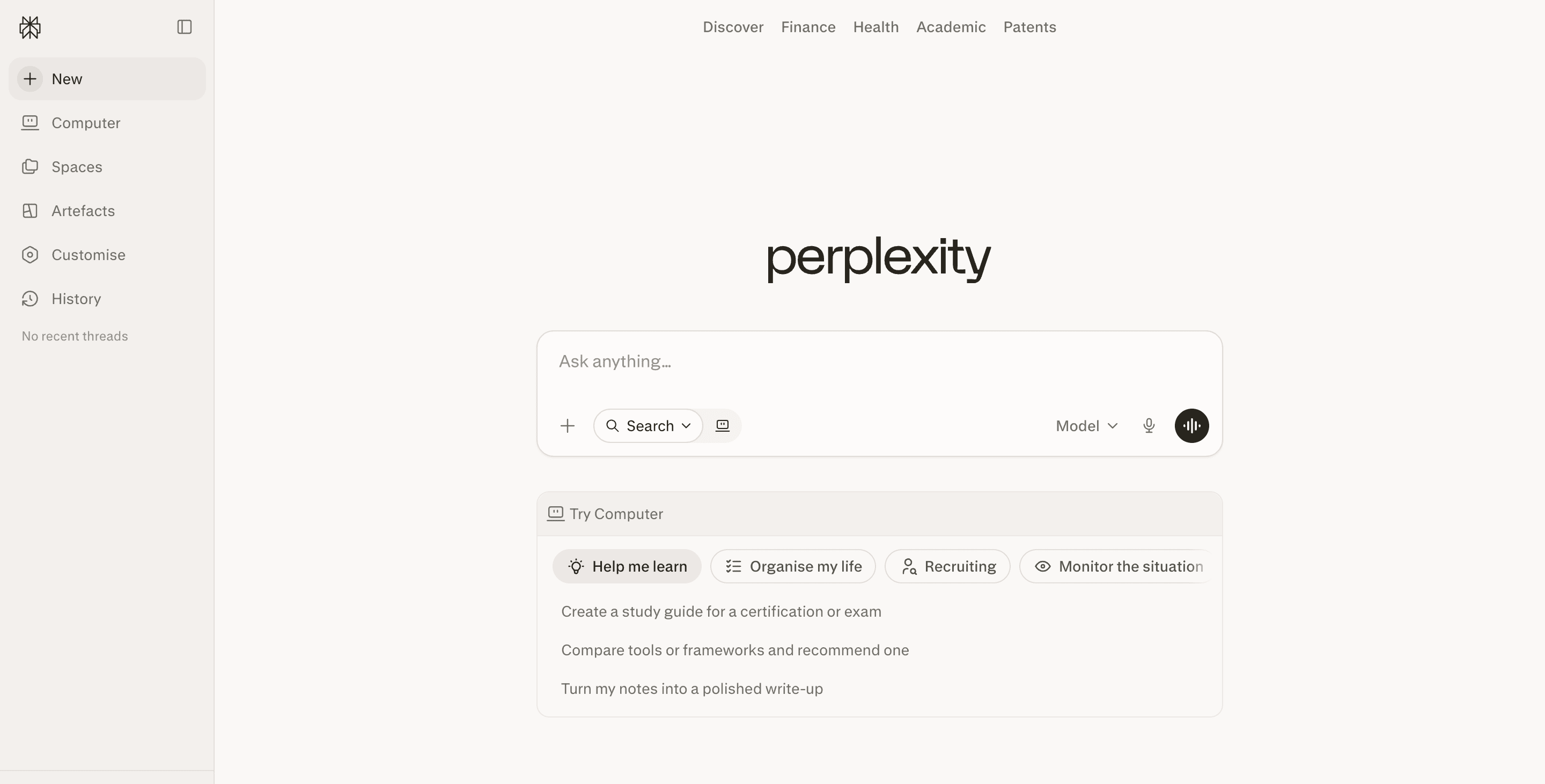
Perplexity functions as an AI-powered research assistant that searches the web in real time, reads and synthesizes content from multiple sources simultaneously, and delivers findings with direct citations that researchers can verify. Every answer includes links to the original sources it drew from a critical distinction from general-purpose AI tools that generate plausible-sounding responses without verifiable attribution.
Perplexity AI compresses that process substantially by combining real-time web search with AI synthesis and source citation in a single conversational interface.
Best Features
- Real-Time Web Search with Citations: Perplexity searches the web in real time and synthesizes findings from multiple sources into a single, coherent response. Every claim is accompanied by a citation linking to the original source, enabling researchers to verify findings and explore primary sources directly.
- Conversational Research Interface: Ask complex research questions in natural language and receive structured, synthesized answers.
- Deep Research Mode: Perplexity's Deep Research feature conducts extended multi-step research tasks autonomously searching across dozens of sources, synthesizing findings, and producing comprehensive research reports within minutes on topics that would otherwise require hours of manual desk research.
- Source Diversity: Perplexity draws from academic papers, news publications, industry reports, company websites, and specialized databases simultaneously, producing more comprehensive secondary research than single-source searches.
- Focused Search Collections: Organize research into persistent collections by topic, project, or client building a curated, searchable repository of secondary research findings that accumulates value over time.
- Competitor Intelligence Gathering: Research competitor positioning, product updates, pricing strategies, recent announcements, and market commentary across multiple sources in a single query, producing a synthesized competitive intelligence briefing in minutes.
- File Analysis: Upload documents, reports, and datasets and ask Perplexity to analyze, summarize, and extract key findings extending its research capabilities to proprietary materials alongside publicly available sources.
Best Use Cases
- Secondary research and market landscape mapping before primary research design
- Competitive intelligence gathering and ongoing competitor monitoring
- Industry trend analysis and emerging market signal identification
- Regulatory and policy environment research across markets
- Quick synthesis of published findings on consumer behavior, category dynamics, or competitive positioning
- Research teams that need fast, cited secondary research to inform primary study design
Pricing
Perplexity AI offers a free tier with access to standard search and synthesis capabilities. Perplexity Pro costs $20 per month, unlocking Deep Research mode, unlimited file uploads, access to advanced AI models, and higher usage limits. Enterprise plans with team management, SSO, and enhanced data privacy are available on request.
15. Attest: Best for Consumer Research with Built-In Quality Controls
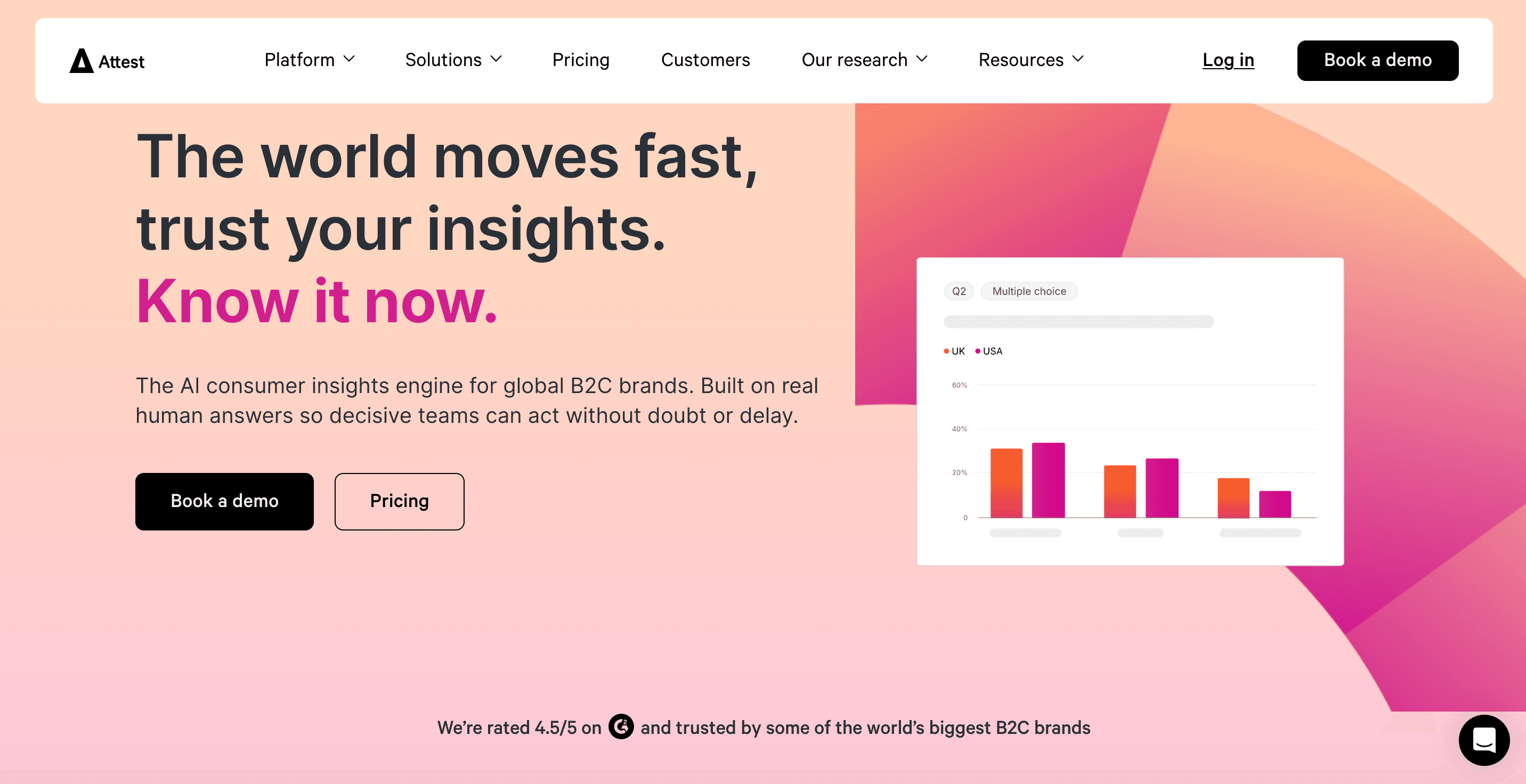
Survey data is only as reliable as the quality of the responses that produced it. Low-quality responses, from inattentive participants, survey farms, or respondents who do not match the target demographic introduce noise into research findings that distorts conclusions and undermines the decisions built on them.
Attest addresses this problem directly, building data quality validation into every stage of the research process.
The platform combines an intuitive survey builder, a managed consumer panel with embedded quality controls, and AI-powered analysis into a single research workflow. For research, marketing, and product teams that need reliable consumer data without the methodological overhead of managing panels, validating responses, and producing reports independently, Attest delivers a quality-assured research output with significantly less operational burden.
Key Features
- Built-In Quality Controls: Attest applies three layers of response validation, impossible checks that flag logically inconsistent answers, improbable checks that identify statistically anomalous response patterns, and behavioral checks that detect inattentive or automated respondents. Low-quality responses are filtered before they enter the dataset.
- Managed Consumer Panel: Access a panel of 125 million consumers across 58 markets with demographic targeting by age, gender, location, income, education, employment, and behavioral characteristics. Panel management, recruitment, and quality assurance are handled by Attest — researchers define the target audience and the platform delivers compliant respondents.
- AI-Automated Survey Analysis: Once fieldwork closes, Attest's AI automatically analyzes results including open-text responses, generating summaries of key findings, sentiment patterns, and demographic differences without requiring manual coding or analyst intervention.
- Interactive Boards: Attest's visualization layer automatically surfaces key insights and segments from survey data in interactive dashboards — identifying statistically significant differences across demographic groups without requiring researchers to build charts or run cross-tabulations manually.
- Survey Builder: Design surveys with multiple question types, branching logic, and draft sharing capabilities. The builder guides researchers through question wording and structure to reduce the risk of design errors that compromise data quality before a single response is collected.
- Brand Tracking: Deploy continuous brand health studies that monitor awareness, perception, consideration, and competitive positioning over time. Automated wave-on-wave comparison identifies statistically significant changes and surfaces them without manual analysis.
- Crosstabs and Segmentation: Analyze results across demographic and behavioral segments with automated crosstabulation — understanding how different consumer groups respond differently to the same questions without building custom analysis frameworks.
- Collaboration and Sharing: Share live dashboards, study drafts, and research outputs across teams with role-based access, enabling marketing, product, and strategy stakeholders to engage with findings directly.
Best Use Cases
- Consumer research programs where data quality is a primary concern
- Brand health tracking across multiple markets with consistent methodology
- Concept and message testing with demographically targeted consumer panels
- Organizations without dedicated research operations teams that need managed panel access and quality assurance built in
- Marketing and product teams running regular consumer studies that need reliable results without significant research expertise
- Multi-market research programs requiring consistent methodology and comparable results across geographies
Pricing
Attest does not offer a free plan. Pricing is based on the number of responses, markets covered, and study frequency. The platform offers a self-serve entry point for smaller research programs and custom enterprise pricing for organizations running higher volumes of studies across multiple markets. Contact Attest directly for a custom quote.
How to Choose the Right AI Market Research Tool
The 15 tools in this guide serve fundamentally different research needs. The purchase-decision starts with a clear understanding of what problem you are solving, not which tool has the longest feature list.
Here is a practical framework for narrowing the field.
1. Start With Your Research Objective
Every tool on this list excels at a specific type of research. Before evaluating platforms, define precisely what question your research needs to answer.
For example,
- If you need to understand what consumers think or feel about a product, brand, or experience — use a survey platform like SurveySparrow, Attest, or Quantilope
- If you need to understand what consumers say about your brand or category in organic conversation — use a social listening platform like Brandwatch
2. Consider Your Team's Technical Capacity
Some tools on this list require data science skills to operate effectively. Others are designed for researchers with no technical background.
Tools that require minimal technical expertise include SurveySparrow, Attest, Poll the People, Perplexity AI, Consensus, and Hotjar. A researcher with standard analytical skills can operate all of them without engineering support.
Tools that benefit from or require technical expertise include Pecan, which requires SQL proficiency and data engineering support to connect historical data sources, and Appen, which requires a defined AI development program to generate value from labeled training data.
Choosing a technically demanding platform without the in-house capacity to operate it produces an expensive tool that goes underused.
3. Match the Tool to Your Research Frequency
How often you conduct research should influence which platform you invest in.
Organizations running continuous research programs like ongoing brand tracking, regular NPS measurement, monthly competitive monitoring, benefit most from platforms built for recurring use.
Organizations with occasional, project-based research needs benefit more from platforms with flexible, per-study pricing. Poll the People, Zappi, and Wevo all support project-based use without requiring long-term subscription commitments.
4. Factor in Your Budget Realistically
The tools on this list span a significant pricing range, from free tiers on Perplexity AI, ChatGPT, and
SurveySparrow to enterprise deployments on Brandwatch and Pecan that can exceed $10,000 per month.
Budget is a real constraint and it should be treated as one rather than discovered after a sales process.
A practical starting point for most mid-market research teams is a primary survey platform. SurveySparrow or Attest combined with a secondary research tool like Perplexity AI and a competitive monitoring tool Crayon or Brandwatch, provides a combination that covers the majority of common market research use cases at a cost that most mid-market budgets can absorb.
Enterprise teams with specialist research needs can layer in predictive analytics. Qualitative analysis — Speak, and concept testing - Zappi as research programs mature and budget justification becomes easier to demonstrate.
5. Verify Data Quality and Methodology Transparency
Not all AI market research tools are equally transparent about how their AI works or how data quality is maintained. Before committing to a platform, ask three specific questions.
First — how does the platform validate response quality? For survey tools, understand whether quality controls are automated, manual, or absent. Attest's three-layer validation system is an example of a platform that has invested carefully in this problem.
Second — how current is the data? For social listening and competitive intelligence tools, understand whether monitoring is real time or batch processed. For panels and research databases, understand how frequently data is refreshed and whether it reflects current consumer behavior.
Third — how does the AI actually work? Platforms that cannot clearly explain their analytical methodology in plain language should be treated with caution. The insight is only as reliable as the process that produced it.
6. Pilot Before You Commit
Most platforms on this list offer either a free tier, a free trial, or a structured pilot program. Use them. A tool that performs well in a sales demonstration may behave very differently when applied to your actual research objectives, your actual data, and your actual team's workflow.
Why Businesses Use AI Tools for Market Research
The shift toward AI-powered market research is not driven by novelty. It is driven by measurable improvements in speed, accuracy, and the quality of decisions that follow. Here is where the practical advantages are most significant.
1. Speed of Insight
Traditional market research cycles typically take weeks. AI tools compress that timeline substantially. Survey platforms with built-in AI analysis can surface patterns and themes within hours of data collection closing. For example, social listening tools track sentiment shifts in real time.
Tools that work with predictive model technology generate trend forecasts without waiting for a full research cycle to complete.
For teams operating in fast-moving markets, the difference between a two-week research cycle and a two-hour analysis is often the difference between informing a decision and missing it.
2. Scale Without Proportional Cost
Manual research scales linearly - more data requires more analysts, more time, and more budget. AI tools break that relationship.
A platform analyzing 500 survey responses can operates with the same efficiency while analyzing 50,000.
For example, social listening tools can monitor millions of online conversations simultaneously. This scalability makes rigorous research accessible to teams that previously lacked the resources to conduct it at meaningful scale.
3. Depth of Analysis
AI tools surface patterns that manual analysis consistently misses. Text analytics platforms identify recurring themes and sentiment shifts across thousands of open-ended responses analysis that would take a team of researchers weeks to complete manually.
The result is that the research goes deeper into the data than human analysis alone typically reaches.
4. Reduced Bias in Analysis
Human analysts, however skilled, bring cognitive biases to the interpretation of data. AI tools apply consistent analytical frameworks across every data point without fatigue, confirmation bias, or selective attention. This does not eliminate the need for human judgment, but improves the quality of the data on which that judgment is exercised.
5. Integration With Existing Workflows
Most modern AI market research tools integrate directly with CRM systems, analytics platforms, and marketing automation tools. This means that the insights flow into the systems that help with decision-making. A customer sentiment score that updates automatically in a CRM dashboard is more likely to influence a sales conversation than one buried in a quarterly research deck.
Read More: Benefits of AI Integrations in CX
Concluding Thoughts
The distance between a research question and a reliable answer has compressed dramatically. A concept test that required three weeks and significant budget two years ago can now be completed in hours on a modern AI research platform. A competitive intelligence program that once demanded a dedicated analyst team can now be automated across hundreds of data sources simultaneously.
That compression is not evenly distributed across tools or teams. The organizations extracting the most value from AI market research are not necessarily those with the largest research budgets. They are the ones that have matched the right tools to the right research questions, and built the operational discipline to act on what those tools surface.
The 15 tools in this guide cover the full spectrum of modern market research needs. No single platform covers all of them well. The most effective research programs combine a primary survey platform for direct consumer data collection, a social listening or competitive intelligence tool for organic market signals, and a secondary research tool for landscape and trend analysis. That combination three complementary tools covering distinct research categories gives most teams everything they need to make faster, better-informed decisions than competitors working with less complete information.
SurveySparrow sits at the center of that stack for teams prioritizing consumer feedback and experience research. Its conversational survey format, AI-powered text analytics through CogniVue, and conversational AI agent Echo give research teams the ability to collect high-quality consumer data and surface the insight behind it — without switching between platforms or waiting days for analysis to complete.
Start your free trial today. No credit card required.
Explore how SurveySparrow can transform your feedback process.
TRUSTED BY BEST-IN-CLASS BRANDS