What is AI in customer experience?
AI in customer experience is the use of artificial intelligence to understand, automate, personalize, and improve customer interactions across the entire customer journey.
The defining characteristic of AI in CX is not the technology itself — it is what the technology makes possible. AI allows organizations to deliver personalized, responsive experiences at a scale that human teams alone cannot match. A support team of fifty agents can handle a finite number of conversations simultaneously. An AI-powered system can handle thousands, without degrading response quality or speed.
Modern AI in CX typically combines several technologies working together:
- Machine learning — identifies patterns in customer behavior and predicts likely outcomes, such as churn risk or likelihood to upgrade.
- Natural language processing (NLP) — helps systems understand customer language in conversations, reviews, surveys, and other text.
- Predictive analytics — uses historical and real-time data to anticipate customer behavior before it happens.
- Conversational AI — enables chatbots and virtual agents to understand customer requests and respond in natural language.
- Sentiment and text analysis — identifies emotions, themes, and recurring issues across large volumes of customer feedback.
It is worth being clear about what AI in CX is not. It is not a replacement for human judgment in high-stakes interactions. It is not a one-time implementation that runs itself. And it is not a substitute for a well-designed customer experience strategy. AI amplifies what you already have — if the underlying experience is poorly designed, AI will scale that problem alongside everything else.
10 ways AI improves customer experience
AI can improve CX in several ways, but the strongest use cases share one characteristic. They solve a specific customer or operational problem.
Here are nine ways the top businesses are using AI to do that.
1. Personalized at scale
Customers expect brands to understand their preferences, but manually creating personalized experiences for thousands or millions of customers is not practical. AI analyzes behavioral, transactional, and contextual data to determine what information, product, offer, or message is most relevant to each individual customer — surfacing it at the right moment, across every channel simultaneously.
Personalization extends beyond product recommendations. Businesses use AI to tailor onboarding flows, support content, marketing messages, surveys, and follow-ups based on where a customer is in their journey. The CX benefit is simple: customers spend less time searching for what they need.
Amazon's recommendation engine personalizes product discovery based on browsing history, purchase patterns, and search intent.
2. Customer support automation
AI in customer service is making these support workflows more efficient by handling routine requests while allowing human agents to focus on complex issues.
AI-powered chatbots and AI support agents can handle high-volume, repetitive customer requests without requiring a human agent for every interaction. For example, it can handle requests like checking order status, answering frequently asked questions, resetting passwords, collecting information before escalation, and scheduling appointments.
As every business scales, there is a growing share of customer share of customer requests. That’s where AI can come in to assist on these support interactions.
But the key isn’t to automate everything, since complex customer issues still require human judgement, empathy, and contextual understanding.
AI works best when it handles predictable requests and passes complex, sensitive, or high-value conversations to human agents. A good handoff preserves the full context of the conversation so customers do not have to explain their problem again. This changes the role of the support team as well — instead of spending most of their time answering repetitive questions.
On the other hand, a poor handoff can bring down customer satisfaction during these conversations.
AI serves as a good support system rather than a full-on automation process.
According to a Bloomberg report, Microsoft was able to save around $750 million annually by adopting AI across its customer support operations.
3. Predictive customer service
Traditional customer service starts after a customer reports an issue.
But with AI, businesses can proactively identify signals that indicate a customer may need help before they ask for it. Some of those signals include reduced usage frequency, increasing support ticket volume, or delayed payments.
With these signals, an AI model can flag accounts at higher churn risk and trigger an intervention from the customer success team before the customer reaches a breaking point.
This shift from reactive to predictive service is one of the most significant changes AI enables in a CX program.
McKinsey calls this propensity model, that scores how likely a customer will churn, upgrade, or respond to a campaign. If a set of customers are going to churn, they can be removed from promotional campaigns and be placed in retention ones.
4. Feedback analysis at scale
Customer feedback contains the most honest and specific signals available to a CX team. The challenge is processing it at scale. A company may collect thousands of survey responses, reviews, support conversations, and emails every month, however, reading every response manually makes it impossible to identify patterns quickly.
AI-powered text analytics can process this bulkload of unstructured feedback, surfacing common customer sentiment themes such as recurring complaints, product issues, feature requests, and the key drivers behind satisfaction or dissatisfaction. This helps CX teams move from "what did customers say?" to "what should we do about it?"
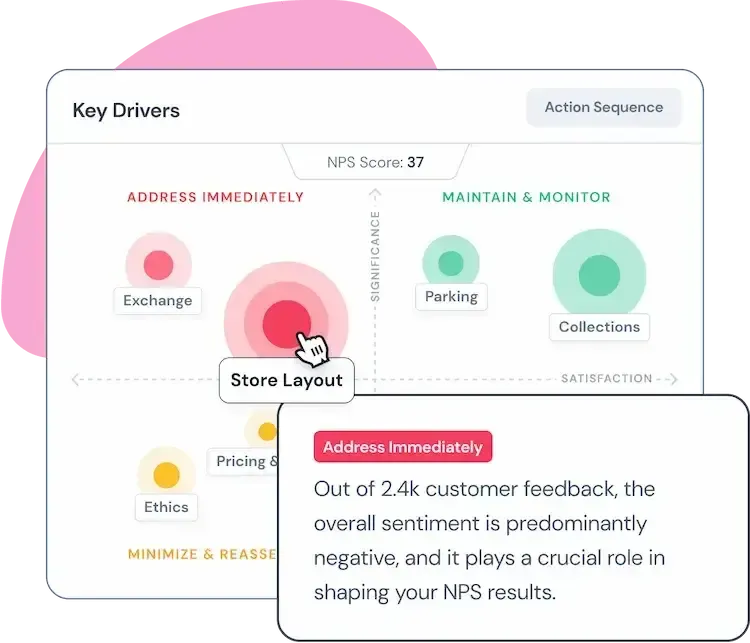
According to G2, 69% of users rate AI text summarization as a positive feature.
Oracle’s Analytics Cloud AI Assistant collects feedback from end users using the thumbs-up and thumbs-down gesture, helping them improve the quality of responses, refine AI Agents and increase adoption.

Check how sentiment analysis works with SurveySparrow—for free.
TRUSTED BY BEST-IN-CLASS BRANDS


5. Faster and more relevant answers
Speed matters in CX, but speed without relevance does not create a good experience. Customers want answers that are both fast and useful.
AI searches large knowledge bases, customer records, product documentation, and previous interactions to provide relevant information based on the customer's specific question.
For support teams, the same capability helps agents find answers faster. AI agents surface relevant knowledge articles, summarizes previous conversations, drafts responses, and highlights important customer context. The result is less effort for both the customer and the agent handling the interaction.
PowerPay handles nearly a 1000 daily inbound service calls as most of the inquiries are asked in different ways. Mike Petrakis, the Founder of PowerPay says that AI is strongest on the front end of volume. He also advocates the speed and reliability of AI - “AI shines in pattern recognition, instant lookup, and being available at 2 a.m., when customers have time after finishing their day jobs and taking care of loved ones to finalize a loan.”
6. Seamless Omnichannel Experiences
Customers rarely stay on one channel throughout their journey. Someone might discover a product through social media, research it on a website, ask a question through chat, make a purchase through an app, and contact support by email. The customer sees one relationship with the brand. Disconnected systems see five separate interactions.
AI connects these touchpoints by combining information from different channels and using it to understand the customer's context. If a customer has already explained an issue through chat, an AI-enabled support system passes that context to the next interaction — email or phone — instead of making the customer start over. The objective is not to be present on more channels. It is to make those channels feel like parts of the same customer journey.
7. Behavioral Segmentation
Traditional segmentation relies on attributes such as age, location, industry, or company size. Those attributes are useful but do not explain what customers actually do. AI identifies behavioral patterns across large datasets and creates more meaningful customer segments based on product usage, purchase frequency, engagement, support behavior, likelihood to churn, and likelihood to upgrade.
At the ETBrandEquity Brand World Summit 2026, Gagandeep Gadri (executive VP and managing director of frog, Capgemini Invent) said, “The same person can make completely different purchase decisions across the day. That’s the liquid customer.”
A SaaS company could distinguish between customers who are highly engaged with advanced features and customers who have signed up but barely use the product. Both groups may share the same job title and company size, but they need very different experiences. Behavioral segmentation makes that distinction visible and actionable.
8. Real-time feedback collection
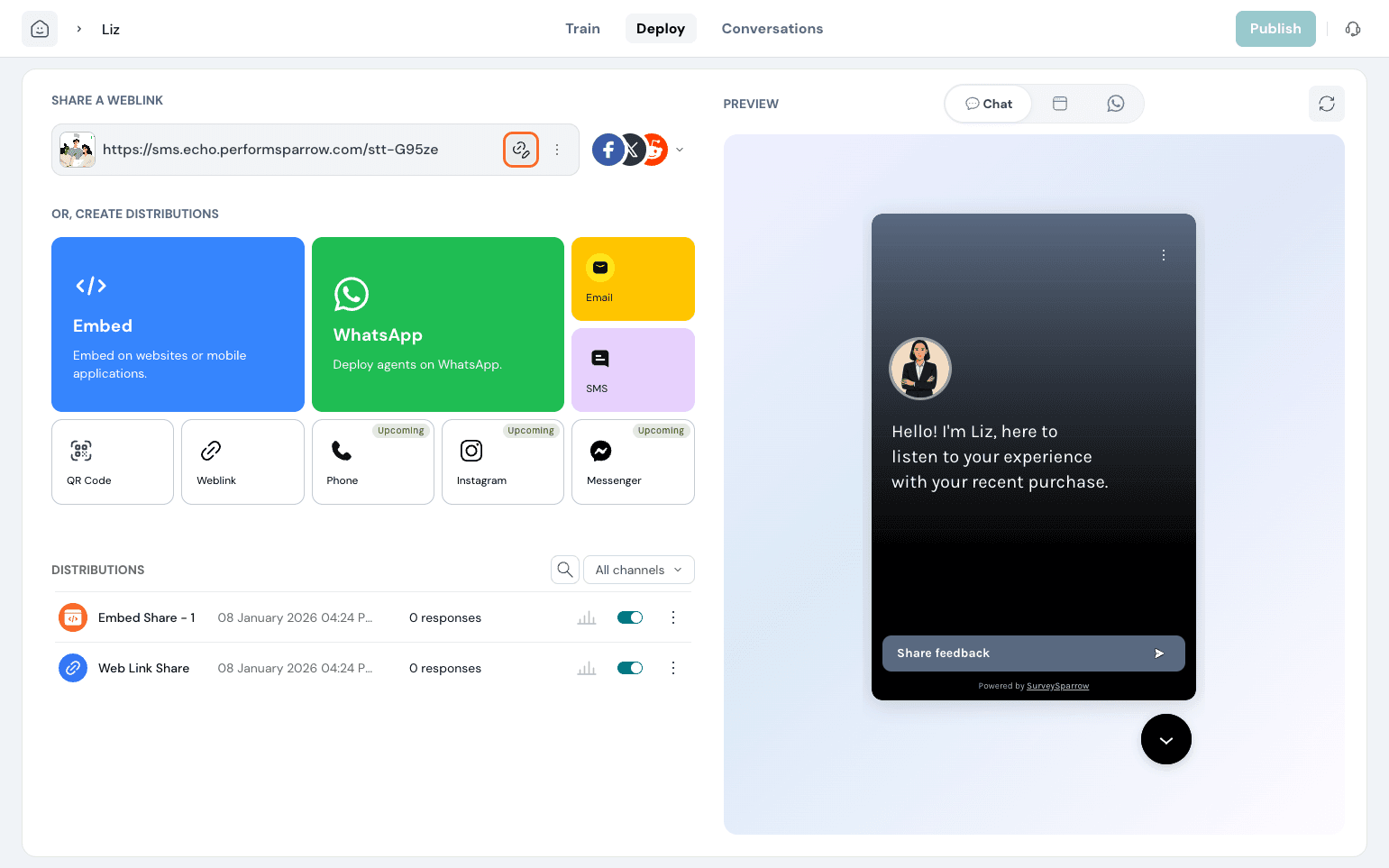
AI enables feedback collection that adapts in real time to the customer's responses. Rather than presenting every respondent with the same set of questions, an AI-powered survey adjusts its flow based on what has already been answered — asking follow-up questions that are relevant to this specific customer's experience. This produces richer, more contextual data while keeping the survey shorter for the respondent, which directly improves completion rates.
Echo’s conversational surveys adapt to questions in real time based on the customer’s responses. One of SurveySparrow’s customers, Pechanga - achieved 40% more response rates. Pechanga also found it easy to segment their audience and tailor their messages for upcoming offers.
9. Better decision-making for CX teams
AI does not only improve the customer-facing side of CX. It improves how CX teams work. AI summarizes customer research, identifies trends, surfaces anomalies, recommends follow-up actions, and helps teams prioritize issues — particularly when teams have more customer data than they can realistically analyze manually.
The human team still makes the decision. AI makes it easier to make that decision with more relevant information and less time spent finding it.
Look at 5 ways SurveySparrow removes the grunt work from CX.
10. AI-powered CRM
A CRM system is only as useful as the insights it surfaces — and AI transforms what a CRM can do. Beyond storing contact data and logging interactions, an AI-powered CRM can score leads based on conversion likelihood, flag at-risk customers before they churn, automate follow-up tasks, and surface the next best action for every customer relationship.
For sales and support teams, this means spending less time on data entry and administration and more time on the conversations that actually move relationships forward. The result is a customer experience that feels more attentive, more timely, and more human.
Challenges of implementing AI in customer experience
AI adoption often looks easier from the outside than it is inside an organization. The technology may be ready, but the data, people, processes, and measurement systems around it may not be. Here are four common challenges CX teams need to plan for before implementation.
Poor data quality and disconnected systems
AI can only work with the information it can access. If customer data lives across disconnected CRM, support, survey, product, and marketing systems, AI will struggle to build a complete picture of the customer. Worse, inconsistent or outdated data produces unreliable outputs — and unreliable outputs erode trust in the system faster than almost anything else.
AI implementation often exposes existing data problems. Businesses that want AI to deliver useful customer insights need to understand where their customer data lives, how reliable it is, and whether different systems can share it — before selecting a tool.
The gap between knowing and doing
This is the most underestimated challenge in AI-powered CX. An AI system can identify that a specific customer segment is at high churn risk. Acting on that insight requires a process, a team, and a clear owner. Many organizations invest in AI tools that surface accurate insights and then fail to act on them consistently.
The insight-to-action gap is an organizational problem, not a technology problem. AI cannot solve it. Ask before you go live: what happens after the AI identifies the problem? Who receives the insight? Who acts on it? How quickly? How do you know whether the intervention worked?
Customer trust and transparency
Customers are increasingly aware of when they are interacting with AI, and their tolerance for it varies significantly by context. A personalized product recommendation based on purchase history is unlikely to create friction. An AI system making consequential decisions about a customer's account without transparency or a clear path to human support will erode trust — sometimes permanently.
Designing AI interactions that are transparent about their nature and provide a genuine escalation path to a human agent is not optional. It is a prerequisite for maintaining the trust that CX programs are designed to build.
Maintaining the human element
The interactions that most directly shape long-term customer loyalty — a complaint handled with genuine empathy, a problem resolved by someone who understood the full context, a recovery moment where the brand made something genuinely right — are human moments. AI can support these interactions by providing agents with better context and faster information. It cannot replicate the judgment and relational intelligence that makes those moments meaningful.
Organizations that automate too aggressively risk degrading the quality of the interactions that matter most. Build clear escalation rules into every AI workflow. Customers should always know how to reach a human when they need one.
4 Finest AI Customer Experience Examples
Now that you know what AI customer experience is and its importance in the ever-evolving market let’s look at how it has helped famous brands improve customer experience.
1. SurveySparrow's AI Customer Experience Analytics
Feedback surveys are a must-have to collect customer feedback, and to understand what your customer feels about the overall service or product.. SurveySparrow, a leading customer experience management platform, leverages AI to decode customer feedback. To start with:
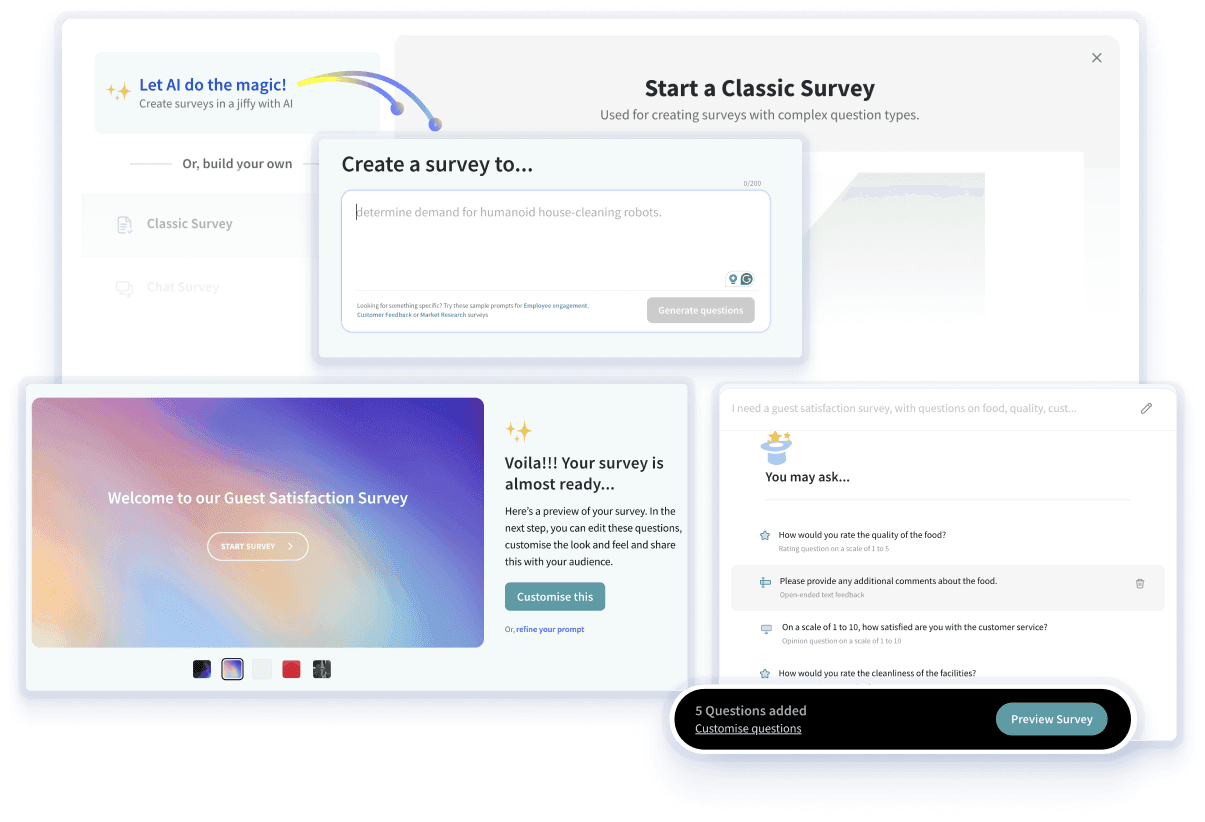
With SurveySparrow’s surveys using AI features, it has been easier for a lot of organizations to build surveys in just a few seconds. All they need to do is enter the prompt, and the survey will be ready for you to brush up on customizing your themes and questions.
Explore how SurveySparrow can transform your feedback process.
TRUSTED BY BEST-IN-CLASS BRANDS
👉 Text-Sentiment Analysis
Collecting feedback is fine, but have you ever wondered about deep diving and directing the emotions behind each feedback? A few years back, not many would have believed in the possibility of understanding the real sentiment behind each feedback and acting on it efficiently.
Hold on! It’s possible to use SurveySparrow‘s text analysis.
Many organizations now use CogniVue, an AI text analysis tool, to conduct root cause analysis and find hidden insights based on the sentiment score followed by the AI text analysis. Once the analysis is done, AI will generate a key driver analysis that shows insights into customer sentiments.
2. Amazon's Product Recommendation System

Amazon has revolutionized e-commerce shopping with its AI-driven product recommendation system.
Amazon’s AI system makes personalized product recommendations by analyzing individual customer behavior, purchase history, items in the shopping cart, and what other customers are buying. This personalization improves the customer’s shopping experience and increases Amazon’s sales.
3. Starbucks' predictive analytics

Starbucks uses AI to enhance its customer experience with the help of a tool called Deep Brew. It uses machine learning and predictive analytics to personalize marketing messages, drive loyalty, and manage store-level inventory.
For example, Deep Brew can suggest menu items based on a customer’s past orders, location, weather, and time of day, among other factors.
These examples show that whether it’s e-commerce, food and beverage, or the cosmetics industry, AI can significantly enhance the customer experience across various sectors.
How to measure AI's impact on customer experience
AI should not exist as a separate measurement category. Measure whether it improves the customer and business outcomes it was designed to influence. The right metrics depend on the use case, but these six provide a strong starting point.
| CX/CSAT Metric | What it measures | How AI can influence it |
|---|---|---|
| NPS | Customer loyalty and likelihood to recommend | Identify drivers of loyalty or dissatisfaction and personalize follow-up |
| CSAT | Satisfaction with a specific interaction | Improve response quality, speed, personalization, and resolution |
| CES | How easy it was to complete a task | Reduce steps, automate repetitive work, and remove friction |
| Churn rate | Customers who stop using or buying | Identify churn signals and trigger proactive interventions |
| FCR | Issues resolved in the first interaction | Help agents find information faster and give customers more accurate answers |
| TTR | Time required to resolve an issue | Automate routine work, summarize context, and accelerate agent workflows |
Do not treat a score improvement as proof that AI caused it. Where possible, compare performance before and after implementation, segment results by customer group, and test specific AI workflows against a baseline. Also look beyond the score — if AI identifies a drop in CSAT, use feedback analysis to understand why the score changed. That is where AI becomes especially useful: connecting quantitative metrics with qualitative feedback to identify the issues driving the change.
How to get started with AI in customer experience
You do not need to transform your entire CX operation at once. Start with one customer problem, one measurable outcome, and one AI use case. A practical implementation process looks like this.
Step 1: Identify the biggest source of friction
Start with the customer journey, not the technology. Look at where customers struggle most — waiting too long for support, repeating information across channels, struggling to find the right product, leaving negative feedback that nobody analyzes, or churning after a specific stage. Find the problem before choosing the AI solution.
Step 2: Choose a use case where AI has a clear advantage
Not every CX problem needs AI. Choose a task where AI can process more information, respond faster, identify patterns, or personalize interactions more effectively than your existing process. Strong starting points include customer feedback analysis, support ticket classification, conversation summarization, self-service support, churn prediction, and personalized recommendations.
Step 3: Audit your customer data
Before implementing AI, identify the data the use case requires. Check where it lives, whether it is accurate and up to date, whether systems can share it, and whether customer privacy requirements are covered. If the underlying data is incomplete, improving the data pipeline will deliver more value than adding another AI feature.
Step 4: Define a baseline
Measure the current experience before introducing AI. If you want AI to improve support, record your current CSAT, FCR, TTR, ticket volume, and escalation rate. Without a baseline, it is impossible to tell whether AI actually improved the experience.
Step 5: Run a controlled pilot
Test the use case with a defined customer segment, channel, or workflow before rolling it out broadly. Monitor both business metrics and customer feedback. Watch specifically for failure modes — incorrect answers, misunderstood requests, customers being blocked from reaching a human, or extra work created for agents. The goal of a pilot is not to prove that AI works. It is to find out where it works, where it fails, and what needs to change.
Step 6: Keep humans in the loop where judgment matters
AI should not replace human judgment simply because it can automate a task. Sensitive complaints, unusual situations, complex account issues, and emotionally charged interactions require human involvement. Build clear escalation rules into the workflow before go-live.
Step 7: Measure, learn, and expand
Once the pilot has enough data, compare results against your baseline. If the AI workflow improves the target outcome without creating new problems, expand it. If it does not, find out why — the problem may be the AI, the workflow design, the data, or simply a use case where AI is not the right solution. That last outcome is useful information too. A successful AI strategy is not about using AI everywhere. It is about using it where it creates measurable value.
The Future of Artificial Intelligence in Customer Experience
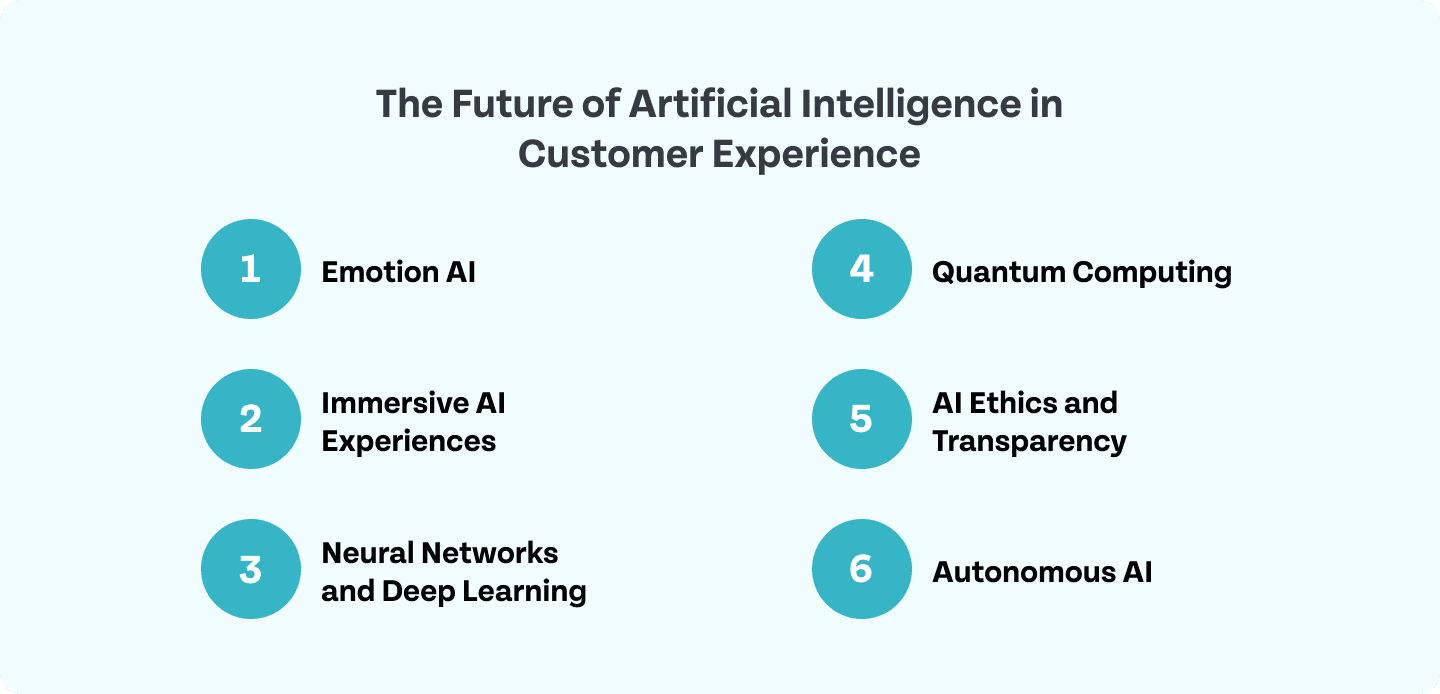
Artificial Intelligence is set to play an even larger role in the customer experience as we head into the future. As technology evolves, we can expect several key trends to take shape.
Here are some of the extraordinary prospects of AI in revolutionizing customer experience:
Emotion AI
Artificial Intelligence is poised to transcend mere text and voice recognition; the future holds promise for ‘Emotion AI.’ This AI can comprehend and respond to human emotions expressed via facial cues or tone of voice. Imagine a customer service that understands what you’re saying and how you feel. This will pave the way for truly empathetic customer experiences.
Immersive AI Experiences
With advancements in AR (Augmented Reality) and VR (Virtual Reality), AI can provide immersive customer experiences. Imagine trying clothes on your digital avatar in a VR environment before purchasing or using AR to see how a piece of furniture would look in your room. Businesses looking to leverage this technology can hire virtual reality developers to create engaging, AI-powered AR/VR experiences that redefine customer interaction.
Neural Networks and Deep Learning
These advanced AI systems will enable ultra-intelligent customer experiences. They’ll make sense of unstructured data (like a customer’s social media activity) to provide tailored experiences on another level of personalization.
Quantum Computing
As quantum computing comes into play, the speed at which AI can process customer data and make predictions will be unlike anything we’ve seen. Quantum data encoding enables more efficient processing, real-time personalization, and immediate responses to customer actions.
AI Ethics and Transparency
As AI becomes more sophisticated, an increased focus will be on making AI ethical and transparent. Customers will better understand how AI processes their data and makes decisions, leading to increased trust in AI-powered customer experiences.
Autonomous AI
AI in will take on a more autonomous role in managing customer experiences. AI agents for customer service will support human agents and act as independent agents, making decisions and taking actions to optimize the customer journey.
AI call centers are set to revolutionize the industry, enabling businesses to handle most interactions autonomously and significantly reduce their reliance on human agents.
In a nutshell, the future of AI in customer experience is not just about making processes faster and more efficient. It’s about creating unique, immersive, and emotionally intelligent interactions that respect the customer’s individuality and autonomy.
It’s about AI becoming an integral part of the business ecosystem, where it understands and anticipates customer needs and values and respects and empathizes with the customer. Truly, we are on the cusp of an extraordinary revolution in customer experience.
Revolutionize AI Customer Experience with SurveySparrow
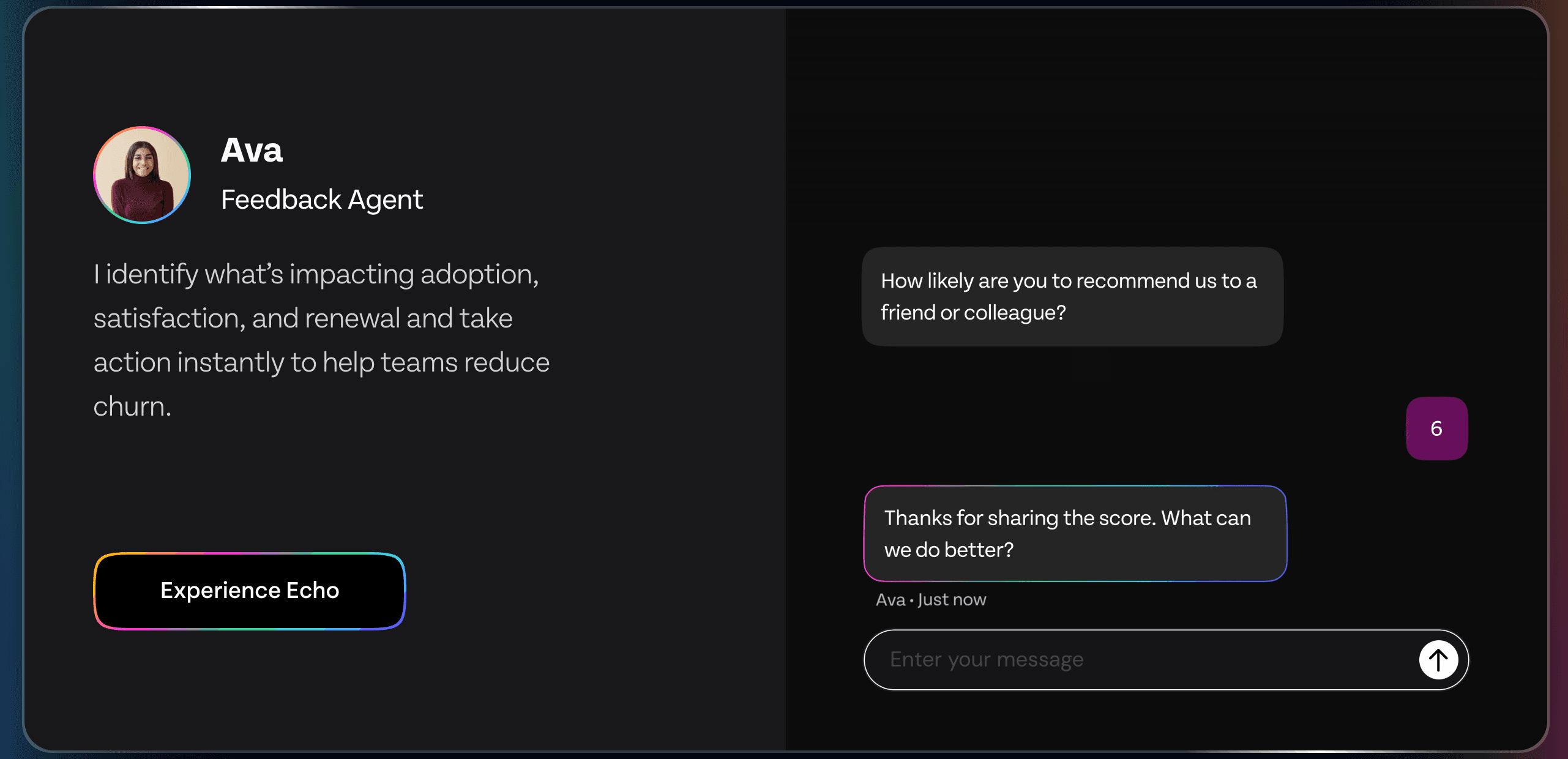
SurveySparrow brings AI into the feedback and experience management workflow at the points where it has the most direct impact on CX outcomes.
Echo — Our Flagship Conversational AI agent, understands the reasoning behind every customer rating and autonomously probes deeper, so you always get the complete story. A customer who gives a low satisfaction score may have a very different reason from another customer who gives the same score. Echo helps uncover that reasoning at scale.
CogniVue — turn open-ended feedback into insight. CX teams can collect thousands of written responses, but manually analyzing them takes time and produces inconsistent results. CogniVue analyzes text feedback to identify sentiment, themes, and key drivers — moving teams from a large collection of individual responses to a prioritized view of the issues affecting the customer experience. This is the insight-to-action gap closed at the analysis stage.
AI Survey Generator — build surveys faster. Survey design takes time, especially when CX teams need surveys for different customer journeys or research goals. SurveySparrow's AI survey generator builds a complete, structured survey from a plain-language prompt — reducing the time from research question to live survey from hours to minutes.
Audience Panel — get feedback from the right customers. AI-powered CX programs are only as useful as the feedback behind them. SurveySparrow's Audience Panel provides access to verified respondents across 130 countries, with filtering by geography, profession, industry, demographics, and consumer behavior. Automated integrity checks maintain response quality. When teams need to validate journey assumptions or benchmark against the market, the panel provides the research input without requiring a specialist panel provider.
Explore how SurveySparrow can transform your feedback process.
TRUSTED BY BEST-IN-CLASS BRANDS