


25 hours.
That's how long the average proposal team spends writing a single RFP response. And that's just the writing part; it doesn't count chasing down SMEs, formatting chaos, version control nightmares, or the last-minute scramble before the deadline.
Now layer this on top: RFPs influence roughly 35% of a company's annual revenue. That's not side-of-desk work. That's business-critical.
Most teams are still doing this the hard way. Juggling email threads, shared Google Docs, and copy-paste responses that haven't been updated since 2022. Meanwhile, the companies winning more RFPs are doing something different: they're using the right software.
This guide breaks down the best RFP software tools available today, what each does well, where it falls short, and who it's really built for. No inflated claims, no filler. Just the honest comparison your team needs to make a smart decision.
What to Actually Look For in RFP Software
Before we get into the tools, let's agree on what matters. Not every RFP platform is built the same, and the right choice depends heavily on your team size, RFP volume, and how messy your current process already is.
Here are the criteria that actually move the needle:
AI-powered response generation: Can it draft answers from your own content library, not just generic suggestions pulled from the internet?
Knowledge management: How easy is it to build, organize, and update your answer library over time?
Collaboration workflows: Can SMEs, reviewers, and approvers work inside the same platform without constant friction?
Integrations: Does it connect with your CRM (Salesforce, HubSpot), Slack, or Teams?
Format flexibility: Can it handle RFPs in Word, Excel, PDF, and portal submissions?
Security and compliance: Role-based access, audit trails, and data encryption matter more than most teams realize until they don't have them.
Pricing transparency: Hidden per-user costs have a way of blowing up mid-market budgets at renewal time.
With that in mind, let's get into few of the best RFP softwares in the market.
Looking for an AI-powered RFP software for your team? Book a demo and get start your journey.
Best RFP Softwares 2026
1. SparrowGenie
Source: SparrowGenie
Best for Enterprise Teams That Need Speed, Security, and Smart AI
G2 Rating: 4.5/5
At SurveySparrow, we were no strangers to growth. But as we scaled, so did the volume of RFPs, DDQs, and security questionnaires landing in our inbox. Our sales and security teams were spending countless hours repeating answers, chasing SMEs, and wrestling with formatting, week after week.
We realized the problem wasn’t effort. It was the system. So instead of patching workflows or adding another spreadsheet, we built the solution we wished we had. That solution became SparrowGenie.
SparrowGenie is our AI-powered RFP automation and sales enablement platform, designed for enterprise teams handling 10+ RFPs per month. It’s built with an AI-first approach to generate high-quality first drafts in minutes, so teams can focus on strategy and deals, not repetitive documentation and formatting chaos.
What makes it different:
Contextual AI that actually understands your RFPs.
SparrowGenie uses heuristics to interpret even the most unstructured, inconsistently formatted RFPs, not just simple keyword matching. It maps questions to your knowledge library intelligently, so the draft it generates actually makes sense in context.
Full lifecycle knowledge management.
Most tools give you an answer library. SparrowGenie gives you a knowledge hub with dedicated modules for Training, Testing, Improvement, and Conflict Resolution. It's built to get smarter over time, not just store static answers that go stale.
Frictionless collaboration workflows.
Role-based assignments, in-line commenting, and one-click SME routing mean you spend less time chasing people down and more time refining the actual response.
Real-time project dashboard.
Every active RFP, every blocker, every deadline, visible in one place. No more status-update meetings just to figure out where things stand.
Security without sacrificing speed.
Role-based access controls, encrypted data handling, and audit trails are built in, not bolted on as a paid add-on.
White-glove onboarding.
Most platforms leave you to figure things out from a help doc. SparrowGenie's team works with you from day one to configure workflows, migrate content, and get your team productive fast.
The results teams are seeing:
- 80% faster proposal creation from intake to submission
- Up to 3x more RFPs handled without adding headcount
- Significant reduction in SME interruptions; answers are sourced from the knowledge hub first
- Consistent, on-brand responses across every submission
Best for: Enterprises and growth-stage companies (200–5,000 employees) in SaaS, IT services, fintech, healthcare tech, or professional services handling 10+ RFPs per month; teams that want measurable speed improvements, secure AI, and a platform that respects human expertise rather than trying to replace it.
Interested to check out a demo? Book it here.
2. Loopio
Source: Loopio
Best for Mid-Market Teams Getting Started with RFP Automation
G2 Rating: 4.6/5
Loopio has been in this space since 2014 and has built a strong reputation for being approachable. Over 1,500 brands use it, and it scores a solid 4.6 out of 5 on G2, largely because the UI is clean, onboarding is fast, and the support team is genuinely responsive.
What it does well:
- Clean, intuitive interface that new users can pick up quickly
- Strong content library with automated review cycles to keep answers current
- Native integrations with Salesforce, Slack, and HubSpot
- AI auto-fill that pulls answers from your library and populates RFP sections
- Solid project management with deadline tracking and SME assignment
Where it gets tricky:
- Search is largely keyword-based, which gets limiting as your content library scales
- Per-user pricing that can climb quickly for larger teams
- AI capabilities, while improving, still require meaningful manual refinement for complex or nuanced answers
- Advanced features have a steeper learning curve than the initial setup suggests
Best for: Small-to-mid-sized teams (20–100 users) handling 10–40 RFPs per month who want a structured platform without a heavy implementation process.
3. Responsive (formerly RFPIO)
Source: Responsive
Best for Enterprise Teams With High RFP Volume
G2 Rating: 4.5/5
Responsive is the enterprise heavyweight in this space. It's been named a G2 leader for 23 consecutive quarters and is purpose-built for teams handling large volumes of complex, multi-stakeholder RFPs with global reach.
What it does well:
- Handles large-scale RFP operations with advanced workflow automation and governance
- Broad integration ecosystem with deep API support for complex tech stacks
- AI response generation drawing from a centralized knowledge base
- 70+ language support, genuinely useful for global teams managing regional RFPs
- Detailed analytics on content performance, response times, and win rates
Where it gets tricky:
- Pricing now includes per-user costs on top of project-based fees, which adds real budget complexity
- Users report the interface can feel clunky when navigating multiple large projects simultaneously
- Implementation typically takes weeks, not ideal if you need to move quickly
- Content libraries require a dedicated admin to stay clean and current over time
Best for: Mid-to-large enterprises (100+ users) with global customers, complex tech stacks, and teams managing 50+ RFPs per month.
4. Proposify
Source: Proposify
Best for Teams That Need Beautiful Proposals, Not RFP Automation
G2 Rating: 4.6/5
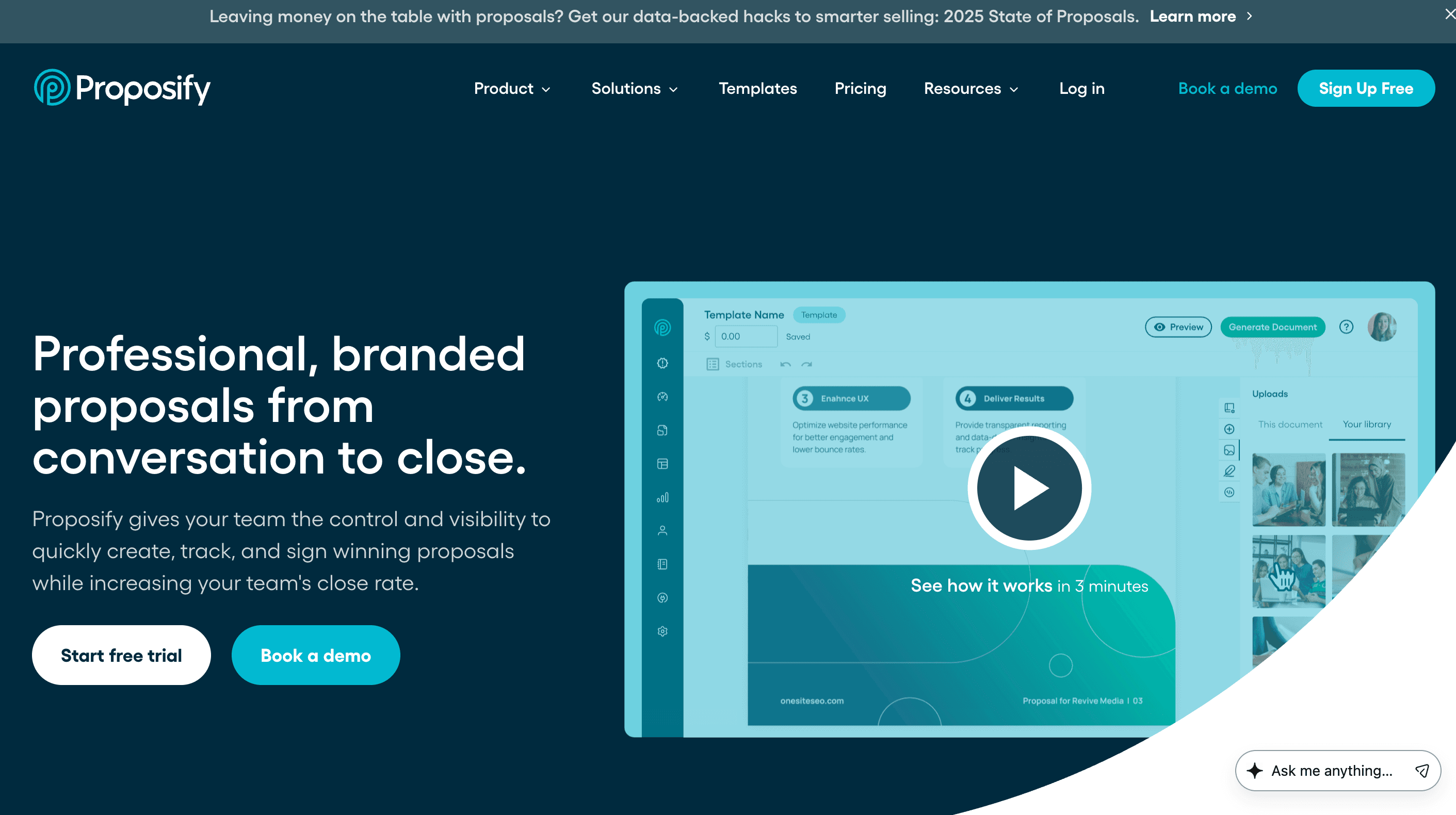
Let's be clear upfront. Proposify is a proposal creation tool, not a dedicated RFP platform. But it earns a spot on this list because many B2B sales teams use proposals and RFPs interchangeably in their workflow.
Where Proposify shines is visual design. It has a drag-and-drop editor, interactive proposal features, and built-in e-signature functionality that makes proposals look polished and professional. It reportedly achieves a 43% win rate for proposals viewed within 24 hours of sending.
What it does well:
- Visually stunning proposal templates with drag-and-drop customization
- E-signature functionality built in, no need for a separate DocuSign subscription
- Live analytics showing how long prospects spend on each proposal section
- Strong branding controls with pre-approved templates and custom fonts
Where it gets tricky:
- Not built for RFP-specific workflows, no questionnaire import, SME assignment, or compliance tracking
- Fewer automated content generation options compared to purpose-built RFP platforms
- Per-user pricing at $49/user/month scales up fast
- Integration library is more limited than enterprise alternatives
Best for: Creative agencies and SMBs focused on visual proposal design and digital sales rooms. Not the right fit if your primary challenge is responding to structured RFP questionnaires.
5. PandaDoc
Source: PandaDoc
Best for Document Workflows and E-Signatures
G2 Rating: 4.7/5
PandaDoc is a well-known name in the sales document space, proposals, contracts, quotes, and e-signatures. It's a versatile tool and a solid fit for smaller teams that need streamlined document creation without the complexity of a full RFP automation platform.
What it does well:
- Fast, clean document creation with a strong template library
- Built-in e-signature and payment collection features
- Workflow automation for approvals and follow-ups
- Good integrations with CRMs and project management tools
Where it gets tricky:
- Not purpose-built for RFP management, lacks questionnaire import, answer libraries, and structured SME routing
- Weak on compliance-heavy submissions or heavily structured RFPs
- Doesn't offer the knowledge management capabilities that proposal teams depend on at scale
Best for: Small sales teams that need a fast, polished way to send proposals and collect signatures. Not designed for RFP-specific workflows.
6. Qvidian (Upland)
Source: Qvidian
Best for Regulated Industries That Need Governance and Structure
G2 Rating: 4.3/5
Qvidian has been around for a long time and is part of the Upland Software portfolio. It's built for large enterprises, particularly those in regulated industries where compliance, brand standards, and documentation control are non-negotiable.
What it does well:
- Rules-based proposal automation with strong governance controls
- Excellent at managing brand consistency across large, distributed teams
- Strong content management with version control and role-based access
- Deep audit trails for compliance-driven industries like financial services and legal
Where it gets tricky:
- Older UI that many users describe as dated, navigation can feel rigid and unintuitive
- Limited AI capabilities compared to newer platforms in this space
- Implementation is heavy, expect a months-long rollout for large teams
- Enterprise-tier pricing that can be prohibitive for mid-market buyers
Best for: Large enterprises in financial services, legal, or government-adjacent sectors that prioritize compliance, brand governance, and audit trails over speed and ease of use.
At a Glance: Quick Comparison
| Tool | Best For | AI Strength | G2 Rating | Pricing Model |
| SparrowGenie | Enterprises, 10+ RFPs/month | Contextual, knowledge-hub AI | 4.5/5 | Custom |
| Loopio | Mid-market, first-time buyers | Keyword-based AI | 4.6/5 | Per-user |
| Responsive | Large enterprise, high volume | Strong, but needs admin | 4.5/5 | Per-user + project |
| Proposify | Visual proposals, agencies | Basic AI writing | 4.6/5 | Per-user |
| PandaDoc | Docs and e-signatures | Limited | 4.7/5 | Per-user |
| Qvidian | Regulated industries | Minimal | 4.3/5 | Enterprise custom |
Experience seamless RFP automation with Genie AI. Book a demo to know more.
How to Choose the Right RFP Software for Your Team
Here's a straightforward way to think about it.
If you're just getting started and need something clean and easy to adopt, start with SparrowGenie or Loopio. They're friendly, fast to implement, and will give you a solid foundation.
If you're a large enterprise managing 50+ concurrent RFPs across a global team, SparrowGenie or Responsive is probably your fit, despite being newest in market and pricing complexity, respectively.
If your main need is beautiful proposals with e-signatures, SparrowGenie, Proposify or PandaDoc handles that well.
If you're in a regulated industry where compliance is the top priority, SparrowGenie is good. Also, Qvidian's rules-based structure might be worth the heavy implementation investment.
If you're a growth-stage B2B company drowning in RFPs and security questionnaires, and you want AI that actually uses your content, not generic suggestions, SparrowGenie is worth a serious look.
The right tool is ultimately the one your team will actually use. Consider implementation time, how it fits your existing tech stack, and whether the pricing model makes sense as you scale. A tool that takes six months to fully adopt isn't saving you time; it's costing you time.
Final Thought
RFPs drive serious revenue. They influence over a third of annual company revenue for most B2B organizations, yet most teams still respond to them with tools that weren't built for the job.
The good news is that the gap between struggling teams and winning teams isn't talent; it's process and tooling. Teams using purpose-built RFP software submit significantly more responses per year and win at higher rates. That's not a coincidence.
Pick the tool that fits where your team is today and where you're heading. Build a clean content library, establish tight workflows, and treat proposals as the revenue-driving function they actually are. If you're a growth-stage B2B team handling 10+ RFPs a month and still stitching things together with shared folders and email chains, platforms like SparrowGenie exist precisely for this moment, to give your team a smarter starting point without the enterprise price tag or the six-month implementation.
Because the teams winning the most RFPs aren't working harder. They're working smarter, with the right software behind them.
Ready to see what faster RFP responses look like? Book a free 15-minute demo of SparrowGenie and see how your team could cut response time in half.