Let's be honest about what's happening when you search "Qualtrics pricing." You're not just curious — you're about to make a serious budget decision and you've noticed that Qualtrics makes that decision as difficult as possible. No price on the website. A sales call required. Numbers that depend on who you talk to and when.
This guide gives you the real numbers, the PAA answers Google's AI Overview is already surfacing, and a clear-eyed comparison of what you get for every dollar.
A note on Qualtrics pricing: Qualtrics operates on a quote-based model and does not publish prices. The figures in this article reflect publicly available buyer reports and third-party research; not official Qualtrics documentation. We update this post regularly, but always verify directly with their sales team before making a budget decision.
What Qualtrics actually costs in 2026
Qualtrics doesn't publish pricing. What it does publish is a "contact sales" button and a free account that limits you to 100 responses and three active surveys. Here's what buyers report paying after going through the sales process:
| Plan/Tier | Reported Cost | What's included | What's the catch? |
|---|---|---|---|
| Free | $0 | 3 active surveys, 100 responses/month | Not viable for real CX programs |
| CoreXM (self-service) | ~$420/year | Basic survey creation, limited analytics | No AI features, no CX workflows |
| Research / CX Suite (quoted) | $1,500–$5,000/user/year | Full analytics, workflows, 500+ question types | Minimum seat requirements apply |
| Enterprise | $15,000–$50,000+/year | Custom AI, advanced integrations, SSO, SLA | Multi-year contracts common |
The fine print buyers learn too late: Qualtrics charges separately for responses above your tier limit, additional features like Text iQ and Stats iQ, premium support, implementation, and training. What looks like a $5,000/year contract can land at $20,000+ once all add-ons are billed.


Why there's no public pricing page
Enterprise software companies hide pricing for a reason: it lets them charge different buyers different amounts based on company size, urgency, and negotiating leverage. Qualtrics, like Salesforce and Workday, is a quote-based product — meaning your final number depends heavily on the sales rep you get, what quarter it is, and how much you've already pushed back.
That's not inherently bad for large enterprises with procurement teams and legal departments. But for growing companies, mid-market CX teams, and startups that need to move fast without a six-week sales cycle, it's a tax on your time as much as your budget.
The agility gap: By the time a mid-market team gets through Qualtrics' sales process, demo cycle, security review, and contract negotiation, they've spent 30–60 days — and often land on a price that's 3–6x what a platform like SurveySparrow costs on day one.
What you actually get for the price
Qualtrics is a powerful product. That's not in question. The question is whether the capabilities it delivers match what a typical CX, marketing, or HR team actually needs — and whether the price-to-value ratio justifies the spend.
Here's where Qualtrics earns its cost, and where the value gets thin:
Where Qualtrics earns its price
- Advanced statistical analysis (conjoint, MaxDiff, Van Westendorp) for dedicated research teams
- Deep SAP and enterprise ERP integrations for companies already in that ecosystem
- 600+ question types for highly specialized academic or scientific research
- Robust compliance posture for regulated industries (HIPAA, FedRAMP)
Where the value gets thin for CX teams
- No native conversational/chat survey format — completion rates lag behind chat-style tools
- AI features (Text iQ, Predict iQ) are add-ons, not core to every plan
- Closed-loop ticketing is limited compared to purpose-built CX platforms
- Implementation complexity often requires professional services, adding to total cost
- No built-in reputation management or review response workflows
SurveySparrow vs. Qualtrics: feature-for-feature
This isn't a hit piece on Qualtrics. It's a practical comparison for CX and HR teams deciding whether to pay enterprise prices or find a more agile path to the same outcomes.
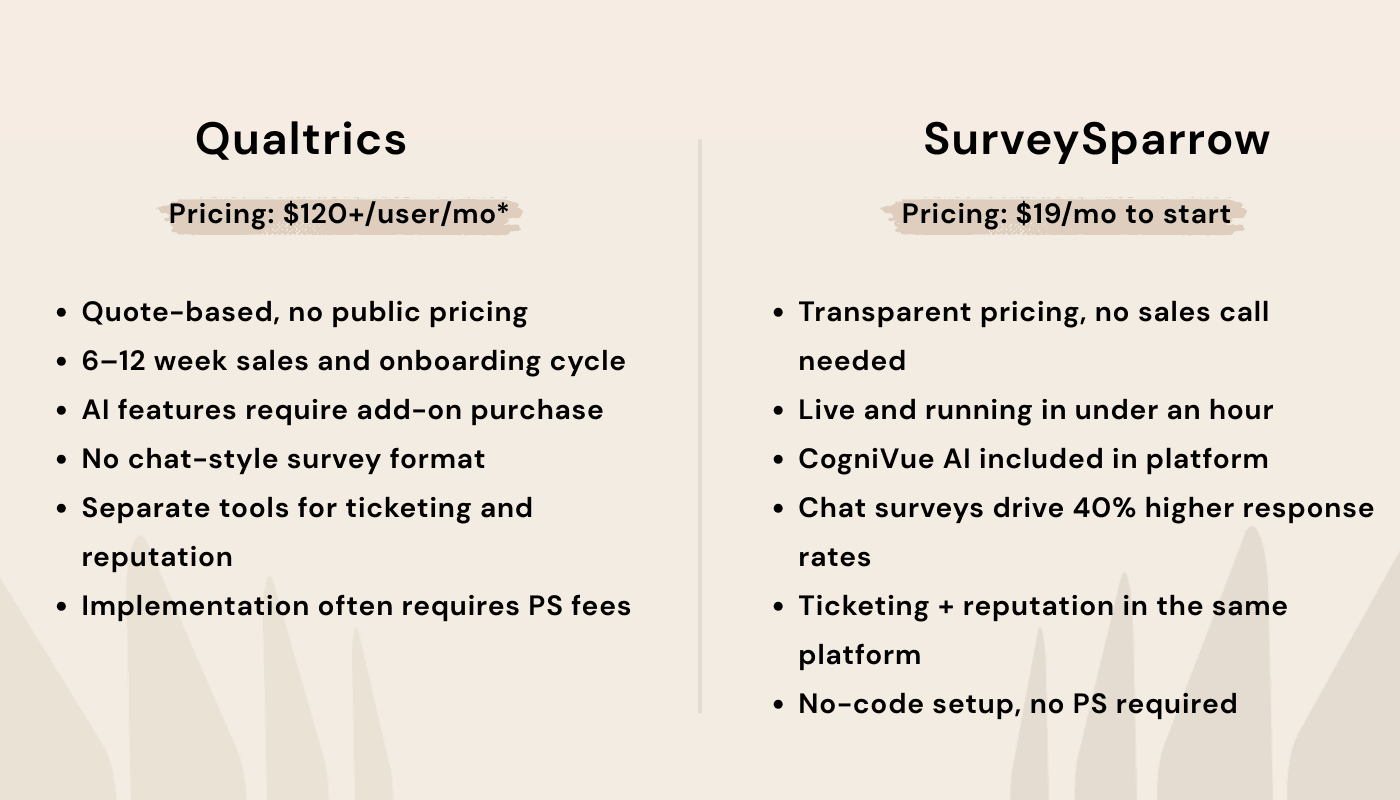
*Pricing data for third-party products referenced in this article is sourced from publicly available buyer reports and review platforms.
| Features | SurveySparrow | Qualtrics |
|---|---|---|
| Conversational / chat surveys | ✓ | ✗ |
| AI-powered text analytics | ✓ Built in | Add-on |
| Omnichannel distribution (email, SMS, WhatsApp, web) | ✓ | Partial |
| Reputation management | ✓ | ✗ |
| Closed-loop ticketing | ✓ | Limited |
| No-code drag-and-drop builder | ✓ | Moderate |
| Transparent public pricing | ✓ | ✗ |
| Free trial (full features) | ✓ 14-day | Limited free tier |
| SOC 2 / ISO 27001 / HIPAA / GDPR | ✓ | ✓ |
| 80+ language auto-translation | ✓ | Limited |
| 2000+ integrations | ✓ | ✓ |
| Advanced statistical research tools | Standard | ✓ Deep |
Who Qualtrics is (and isn't) for
Qualtrics makes the most sense for a specific kind of buyer: a large enterprise or academic institution with a dedicated research team, an existing SAP ecosystem, a compliance-heavy environment, and a budget that can absorb $15,000–$50,000+ per year without significant internal debate.
If that's you — it's a strong product. The depth of its research capabilities is real, and enterprise buyers who need conjoint analysis, MaxDiff, and FedRAMP compliance don't have many alternatives.
Qualtrics is a harder sell if you're a CX team that needs to move fast, a mid-market company watching unit economics, or a business that wants feedback to connect directly to action — ticketing, reputation management, automated follow-ups — without paying for a second or third platform to close the loop.
The question most buyers don't ask: What percentage of Qualtrics' 500+ question types will you actually use? For the vast majority of CX, NPS, and employee feedback programs, the answer is fewer than 20. You're paying for enterprise research infrastructure to run a customer satisfaction program.
The smarter alternative for CX-first teams
SurveySparrow was built on a single observation: surveys are boring, and boring surveys get ignored. The fix wasn't to add more question types — it was to redesign how the conversation happens.
The result is a unified Voice of Customer platform that closes the feedback loop end-to-end: conversational surveys that people actually want to fill out (40% higher response rates), AI-powered analytics through CogniVue that surface what matters without manual sorting, omnichannel distribution through SmartReach AI that reaches customers on the right channel at the right moment, and built-in ticketing and reputation management so feedback actually turns into action.
All of it starts at $19/month. All of it is live in under an hour. No sales call. No implementation consultant. No six-figure commitment before you've seen a single result.
For enterprise teams with compliance requirements — SurveySparrow is SOC 2, ISO 27001, HIPAA, and GDPR certified. The platform scales to 100,000+ customers across 149 countries. Brands like Tata Digital, Decathlon, McDonald's, and Xerox run their CX programs on it.
The difference isn't that SurveySparrow does less. It's that SurveySparrow is designed for CX outcomes — not research for its own sake.

Explore how SurveySparrow can transform your feedback process.
TRUSTED BY BEST-IN-CLASS BRANDS