

Customer expectations have shifted dramatically in recent years, leaving many traditional customer service teams struggling to keep pace. Today’s customers demand instant responses, personalized experiences, seamless multi-channel interactions, and genuine human empathy when things go wrong. Meanwhile, businesses face rising support costs, agent burnout, talent shortages, and an explosion in interaction volume across channels.
This widening gap is exactly why CX AI agents have become indispensable—and why they are rapidly replacing basic chatbots across industries. But despite rapid adoption, around 65-70% of consumers still prefer human interaction for complex issues.
So how do you bridge this gap? The answer lies in CX AI agents—intelligent systems that listen, clarify, and act autonomously to transform customer interactions. Not all AI agents are created equal, though. Solutions like Echo by SurveySparrow offer no-code conversational AI agents that handle feedback, bookings, sales, and more—all in your brand voice, without the need for complex coding or juggling multiple tools.
What Is a CX AI Agent?
A CX AI agent (Customer Experience AI Agent) is an advanced artificial intelligence system designed to autonomously understand, predict, and respond to customer needs through natural conversations and intelligent actions. Unlike traditional chatbots or basic automation, CX AI agents leverage machine learning, natural language processing (NLP), and predictive analytics to deliver personalized customer support at scale—24/7
Unlike traditional chatbots, CX AI agents:
- Understand meaning, not just keywords
- Learn continuously from interactions
- Maintain memory across conversations and channels
- Execute actions (refunds, bookings, updates)
- Escalate intelligently when human judgment is required
In simple terms: Chatbots answer questions. CX AI agents solve problems.
Platforms such as Echo exemplify this new wave of AI agents by offering intuitive builders that let teams create goal-based agents quickly, ensuring your AI works exactly how your business needs it to.
Definition
CX AI agents are intelligent software systems that use artificial intelligence to autonomously handle customer interactions, make contextual decisions, learn continuously from experiences, and provide personalized support across multiple channels while maintaining conversation context and understanding deep customer intent.
Why CX AI Agents Are Different from Traditional Automation
Most so-called “AI” customer service tools are still rule-based automation in disguise. Traditional automation relies on scripted flows, keyword matching, and manual updates, which fail when customers deviate from expected inputs.
| Feature | Traditional Automation | CX AI Agent |
|---|---|---|
| Adaptability | Low | High – adapts in real time |
| Learning Capability | None | Continuous learning from data |
| Context Awareness | No | Yes |
| Sentiment & Urgency | No | Yes |
| Decision Making | Fixed | Autonomous |
| Maintenance | Manual updates | Self-improving |
According to McKinsey, companies deploying AI effectively in customer operations see 20-45% productivity gains, with top performers achieving even more.
How CX AI Agents Work
CX AI agents combine several advanced technologies into a single operational system:
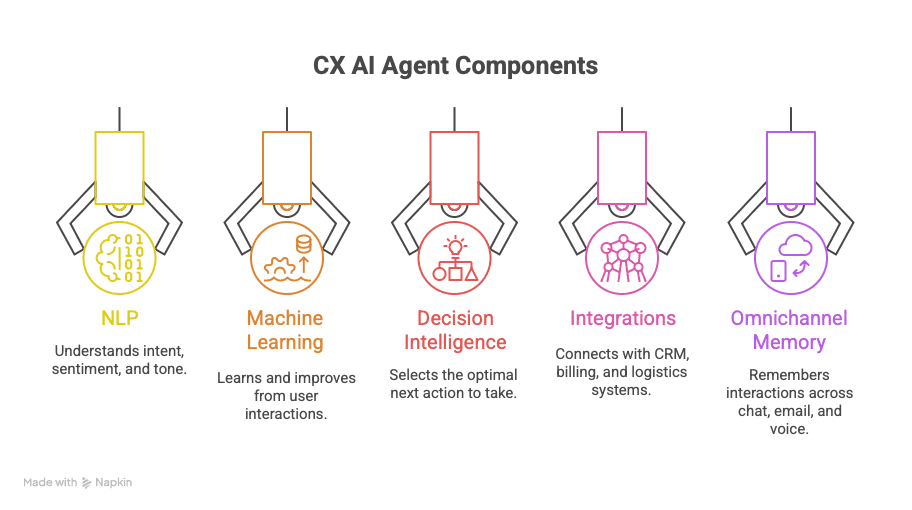
- Natural Language Processing (NLP): Understands customer intent, tone, sentiment, and ambiguity—not just keywords.
- Machine Learning: Learns from every interaction, resolution, and failure to improve responses.
- Decision Intelligence: Dynamically chooses the best action instead of following rigid scripts.
- System Integrations: Connects to CRM, billing, logistics, scheduling, and knowledge bases.
- Omnichannel Memory: Preserves context across chat, email, voice, and social channels.
This integration enables CX AI agents to say things like:
“I see you contacted us yesterday about this issue—let’s finish resolving it.”
CX AI Agent vs Chatbot vs Robotic Process Automation (RPA)
| Capability | Chatbot | RPA | CX AI Agent |
|---|---|---|---|
| Intelligence | Scripted | Task-only | Adaptive ML + NLP |
| Context Awareness | ❌ | ❌ | ✅ |
| Learning | ❌ | ❌ | ✅ |
| Personalization | Minimal | ❌ | Deep |
| Decision-making | Fixed | Fixed | Autonomous |
| Emotional Awareness | ❌ | ❌ | ✅ |
| Omnichannel Support | Limited | ❌ | Native |
Unlike chatbots that follow strict scripts or RPA that automates repetitive tasks, CX AI agents bring adaptive intelligence, emotional awareness, and autonomous decision-making to customer experience.
Business Benefits of CX AI Agents
Organizations that deploy CX AI agents well report:
- 30–40% reduction in customer service costs
- 70–80% automation of routine inquiries
- 1.5–2× faster resolution times
- Higher first-contact resolution (FCR)
- Improved CSAT and NPS
The Less Obvious Benefits
- Reduced agent burnout
- Lower attrition and training costs
- Consistent service quality
- Scalability without proportional headcount growth
CX AI doesn’t just save money—it stabilizes operations.
Why AI agents matter more than ever in customer experience
Technology advances and customer expectations meet to make AI agents vital today. Companies that add AI to their CX workflows cut operational costs by 30% and boost team productivity by 40%. AI agents also handle cases 1.5 to 2 times faster while solving more problems on the first try.
AI agents create customized experiences at scale. They look at lots of customer data—from buying history to browsing patterns—to provide tailored interactions. This meets a critical market need, since 71% of customers expect personalized interactions and 76% feel frustrated when they don't get them.
AI agents now move from reactive to proactive support. They predict issues, alert customers about shipping delays, and remind them about subscription renewals. This move toward proactive service shows the future of customer experience—where AI prevents problems before they happen.
How AI agents for CX are used today
Companies are quickly embracing cx ai agents to tackle business challenges and improve customer interactions. These intelligent systems redefine service delivery in many sectors, from initial contact to after-purchase support.
Contact centers: Automating first-line support
Contact centers struggle with overwhelming call volumes and high agent turnover. AI agents act as first-line responders on chat, email, and social channels. They lower the operational burden substantially. These systems understand customer needs through natural language processing and deliver relevant responses that improve the overall experience.
Results are impressive: organizations that use AI agents can automate more than 80% of customer interactions—whatever the complexity. This intelligent automation leads to faster service, lower costs, and stronger customer loyalty by coordinating end-to-end operations.
Retail: Personalized recommendations and order tracking
Retail cx ai agents excel at managing routine support tasks like order status updates, return authorizations, and FAQ resolution. Walmart leads in this area by using AI agents to improve service response times, route questions quickly, and automate routine tasks while bringing in humans for complex issues.
Beyond customer service, retail AI agents transform operations by:
- Automating repetitive questions about stock availability or store hours
- Learning about consumer behavior through interactions
- Improving inventory management with up-to-the-minute updates
This balance between automation and human touch allows retail staff to focus on strategic tasks while keeping customers satisfied.
Banking: Fraud detection and account management
Banks quickly deploy ai for cx in security applications—90% of banks now use AI to detect fraud, and two-thirds have added these solutions in the past two years. The need is clear: artificial intelligence powers more than 60% of today's fraud, including deepfakes, synthetic identities, and AI-powered phishing.
AI agents analyze big data sets to spot anomalies, identify fraud patterns, and block suspicious transactions early. To cite an instance, PayPal improved up-to-the-minute fraud detection by 10% without affecting customer experience. This proactive approach explains why 77% of customers support banks using AI technologies that prevent fraud. Fraud prevention software like Sift is among the advanced tools used by financial institutions to help identify and prevent fraudulent activity.
Healthcare: Appointment scheduling and reminders
Healthcare providers use ai agents to streamline administrative processes. These agents automate appointment booking, cut patient wait times by 25-35%, and reduce administrative costs by 30%. The appointment scheduling accuracy reaches 95-90%.
These agents handle routine tasks like booking, rescheduling, and sending reminders. They reduce no-shows and let healthcare staff focus on patient care. They also optimize available time slots based on patient demand and previous scheduling patterns to ensure maximum efficiency.
Travel: Booking, itinerary planning, and support
Travel experts call AI agents "the greatest transformation of our industry since the advent of the internet". These systems now offer complete planning and autonomous booking capabilities.
AI agents detect when customers should return for important events like a child's birthday. They analyze sentiment and apply reasoning logic to offer tailored recommendations. Expedia's AI-powered Trip Matching helps travelers build itineraries based on Instagram Reels and book directly.
The change toward autonomous agents shows promise—35-40% of consumers feel comfortable letting an AI agent plan their travel. This trust brings practical benefits: AI travel agents cut search and booking time by over 50% and lower corporate airfare expenses by 10-15%.
Ready to improve your customer feedback process with AI? Explore SurveySparrow's AI-powered survey tools that naturally integrate with your existing CX strategy.
Common Mistakes Businesses Make with CX AI Agents
AI adoption in customer experience continues to grow, yet about 80 to 85% of AI projects fail to deliver expected ROI. These failures usually stem from simple misunderstandings about what makes CX AI agents work. Let's get into the five most critical mistakes businesses make when they implement AI agents for customer experience.
Mistaking chatbots for AI agents
Companies often roll out simple chatbots and call them "AI agents," which creates confusion and letdown. True AI agents use large language models to understand context, semantics, and customer's intent across multiple conversation turns. Simple chatbots, on the other hand:
- Follow rigid scripts and pre-programmed workflows
- Use simple keyword matching instead of understanding intent
- Point to help articles rather than executing tasks
- Need constant manual updates instead of learning on their own
This difference significantly affects customer satisfaction. Chatbots can't summarize interactions or provide detailed handovers, which results in disconnected customer trips.
Ignoring the need for personalization
87% of customers expect businesses to know who they are, what products they use, and their previous issues. In spite of that, many companies roll out AI solutions that ignore context and give irrelevant suggestions. This lack of personalization breaks trust, as Target's infamous case showed when AI-powered marketing revealed a teen's pregnancy to her parents before she told them.
Over-automating and removing the human touch
Pushing automation too far stands out as one of the worst mistakes. Companies often try to remove human involvement completely. They don't see that certain moments in the customer's trip need human empathy. The problem gets worse as 67% of businesses make it hard for customers to bypass automated processes to talk to a human agent. Customers feel stuck and frustrated, which leads them to abandon purchases or cancel accounts.
Failing to train or monitor AI agents
AI agents without proper training and oversight can deliver poor experiences or make automated responses that hurt your reputation. A global bank's case shows this clearly. They launched an AI tool for customer support without training their agents properly. The agents either ignored or felt threatened by the AI's suggestions. Such oversights create inconsistent customer experiences and waste chances to improve the system.
Not lining up AI with customer journey goals
The biggest mistake might be rolling out AI without strategic planning or clear business goals. Companies often add AI just because their competitors have it, rather than solving specific customer problems. AI projects without defined success metrics drift aimlessly and don't improve customer experience meaningfully. The answer lies in connecting AI development to measurable business outcomes from day one.
Want to avoid these common CX AI pitfalls? Find out how SurveySparrow's intelligent feedback collection tools complement your AI strategy with human-centered design.
How to Implement CX AI Agents the Right Way
The right strategic planning makes CX AI agents work better than just deploying technology. Organizations see up to 40% higher completion rates by doing this structured approach to AI implementation.
Start with clear goals and use cases
Your business needs should drive specific, measurable objectives. AI agents with goal-based approaches deliver measurable value through well-laid-out SMART objectives. Specific KPIs provide direction whether you want to cut handling time by 30% or boost customer resolution rates. The best approach starts with high-value but focused use cases. Quick wins from pilot programs build confidence that leads to future growth.
Choose between building or buying
Your specific business requirements should determine the build-vs-buy decision. Building gives you control and flexibility when creativity matters most. Buying makes sense at the time you need narrow, quick, system-specific tasks done. A hybrid approach works best for most organizations. They purchase ready-made solutions for standard functions and develop custom capabilities that give them competitive advantage.
Ensure data quality and integration
The quality of data determines how well AI agents work. Bad data quality costs businesses an average of $12.90 million annually. Your systems should handle AI-driven service at scale with clean, available customer data before implementation. The core team needs to combine smoothly your AI agents with existing CRM systems, knowledge bases, and support platforms to provide detailed context.
Maintain transparency and customer trust
Customer confidence grows with transparency—70% of users prefer human agents over AI. You can address this preference by setting ethical guidelines, keeping human oversight (38% of users say this is vital), and ensuring accountability. Your customers should always know when they interact with AI agents.
Train your team to work with AI agents
Your staff needs hands-on training with AI-powered CRM systems, chatbots, and analytics tools. Technical skills matter as much as empathy and critical thinking—qualities that work well with AI capabilities. Teams learn about best practices through regular collaborative sessions.
SurveySparrow's CogniVue revolutionizes feedback collection. This AI-powered analytics engine extracts meaningful insights from large amounts of customer data. The conversational surveys get up to 40% higher response rates. This helps you understand customer needs better.
The future of CX AI agents: What to expect next
The next phase of customer service appears on the horizon. Nearly half of consumers would abandon a brand after a poor experience. Smart companies now adopt a fundamental change in CX AI capabilities.
From reactive to proactive support
Customer service no longer needs to wait for problems. Tomorrow's CX AI agents will spot issues before customers notice them. This progress from problem-solving to problem prevention represents what experts call "the gold standard in service". AI can identify potential issues through continuous monitoring and initiate corrective action automatically. This approach bridges the gap between friction and resolution.
Rise of agentic AI and autonomous decision-making
Agentic AI marks a significant advancement beyond current capabilities. These systems understand goals, break them into subtasks, and execute actions with minimal human oversight. Gartner predicts that 33% of enterprise software applications will include agentic AI by 2028. These autonomous systems will make 15% of day-to-day work decisions.
AI agents as digital concierges
Modern AI concierges deliver tailored experiences that surpass simple chatbots. A luxury resort group achieved a 23% boost in ancillary revenue by implementing AI-driven upselling based on guest profiles and previous stays. These digital concierges understand context and provide thoughtful recommendations. Their approach feels more human than the impersonal systems they replace.
Preparing your business for AI-first customer experiences
AI revolutionizes competitive advantage. Businesses must adapt through:
- Deepening their commitment to direct customer relationships and high-quality data collection
- Developing AI-fluent talent throughout the organization
- Optimizing workflows with AI at their core, not as an add-on
This transition requires a new approach to work organization. Hierarchies will flatten as AI agents handle back-office processes under human supervision.
Conclusion
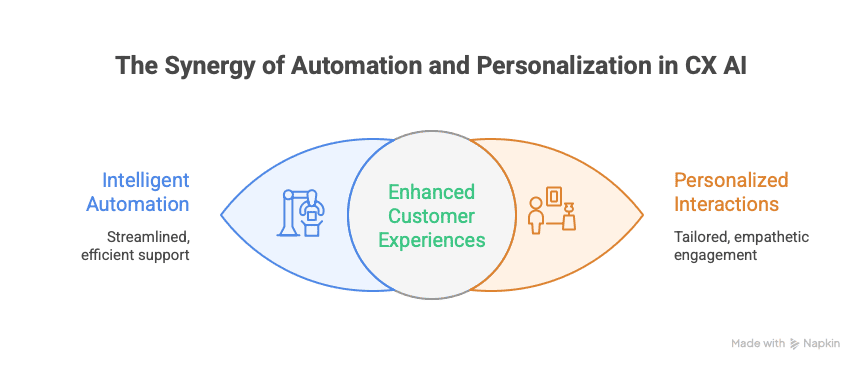
CX AI agents are revolutionizing customer experience by bridging the gap between automation and human empathy. Companies that balance AI-driven efficiency with meaningful human connections achieve lower costs, higher productivity, and stronger customer loyalty.
Your success depends on clear goals, quality data, transparency, and skilled teams. Start building your balanced CX AI strategy today—because your customers expect nothing less.
Collecting feedback and managing bookings shouldn’t feel like a full-time job. Solutions like Echo by SurveySparrow let you do it all with one intelligent agent; saving time, reducing tool overload, and delivering personalized experiences your customers expect.