


Most businesses waste thousands on the wrong automation tool because they don't understand the difference between conversational AI vs chatbots. We know companies spending about $15,000 on a "smart chatbot" only to discover it couldn't handle anything beyond "What are your business hours?"
Does that sound familiar?
The debate between conversational AI vs chatbots has evolved into a $10-11 billion market worldwide in 2026, yet the confusion remains. Organizations handling 20,000 monthly support requests save 240+ hours monthly when they choose the right technology (assuming 50% automation and 2-minute savings per inquiry). But knowing what to choose is the most important because if not, you are basically paying for an expensive FAQ page.
The global chatbot market reached approximately $1.7 billion in 2026 and is projected to grow at 18.8% CAGR to $8 billion by 2035. With 88% of enterprises adopting AI in at least one function, the question isn't whether to automate—it's which tool actually solves your problem.
Some businesses report drops up to 50% in live chat needs after implementing the right solution. Others manage 10,000+ daily customer interactions through automation. The difference? They understood what they were buying.
This guide breaks down conversational AI vs chatbots in plain English, shows you real-world applications, and helps you pick the technology that actually works for your business in 2026.
What is the Difference Between Conversational AI vs Chatbots?
Let's clear up the confusion around conversational AI vs chatbots. The distinction runs deep, it fundamentally changes what your automation can do.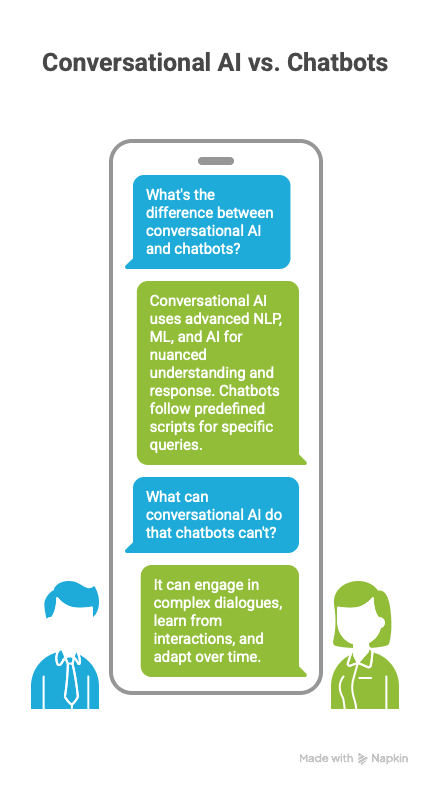
Rule-Based Logic vs AI-Powered Understanding
Here's where conversational AI vs chatbots diverge at the core.
Traditional chatbots operate on predefined rules and optimized workflows—think "if-then" systems. Customer says "X," bot responds with "Y." Period. These bots follow strict conversation paths with zero room to adapt. It's like talking to a vending machine: you get exactly what's programmed, nothing more.
Conversational AI takes a completely different approach. It uses machine learning, natural language processing (NLP), and generative AI to create flexible, context-aware conversations that adapt in real-time. The system actually understands what you're asking, not just which keywords you used.
About 88% of enterprises have adopted AI in at least one function for customer interactions. Why? Because when a customer asks "Can you help with my order?"—conversational AI knows whether they want to track, modify, or cancel it. A basic chatbot just sees the word "order" and shows a generic menu.
Keyword Matching vs Intent Recognition
The difference between chatbots and conversational AI becomes painfully obvious when you look at how they process language.
Traditional chatbots struggle with basic language nuances:
- Keyword detection spots specific words without understanding context. Ask "I don't want to cancel" and it triggers the cancellation flow because it only sees "cancel"
- Context blindness creates false positives that waste your quality assurance team's time
- Rigid keyword lists can't handle different phrasings, slang, or natural language variations
Intent recognition changes everything. It's the backbone of conversational AI and analyzes tone, context, and words together to understand what customers actually want. The system recognizes that "I want my money back" and "Can you process a refund?" mean the same thing, even with completely different wording.
This is why the conversational AI and chatbots debate matters for your bottom line. One understands your customers. The other just pattern-matches.
Static Scripts vs Dynamic Learning
The final piece of the conversational AI vs chatbots puzzle is how they evolve.
Rule-based chatbots are static. They need manual updates to improve and deliver identical scripts regardless of context. Every possible conversation path must be programmed by developers. Miss one scenario? Your customer gets "I don't understand that request."
Conversational AI learns from every single interaction. Machine learning algorithms study patterns from past conversations and improve responses over time. This learning capability handles complex tasks, interruptions, and ambiguous requests that would completely stump traditional chatbots.
As it interacts with more customers, the system adapts to your specific audience's communication style. It's the difference between hiring someone who follows a script versus someone who actually thinks.
Conversational AI vs Chatbots: Understanding the Technology Types
The automated chat landscape includes several distinct technologies. Here's how they compare in the conversational AI vs chatbots spectrum.
Traditional Chatbots: Menu-Based and Rule-Driven
At the basic end of the conversational AI vs chatbots comparison, traditional chatbots work through predefined rules and scripted flows. They show users text menus or buttons to guide interactions.
These rule-based or decision-tree chatbots create specific conversation paths and attempt to understand customer intent through preset options. They offer choices that lead to answers, but users with complex questions hit dead ends fast.
The limitations are clear: These bots can't learn new things and only function in specifically designed scenarios. They require manual updates to improve. For businesses comparing conversational AI vs chatbots, traditional bots work for one thing: simple, predictable interactions.
AI Chatbots: NLP and Machine Learning Capabilities
Moving up the conversational AI vs chatbots spectrum, AI-powered chatbots utilize machine learning (ML) and natural language processing (NLP) to create human-like interactions.
Unlike their rule-based cousins, these systems learn from experience and improve over time. Machine learning helps them spot patterns and trends in large datasets, allowing them to grasp user intent even when people phrase things differently.
They employ three key learning techniques:
- Supervised learning with labeled data for specific outcomes
- Unsupervised learning to discover patterns in unlabeled data
- Reinforcement learning that improves through feedback loops
This is where the conversational AI vs chatbots distinction starts getting interesting for businesses with moderate complexity needs.
Conversational AI Chatbots: Contextual and Sentiment-Aware
At the advanced end of conversational AI vs chatbots, these systems add context awareness and sentiment analysis to the mix.
Advanced conversational AI chatbots track conversational context and remember previous chats to deliver coherent responses across multiple exchanges. Context-aware systems track information from earlier conversation segments, reducing repetitive questions.
For example, after discussing hotels near one stadium, they handle questions about accommodations near another location without requiring additional details. Some conversational AI tools even detect user mood and adjust their response tone accordingly.
This is the sweet spot in the conversational AI vs chatbots debate for companies handling complex, emotional customer interactions.
Virtual Assistants vs Voice Assistants
The conversational AI vs chatbots discussion extends to specialized applications.
AI virtual assistants function as digital teammates across connected apps, offering personalized support based on learned user habits and priorities. Their contextual intelligence remembers conversation details and suggests next steps, creating natural experiences.
Voice assistants focus on spoken language through speech recognition and synthesis technologies. They excel at hands-free access, making them perfect for busy professionals. However, voice assistants struggle with accents, background noise, and speech clarity issues that text-based solutions avoid.
Conversational AI vs Chatbots in Real-World Use Cases
Understanding conversational AI vs chatbots theoretically is one thing. Seeing how they perform in actual business scenarios? That's where the rubber meets the road.
Customer Support: Where Conversational AI vs Chatbots Shows Clear Winners
Companies using chatbots save more than 240 hours monthly handling 20,000 support requests (assuming 50% automation and 2-minute savings per inquiry). But the type of chatbot determines whether those hours translate to better customer experience or just frustration.
Basic chatbots excel at:
- Frequently asked questions with straightforward answers
- Simple tasks like appointment confirmations or password resets
- Providing identical responses to predictable questions
Conversational AI dominates with:
- Complex customer issues requiring context and history
- Multi-step problem resolution across different systems
- Understanding sentiment and escalating appropriately
The practical difference is stark. A basic chatbot follows the same flow every time. Conversational AI analyzes "I'm having trouble logging in again," checks previous tickets, identifies the pattern, and suggests solutions without human intervention.
This capability explains why adoption surged during the pandemic as companies sought better interaction solutions. The conversational AI vs chatbots choice determined whether automation actually helped customers or just annoyed them.
Sales and Lead Generation: Conversational AI vs Chatbots ROI
The conversational AI vs chatbots decision directly impacts your conversion rates.
AI chatbots qualify prospects by asking relevant questions and capturing contact details. In B2B scenarios, conversational AI assesses visitors by asking about company size and needs before routing qualified leads to sales teams. Businesses that want to build lead generation chatbot solutions often use these AI-driven flows to replace static forms and create more engaging lead capture experiences.
Where conversational AI truly separates from basic chatbots: personalization based on user behavior. Advanced systems detect when someone views pricing pages or shows exit intent, then respond with targeted messages—offering demos or suggesting helpful resources.
Standard forms convert at 2-20%. Conversational chatbots achieve approximately 3x better performance (20-30% lead conversion rates). That's the conversational AI vs chatbots difference in dollars and cents.
E-commerce and Order Tracking
Retail illustrates the conversational AI vs chatbots spectrum clearly.
Retail chatbots handle basic tasks like tracking packages or processing returns. Conversational AI provides advanced help, guiding customers through complex buying decisions while adjusting conversations based on past interactions and preferences.
Domino's Pizza uses voice assistant technology that understands natural speech for food orders. Customers modify requests and track deliveries through natural conversation instead of rigid menu selections. This flexible approach creates natural customer interactions that scale effortlessly.
So How Smart Feedback Loops Bridge the Gap?
Here's where the conversational AI vs chatbots debate gets practical for your business.
The pain point most companies face: Traditional surveys feel like interrogations. Email surveys get 22% completion rates if you're lucky. You need feedback to improve, but customers won't engage with boring forms.
Conversational survey platforms show how AI makes feedback collection actually work. These systems help companies send NPS surveys easily while tracking responses and analyzing results in real-time.
The key feature that separates these from basic chatbots: closing the feedback loop. Organizations can thank customers immediately or address issues through automated responses based on specific triggers. This isn't just automation—it's intelligent engagement.
SurveySparrow Echo exemplifies this approach. The platform uses conversational AI to create surveys that feel like natural dialogues, achieving up to 85% completion rates compared to 22% for traditional surveys—approximately a 4x improvement.
The difference? Echo doesn't just collect data. It:
- Adapts questions based on previous answers (context awareness)
- Triggers follow-up actions automatically based on sentiment
- Integrates with your existing systems to close the feedback loop
- Learns from response patterns to optimize future surveys
This builds trust by showing customers their opinions drive real changes, resulting in stronger brand loyalty and actionable insights.
Try SurveySparrow Echo Free →
14-day free trial • Cancel Anytime • No Credit Card Required • No Strings Attached
See the conversational AI vs chatbots difference in your completion rates within 24 hours.
Benefits and Limitations
Evaluating conversational AI vs chatbots requires understanding both strengths and limitations. Here's the honest comparison.
Scalability and Cost Efficiency in Conversational AI vs Chatbots
Traditional chatbots require less upfront investment, making them attractive for businesses with tight budgets. These rule-based systems handle routine tasks quickly, freeing your team for complex issues. Teams managing 20,000 monthly support requests save more than 240 hours monthly using chatbots (assuming 50% automation and 2-minute savings per inquiry).
Conversational AI costs more initially but delivers superior long-term value through enhanced scalability and advanced features. As your business grows into new markets, products, or policies, conversational AI naturally adapts to new contexts and data sources.
This scalability matters more now that 88% of enterprises have adopted AI in at least one function. The conversational AI vs chatbots ROI equation shifts heavily toward AI when you factor in reduced manual updates and improved customer satisfaction.
User Experience and Personalization
These technologies create vastly different user experiences—the core of the conversational AI vs chatbots debate for customer-facing teams.
Traditional chatbots deliver standard, one-size-fits-all responses with minimal personalization. Think vending machine: you get what's programmed, exactly as programmed.
Conversational AI adapts based on user preferences, behavior, and past interactions. It interprets context, tone, and previous conversations, making it superior for complex customer interactions.
Most consumers now expect personalized interactions and demonstrate loyalty to brands delivering tailored experiences. The conversational AI vs chatbots choice directly impacts whether you meet those expectations.
Learning Curve and Maintenance
Traditional chatbots need less ongoing work since they don't learn from interactions. This apparent advantage becomes a drawback—they remain static without manual updates, creating additional work for your team over time.
Conversational AI improves with each interaction, learning from past conversations to deliver more accurate responses. The system requires regular data training to stay effective, but it becomes smarter with every customer interaction and adapts to your users' communication style.
When comparing conversational AI vs chatbots for total cost of ownership, factor in the engineering hours spent updating traditional chatbots versus the training time for AI systems.
Conversational Surveys: The Practical Application
AI-powered survey automation demonstrates the conversational AI vs chatbots difference clearly.
Standard forms convert at 2-20%. Conversational chatbots achieve approximately 3x better performance (20-30% lead conversion rates). Platforms like SurveySparrow Echo claim conversational surveys reach up to 85% completion rates compared to 22% for traditional surveys.
These tools create engaging experiences feeling like natural conversations rather than interrogations. AI-powered survey tools help gather better, contextual data through natural language responses, improving data quality and building stronger customer relationships through meaningful interactions.
Conversational AI vs Chatbots: Which One Works Better for Your Business?
The conversational AI vs chatbots decision depends on your specific business needs and resources. Here's how to choose.
When to Choose a Traditional Chatbot
Traditional chatbots excel at handling simple, repetitive questions following clear rules or scripts. Choose basic chatbots when the conversational AI vs chatbots ROI doesn't justify the investment:
- Simple customer support answering questions about store hours, shipping costs, or return policies
- Lower upfront budget and limited technical resources
- Quick deployment for specific, well-defined use cases
- Predictable interactions that don't require context or learning
If your customer interactions follow predictable patterns and don't require personalization, traditional chatbots solve your problem at lower cost.
When to Choose Conversational AI
Complex, customized interactions requiring deeper understanding make conversational AI the clear winner in the conversational AI vs chatbots comparison:
- Multi-step conversations needing context awareness across multiple exchanges
- Learning and improvement over time as you gather more customer data
- Deep integration with your platforms and data sources for personalized experiences
- Emotional intelligence detecting sentiment and responding appropriately
- Complex problem-solving requiring analysis of multiple data points
When customer satisfaction and personalization drive your business model, conversational AI justifies the higher investment.
Hybrid Models: Combining Both for Best Results
Smart organizations realize the conversational AI vs chatbots debate isn't either/or. Hybrid models blend rule-based chatbots for speed with conversational AI for customization.
Hybrid chatbots in healthcare show impressive results—reducing hospital readmissions by 25% and improving patient involvement by approximately 30%. This combined approach handles simple queries efficiently through traditional chatbots and switches naturally to AI-powered solutions for complex conversations.
Hybrid models also cut customer service costs by about 30% while maintaining quality. You get the conversational AI vs chatbots benefits of both: efficiency and intelligence.
Conversational AI vs Chatbots: Complete Comparison Table
| Aspect | Traditional Chatbots | Conversational AI |
|---|---|---|
| Core Operation | Rule-based "if-then" systems with predefined scripts | Machine learning and NLP with dynamic, context-aware interactions |
| Language Processing | Simple keyword matching and detection | Intent recognition with context understanding |
| Learning Capability | Static, needs manual updates | Learns continuously from interactions |
| Response Flexibility | Fixed responses following set paths | Adapts responses based on context and user behavior |
| Best Use Cases | • Simple FAQs • Appointment confirmations • Password resets • Basic order tracking | • Complex customer queries • Multi-step workflows • Personalized interactions • Advanced lead qualification |
| Initial Investment | Lower upfront costs ($1,000-$10,000) | Higher original investment ($10,000-$100,000+) |
| Maintenance | Less ongoing work but needs manual updates | Needs regular data training but improves autonomously |
| Scalability | Limited by set rules and scripts | Highly adaptable, fits new contexts automatically |
| Conversion Rate | Forms: 2-20% | Chatbots: 3x better (20-30%) |
| Time Savings | Saves 240+ hours monthly for teams handling 20,000 support requests (with 50% automation, 2-min savings/inquiry) | Same base efficiency with additional benefits from learning capabilities |
| Personalization | Minimal, one-size-fits-all approach | Advanced customization based on user history and behavior |
| Error Handling | Limited to programmed scenarios | Handles interruptions, context switches, and unclear inputs |
| Market Position | Part of $10-11B market (2026) | Driving 18.8% CAGR to $8B by 2035 |
| Context Awareness | No memory of previous interactions | Remembers conversation history and user preferences |
| Sentiment Analysis | Cannot detect emotional tone | Analyzes sentiment and adjusts responses accordingly |
| Integration Complexity | Simple API integrations | Complex integrations with CRM, analytics, and business systems |
When to Choose Chatbots or Conversational AI?
The conversational AI vs chatbots choice impacts your customer experience and bottom line for years. Here's what you need to know.
The distinction between conversational AI vs chatbots grows more critical daily. Rule-based chatbots offer budget-friendly solutions for simple tasks. Conversational AI handles complex situations requiring context, learning, and personalization.
Your business needs should drive your technology choice in the conversational AI vs chatbots equation:
Choose traditional chatbots when you need to answer simple FAQs, confirm appointments, or track orders with predictable patterns.
Choose conversational AI when you handle multi-step workflows, personalized interactions, or situations requiring continuous learning and adaptation.
Choose hybrid models when you want efficiency for simple queries and sophistication for complex interactions—getting the best of both in the conversational AI vs chatbots spectrum.
The market validates these distinctions. The chatbot market projects 18.8% annual growth reaching $8 billion by 2035. AI-powered survey interfaces like SurveySparrow Echo demonstrate impressive results—up to 4x higher completion rates compared to traditional forms.
Stop Guessing, Start Getting Results
The conversational AI vs chatbots debate ends when you see results in your own business.
If you're struggling with low survey completion rates, poor feedback quality, or customers ignoring your forms—you're experiencing the exact pain point conversational AI solves. Try out SurveySparrow to see if it fits your needs.
See the conversational AI vs chatbots difference firsthand: ✓ 4x higher completion rates in 24 hours ✓ Richer, contextual feedback from natural conversations ✓ Automated follow-ups that close the feedback loop ✓ No credit card required
Companies choosing technologies based on real customer needs lead their markets. Your success depends on picking tools that improve customer experiences and deliver measurable business value—whether traditional chatbots, conversational AI, or both.
The conversational AI vs chatbots question isn't about following trends. It's about matching technology to your specific business challenges and customer needs.
14-day free trial • Cancel Anytime • No Credit Card Required • No Strings Attached