


Most businesses evaluating conversational AI platforms face the same problem: every comparison list throws 15 enterprise tools at them, and 12 of them start at $100K a year.
That's not a shortlist. That's a procurement project.
The gap between the most powerful conversational AI platforms on the market and what most teams can realistically deploy has never been wider.
Here's what those conversational AI platforms lists rarely say: most businesses don't need a contact center automation platform. They need a tool that makes conversations with customers, prospects, or employees feel natural, captures what people actually think, and turns that into something their team can act on.
That distinction matters. A lot.
This guide covers 15 conversational AI platforms worth evaluating in 2026. We've organized them by what they're actually built for—so you can skip the conversational AI platforms designed for Fortune 500 call centers and focus on what fits your team, your budget, and your real goals.
What Do Conversational AI Platforms Actually Do?
Before the list, a quick grounding point.
"Conversational AI" has become a catch-all term covering everything from voice bots that handle insurance claims to survey tools that ask follow-up questions based on your last answer. Conversational AI platforms are very different from each other, even when they share a category label.
At the core, conversational AI platforms do one or more of the following:
- Automate dialogues — handle inbound queries, route calls, answer FAQs without human agents
- Collect structured information — ask questions in a way that feels natural, not form-like
- Analyze language — detect intent, sentiment, and meaning from unstructured text or voice
- Take action — connect conversations to workflows, CRMs, help desks, or other systems
If you're still wondering whether your business needs a simple automated responder or a full-scale AI system, our Conversational AI vs Chatbots: The Complete 2026 Guide breaks down the technical differences between the two.
To define it, conversational AI platforms are software applications that use natural language processing (NLP) and machine learning to simulate human-like interactions. These platforms automate dialogues, collect structured data through chat-like interfaces, and analyze sentiment to trigger specific business workflows.
Understanding which of these your business actually needs is the fastest way to narrow a 15-item conversational AI platforms list down to two or three real candidates.
15 Conversational AI Platforms Evaluated for 2026
1. SurveySparrow — Best Overall for Feedback-Driven Conversations

Most conversational AI platforms are built to deflect. SurveySparrow is built to understand.
Where contact center tools aim to reduce the number of conversations a human has to handle, SurveySparrow's approach is different: make every conversation your business chooses to have more engaging, more complete, and more actionable.
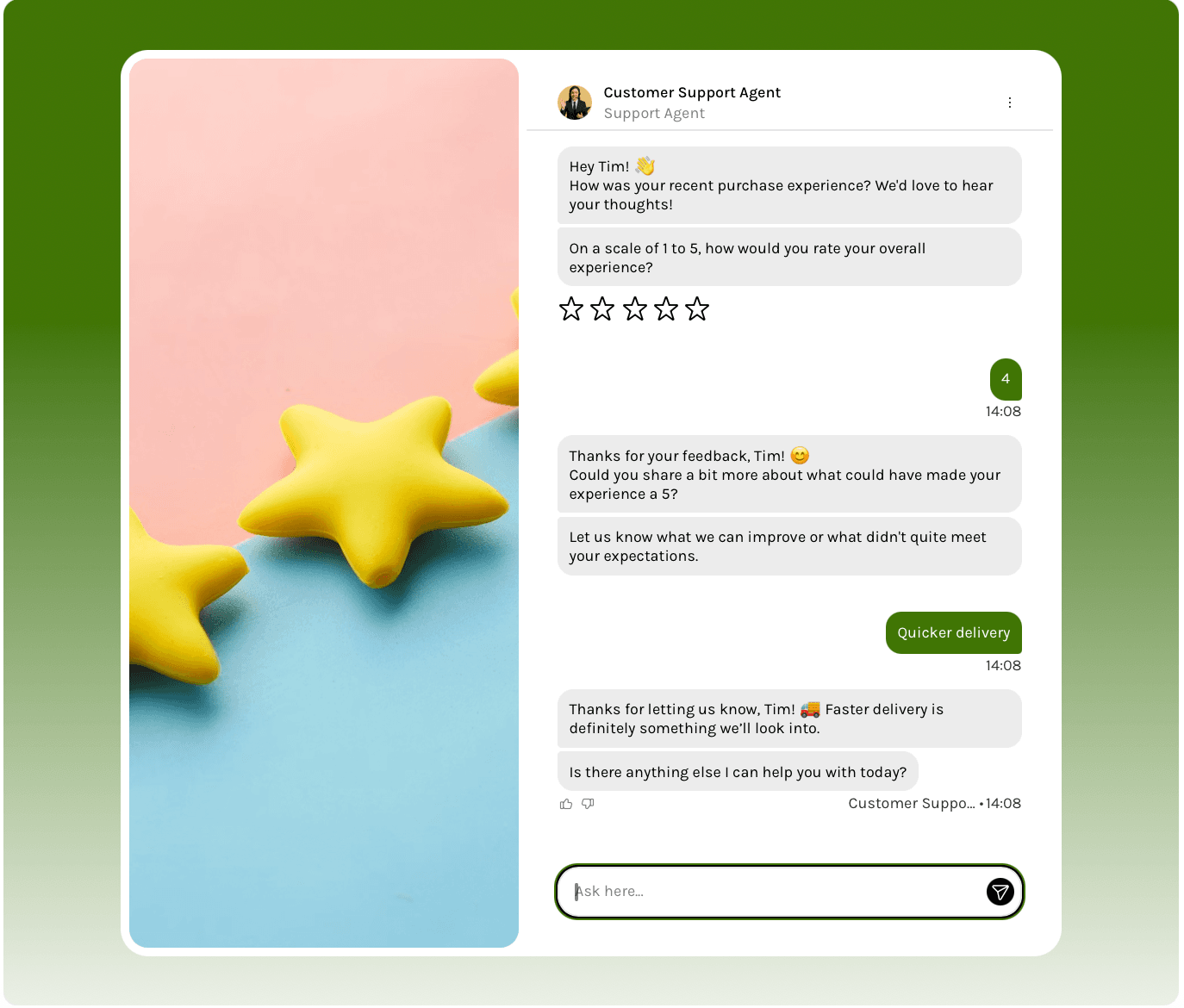
The platform's conversational survey format presents one question at a time in a chat-like flow—the kind of experience that feels like texting rather than filling out a government form. The difference in outcomes is measurable. Companies like Tata Digital have seen 90% survey completion rates using SurveySparrow, compared to the 20-30% most static forms generate.
What makes it distinct:
SurveySparrow's Echo AI agent goes further than standard survey tools. Echo turns a single open-ended question into a branching conversation—asking follow-ups based on what the respondent actually says, not just routing them through a pre-built decision tree. If a customer mentions a delay in your shipping process, Echo probes that specifically. You get depth, not just volume.
Collecting feedback is only half the battle. To see how modern teams are moving from raw data to real-time action, explore our guide on AI Customer Feedback: How Teams Analyze and Act on Feedback at Scale .
Where it fits:
A mid-sized e-commerce team running quarterly customer satisfaction surveys was getting roughly 18% completion on their email-distributed forms. After switching to SurveySparrow's conversational format distributed via SMS, completion hit 61% within the first cycle. More importantly, the open-ended responses were richer—Echo's follow-up logic surfaced specifics (packaging complaints, delivery window frustrations) that never appeared in checkbox answers.
That's the shift SurveySparrow enables: from data collection to genuine understanding.
Key features:
- AI-powered survey builder generating questions in seconds
- Echo AI agent with automatic follow-up logic
- Multi-channel distribution (email, SMS, web embed, WhatsApp)
- Sentiment analysis and insight tagging on responses
- Integrations with Stripe, CRMs, and helpdesk tools
- Mobile-first design with chat-like one-question-at-a-time flow
Advanced sentiment analysis does more than just spot a 'happy' or 'sad' customer; it uncovers the why behind the emotion. Learn more in our deep dive into AI Sentiment Analysis for Customer Feedback in 2026 .
Best for: Customer experience, employee feedback, NPS programs, product research, event feedback
Pricing: Free forever plan available. Paid plans from $19/month (billed annually). Enterprise pricing available.
See how SurveySparrow turns feedback into conversations →
14-day free trial • Cancel Anytime • No Credit Card Required • No Strings Attached
2. Retell AI — Best for Voice-First Automation
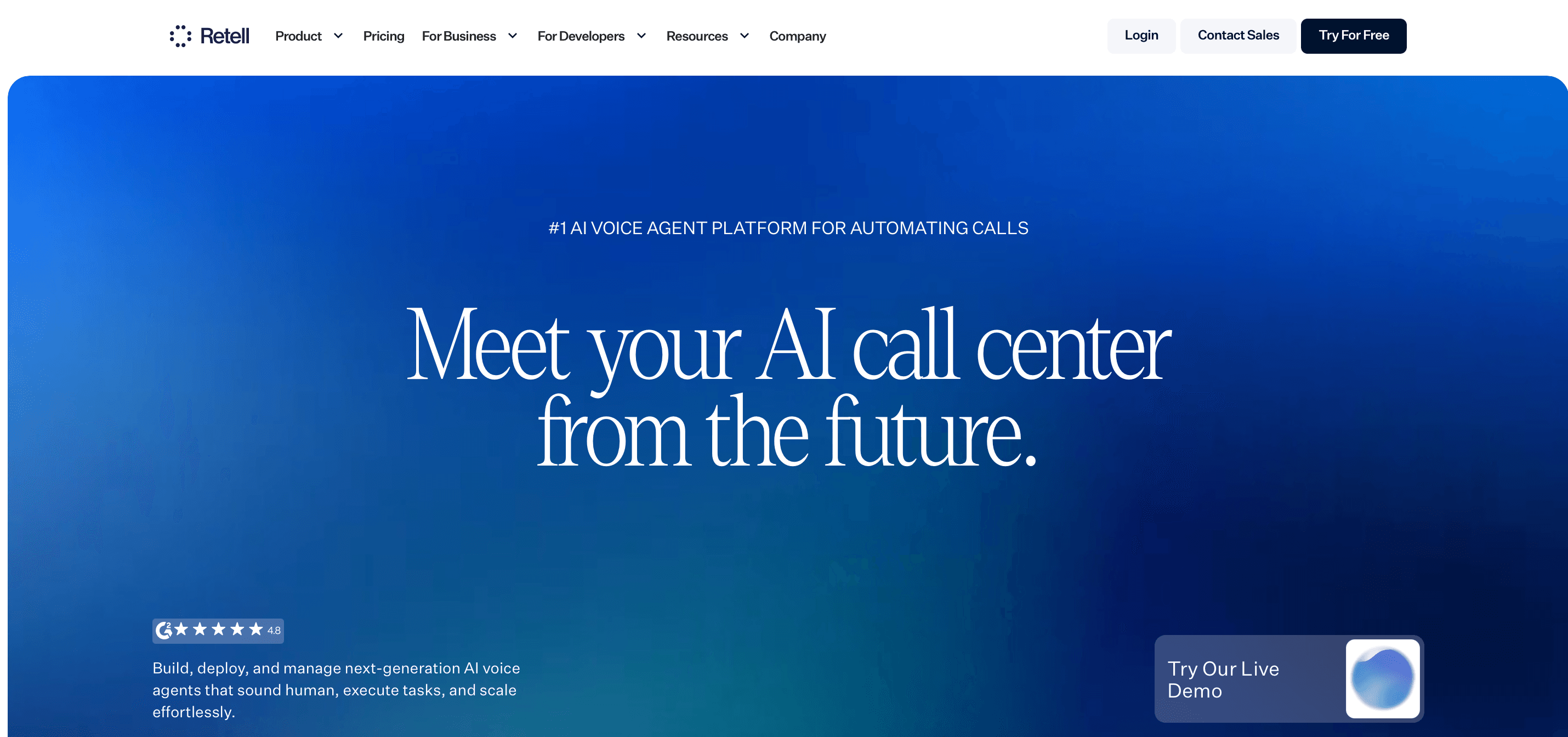
Retell AI is purpose-built for automated phone calls that don't sound automated. Its 800ms response time eliminates the awkward pause most voice bots produce, and its turn-taking model creates genuinely natural back-and-forth.
Best for: Healthcare appointment scheduling, inbound/outbound call automation, lead qualification at scale
Pricing: Pay-as-you-go, advertised from around $0.07/minute, with real-world setups often higher once extras are included. $10 in free credits to start.
Watch out for: API-centric design. Non-technical teams will need developer support to get the most out of it.
Notable: 3.4x higher connect rate than traditional power dialers. Cuts no-show rates by 89% in healthcare implementations.
3. Cognigy.AI — Best for Enterprise Contact Center Automation
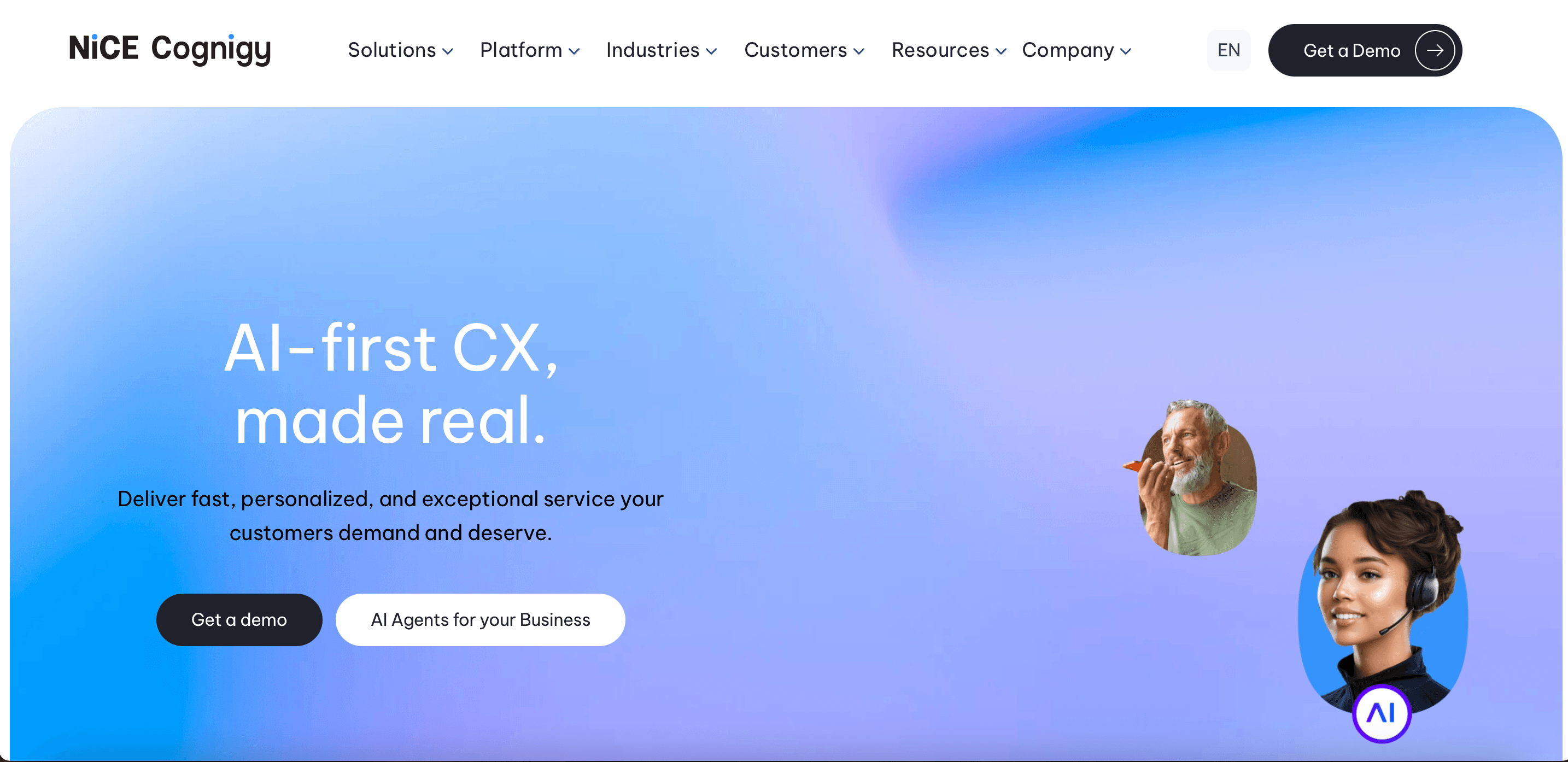
Cognigy is enterprise-grade in every sense: capabilities, integration depth, price point, and implementation complexity. Its Agentic AI combines LLM reasoning with live context and governance controls that regulated industries require.
Best for: Large contact centers, multilingual customer service operations, organizations needing 30+ channel coverage
Pricing: Starts at $2,500/month for entry plans; large enterprise deployments can reach six‑figure annual contracts.
Watch out for: Non-technical users will need engineering support for custom workflows. Implementation timelines can stretch several months.
Notable: 100+ prebuilt integrations. Visual flow builder non-developers can use for standard flows.
4. Kore.ai — Best for Multi-Agent Enterprise Orchestration
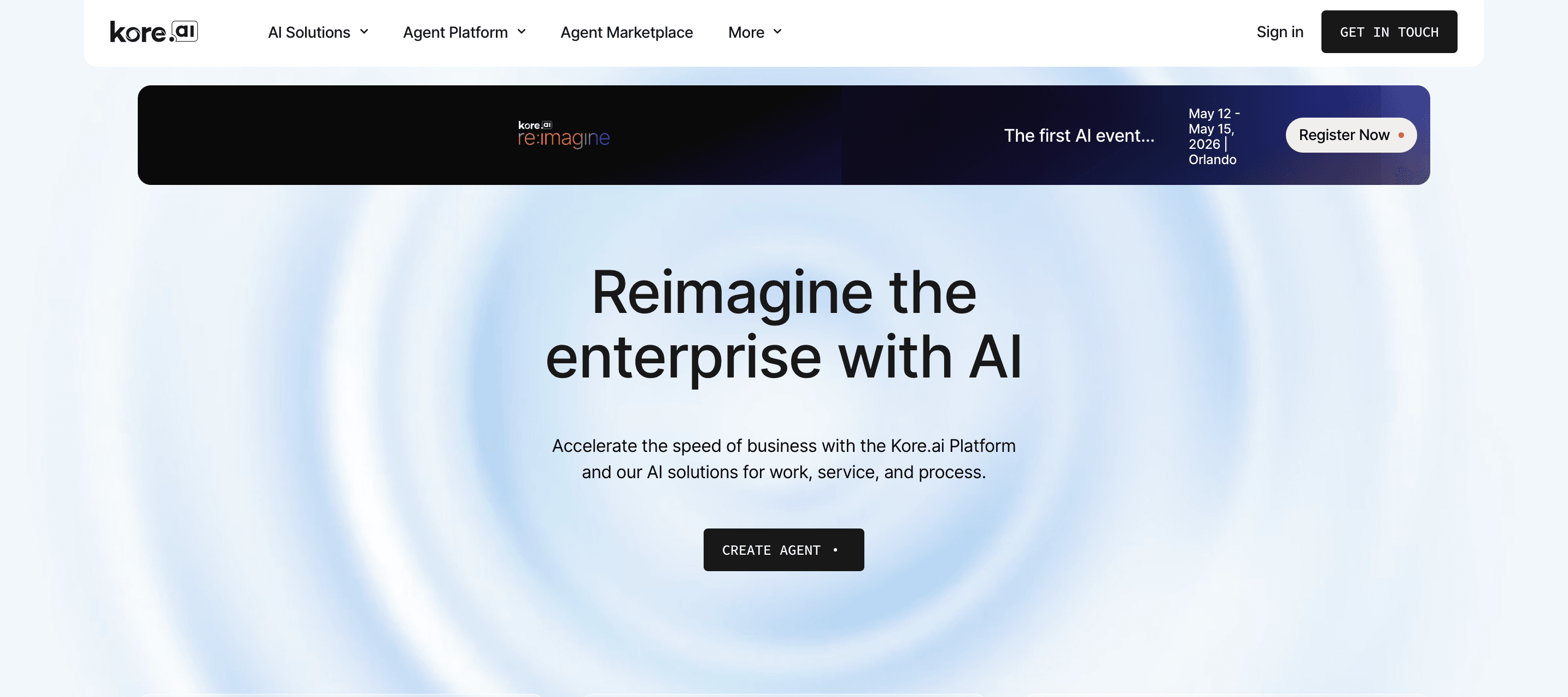
Kore.ai's XO Platform handles complexity that most platforms can't—multiple AI agents working together, sharing memory, and making decisions across enterprise systems. 100+ pre-built search connectors and native RAG support make it a serious option for knowledge-intensive environments.
Best for: Large enterprises in banking, healthcare, and insurance with complex multi-step workflows
Pricing: Enterprise contracts are typically in the mid‑ to high‑five‑figure or six‑figure range annually, often reaching ~$300,000/year for large deployments.
Watch out for: Implementation typically takes 6-18 months. Not suited for teams without dedicated AI resources.
Notable: Deployed by Morgan Stanley, Pfizer, and Deutsche Bank for specific high-stakes workflows.
5. Yellow.ai — Best for Omnichannel Customer Service at Scale
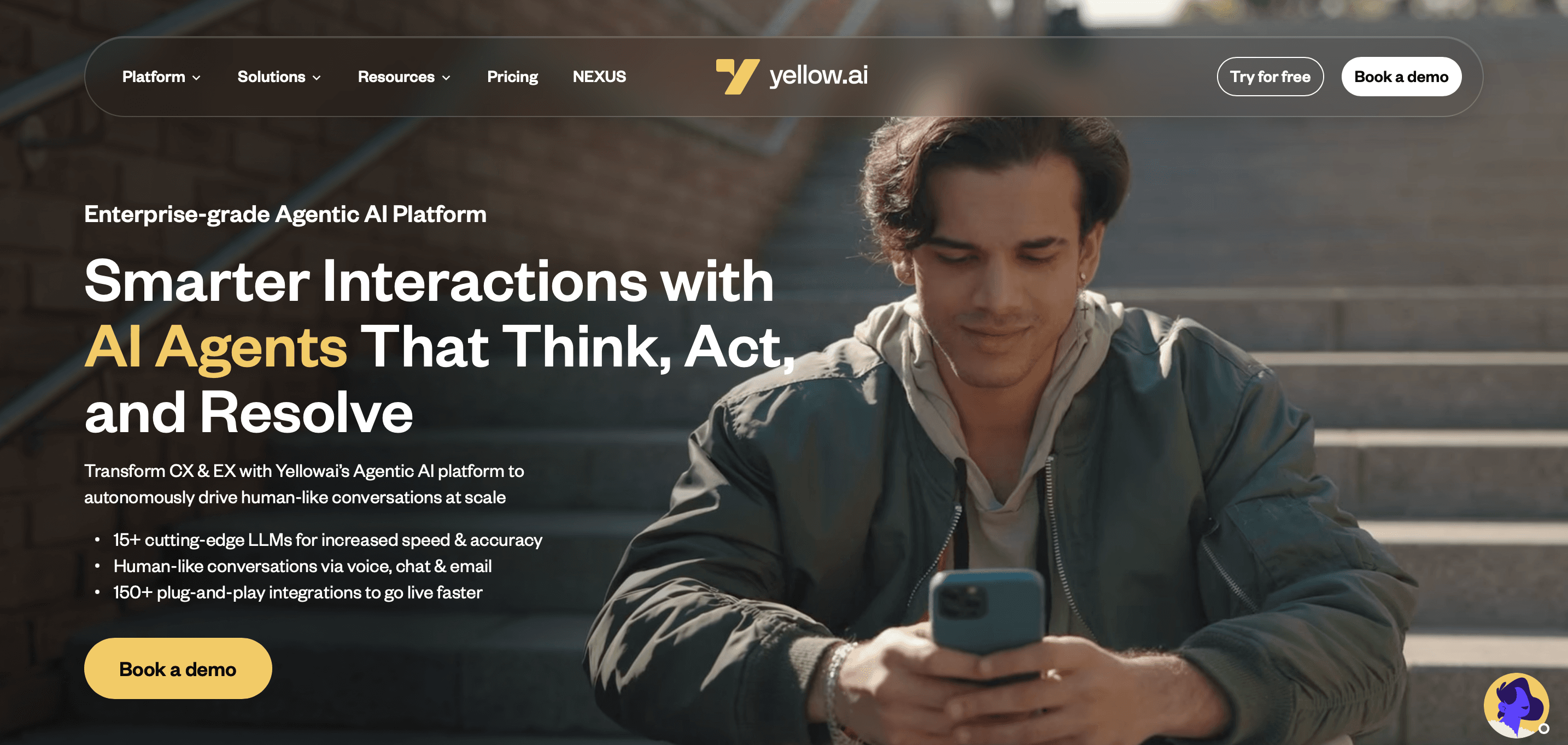
Yellow.ai's multi-LLM architecture handles billions of conversations per year and supports 135+ languages across 35+ channels. The AI Agent Builder 2.0 accelerates deployment for teams that need to move fast.
Best for: Global companies with large customer service volumes, multilingual support requirements
Pricing: Freemium plan available (1 bot, 500 sessions/month). Enterprise pricing on request.
Watch out for: Steep learning curve for non-technical configurators.
Notable: Reduced operational costs by 60% for some enterprise clients through voice automation.
6. DRUID AI — Best for Department-Wide Process Automation
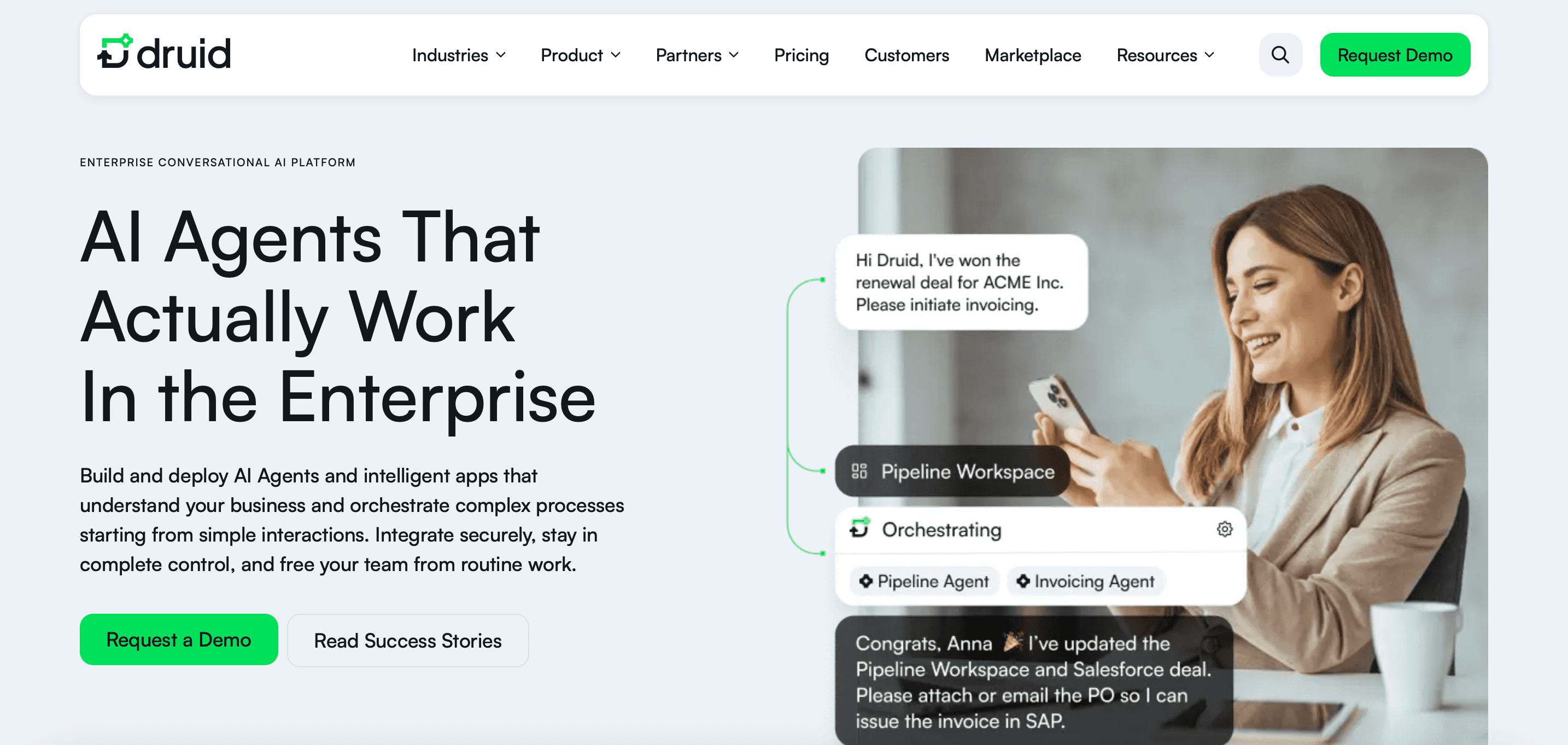
DRUID's NLP/NLU engine hits 95%+ accuracy on intent interpretation and handles compound questions with multiple intents in a single message. Its modular architecture keeps AI logic, conversation flows, and enterprise integrations separate—which makes it easier to scale across departments without starting over.
Best for: Organizations automating across multiple departments (HR, finance, customer service) simultaneously
Pricing: Custom. Some sources suggest starting around $50,000/year depending on the scope.
Watch out for: Cloud version outperforms on-premises deployment. Initial setup needs time investment.
Notable: Auchan improved SLA response time by 40%. European bank cut HR administrative tasks by 30%.
7. Moveworks — Best for Internal Employee Support Automation
Moveworks (now part of ServiceNow) focuses on employee experience: answering IT and HR questions, automating routine requests, and cutting internal support ticket volume. Its Reasoning Engine handles requests in 100+ languages without human escalation.
Best for: Large enterprises looking to reduce IT and HR support burden
Pricing: $100-$200 per employee/year. Median buyer spends ~$130,000/year.
Watch out for: ServiceNow acquisition creates uncertainty for non-ServiceNow environments. Premium pricing makes it a clear enterprise play.
Notable: Clients have cut support ticket volume in half over four years.
8. Sprinklr — Best for Unified Social and Digital CX
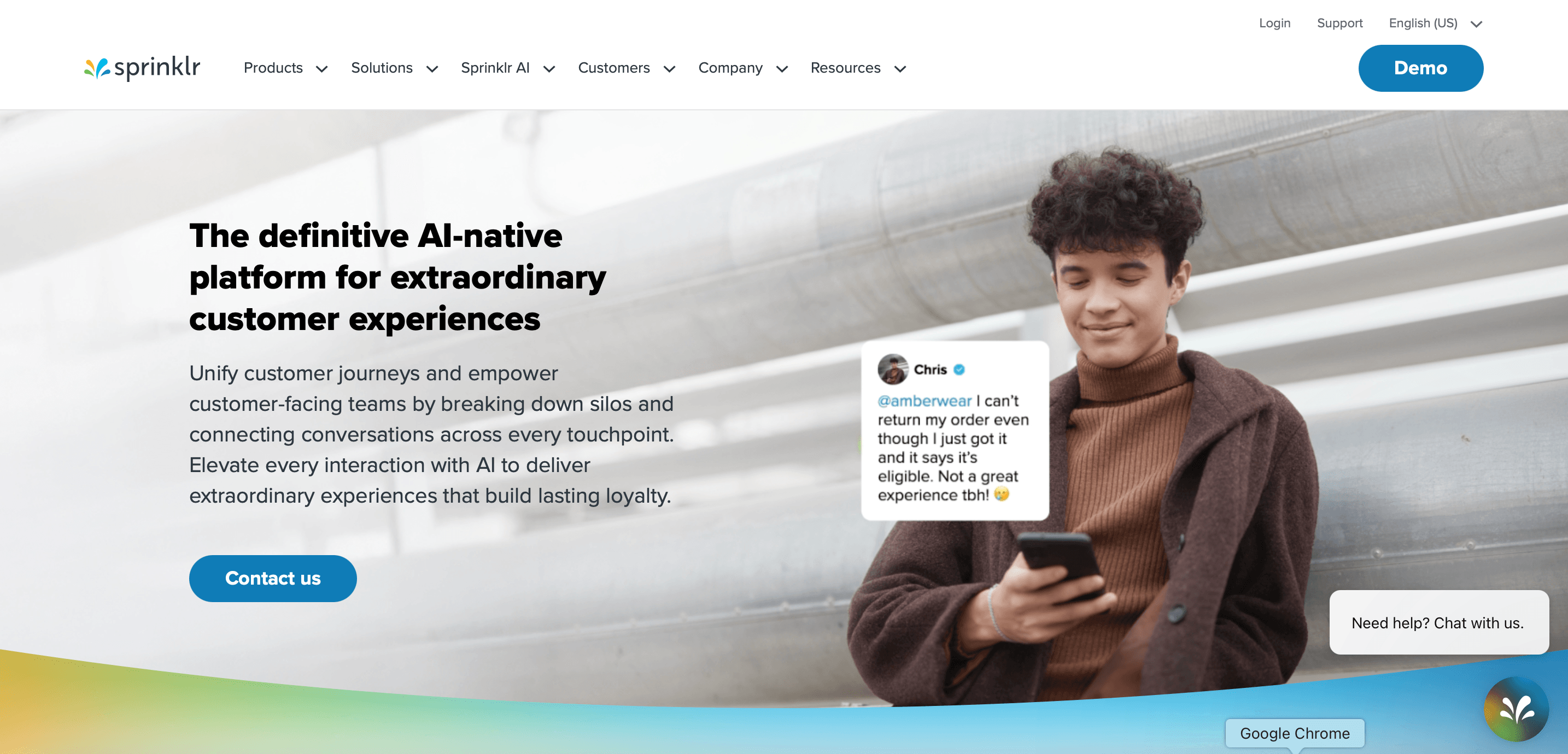
Sprinklr's conversational AI handles 30+ digital and social channels from one platform, making it the strongest option for brands whose customers are spread across WhatsApp, Instagram, Twitter, live chat, and voice simultaneously. 750+ pre-built AI models cover industry-specific scenarios.
Best for: Enterprise brands managing customer conversations across many social and digital channels
Pricing: Advanced plan at $299/user/month. Enterprise requires custom quote.
Watch out for: Interface reported as dated and non-intuitive. Training investment required.
Notable: Natural Language Generation, OCR/Computer Vision, and Generative AI capabilities beyond standard NLU.
9. Amazon Lex — Best for AWS-Native Conversational AI Development
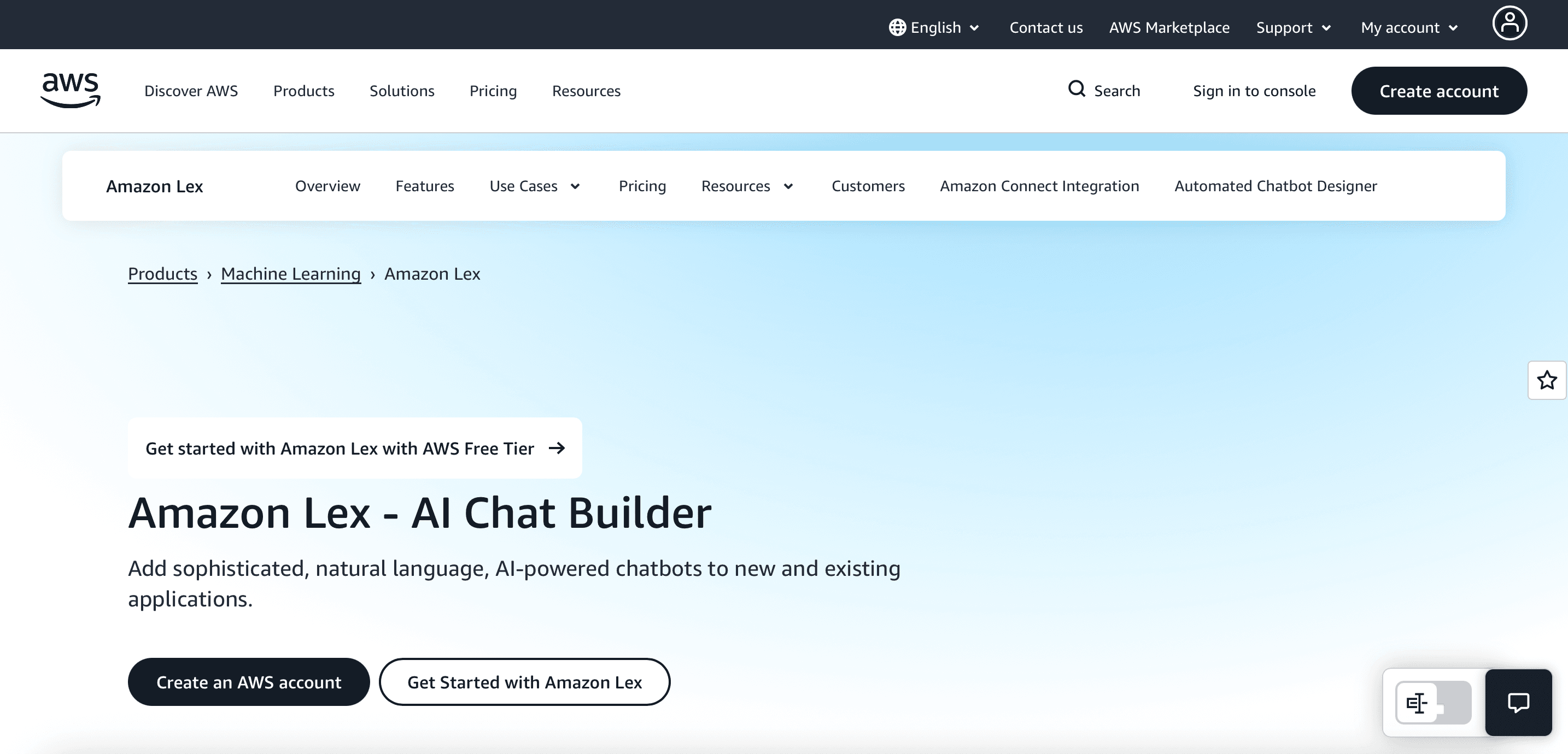
Amazon Lex brings the same NLU and ASR technology that powers Alexa to custom application development. The Assisted NLU feature uses LLMs to improve intent classification with minimal training data—useful for teams iterating quickly.
Best for: Developer teams building custom conversational interfaces within the AWS ecosystem
Pricing: Pay-as-you-go. First year free tier: 10,000 text requests and 5,000 speech requests monthly. ~$33.50 for 10,000 monthly interactions after that.
Watch out for: Requires AWS ecosystem knowledge. Limited out-of-the-box functionality compared to managed platforms.
Notable: TransUnion cut IVR interaction time from 2 minutes to 18 seconds. WaFd Bank achieved 90% faster account balance queries.
10. Google Dialogflow CX — Best for Complex Conversational Flow Design
Dialogflow CX's Visual State Machine gives developers direct control over conversation paths, with flow-level versioning and A/B testing built in. Teams can work on different conversation flows simultaneously, which matters for large-scale agent development.
Best for: Technical teams building sophisticated multi-step conversational applications
Pricing: Roughly about $0.007 per text request. No free tier.
Watch out for: Steeper learning curve than Dialogflow ES. More technical knowledge required for setup.
Notable: Best suited for complex enterprise settings where conversation state management over time is critical.
11. AiseraGPT — Best for Domain-Specific Enterprise Support
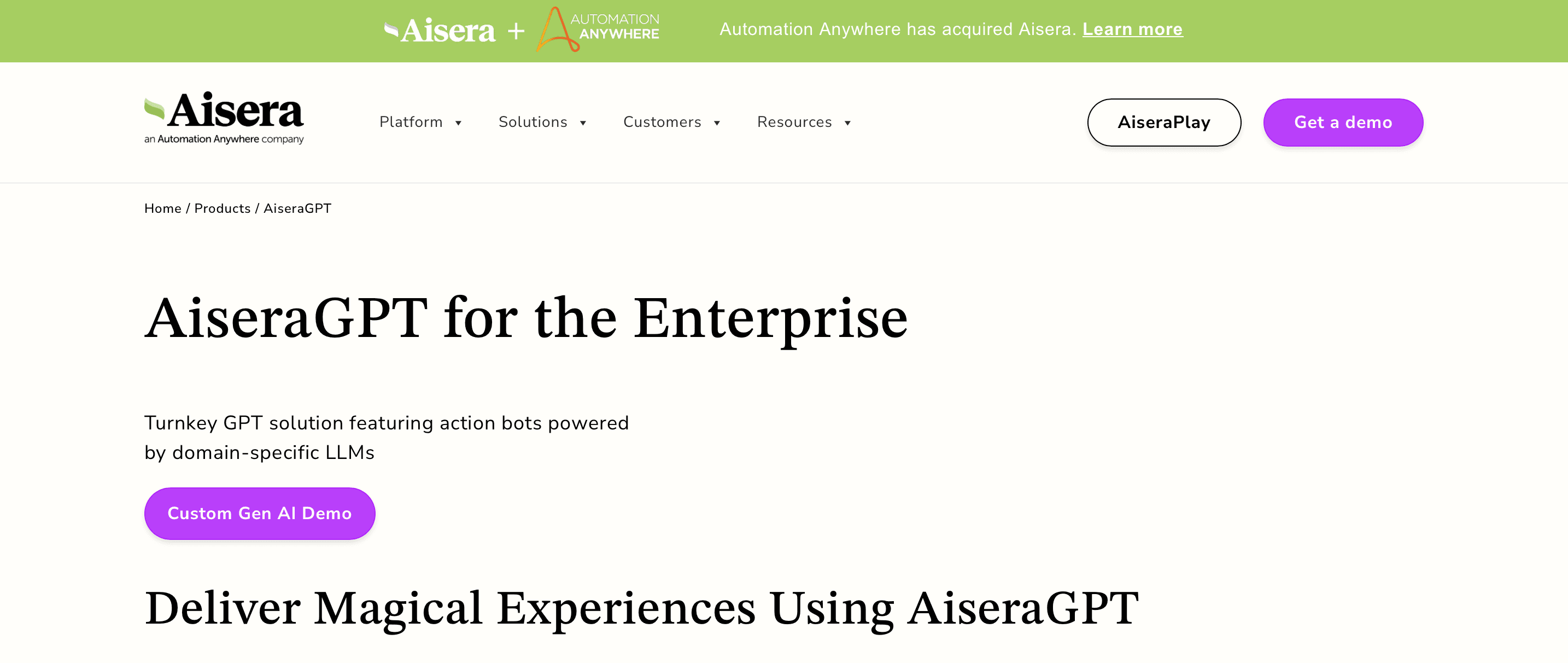
AiseraGPT's domain-specific LLMs deliver higher accuracy than general-purpose models by training on industry-specific data—support tickets, knowledge articles, and conversation logs from your actual environment. UniversalGPT handles requests across domains, channels, and languages from a single interface.
Best for: Financial services, healthcare, and high-tech companies with complex, domain-specific support needs
Pricing: Enterprise. Starting costs around $200,000/year per independent analysis.
Watch out for: Implementation typically takes longer than estimated. Needs dedicated internal technical resources.
Notable: 89% resolution rate on mobile app experiences.
12. Amelia by SoundHound — Best for Emotionally-Aware Customer Interactions
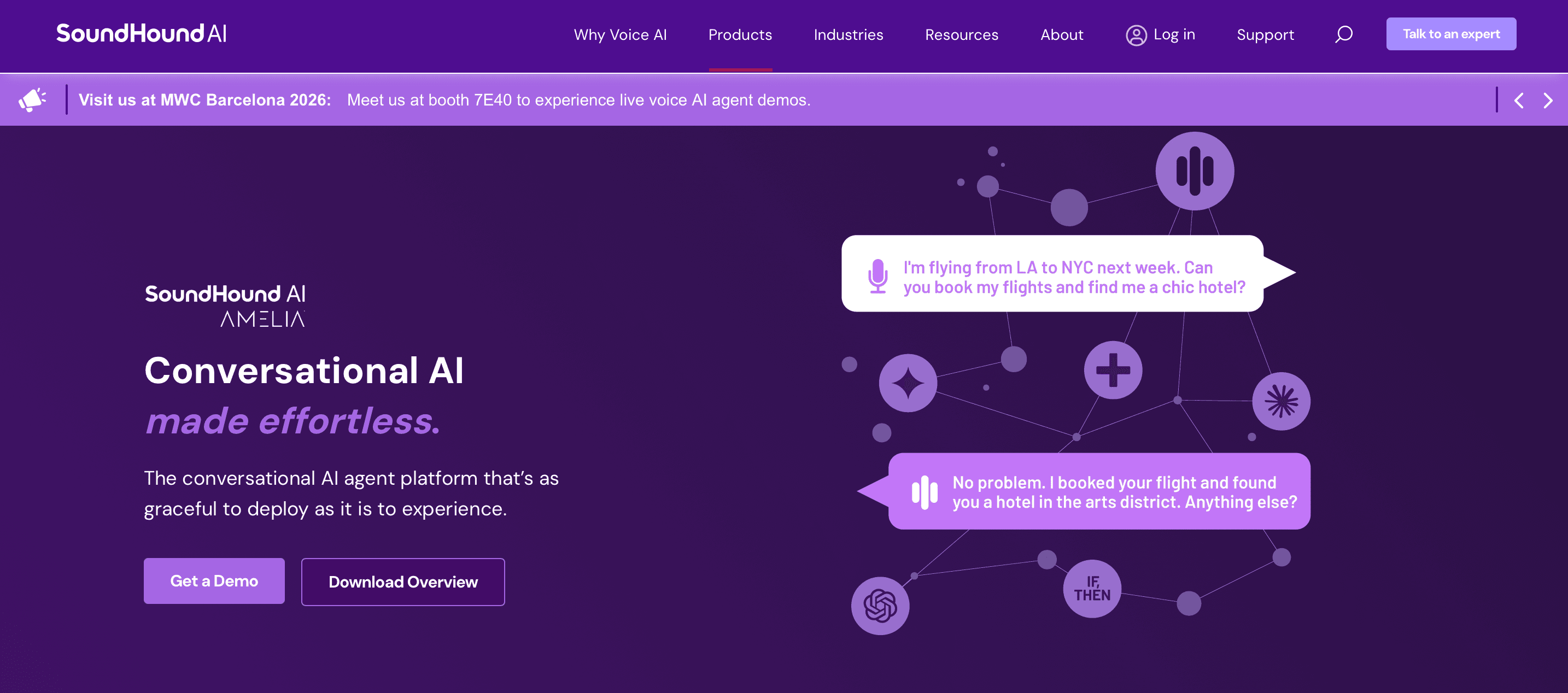
Amelia's cognitive agent technology detects customer emotional states and adapts responses accordingly—one of the more genuinely differentiated capabilities in this space. Neural ontology architecture enables natural multi-turn conversations with episodic memory.
Best for: Banking, insurance, IT service desks where emotional context changes the best response
Pricing: Enterprise, quote‑based pricing (post‑acquisition). Public per‑seat “Standard/Pro/Elite” annual tiers are no longer advertised; expect custom contracts
Watch out for: Initial setup requires extensive knowledge base development. Limited dashboard customization.
Notable: SEB Bank achieved 85% intent recognition. Cut guest Wi-Fi access time from 3 minutes to 30 seconds.
13. OneReach.ai — Best for Custom Enterprise Agent Orchestration
OneReach.ai's Generative Studio X orchestrates multiple agents using 700+ pre-built workflow steps. The three-layered development approach (no-code, low-code, full-code) makes it accessible across technical skill levels, which matters for organizations where IT resources are stretched.
Best for: Enterprises building custom, complex AI orchestration across multiple systems
Pricing: Standard tier from $300/month. Enterprise on request.
Watch out for: Unclear pricing requires sales contact. Better for large enterprises than simple projects.
Notable: 80% of users are non-developers. Deployed by PepsiCo and Deloitte.
14. Boost.ai — Best for Regulated Industry Conversational AI
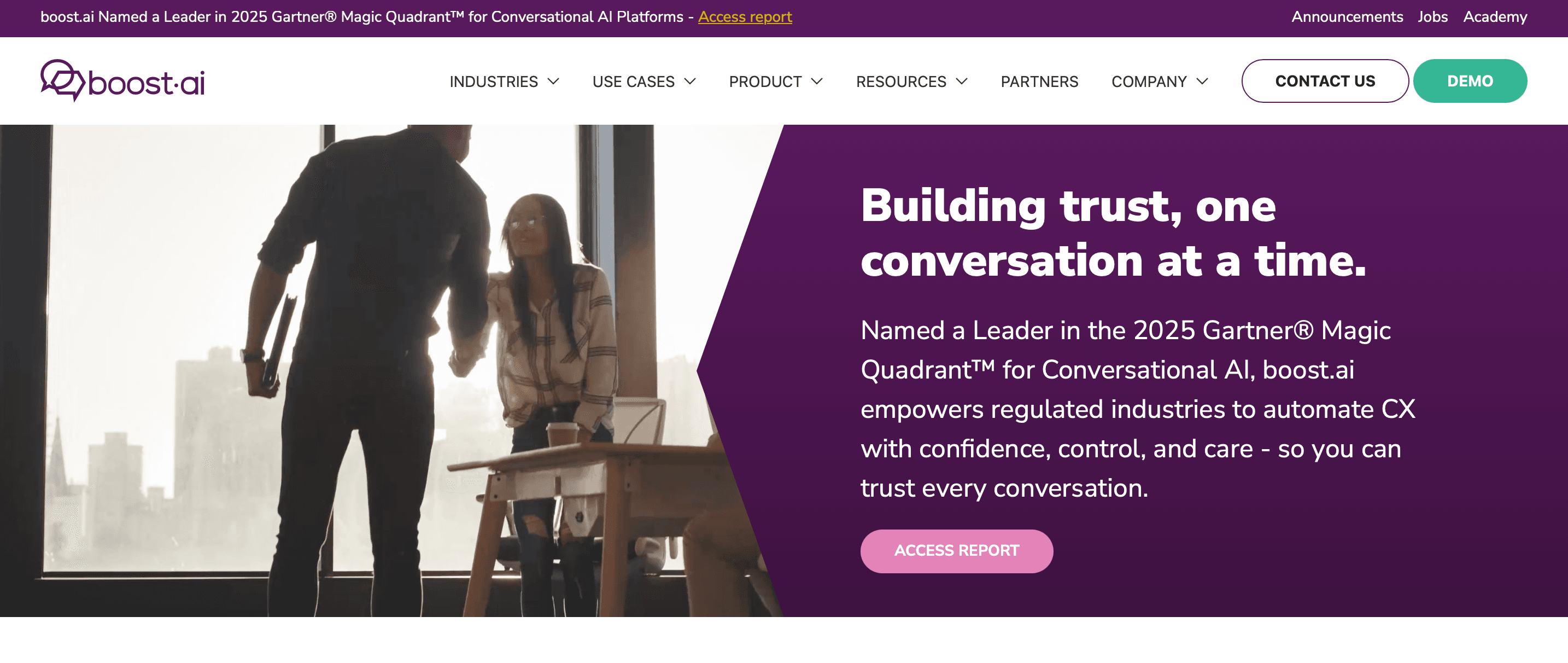
Boost.ai's hybrid AI architecture blends traditional NLU with generative AI while maintaining the governance and compliance controls that banking and insurance require. Its Automatic Semantic Understanding (ASU) is one of the stronger proprietary NLU implementations in the market. 2025 Gartner Magic Quadrant Leader.
Best for: Banks, insurers, and regulated enterprises needing auditability alongside AI performance
Pricing: Starting around $50,000/year.
Watch out for: Initial investment is higher than simpler solutions. Dedicated resources needed.
Notable: DNB automates 55% of all incoming chat traffic. Financial sector clients handle 60-70% of traffic through AI.
15. Mosaicx — Best for Voice-Led Customer Service
Mosaicx's streaming speech-to-speech AI creates real-time voice conversations at scale, managing over 1.1 billion annual inbound call minutes. LinguaAI handles multilingual support with accent recognition—useful for global operations where voice is the primary channel.
Best for: High-volume inbound call environments in finance, healthcare, insurance, and retail
Pricing: Custom enterprise pricing.
Watch out for: Focused on enterprise needs. Not designed for small business use cases.
Notable: Vibrant Emotional Health used Mosaicx to connect crisis callers with mental health counselors in under 30 seconds.
Side-by-Side: Conversational AI Platforms at a Glance
| Platform | Primary Use Case | Starting Price | SME-Friendly | Setup Time |
|---|---|---|---|---|
| SurveySparrow | Feedback & insight conversations | $19/month | Yes | Hours |
| Retell AI | Voice call automation | $0.07/min | Yes with dev support | 24 hours |
| Cognigy.AI | Enterprise contact center | $2,500/month | Enterprise only | Months |
| Kore.ai | Multi-agent enterprise orchestration | Mid‑ to high‑five‑figure up | Enterprise only | 6-18 months |
| Yellow.ai | Omnichannel customer service | Freemium | Partial | Weeks |
| DRUID AI | Dept-wide process automation | Custom | Partial | Weeks |
| Moveworks | Internal employee support | ~$130K/year | Enterprise only | Months |
| Sprinklr | Social + digital CX | $299/user/month | Enterprise only | Months |
| Amazon Lex | Custom voice/text AI dev | Pay-per-use | Needs devs | Varies |
| Dialogflow CX | Complex conversational flows | ~$0.007/text request | Needs devs | Varies |
| AiseraGPT | Domain-specific support AI | Custom | Enterprise only | Months |
| Amelia | Emotionally-aware interactions | $89/year | Yes with setup | Weeks |
| OneReach.ai | Custom agent orchestration | $300/month | Partial | Weeks |
| Boost.ai | Regulated industry AI | ~$50K/year | Enterprise only | Months |
| Mosaicx | Voice-led customer service | Custom | Enterprise only | 90 days |
The Two Mistakes Teams Make When Evaluating Conversational AI Platforms
Mistake 1: Treating all conversational AI the same
A platform designed to automate 10,000 customer support calls per day is not the right tool for collecting employee feedback or running post-purchase surveys. The underlying tech may overlap, but the workflow, setup complexity, and ROI profile are completely different.
Mistake 2: Defaulting to the most expensive option
Enterprise conversational AI platforms like Cognigy.AI and Kore.ai often start with entry plans around a few thousand dollars per month and can reach the $300,000‑per‑year range for large deployments. They're excellent—but they're built for teams with dedicated AI engineers, six-month implementation timelines, and contact centers managing millions of interactions. If that's not you, paying enterprise prices for mid-market problems burns budget and goodwill fast.
The honest answer: identify your primary use case first. The right platform follows from that.
How to Choose the Right Conversational AI Platform
Ask these four questions before reading any platform description:
1. What kind of conversation are you trying to improve? Customer support calls, employee feedback, lead qualification, post-purchase surveys, and onboarding sequences are all "conversations"—but each needs a different tool.
2. Who will build and maintain it? Some platforms need engineering resources to configure. Others are genuinely no-code. Be honest about what your team can sustain.
3. What does success look like in 90 days? If you can't name a specific metric—response rate, call deflection, NPS improvement, ticket reduction—the evaluation criteria will drift toward features that feel impressive rather than ones that actually solve something.
4. What does it need to connect to? CRM, help desk, Slack, your data warehouse—integration requirements cut the list quickly and save you from buying something that will sit isolated.
With those answers in hand, here's where each platform fits.
Which Conversational AI Platform Is Actually Right for You?
If you're a growing SME or mid-market company:
The enterprise conversational AI platforms dominating this list weren't designed for you. $300K annual contracts, 18-month implementations, and dedicated AI engineering teams are reasonable for Fortune 500 contact centers. They're overkill for teams with 50 employees and a genuine need to understand their customers better.
What you actually need: A conversational AI platform that's fast to deploy, generates real signal from customer or employee conversations, and connects to the tools you already use.
SurveySparrow fits this exactly. It's designed for teams that want to have better conversations with customers—not automate away all human contact. The conversational survey format, Echo AI agent, and multi-channel distribution work for a team of five or fifty. It takes hours to launch, not months.
Start a free 14-day trial of SurveySparrow →
14-day free trial • Cancel Anytime • No Credit Card Required • No Strings Attached
If you're an enterprise running a contact center:
Your shortlist is different: Cognigy.AI, Kore.ai, or Yellow.ai if omnichannel scale is the priority. Boost.ai or DRUID AI if you're in a regulated industry. Moveworks if the primary problem is internal IT and HR support volume.
Budget for integration work regardless of platform. None of these systems deliver value sitting isolated from your CRM, help desk, and data infrastructure.
If you need voice automation specifically:
Retell AI for outbound/inbound calls at a reasonable cost. Mosaicx for enterprise-scale inbound voice with real-time speech processing. Amazon Lex if you have AWS developers and need maximum control. All three are conversational AI platforms with voice as their primary channel—not retrofitted chat tools.
If you're building a custom conversational application:
Amazon Lex or Google Dialogflow CX are conversational AI platforms for developers, not managed services. Both are pay-as-you-go and give you fine-grained control over conversation logic. Neither is a managed platform—you'll build and maintain it yourself.
Choosing a tool is just step one. For a step-by-step roadmap on deploying these tools effectively, check out our What is a CX AI Agent? Complete 2026 Guide + Implementation Strategy .
What "Conversational AI" Actually Means in Practice
It's worth stepping back from the platform list to name something competitors in this space rarely admit:
Conversational AI platforms are only as good as the conversations they're designed to support.
A voice bot that deflects calls without understanding the caller's frustration isn't solving a customer experience problem—it's moving it. A survey that generates 3,000 responses nobody looks at isn't creating insight.
The real question isn't which conversational AI platform has the most features. It's: what conversation matters most to your business right now, and what would it mean to genuinely improve it?
For teams focused on customer feedback, that conversation is the NPS survey where customers give you a 6 but the form never asks why. It's the post-onboarding check-in where employees say "fine" because the format doesn't invite honesty. It's the product feedback loop where you're collecting data but not understanding people.
SurveySparrow's conversational AI approach is built specifically for that gap: the space between collecting responses and actually understanding them. Echo doesn't just ask your questions. It listens to answers and asks the next right question—automatically.
That's the shift from data collection to genuine conversation. And it's available to teams of any size, starting at $19 a month.
14-day free trial • Cancel Anytime • No Credit Card Required • No Strings Attached