A customer sends a WhatsApp message at 11 PM. Another opens a chat widget during lunch. A third calls your support line while driving. They all want the same thing: a fast, accurate answer without repeating themselves across three different channels.
That is the job of AI conversational platforms. They let you build, deploy, and manage AI agents that hold real conversations with people — through text, voice, or both — across whatever channel your customers prefer.
The market for these tools hit $14.79 billion in 2025 and is on track to reach $17.97 billion this year, according to Fortune Business Insights. Gartner estimates that conversational AI in contact centers alone could cut agent labor costs by $80 billion by the end of 2026. Those numbers tell you the size of the bet companies are making. But they don’t tell you which platform actually fits your team.
That’s what this guide is for. We’ve compared 10 AI conversational platforms across features, pricing, channels, and use cases — so you can skip the sales demos and start with a shorter list.
What actually makes an AI conversational platform worth using
There are over 200 tools in this category now. Most of them will tell you they do NLP, support multiple channels, and integrate with your CRM. That’s table stakes. Here’s what separates the useful platforms from the ones that just look good in a demo:
Natural language understanding that handles real speech
Your customers don’t type neat, well-structured queries. They use slang, switch between languages mid-sentence, make typos, and ramble. A good platform recognizes intent even when the input is messy. Look for platforms that report 90%+ accuracy on intent recognition out of the box, not just after six months of training.
Omnichannel support that actually shares context
Omnichannel doesn’t mean “we have a chat widget and an email bot.” It means a customer can start a conversation on WhatsApp, switch to a phone call, and the agent — human or AI — picks up where the last one left off. Context carries over. No “can you repeat that?”
Agentic capabilities, not just scripted flows
The newer platforms don’t just respond to questions. They complete tasks: update a CRM record, schedule a follow-up, issue a refund, route a ticket. If your “conversational AI” still needs a human to click three buttons after every interaction, you’re running a chatbot with a fancier name.
Integration depth
Can it connect to your CRM, help desk, payment system, and scheduling tool without custom API work? The fastest time-to-value comes from platforms that plug into your existing stack in days, not months.
Transparent pricing
Watch for low sticker prices that hide per-conversation fees, telephony charges, or add-on costs for the AI features you actually need. Ask vendors to model your monthly volume before you sign anything.
10 AI conversational platforms compared
Here’s a side-by-side view of 10 platforms worth evaluating. We’ve focused on what each one does best, where it falls short, and who it’s built for.
[IMAGE: Comparison table infographic with platform logos, key features, and starting prices]
Platform | Best for | AI capabilities | Channels | Starting price |
|---|---|---|---|---|
SurveySparrow | Conversational feedback + VoC | CogniVue, Wing AI, SmartReach AI, sentiment analysis | Email, SMS, WhatsApp, web, social, offline (12 channels) | $19/mo |
Intercom (Fin AI) | SaaS customer support | GPT-4 powered resolution bot, conversation summaries | In-app chat, email, social | $39/mo + $0.99/resolution |
Drift (Salesloft) | B2B sales conversations | AI chatbots, lead routing, revenue intelligence | Web chat, email | Custom pricing |
Zendesk AI | Enterprise support automation | AI agents, intent detection, auto-triage | Email, chat, phone, social, messaging | $55/agent/mo |
Kore.ai | Complex enterprise workflows | Model-agnostic NLU, agentic AI, process automation | Voice, chat, email, SMS | Custom pricing |
Yellow.ai | Multilingual support at scale | Dynamic AI agents, sentiment analysis, 135+ languages | Voice, chat, WhatsApp, social | Custom pricing |
Cognigy.AI | Contact center automation | Voice + text virtual agents, workflow automation | Phone, chat, messaging | Custom pricing |
IBM watsonx | Regulated industries | Enterprise NLU, retrieval-augmented generation | Voice, chat, web, phone | $140/mo (Plus) |
Google Dialogflow | Developer-first builds | Vertex AI integration, NLU, speech-to-text | Web, mobile, telephony, smart devices | Pay-per-request |
Botpress | Custom chatbot development | Open-source LLM integration, autonomous agents | Web, messaging, API | Free tier available |
Now, let’s dig into each one.
1. SurveySparrow — conversational feedback that closes the loop

Best for: CX teams, HR leaders, and marketing teams that need conversational data collection tied to AI-powered analysis and action.
SurveySparrow built the first chat-based survey back in 2017, modeled after the way people actually message each other — one question at a time, in a conversational flow. That design decision drove a 40% lift in response rates compared to traditional form-based surveys, and it’s still the core of how the platform works.
But the product has grown well past surveys. It’s now a unified Voice of Customer platform that covers the full feedback cycle: collect it (across 12 channels including WhatsApp, SMS, email, and web), analyze it (with CogniVue, their AI engine for sentiment, topics, and theme detection), and act on it (with built-in ticketing and workflow automation).
What stands out
- Conversational surveys that feel like a chat, not a form. This is the original differentiator, and it still works.
- CogniVue scans open-text feedback for sentiment, recurring themes, and the specific drivers behind your NPS or CSAT scores. No manual sorting.
- SmartReach AI picks the right channel and timing for each customer, so you’re not blasting the same email to everyone at 9 AM.
- 12 distribution channels — more than most competitors. WhatsApp and SMS are included, not treated as premium add-ons.
- Full feedback loop: survey response → AI analysis → ticket created → assigned to a team member → closed. In one platform.
- Enterprise compliance: SOC 2, ISO 27001, HIPAA, GDPR.
Where it fits
SurveySparrow is strongest when your goal is understanding what customers think and acting on it quickly. If you need a pure support chatbot that resolves tickets autonomously, you’d pair it with a tool like Intercom or Zendesk. But if your problem is low response rates, scattered feedback data, and no system for turning insight into action, this is where SurveySparrow fills a gap that most conversational AI platforms don’t even try to address.
SurveySparrow Pricing: Starts at $19/month. 14-day free trial, no credit card required.

Explore how SurveySparrow can transform your feedback process.
TRUSTED BY BEST-IN-CLASS BRANDS


Learn how conversational surveys boost response rates →
See how CogniVue analyzes customer sentiment →
2. Intercom (Fin AI) — fastest time-to-value for SaaS support
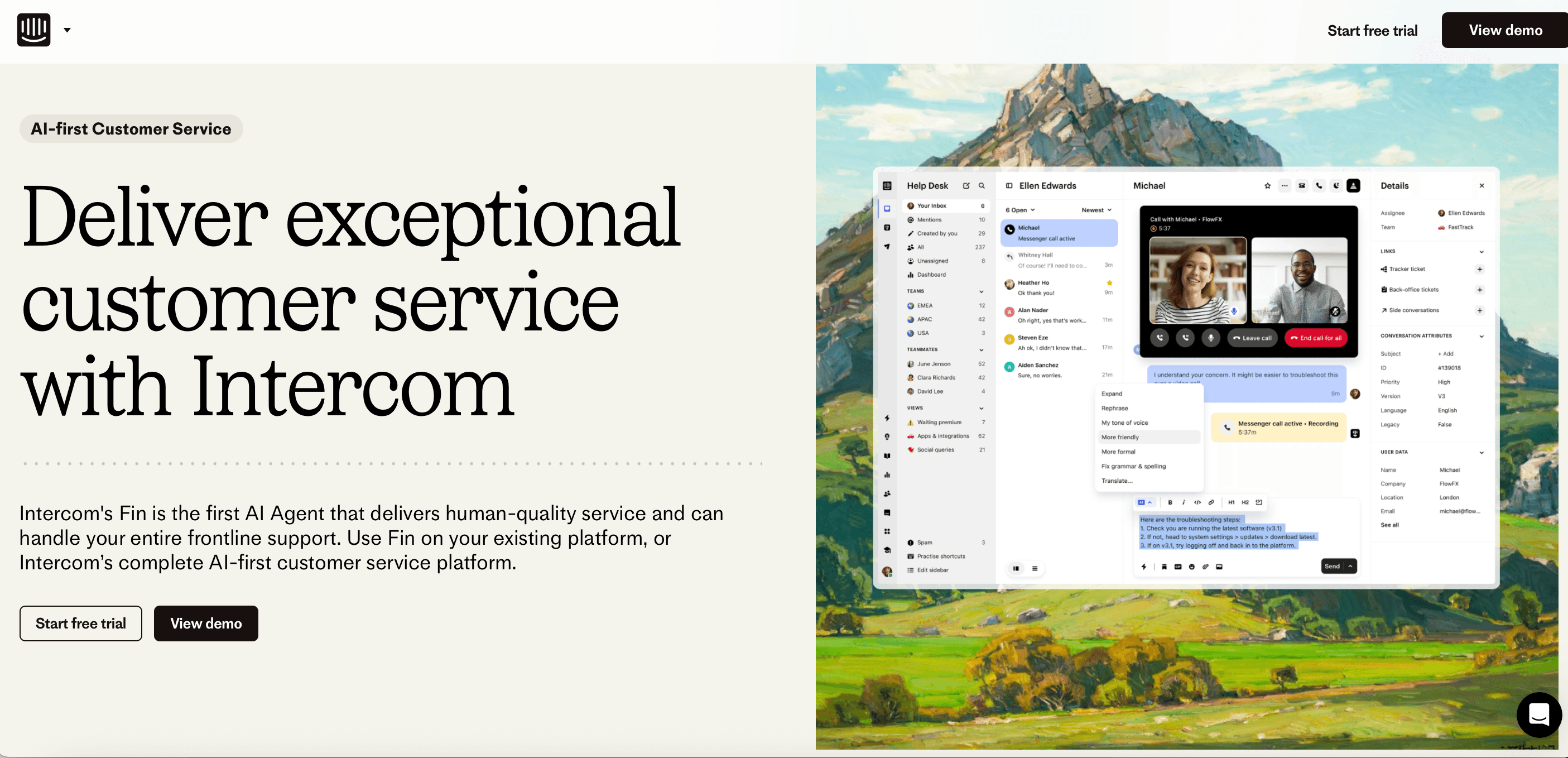
Best for: SaaS companies that want an AI agent resolving support tickets within hours of setup.
Intercom’s Fin AI Agent uses GPT-4 to answer customer questions by pulling from your help center, docs, and past conversations. It can resolve common issues end-to-end without human handoff. Zip, the buy-now-pay-later company, reported that Fin handles 34–38% of conversations automatically, saving over $500,000 in seven months.
The pricing model is unusual: $0.99 per resolved conversation, on top of the base platform fee. That means you only pay when the AI actually solves something, but costs can scale fast with volume.
Strengths
- Goes live in hours, not weeks. Minimal configuration needed.
- Transparent outcome-based pricing — you pay for resolutions, not seats or messages.
- Strong conversation summaries and handoff to human agents when needed.
Limitations
- Built for support, not sales or marketing workflows.
- Limited customization compared to full-stack platforms like Kore.ai or Cognigy.
- Per-resolution pricing gets expensive at high volumes.
Intercom Pricing: Platform starts at $39/month for small teams. Fin AI is $0.99 per resolved conversation.
3. Drift (now part of Salesloft) — B2B sales conversations
Best for: B2B sales teams that want AI chatbots qualifying leads and booking meetings on their website.
Drift was one of the first platforms to make “conversational marketing” a real category. Its AI chatbots engage website visitors, qualify them against your ICP criteria, and route them to the right sales rep in real time. Since Salesloft acquired Drift, it’s been integrated into a broader revenue intelligence stack.
The platform is strong for pipeline generation but narrower in scope than tools built for support or feedback. If your primary use case is converting website traffic into sales meetings, Drift does that well. If you need post-sale support or feedback workflows, you’ll need another tool.
Drift AI Pricing: Custom pricing. Historically positioned as a premium tool.
4. Zendesk AI — enterprise support with AI triage
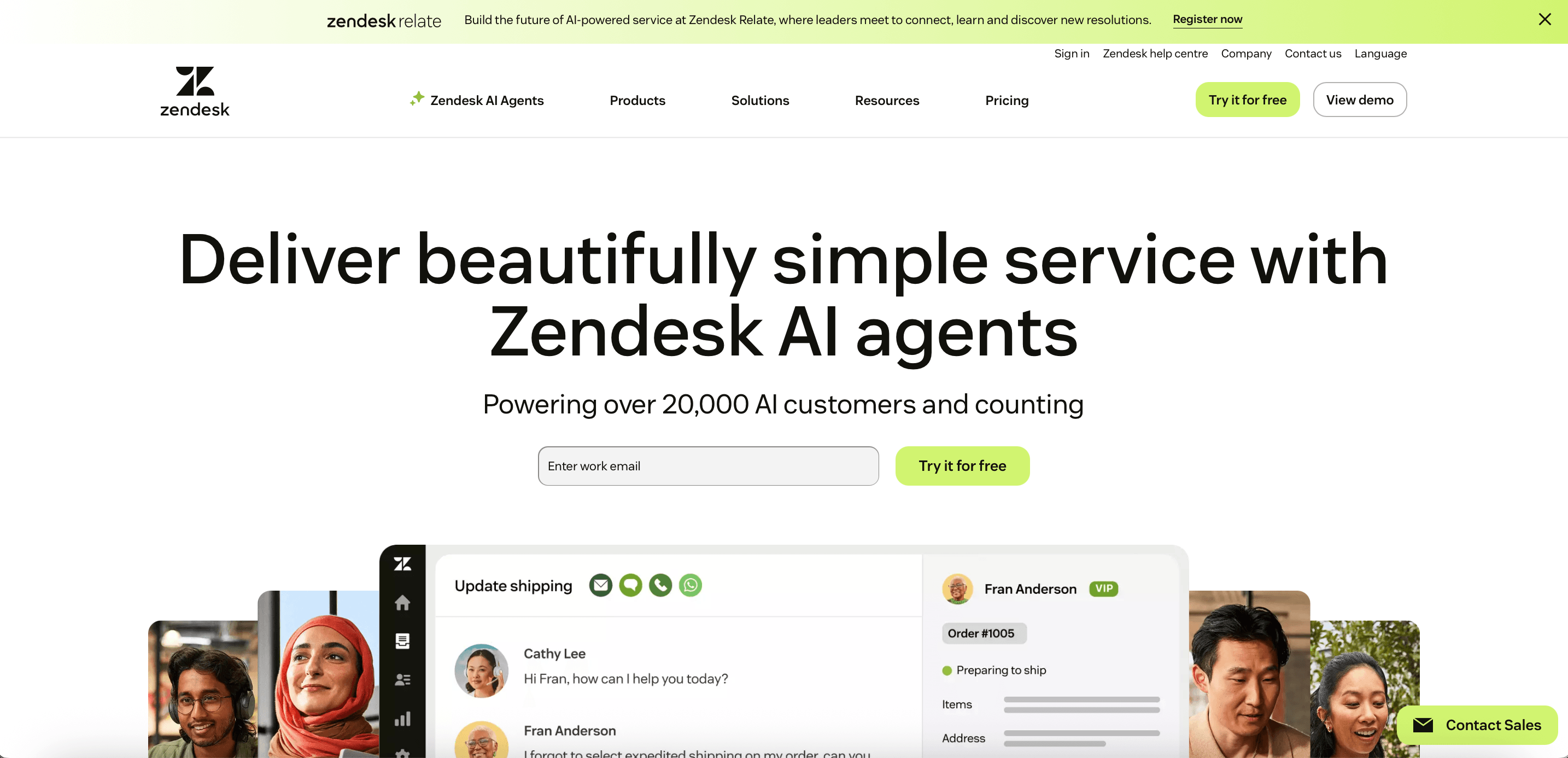
Best for: Large support teams that already use Zendesk and want to add AI automation on top.
Zendesk has layered AI across its existing support suite: AI agents that handle routine queries, auto-triage that routes tickets by intent and urgency, and AI-assisted responses that help human agents reply faster. The advantage is that it works inside a platform millions of support teams already use, so migration cost is zero.
The downside: Zendesk’s AI capabilities are add-ons to an existing ticketing system, not a purpose-built conversational AI engine. If you’re starting from scratch, a platform designed ground-up for AI conversations (like Kore.ai or Yellow.ai) may give you more flexibility.
Zendesk Pricing: Starts at $55/agent/month. AI features require Suite Professional or higher.
5. Kore.ai — model-agnostic enterprise platform
Best for: Enterprise teams that need full control over AI models, workflows, and multi-step automation.
Kore.ai’s XO Platform is explicitly model-agnostic — you can swap between GPT, Gemini, Claude, and others depending on the task, compliance requirements, or cost. This prevents vendor lock-in and lets teams optimize different AI models for different use cases within the same platform.
It’s one of the few platforms that genuinely supports agentic AI: bots that complete multi-step tasks across systems (updating a CRM, checking inventory, processing a return) rather than just answering questions. Gartner has recognized Kore.ai in its Magic Quadrant for conversational AI for multiple years.
The trade-off: it’s complex. You’ll need technical resources to configure it properly, and the time-to-value is longer than simpler platforms.
Kore.ai Pricing: Custom pricing based on usage and deployment.
6. Yellow.ai — multilingual automation at scale
Best for: Global companies that need AI conversations in 135+ languages across voice and text.
Yellow.ai positions itself as the platform for companies operating across dozens of markets and languages. Its dynamic AI agents handle both voice and text, detect sentiment in real time, and switch languages within a single conversation. For multinational businesses that can’t afford to build separate bots for each region, that’s a real advantage.
The platform includes pre-built industry templates for retail, BFSI, healthcare, and telecom, which speeds up deployment. But the heavy customization and enterprise positioning means it’s not a natural fit for smaller teams or simple use cases.
Yellow.ai Pricing: Custom pricing. Typically positioned for mid-market and enterprise.
7. Cognigy.AI — contact center transformation
Best for: Contact centers replacing IVR systems with AI-powered voice and text agents.
Cognigy is built for contact centers. It creates both voice and text virtual agents that plug into existing telephony infrastructure, handle inbound calls, and route complex issues to human agents with full context. Gartner named it a Customers’ Choice in 2025.
If your AI conversational platform needs center around phone calls and voice automation, Cognigy is one of the strongest options. It’s less suited for web chat, social media, or feedback-collection workflows.
Pricing: Custom pricing.
8. IBM watsonx Assistant — regulated industries
Best for: Healthcare, financial services, and government organizations with strict compliance requirements.
IBM’s watsonx Assistant is the enterprise-grade option for industries where compliance and data governance are non-negotiable. Humana uses it to process over 7,000 healthcare provider calls daily, with NLP trained on medical terminology and integrated with Watson Discovery for real-time data retrieval.
The platform supports retrieval-augmented generation (RAG), meaning it pulls answers from your own knowledge base rather than hallucinating. For regulated environments, that’s a critical feature. The downside: IBM’s pricing and deployment complexity makes it overkill for teams that don’t need that level of governance.
Pricing: Plus plan starts at $140/month. Enterprise pricing is custom.
9. Google Dialogflow CX — developer-first builds
Best for: Teams with development resources that want to build custom conversational AI on Google Cloud.
Dialogflow CX is Google’s enterprise conversational AI offering, tightly integrated with Vertex AI, Google Cloud, and their speech-to-text engine. It’s not a plug-and-play tool — you need developers to design flows, configure NLU models, and manage deployments. But for teams that want total control over their conversational AI architecture, Dialogflow gives you that.
It works well for complex, multi-turn conversations across web, mobile, telephony, and smart devices. The pay-per-request pricing model keeps costs low for early experiments but can spike at volume.
Pricing: Pay-per-request. Pricing varies by feature (text, audio, design-time).
10. Botpress — open-source flexibility
Best for: Developers and startups that want to build custom AI chatbots without licensing fees.
Botpress is open-source at its core, which means you can inspect the code, modify it, and host it yourself. It integrates with multiple LLMs and lets you build autonomous agents that handle multi-step workflows. For technical teams that want full ownership of their conversational AI, Botpress removes the vendor dependency.
The flip side: you need developers. There’s no drag-and-drop builder that a marketing team can pick up in an afternoon. And while the free tier is generous, enterprise features (security, compliance, SLAs) cost extra.
Pricing: Free tier available. Paid plans start at $79/month. Enterprise pricing is custom.
Explore how SurveySparrow can transform your feedback process.
TRUSTED BY BEST-IN-CLASS BRANDS
Gartner’s 2025 Magic Quadrant for Conversational AI Platforms → Gartner research report
Fortune Business Insights conversational AI market forecast → fortunebusinessinsights.com
How to pick the right AI conversational platform for your team
The biggest mistake teams make is choosing based on feature lists. Every platform on this page has NLP, multi-channel support, and integrations. The real question is: what problem are you solving?
Start with your use case
- Need to resolve support tickets with AI? Look at Intercom, Zendesk AI, or Cognigy.
- Need to qualify and convert website leads? Drift is purpose-built for that.
- Need to collect feedback, understand sentiment, and close the loop? SurveySparrow does all that in one platform.
- Need multi-step process automation across enterprise systems? Kore.ai or IBM watsonx.
- Need full code-level control? Dialogflow CX or Botpress.
- Need multilingual support across 100+ languages? Yellow.ai.
Factor in who’s going to run it
Some platforms need a dedicated technical team. Others can be set up by a CX manager in a day. If your team doesn’t have developers, eliminate the platforms that require them. This one filter will cut your shortlist in half.
Ask about total cost of ownership
Base price is never the full story. Ask about per-conversation fees, overage charges, AI feature add-ons, and what’s included in each tier. Model your actual monthly volume and have the vendor price it out before you commit.
Test with real scenarios
Don’t evaluate AI conversational platforms with simple FAQ questions. Test with messy, real-world inputs — typos, multi-part questions, language switching, edge cases. That’s where you’ll see the difference between platforms that actually understand language and ones that pattern-match against keywords.
Why AI conversational platforms matter more now than a year ago
The market data tells a clear story. The global conversational AI market grew from $11.58 billion in 2024 to $14.79 billion in 2025. Multiple research firms project it will reach between $41 billion and $82 billion by the end of the decade, depending on whose estimate you use. The range matters less than the direction.
What’s driving this: customer expectations have moved faster than most companies’ support operations. 82% of customers say they’d rather talk to an AI than wait for a human rep, according to Tidio. 64% of CX leaders plan to increase their chatbot budgets in 2026. And Gartner expects 42% of organizations to hire specifically for AI-focused CX roles this year.
The shift is happening across industries. Retail leads adoption at 21.2% market share. Healthcare is the fastest-growing vertical, with conversational AI expected to save the U.S. healthcare system roughly $150 billion annually. BFSI holds 23% of the chatbot market. These aren’t pilot programs anymore — they’re operational infrastructure.
For teams still evaluating, the question has shifted from “should we adopt conversational AI?” to “which platform fits our specific workflow?”
Want higher response rates without chasing? SurveySparrow’s conversational surveys get 40% more completions. Try it free for 14 days. Explore how SurveySparrow can transform your feedback process.TRUSTED BY BEST-IN-CLASS BRANDS |
If you’re building a feedback loop that actually closes — where customer input turns into insight and insight turns into action — SurveySparrow is worth a look. The conversational format gets more people to respond, and the AI engine tells you what they’re really saying. No credit card required to start.