Customer Feedback Survey
Feedback is fuel for growth! Leverage insights, enhance experiences, and build a thriving business
Stop guessing, start knowing!
Access the features you need instantly
Get Started in minutes
No credit card required
It is not surprising that companies want to know what their customers really think about the service they provide. A great customer experience is created when you make sure to understand your customers’ needs and expectations. This way, you can make sure you meet them every time.
And wouldn’t it be nice if you could gather useful feedback from customers in one place?
As more organizations begin to allow customers to be involved and become part of the product development process, the idea of customer surveys might start to seem strange. But this type of feedback could be invaluable in improving an organization’s sales, marketing, and product development efforts.
Enter customer feedback surveys, a complete methodology to distribute questionnaires and analyze responses for a complete picture of customer sentiments. In this blog, we'll go over the importance of customer feedback surveys, and the role it plays in helping organizations reap more revenue by creating a good experience.
What is a Customer Feedback Survey?
A customer feedback survey is a structured set of questions designed to collect information from customers about their experience with your product, service, or brand. It gives businesses a direct, measurable way to understand what customers think, how they feel, and where the experience is falling short of their expectations.
The goal of a customer feedback survey is to gather honest feedback from customers about their experience with a business. This feedback can then be used to improve the products or services offered, as well as the overall customer experience.
The terms customer feedback survey and customer feedback questionnaire are closely related but refer to different things.
The questionnaire is the set of questions you present to respondents.
The survey is the broader process. It includes designing the questionnaire, distributing it, collecting responses, analyzing the data, and acting on the insights. A survey always contains a questionnaire, but a questionnaire on its own is not a survey.
Customer feedback surveys can take many forms depending on what you are trying to measure.
For example, a post-purchase survey asking a single satisfaction rating question is a customer feedback survey. A quarterly NPS study sent to your entire customer base is a customer feedback survey. An in-app prompt asking users to rate a specific feature is a customer feedback survey. What they share is a common purpose — to give customers a structured channel to share their experience and give businesses the data to act on it.
The businesses that use customer feedback surveys most effectively treat them not as a periodic exercise but as a continuous system. Feedback collected at the right moment, from the right customers, through the right channel, and analyzed with the right framework produces insights that inform product decisions, improve service quality, and build the kind of customer relationships that drive long-term growth.
Why Customer Feedback Surveys Matter?
Businesses make decisions about their products, services, and customer experience every day. The question is what those decisions are based on. Internal assumptions, historical data, and anecdotal evidence from customer-facing teams all have a role, but none of them replace direct input from the customers themselves.
Customer feedback surveys close that gap.
Here is why they matter in practice. Businesses can:
Surface what customers actually think
The gap between what a business believes its customers experience and what customers actually experience is often significant. A product team might assume a feature is intuitive because it tested well internally. A support team might assume resolution rates are high because tickets are closing. Customer feedback surveys test those assumptions against reality, and the results are frequently surprising.
Research from Bain and Company found that 80% of companies believe they deliver a superior customer experience, while only 8% of their customers agree.
Identify problems before they become costly
A customer who encounters friction and says nothing is not a satisfied customer, they are a customer on their way out. Research consistently shows that the majority of dissatisfied customers never complain directly to the business. They simply leave, and often take others with them through negative word of mouth.
Customer feedback surveys create a structured channel for customers to share friction before it reaches that point. A sharp drop in CSAT scores after a product update, a recurring theme in open-ended responses about a specific pain point, or a declining NPS trend across a customer segment, are all signals that a business must act on before they translate into churn.
Get a competitive advantage
The businesses that consistently collect, analyze, and act on customer feedback make better decisions faster than those that do not. As a result, they know which features to build and which to deprioritize. Where the service experience is creating friction and where it is genuinely delighting customers.
They also know how their customer sentiment compares to industry benchmarks.
That knowledge compounds over time. A business with two years of consistent customer feedback data understands its customers in a way that a business starting from scratch simply cannot replicate.
Build trust and loyalty
Asking for feedback signals to customers that their opinion matters. However, acting on that feedback and communicating what changed signals that the business is genuinely listening.
Research from Microsoft found that 77% of customers view brands more favorably when they proactively seek and act on feedback.
Customers who feel heard are more likely to stay, more likely to expand their relationship with the business, and more likely to recommend it to others.
Connect customer sentiment to business outcomes
A 5% increase in customer retention can increase profits by 25% to 95%, according to research from Bain and Company. Customer feedback surveys are one of the most direct tools available for understanding and improving retention.
When sentiment data is connected to revenue metrics, churn rates, and product usage data, it becomes possible to quantify the business impact of customer experience improvements — and make the case for investment in them.
What happens in the Customer Feedback Collection Process?
Feedback collection is a crucial step in any research or analysis process. Here are the four key steps that happen in the customer feedback collection process:
Creation
The first step in the feedback collection process is to create a plan. This involves determining the feedback collection method, such as surveys, interviews, or observational studies, and designing the feedback collection instruments, such as questionnaires or observation checklists. It is essential to ensure that the feedback collection methods and instruments are reliable, valid, and appropriate for the research questions.
Distribution
Once the feedback collection instruments are designed, the next step is to share them with the target population. This may involve distributing surveys, scheduling interviews, or setting up observation sessions. It is important to ensure that the feedback collection process is ethical and respects the privacy and confidentiality of the participants.
Analysis
Once collecting the feedback, it has to be analyzed. This involves organizing and cleaning the data, checking for errors, and applying statistical techniques to extract meaningful insights. It is important to use appropriate software tools and techniques to ensure that the analysis is accurate and reliable.
Action
The final step in the customer feedback collection process is to act on the insights gained from the analysis. This may involve making decisions, developing policies, or taking action to improve processes or services. It is essential to ensure that the insights gained from the feedback collection process are communicated effectively to the relevant stakeholders and that appropriate actions are taken based on the insights.
Types of Customer Feedback Surveys
The type of survey you choose determines what you can measure, when you should deploy it, and what you can do with the data it produces. Here are the four most widely used types and the questions that work best for each.
- CSAT Surveys
- NPS Surveys
- CES Surveys
- Product Feedback Surveys
1. Customer Satisfaction Score (CSAT)
A CSAT survey measures how satisfied a customer is with a specific interaction, product, or experience. It is the most widely used customer feedback survey format because it is simple to deploy, easy for customers to complete, and produces data that is immediately actionable.
CSAT surveys are typically sent immediately after a defined touchpoint, such as a support interaction, a purchase, an onboarding session, or a product delivery. The closer to the interaction the survey is sent, the more accurate and reliable the response tends to be.
CSAT scores are calculated as a percentage of customers who responded positively — typically a 4 or 5 on a 5-point scale — out of the total number of responses received.
CSAT Survey Questions
1. How satisfied are you with the support you received today?
Very satisfied / Satisfied / Neutral / Dissatisfied / Very dissatisfied
2. How would you rate your overall experience with our product?
Excellent / Good / Average / Below average / Poor
3. How satisfied are you with the speed at which your issue was resolved?
Very satisfied / Satisfied / Neutral / Dissatisfied / Very dissatisfied
4. How well did our team meet your expectations today?
Exceeded expectations / Met expectations / Did not meet expectations
5. How satisfied are you with the quality of the product you received?
Very satisfied / Satisfied / Neutral / Dissatisfied / Very dissatisfied
6. What could we have done to make your experience better? (open-ended)
2. Net Promoter Score (NPS) Survey
NPS measures overall customer loyalty and the likelihood of a customer recommending your business to others. It is one of the most widely used metrics in customer experience management because it correlates strongly with long-term business growth and customer retention.
Unlike CSAT which measures satisfaction at a specific moment, NPS measures the overall health of the customer relationship. It is best deployed at regular intervals, quarterly or at major milestones such as renewal or post-onboarding.
Respondents are asked a single question and scored on a scale of 0 to 10. Those who score 9 or 10 are Promoters, 7 or 8 are Passives, and 0 to 6 are Detractors. The NPS is calculated by subtracting the percentage of Detractors from the percentage of Promoters.
NPS Survey Questions
1. On a scale of 0 to 10, how likely are you to recommend us to a friend or colleague?
Scale of 0 to 10
Note: This question is the most commonly used across businesses of all sizes. Feel free to use it as is to measure your customer's perception.
2. What is the primary reason for your score? (open-ended)
3. What would make you more likely to recommend us to others? (open-ended)
4. How long have you been a customer?
Less than 6 months / 6 to 12 months / 1 to 2 years / More than 2 years
5. Which of the following best describes your overall experience with us?
Consistently excellent / Mostly positive / Mixed / Mostly negative
6. Is there anything specific we could do to improve your experience with us? (open-ended)
3. Customer Effort Score (CES) Survey
CES measures the amount of effort that a customer had to expend to complete a specific action. It could be anything from resolving a support issue, completing a purchase, navigating an onboarding process, or finding information they needed.
According to Gartner, reducing customer effort is one of the strongest predictors of customer loyalty available.
CES surveys are most effective when deployed immediately after interactions where effort is most likely to be a factor, with support resolutions, checkout completions, and onboarding milestones being the most common.
A low CES score can indicate high friction. Identifying and eliminating the sources of that friction is one of the highest-leverage improvements a business can make to its customer experience.
CES Survey Questions
1. How easy was it to resolve your issue today?
Very easy / Easy / Neutral / Difficult / Very difficult
2. How easy was it to find the information you were looking for on our website?
Very easy / Easy / Neutral / Difficult / Very difficult
3. How easy was the checkout process?
Very easy / Easy / Neutral / Difficult / Very difficult
4. How much effort did you personally have to put in to get your issue resolved?
Very little effort / Some effort / A moderate amount / A lot of effort / An extreme amount
5. What made the process more difficult than it needed to be? (open-ended)
6. What could we do to make this process easier for you? (open-ended)
4. Product Feedback Survey
A product feedback survey collects structured input from customers about their experience with a specific product or feature. Product feedback surveys help surface actionable insights that inform product development decisions (what to build next, what to improve, and what to deprioritize).
Product feedback surveys are most valuable when deployed after a customer has had enough time to experience the product meaningfully — typically 7 to 14 days after onboarding for SaaS products, or after a defined usage milestone.
Product Feedback Survey Questions
1. How would you rate the overall quality of our product?
Excellent / Good / Average / Below average / Poor
2. Which features do you use most frequently? (select all that apply)
List relevant features
3. Which features do you find least useful or never use?
List relevant features
4. How well does our product meet your needs?
Extremely well / Very well / Somewhat well / Not very well / Not at all
5. What is the one thing you would most like to see improved or added to our product? (open-ended)
6. If our product were no longer available, how would you feel?
Very disappointed / Somewhat disappointed / Not disappointed
7. How does our product compare to alternatives you have used or considered?
Much better / Somewhat better / About the same / Somewhat worse / Much worse
How to Create a Customer Feedback Survey?
The quality of the data you collect depends directly on the decisions you make before you write a single question. Here is a step-by-step process for building one that produces reliable, actionable results.
1. Define Your Objective
Before anything else, be specific about what you need to know and why.
If you are measuring satisfaction after a support interaction, your objective might be: "Understand how satisfied customers are with the resolution process and identify the most common sources of friction." Every question you include should connect directly to that statement.
Match the survey type to your objective. If you need to measure satisfaction at a specific touchpoint, use CSAT. If you need to measure overall loyalty and likelihood to recommend, use NPS.
2. Identify Your Target Audience
Who you survey shapes everything.
A survey sent to enterprise customers with complex use cases will look very different from one sent to first-time buyers.
Consider your audience's familiarity with your product, their available time, and the channel through which they will receive the survey. A five-question survey sent immediately after a support interaction is appropriate in a way that a fifteen-question survey sent to a customer who has been with you for one week is not.
3. Write Clear, Neutral Questions
Every question should be immediately understandable to someone with no prior knowledge of your product or organization. Avoid jargon, technical language, and double-barreled questions that ask about two things at once.
Avoid leading language. "How much did you enjoy working with our team?" assumes the customer enjoyed it. Instead, use "How would you rate your experience working with our team?"
4. Keep It Short
Every question you add reduces your completion rate. A customer feedback survey that takes more than five minutes to complete will see a significant drop in responses.
I travelled by Indigo a few months back. The feedback form I received was user-friendly at the start. I was happy to answer their questions until it was too much. There were more than 5 sections, and each section had around 7-8 questions. I started to regret taking the survey. The questions got harder as each section passed. I couldn't answer so many, so I exited the survey.
For post-interaction surveys, aim for three to five questions. For relationship surveys, ten questions is a reasonable ceiling.
If you find yourself including questions that are interesting but not essential to your objective, remove them.
You can always run a follow-up survey if you need additional data on a specific topic.
5. Choose the Right Distribution Channel
How you distribute your survey affects who responds and how accurately.
Email surveys work well for existing customers with an established relationship. In-app surveys work best for product-specific feedback triggered by user behavior. SMS surveys work well for post-interaction feedback where speed matters. Web-embedded surveys work well for capturing feedback from website visitors at specific moments.
Match your distribution channel to your audience and your research objective rather than defaulting to whatever is most convenient for your team.
6. Offer Incentives
Offering incentives, such as discounts or freebies, can encourage customers to complete your survey. Make sure the incentives are relevant to your business and will appeal to your target audience.
7. Test Your Survey
Before launching your survey, test it with a small group of customers to ensure it is easy to understand and provides the information you need.
SMS Survey: An Alternative Distribution Channel
SMS surveys consistently outperform email surveys on response rates.
SMS open rates average around 98% compared to 20% for email. This means that the probability of survey participation increases.
For businesses that need fast, high-volume feedback, particularly after in-person or phone-based interactions, SMS is one of the most effective collection channels available.
But the constraints of SMS are significant. You are working with a small screen, a character limit, and a respondent who did not open an app or sit down at a desk to engage with your survey. Every design decision needs to account for that context.
How to Create an SMS Survey?
Keep It to Three Questions or Fewer
SMS surveys that exceed three questions see a sharp drop in completion rates. The format is designed for speed — respondents expect to answer quickly and move on. If your objective requires more than three questions, SMS is not the right channel for that survey. Use it for focused, single-metric feedback — a CSAT rating after a support call, an NPS score at a renewal milestone, or a single satisfaction question after a delivery.
Lead With the Most Important Question
Put your primary question first. If a respondent drops off after one question, you want to have captured the most valuable data point before they do. A CSAT rating or an NPS score as the first question ensures you collect the core metric even from respondents who do not complete the full survey.
Use Simple Response Formats
Ask respondents to reply with a number rather than typing a free-text response. "Reply 1 for Yes, 2 for No" or "Reply with a number from 1 to 5" are formats that work naturally in an SMS context. Long open-ended responses are frustrating to type on a phone and produce low-quality data in an SMS format. Save open-ended questions for email or in-app surveys where typing is easier.
If you want qualitative context, limit it to one optional follow-up question at the end — something as simple as "Any comments? Reply with your thoughts or reply SKIP to finish."
Identify Your Business Clearly
SMS messages from unknown numbers are frequently ignored or reported as spam. Always open with a clear identification of who is sending the message. "Hi [Name], this is [Business Name]. We'd love your feedback on your recent visit." gives the respondent immediate context and significantly improves open and response rates.
Including an opt-out option is both a legal requirement in most markets and a trust signal that increases the likelihood of genuine engagement from the respondents who do participate.
Time Your SMS Survey Correctly
The timing advantage of SMS is its immediacy. An SMS survey sent within minutes of an interaction captures feedback while the experience is still fresh and the respondent is most motivated to share it. Sending an SMS survey 24 or 48 hours after an interaction loses much of the format's natural advantage.
For in-store retail and restaurant interactions, send the survey within 30 minutes of the visit. For phone-based support interactions, send it within minutes of the call ending. For delivery and fulfillment interactions, send it within an hour of confirmed delivery.
Comply With SMS Marketing Regulations
SMS surveys are subject to marketing communication regulations in most markets including TCPA in the United States and GDPR in Europe. Ensure you have explicit opt-in consent from respondents before sending SMS surveys, include a clear opt-out mechanism in every message, and maintain a record of consent for compliance purposes.
Non-compliance carries significant financial penalties and — more importantly for your feedback program — erodes the trust that makes customers willing to respond honestly.
A Simple SMS Survey Template
Here is an example of a well-structured three-question SMS survey for a retail or service business:
"Hi [Name], thanks for visiting [Business Name] today. We'd love your feedback — it only takes 30 seconds.
1. How satisfied were you with your visit today?
Reply 1 (Very satisfied), 2 (Satisfied), 3 (Neutral), 4 (Dissatisfied), or 5 (Very dissatisfied).
2. How likely are you to visit us again?
Reply 1 (Very likely), 2 (Likely), 3 (Unsure), 4 (Unlikely).
3. Any comments? Reply with your thoughts or reply DONE to finish.
Reply STOP to unsubscribe."
When to Send Your Customer Feedback Survey
Timing is one of the most important variables in customer feedback survey design. A well-written survey sent at the wrong moment produces lower response rates and less accurate data than a simpler survey sent at exactly the right time.
The general rule is straightforward. Send your survey as close to the interaction as possible, while the experience is still fresh in the respondent's mind.
| Survey Type | Best time to send |
| Post-purchase CSAT | Within 24 hours of purchase confirmation |
| Post-support CSAT | Within minutes of ticket or chat closing |
| In-store or restaurant feedback | Within 30 minutes of the visit |
| Delivery or fulfillment feedback | Within 1 hour of confirmed delivery |
| NPS - relationship survey | Quarterly or at renewal milestones |
| Product feedback | 7 to 14 days |
| Employee-facing feedback | At the end of a project or review cycle |
Avoid sending surveys during periods when your customers are least likely to engage. Early mornings, late evenings, and weekends consistently produce lower response rates for B2B audiences. For B2C audiences, evenings and weekends can actually perform well depending on the product and demographic.
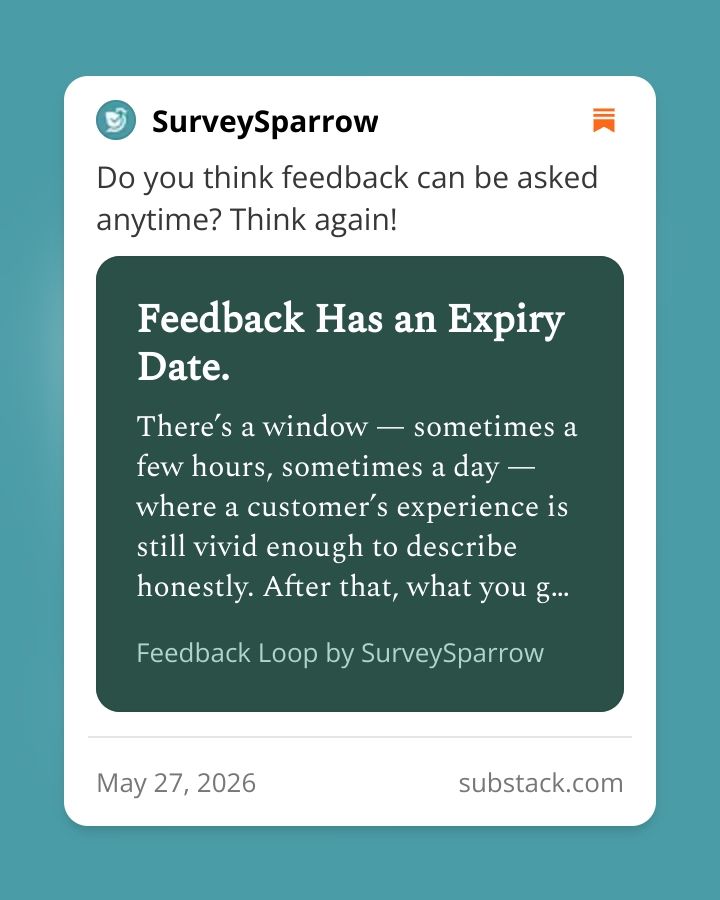
Read on Substack: Feedback has an expiry date
Customer Feedback Survey Examples by Industry
Customer feedback surveys look different depending on the industry, the customer relationship, and what the business needs to measure. Here are four industry-specific examples with sample questions you can adapt for your own surveys.
A. Customer Feedback Survey for Retail Businesses
Retail feedback surveys are typically short, transactional, and sent immediately after a purchase or in-store visit. The main purpose is to measure their satisfaction with the product, the purchase experience, and the service received.
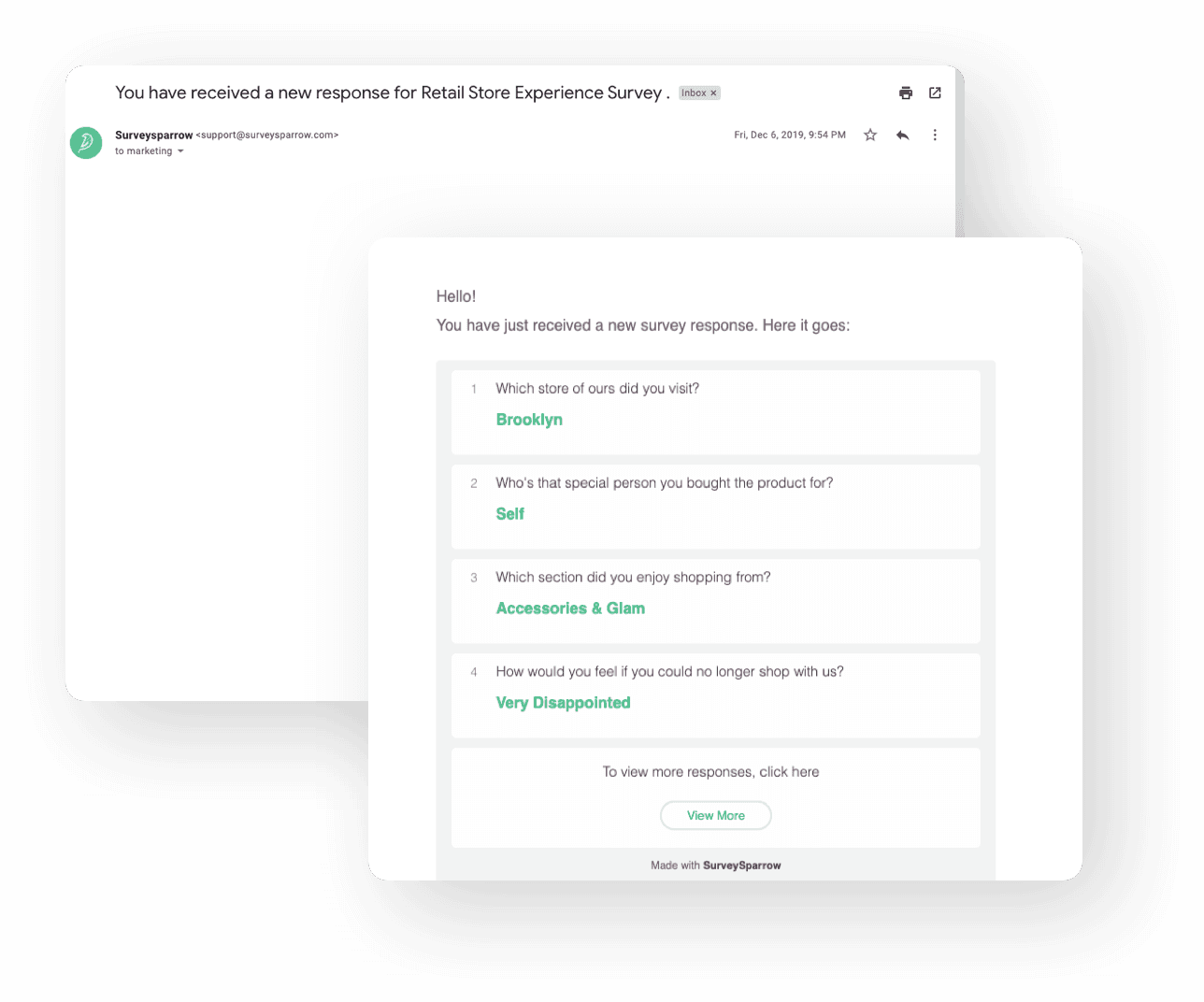
A retail customer feedback survey typically covers:
1. How satisfied are you with your purchase today?
Very satisfied / Satisfied / Neutral / Dissatisfied / Very dissatisfied
2. How would you rate the quality of the product you received?
Excellent / Good / Average / Below average / Poor
3. How easy was it to find what you were looking for in our store?
Very easy / Easy / Neutral / Difficult / Very difficult
4. How would you rate the service you received from our staff?
Excellent / Good / Average / Below average / Poor
5. How likely are you to shop with us again?
Extremely likely / Likely / Neutral / Unlikely / Extremely unlikely
6. Is there anything we could have done to improve your experience today? (open-ended)
Best sent: Within 24 hours of purchase confirmation for online retail, within 30 minutes for in-store visits via SMS or receipt-linked QR code.
B. Restaurant Feedback Survey
Restaurant feedback surveys need to move quickly. A customer who had a great meal is in a positive frame of mind immediately after leaving, that window closes fast. The survey should be short enough to complete before they reach their car.
A restaurant customer feedback survey typically covers:
1. How would you rate your overall dining experience today?
Excellent / Good / Average / Below average / Poor
2. How satisfied were you with the quality of the food?
Very satisfied / Satisfied / Neutral / Dissatisfied / Very dissatisfied
3. How would you rate the service you received?
Excellent / Good / Average / Below average / Poor
4. How satisfied were you with the speed of service?
Very satisfied / Satisfied / Neutral / Dissatisfied / Very dissatisfied
5. How likely are you to recommend us to a friend or family member?
Extremely likely / Likely / Neutral / Unlikely / Extremely unlikely
6. What could we have done to make your experience better today? (open-ended)
Best sent: Within 30 minutes of the visit via SMS, or through a QR code placed on the receipt or table card.
C. Customer Feedback Survey for SaaS and Software Industry
SaaS feedback surveys serve a different purpose from retail and restaurant surveys. The customer relationship is ongoing rather than transactional, and the feedback collected needs to inform product decisions as much as service quality. SaaS surveys are typically longer, more detailed, and sent at defined points in the customer lifecycle.
A SaaS customer feedback survey typically covers the following questions:
1. How satisfied are you with our product overall?
Very satisfied / Satisfied / Neutral / Dissatisfied / Very dissatisfied
2. How well does our product meet your business needs?
Extremely well / Very well / Somewhat well / Not very well / Not at all
3. Which features do you use most frequently? (select all that apply)
List relevant features
4. How easy is our product to use on a day-to-day basis?
Very easy / Easy / Neutral / Difficult / Very difficult
5. How likely are you to recommend our product to a colleague or peer?
Scale of 0 to 10
6. What is the one thing we could do to significantly improve your experience with our product? (open-ended)
7. How does our product compare to alternatives you have used or evaluated?
Much better / Somewhat better / About the same / Somewhat worse / Much worse
Best sent: 14 days after onboarding for new customers, quarterly for existing customers, and immediately after a major product release or significant support interaction.
D. Customer Feedback Survey for Healthcare Industry
Healthcare feedback surveys require particular care around language, privacy, and sensitivity. Questions should be neutral, non-clinical in tone for patient-facing surveys, and compliant with relevant data privacy regulations including HIPAA in the United States.
A healthcare customer feedback survey typically covers:
1. How satisfied were you with your overall experience at our facility today?
Very satisfied / Satisfied / Neutral / Dissatisfied / Very dissatisfied
2. How would you rate the friendliness and professionalism of our staff?
Excellent / Good / Average / Below average / Poor
3. How clearly did our team explain your care plan or next steps?
Very clearly / Clearly / Somewhat clearly / Not very clearly / Not at all
4. How satisfied were you with the wait time before being seen?
Very satisfied / Satisfied / Neutral / Dissatisfied / Very dissatisfied
5. How likely are you to return to our facility for future care?
Extremely likely / Likely / Neutral / Unlikely / Extremely unlikely
6. Is there anything we could have done to improve your experience today? (open-ended)
Best sent: Within 24 hours of the appointment or visit via email or SMS, with a clear privacy notice explaining how responses will be used and stored.
Try SurveySparrow's HIPAA Compliant platform to conduct any type of survey related to the healthcare industry.
Here's a list of sample healthcare related surveys that you can begin using instantly.
And many more such templates.
In addition to data collection, SurveySparrow's AI-powered analytics surfaces patterns, sentiment shifts, and key drivers behind every response, so you spend less time reading through data and more time acting on it. Start your 14-day free trial today.
How to Analyze Your Customer Feedback Questionnaire
Collecting responses is only half the job. The value of a customer feedback questionnaire lies entirely in what you do with the data after it comes in. Here's how to go from raw responses to decisions you can act on.
Step 1: Clean Your Data
Before any analysis begins, review your responses for quality. Remove incomplete submissions, duplicate entries, and responses that show signs of straight-lining — where a respondent has selected the same answer for every question without genuine consideration.
For open-ended responses, read through and flag any that are too vague, off-topic, or too short to be useful. A clean dataset produces more reliable conclusions than one padded with low-quality responses.
Step 2: Separate Quantitative and Qualitative Data
Your closed-ended questions produce quantitative data that can be measured and compared. Your open-ended questions produce qualitative data that needs to be interpreted rather than calculated.
Keep these two types separate from the start. Begin with your quantitative data to establish the broad picture, then use your qualitative data to add context and depth to what the numbers are telling you.
Explore the differences between quantitative and qualitative feedback
Step 3: Look for Patterns Across Segments
Aggregate scores tell you what is happening across your entire customer base. Segmented analysis tells you where it is happening and for whom.
Break down your results by customer type, plan level, purchase channel, geographic region, or any other variable relevant to your business. A satisfaction score of 4.2 out of 5 overall might mask a score of 2.8 among a specific customer segment that is at risk of churning, a pattern that aggregate analysis would never surface.
Step 4: Analyze Your Open-Ended Responses
Open-ended responses require a different approach from quantitative data. Read through all responses and identify recurring themes (topics, concerns, or ideas) that multiple respondents mention independently. Group similar responses together and note how frequently each theme appears.
For smaller datasets, manual thematic analysis works well.
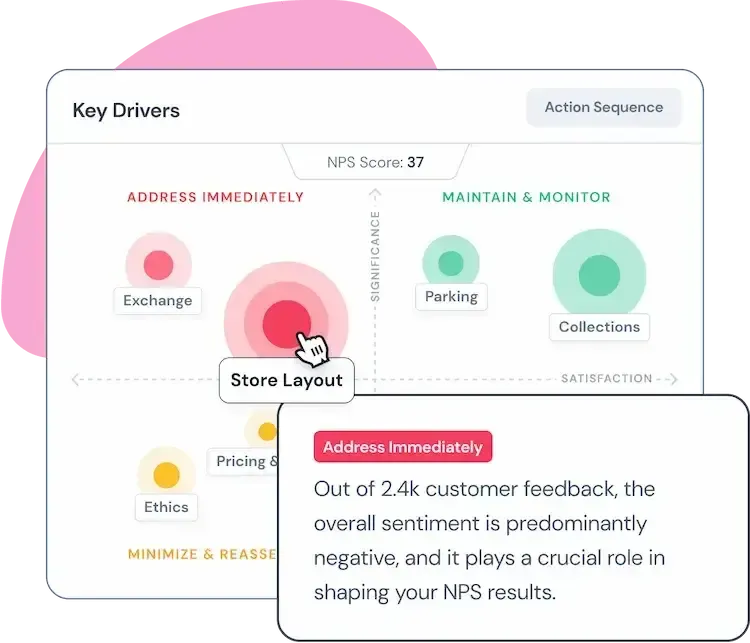
For larger volumes of open-ended feedback, text analytics tools can automatically identify sentiment patterns and surface the most commonly mentioned themes across hundreds or thousands of responses without requiring you to read every response individually.
CogniVue does exactly this. It analyzes open-ended feedback at scale to surface recurring themes, sentiment patterns, and the key drivers behind your scores automatically.
Step 5: Benchmark Your Results
A CSAT score of 78% or an NPS of 42 means very little without context. Benchmark your scores against industry averages to understand where you stand relative to your competitive landscape.
Here are general benchmarks across common metrics:
| Metric | Below Average | Average | Good | Excellent |
| CSAT | Below 60% | 60% to 75% | 75% to 85% | Above 85% |
| NPS | Below 0 | 0 to 30 | 30 to 50 | Above 50 |
| CES | Below 3 | 3 to 4 | 4 to 5 | Above 5 |
Sources:
- https://surveysparrow.com/blog/csat-benchmarks/
- https://surveysparrow.com/blog/saas-nps-benchmarks-2026/
Step 6: Translate Findings Into Action
Analysis without action is just data. Once you have identified patterns in your quantitative data and themes in your qualitative responses, define what changes those findings should drive and who in your organization needs to act on them.
Prioritize improvements based on two factors — the frequency of the issue across respondents and the potential impact of resolving it on customer satisfaction and retention. An issue mentioned by 40% of respondents that directly correlates with churn deserves significantly more urgency than one mentioned by 5% with no clear business impact.
Document your conclusions and track whether the changes you make actually improve your scores in the next survey cycle.
SurveySparrow does all this automatically for you, so you don't have to spend time with analyses and focus your efforts on the right strategies.
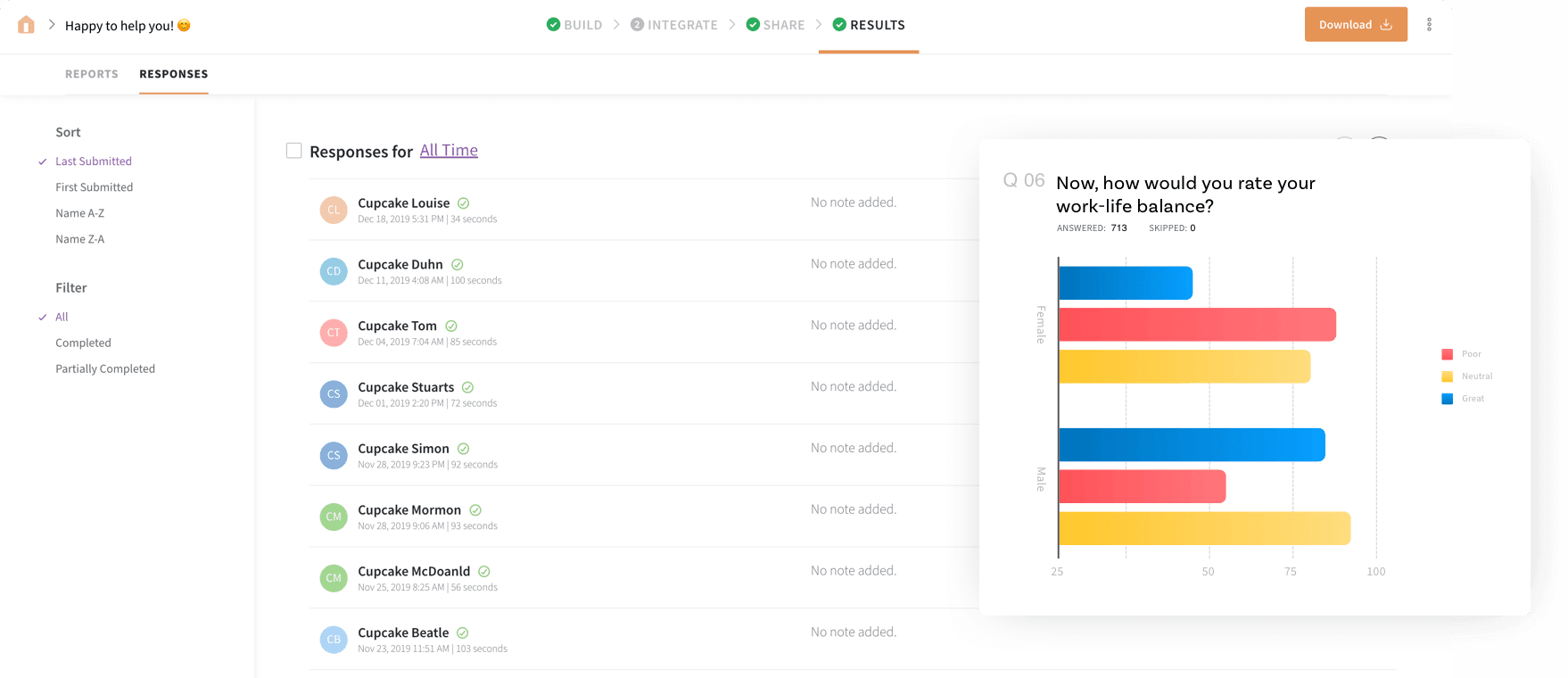
See how you can transition from surveys to data analyses.
Step 7: Close the Feedback Loop
If you collected feedback from customers, let them know what you found and what you plan to do about it. Closing the feedback loop builds trust, signals that their input was genuinely valued, and significantly improves response rates the next time you send a survey.
Customer Feedback Survey Software and Tools
The right customer feedback survey tool determines how easily you can collect responses, how quickly you can analyze them, and how effectively you can act on what you find. Here are the most widely used categories of tools and what each is best suited for.
Conversational Survey Platforms
Tools that present surveys in a chat-like, conversational format rather than a traditional form. Best for businesses that prioritize completion rates and respondent experience. SurveySparrow, Typeform, and Survicate fall into this category.
Enterprise Experience Management Platforms
Comprehensive platforms that combine survey creation, omnichannel distribution, advanced analytics, and CRM integration. Best for large organizations running feedback programs across multiple teams and touchpoints. Qualtrics and Medallia are the leading examples.
In-App Feedback Tools
Lightweight tools designed to collect feedback from users within a product or application without redirecting them to an external survey. Best for SaaS and digital product teams. Hotjar, Pendo, and SurveySparrow's SpotChecks feature are commonly used options.
NPS and CSAT Automation Tools
Platforms purpose-built for deploying NPS, CSAT, and CES surveys automatically at defined touchpoints in the customer journey. Best for customer success and support teams that need structured, recurring measurement without manual effort. Delighted and AskNicely are widely used in this category.
Reputation and Review Management Tools
Platforms that monitor and aggregate customer feedback from public review sites alongside direct survey responses. Best for businesses where online reputation directly influences new customer acquisition. SurveySparrow's reputation management tool and Birdeye are commonly used options.
What to Look for When Choosing a Tool
- Does it support the survey types you need — CSAT, NPS, CES, product feedback?
- Can it distribute surveys across the channels your customers use — email, SMS, in-app, web?
- Does it include analytics capable of handling both quantitative scores and open-ended text?
- Does it integrate with your CRM, helpdesk, or customer success platform?
- Is the respondent experience optimized for mobile?
How SurveySparrow Helps You Collect and Act on Customer Feedback
SurveySparrow is a conversational feedback platform built for businesses that need more than a basic survey tool. It combines high-completion survey design, AI-powered analytics, and reputation management in a single platform, giving you everything you need to collect feedback, understand it, and act on it consistently.
Collect
Conversational survey format achieves up to 40% higher completion rates than traditional form-based surveys
Deploy surveys across email, SMS, in-app, web, QR code, and WhatsApp from one platform
CSAT, NPS, and CES surveys built in with pre-built templates and automated scheduling
SpotChecks for in-app feedback triggered by specific user behavior
Recurring surveys for continuous relationship measurement without manual effort
Analyze
CogniVue automatically analyzes open-ended responses to surface themes, sentiment patterns, and key drivers
Echo, SurveySparrow's conversational AI agent, probes deeper into every customer rating to surface the complete story
Real-time dashboards with customizable views for different teams and stakeholders
Executive reporting that translates raw feedback into clear, actionable summaries
Act
Automated workflows that route low scores to the right team instantly
Reputation management dashboard that centralizes reviews from 100+ platforms in one place
Native integrations with Salesforce, HubSpot, Slack, Intercom, and 1,500+ tools via Zapier
Ticket creation and assignment triggered automatically based on survey responses
Most businesses collect feedback. Far fewer have a system that turns it into action consistently.
SurveySparrow is built to do both.
Start your free trial today. No credit card required.

