
Feedback has become the primary currency of customer experience (CX). In a business landscape dominated by data-driven optimization, organizations continuously look for ways to measure customer satisfaction, product usability, and brand loyalty. To capture these insights, companies send digital evaluation forms at every conceivable opportunity. They distribute surveys immediately after a purchase is completed, following support interactions, during onboarding journeys, after product updates, and across a multitude of secondary touchpoints.
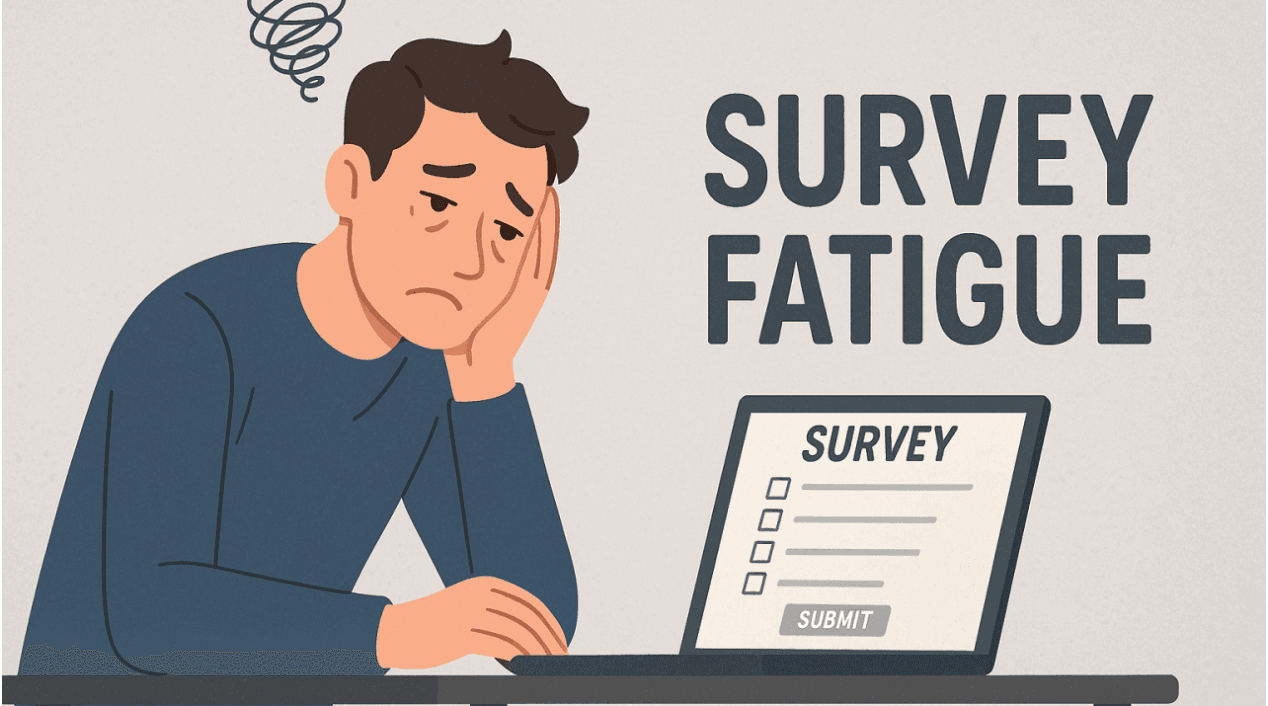
The challenge with this constant search for data is that customers are bombarded with survey requests. What used to be an occasional opportunity for a consumer to weigh in has turned into a deluge of robotic inbox alerts and annoying popups. This structural oversaturation has led to a phenomenon known as survey fatigue, which has rapidly emerged as an increasing pain point for modern CX teams.
When a customer experience program leads to fatigue, the negative effects ripple throughout the entire organization. Declining response rates directly distort executive decision-making by reducing the statistical validity of data pools. Additionally, treating feedback collection as a mere transactional mechanical exercise can harm customer relationships, mask potential churn risks, and ultimately hamper long-term business growth. Organizations don't accurately optimize what they don't understand.
This comprehensive guide explains the structural mechanics of survey fatigue. Readers will learn exactly what survey fatigue is, why it happens across different user journeys, and the hidden business costs of poor-quality data. Finally, we will provide actionable, sophisticated strategies that organizations can implement to improve respondent engagement and successfully recover lost or disengaged respondents.
What is Survey Fatigue?
Survey fatigue is a specific psychological and behavioral condition where a respondent does not want, or no longer wants, to participate in feedback collection processes. Customer experience teams need to know the difference between survey fatigue and customers simply being disengaged.
A generally disengaged customer has lost all appeal for the brand’s products or services, often migrating toward competitors due to pricing, feature gaps or poor service. On the flip side, a customer who’s suffering from survey fatigue may still adore your product and use your service frequently, but they’re at a point of psychological exhaustion from too many requests for feedback.
This psychological fatigue has two distinct operational forms:
- Pre-response fatigue: Before opening a questionnaire. The buyer gets bombarded with too many incoming emails or push notifications and immediately deletes the request.
- Survey-taking fatigue: This occurs as the user works through a questionnaire. The participant gets frustrated because of poor design, repetition, or length, and either abandons the session or enters low-quality data just to complete it.
The Modern Customer Experience Challenge
The structure of modern digital commerce greatly amplifies this problem. The consumer today interacts with a myriad of brands, from B2B software and e-commerce sites to ride-sharing apps and food delivery services.
Automated marketing technology has brought the cost of distributing forms down to almost nothing, so every touchpoint can now be an automated survey request. The customer is not testing out an occasional large purchase; they are being asked to rate a simple delivery, review a standard password reset, or give a detailed analysis of a simple software update.
Common Symptoms of Survey Fatigue
Without a customer success team that’s explicitly monitoring data health metrics, survey fatigue can silently hollow out an entire analytics engine. The primary operational warning signals are:
- Declining Response Rates: A macro-level decline in the proportion of sent questionnaires that are completed.
- Higher Survey Drop-Off Rate: More users open a link, but leave before they reach the final submit button.
- Rushed or Low-Quality Responses: A measurable decline in the time-to-complete metric that indicates users are rushing through or skipping questions.
- Straight-Lining and Random Answers: A behavioral pattern in which participants provide the same numerical value (e.g., all “5”s in a matrix), or provide contradictory options simply to clear the screen.
- Rising Opt-Outs: A surprising increase in the number of people clicking the “unsubscribe from feedback communication” link at the bottom of invitations.
Why companies often overlook the warning signs
These red flags go unnoticed by many data teams, who only look at survey volume, not response quality. If a firm sends out 100,000 questionnaires and receives 10,000 completions, executive dashboards will show a steady 10% volume contribution.
But if half of those responses are straight-line answers, random clicks, or incomplete forms, then the feedback is structurally flawed. Low-quality feedback often presents itself as active participation, and organizations make strategic decisions based on statistical noise.
Why customers stop answering surveys
To tackle the problem of decreasing participation, organizations must identify the key operational and psychological factors that cause users to ignore or drop out of questionnaires.
The Journey of the Respondent Decision
- Survey Request Sent -> Pre-Response Fatigue is the result of too frequent surveys, and it is deleted immediately.
- Survey Opened -> The result is Survey-Taking Fatigue and abandonment if it is too long or generic.
- Survey Completed -> If the company takes no visible action, the result is future non-response and silent churn.
1. They Receive Too Many Surveys
The most common cause of fatigue is simple over-surveying. This issue is seldom born out of malice but rather a basic absence of survey governance across corporate departments. In decentralized companies, different business units have specialized tool sets of their own.
Nick LeRoy, Owner of PPCjobs.com, says response fatigue often sets in when companies forget that every message competes for attention. “People do not ignore every request because they are uninterested. They ignore requests because their inbox already feels overrun. If a company sends too many survey prompts without a clear reason, even useful feedback requests start to feel like noise.”
Take a common business use case. A corporate client may get an onboarding evaluation from the customer success team, a transaction survey from the billing department, a feature feedback form from the product team, and a promotional net promoter score (NPS) inquiry from marketing, all in a single seven-day window. The platforms are not centrally coordinated and therefore work in silos. The same customer account is addressed over and over again, which is immediately annoying and leads to fast opt-out behavior.
2. Surveys seem long and time-consuming
Today’s consumers expect frictionless digital experiences. Friction is instantly introduced when a consumer clicks on a feedback link expecting a simple two-second interaction, only to be faced with a dense questionnaire with multiple matrix blocks and required open text cells.
Benchmarking data across global digital channels indicates a hard and fast inverse relationship between survey length and completion rates.
- 1–3 Questions: Yields a 35.5% to 42.4% median response rate, resulting in high completion and minimal data skew.
- 4–6 Questions: Yields a 21.3% to 29.0% median response rate, resulting in moderate drop-off and steady text insights.
- 7–11 Questions: Yields a 15.0% to 18.6% median response rate, resulting in visible fatigue patterns and rushed selections.
- 12+ Questions: Yields a response rate below 10.0%, resulting in high abandonment (over 70%) and heavy data distortion.
Mobile users are very sensitive to survey length. The abandonment rate routinely exceeds 70% when a multi-question grid layout does not scale properly on a smartphone screen, requiring horizontal scrolling and precise finger tapping.
3. Customers Don’t Get Results
Feedback programs are based on an implicit psychological contract: the user commits their valuable time to providing information, and in exchange, the business benefits from that information in the form of a better product or service. Unfortunately, businesses rarely close this loop. Respondents are seldom informed of the structural changes that resulted directly from their input.
Conrad Wang, Managing Director at EnableU, says feedback only keeps working when people can see that their input leads to action. “People stop sharing feedback when they feel it disappears into a system. Whether you are supporting customers, clients, or families, the real trust comes from showing what changed because someone spoke up.”
This creates a deep trust gap. When consumers fill out multiple forms throughout the year and still encounter the same software bugs, shipping delays, or support bottlenecks, they know their feedback doesn’t matter. Once a user thinks a questionnaire is a compliance drill they’re not being monitored on, they’ll never participate again.
4. Lost Context and Bad Timing
“Context is very perishable.” Evaluating the transaction ten minutes after an item is delivered captures the user while the details are fresh and provides clear, actionable data. If the same evaluation is instead delayed and sent out in an automated batch email three weeks later, the relevance is completely gone.
Luciano Armanasco, Founder of Our Dolce Vita, says feedback is most useful when it is captured close to the experience. “In travel, the small details are what shape the memory of a trip. If you ask guests for feedback weeks later, they may only remember the big picture. When you ask at the right moment, you get clearer, more useful answers about what actually improved or disrupted the experience.”
The customer does not remember exactly how the delivery agent behaved or the condition of the packaging. The obligatory recalling of a previous non-impactful interaction calls for conscious cognitive effort that immediately triggers cognitive resistance and encourages non-responsive behavior.
5. Generic Survey Experiences
Consumers want their digital conversations to be a mirror of the real relationship they have with a business. If a company sends out a one-size-fits-all questionnaire regardless of recipient tenure, purchase history, or account tier, the interaction is completely robotic. A broad question to a ten-year enterprise partner such as “How did you first discover our brand?” is proof that the company does not analyze its own internal CRM data. Consumers want dynamic, personalized conversations—not static database forms.
The Hidden Costs of Survey Fatigue
An analytics team might view a decline in responses as a minor administrative headache, but the financial and strategic fallout is far-reaching. Over-surveying quietly corrodes data systems and customer relationships in a variety of ways.
Cost #1: Lower Response Rates and Unbalanced Sample Sizes
As participation drops across digital channels, data pools shrink dramatically. This smaller sample size means the business loses its ability to establish statistical confidence in reviewing quarterly trends.
For example, if a company with 50,000 users sees its email response rate drop from a healthy 25% to a paltry 4%, the margin of confidence would increase significantly. This means that you can't tell if a 3-point dip in a satisfaction index is a real operational issue or just a random statistical variation in a small group of respondents.
Cost #2: Bad Data Quality and Toxic Analytics
Bad data is created through random clicking, straight-lining behavior, and incomplete responses. In business intelligence, bad data is far more dangerous than having no data at all. If a team has no data, they know they’re in the dark and will naturally be cautious.
Zaheer Dodhia, CEO and Founder of Hummingbird International, says toxic analytics usually begin when companies mistake collected data for trustworthy data. “Bad data does not just weaken a report; it creates false confidence. When survey responses are rushed, duplicated, or filled with low-effort answers, the dashboard may look complete, but the insight behind it is already corrupted.”
But if they use skewed, low-quality data from tired respondents to fill their executive dashboards, they will be making disastrous strategic moves with confidence. A business might spend millions redesigning a software dashboard because of high scores entered by users who were just randomly clicking buttons to get rid of an intrusive pop-up form.
The Toxic Data Breakdown
Respondents Fatigued -> Random Clicks & Straight-Lining -> Flawed Data Pool -> Skewed Dashboard Trends -> Confident Wrong Strategy -> Wasted Enterprise Capital
Cost #3: Digital Clutter & Customer Frustration
Every uncoordinated evaluation request is digital noise in a customer’s life. This creates an experience paradox: what is supposed to be a sign that a company cares about its customers ends up frustrating them.
Andrew Pho, General Manager at Mister Baluster, says post-purchase communication should help customers, not overwhelm them. “Customers already receive order confirmations, shipping updates, delivery notices, and support messages. If a company adds multiple feedback requests on top of that, the experience can start to feel cluttered. A survey should feel useful and well-timed, not like one more task after a purchase.”
A brand that is an e-commerce store will go from helpful to spammy in terms of brand identity if they send a confirmation email, a shipping update email, a delivery confirmation notification, and then three different feedback reminders after a simple purchase. This friction can directly impact the overall customer lifetime value.
Cost #4: The Silent Churn Trap & Lost Insights
When survey fatigue sets in, the first people to stop responding are the busiest, highest-value clients, as well as those who are quietly becoming unhappy and preparing to leave. This leaves companies listening to the loudest, most extreme voices, whether they are very enthusiastic brand advocates or very angry detractors.
Most middle users are silent. This creates a dangerous blind spot where a business looks stable on paper because its remaining respondents are happy, while its highest value accounts are quietly churning with no data trail.
Cost #5: Lower returns on customer experience programs
Enterprise feedback management platforms can be expensive to license and require dedicated internal engineering resources. Fatigue lowers response rates, and the cost per completed response skyrockets.
Companies spend more on technology and distribution, but glean less actionable insight. This damages the internal credibility of the entire CX department, which makes it very difficult for leaders to get budget approvals for future improvement initiatives.
How to Re-Engage Customers and Boost Survey Response Rates
To combat survey fatigue and revive declining response rates, companies must shift from high-volume, automated distribution to a highly strategic, conversational, and respectful approach to customer listening.
1. Streamline Your Feedback Method and Limit Survey Frequency
The easiest way to get rid of fatigue is to stop over-surveying your audience. Organizations should develop a comprehensive cross- departmental survey governance policy. This is accomplished by creating a single contact rules engine within your customer data platform (CDP).
For instance, a company might have a hard throttle rule that no one customer account can get more than one feedback request in any 30-day period regardless of how many business units they interact with. For example, if a user opens a support ticket assessment on a Monday, the system automatically suppresses any marketing or product surveys for the month.
2. Make Surveys Shorter and Action-Oriented
Consistent questions mean better insights. Every question in a questionnaire should have a clear internal purpose. If a piece of data cannot be directly correlated to an operational improvement, it should disappear immediately.
Pulse with one or two questions instead of long questionnaires. Instead of sending a 20-question annual form, use smart tech platforms to ask one targeted question directly in the product interface. This approach respects the user’s time and yields high completion rates.
3. Personalize the Experience Using Conversational Interfaces
To better serve your customers, you need to move away from static database forms and adopt principles of conversational design. Today, feedback experiences should feel like a natural conversation between two people, not an interrogation by a database.
By leveraging native integrations with an intelligent customer feedback platform, companies can deploy conversational feedback interfaces that automatically adapt based on known CRM data. If a customer has been a premium enterprise client for three years, the survey should dynamically adjust its phrasing, skip baseline introductory queries, and reference their specific account history. This approach shifts the tone from a boring chore to an engaging, valued interaction.
4. Close the Feedback Loop with Clear Action
If you want to win back consumer trust, you have to show that feedback leads to real change. When customers fill out a survey, the business needs to follow up and show them what happened next.
The Closed Loop Workflow
Customer Critiques -> AI Clusters Pain Points -> Engineering Ships Update -> Email Sent: "We Heard You & Fixed It" -> Rebuilt Trust / High Future Responses
For example, if software users consistently complain about a confusing dashboard layout, the company could send a targeted email update stating: "You told us our navigation menu was too complex. Based on your feedback, we've rolled out a redesigned interface to streamline your workflow." This demonstrates to customers that their input is truly valued, prompting them to engage in future surveys.
5. Use Smart Survey Logic and Conditional Branching
Don’t ask a user to read or skip over a question that doesn’t apply to them. With conditional branching and adaptive questioning, you can build dynamic paths that change in real time based on the respondent’s prior answers.
The system can also ask a quick follow-up question if a customer answers “Yes” to a particular software feature. If they say “No,” the system immediately skips that whole section, and their path to completion is short and painless.
6. Real-time API triggers for Survey Timing Optimization
Relevance drops off fast. Feedback requests should be done in real time through system API’s, not weekly or monthly batch email distributions.
When a customer finishes an onboarding module, the micro-survey should be presented immediately in the interface while the experience is still fresh. Additionally, provide users with transparent control over their communication preferences, allowing them to select whether they are open to receiving feedback requests via email, SMS, or in-app notifications.
7. Optimize Mobile Survey Experience with Mobile-First Design
Mobile-first design is essential as a great part of online surveys are opened in mobile devices. Questionnaires must be responsive and load instantly on any smartphone screen.
Steer clear of large chunks of text, complicated multi-column grids, and open-ended text fields that demand extensive typing on a mobile keyboard. Clean, touch-friendly buttons replace text entry fields for fluid navigation and stable completion rates.
8. Mix Up Other Feedback Channels Beyond Traditional Forms
Relying solely on formal questionnaires is a recipe for data fatigue. Today’s customer experience programs should mix active surveys with passive listening channels.
By tracking in-app usage data, using AI sentiment tools to analyze customer support chat transcripts, and watching public review sites, companies can gather rich behavioral insights without interrupting the user experience. Formal surveys can then be reserved for critical moments in the customer journey.
Building a Sustainable Feedback Program
Moving your strategy from more feedback to better feedback necessitates a seismic shift in how your organization views customer insights. Real continuous improvement is not just about getting a lot of responses; it’s about listening smartly to effect real change.
To create a healthy, sustainable feedback program that respects their customers’ time and produces high-quality data, organizations must ground their operations in four core tenets:
- Respect Customer Time: Build brief, hyper-focused interactions that get right to the point.
- Personalize Experiences: Use CRM-based tweaks so questions are always relevant to the specific user journey.
- Act on Collected Insights: Systematically close the loop so customers understand their participation led to tangible changes.
- Continuous Optimization: Regularly review your collection methods and collection times to keep up with behavioral trends.
The future of customer insights belongs to unified, intelligent systems. By stepping away from isolated, department-level forms and moving toward integrated conversational feedback ecosystems, businesses can easily capture high-quality data while maintaining long-term customer trust.
Conclusion
Survey fatigue is no longer a minor operational headache for research teams; it’s a critical business risk that directly threatens customer relationships and distorts executive decision-making. When companies continuously flood their audiences with long, uncoordinated questionnaires, they break the trust needed for genuine communication, leaving them dependent on biased data.
The answer to declining response numbers isn’t to send out more reminders; it’s to create a smarter and more respectful form of customer listening. Aligning requests across departments, cutting down on forms, personalizing every interaction, and showing real action based on results can revitalize participation rates and unlock deep, consistent insights.
An omnichannel customer feedback framework enables organizations to easily transform stale, high-friction questionnaires into engaging, conversational experiences that people actually want to complete. Step back, refine your feedback touchpoints, and make sure every survey you send provides real value to your business and your customers.