Fans are the entire reason sports organizations exist. Yet most sports teams, leagues, and media properties still rely on ticket sales data, social media analytics, and TV ratings to understand them — all of which tell you what fans did, not what they think, feel, or want next.
Fan engagement surveys change that equation. They give organizations a direct line into fan sentiment: what's working, what's broken, what would make them more loyal, more likely to renew, more likely to attend. And in a sports industry that is becoming increasingly competitive for fan attention — audience growth now depends on timing, context, and adaptability rather than a single fan journey or channel — that direct line is becoming a strategic necessity.
This guide covers everything you need to build a fan engagement survey program that actually works: the right questions for every touchpoint, design principles that drive completion, how to pick the right metric for each situation, and how organizations from global motorsport championships to rugby league clubs have used this approach to deepen fan loyalty and drive measurable outcomes.
What Fan Engagement Surveys Actually Measure
Fan engagement is not one thing. It's a spectrum of behaviors and sentiments — attendance frequency, streaming habits, merchandise spend, social media interaction, emotional connection to the team, likelihood to recommend — that each require different questions to uncover.
The most useful framework is to think of fan engagement across three dimensions:
Behavioral engagement — What fans actually do. How often they attend, watch, buy, share, post. Surveys surface the why behind these behaviors and reveal what would change them.
Attitudinal engagement — How fans feel. Their emotional connection to the team or sport, their satisfaction with specific experiences, their loyalty and sense of belonging. This is the territory NPS and CSAT surveys cover.
Preference data — What fans want. Content formats, channel preferences, pricing sensitivity, feature requests. This guides product and content decisions before you commit resources to them.
A good fan engagement survey program covers all three. Most organizations start with attitudinal surveys (because they're easiest to benchmark) and gradually add behavioral and preference dimensions as their program matures.
Choosing the Right Metric: NPS, CSAT, or CES?
Before writing any questions, you need to decide what you're measuring — because the metric shapes everything else.
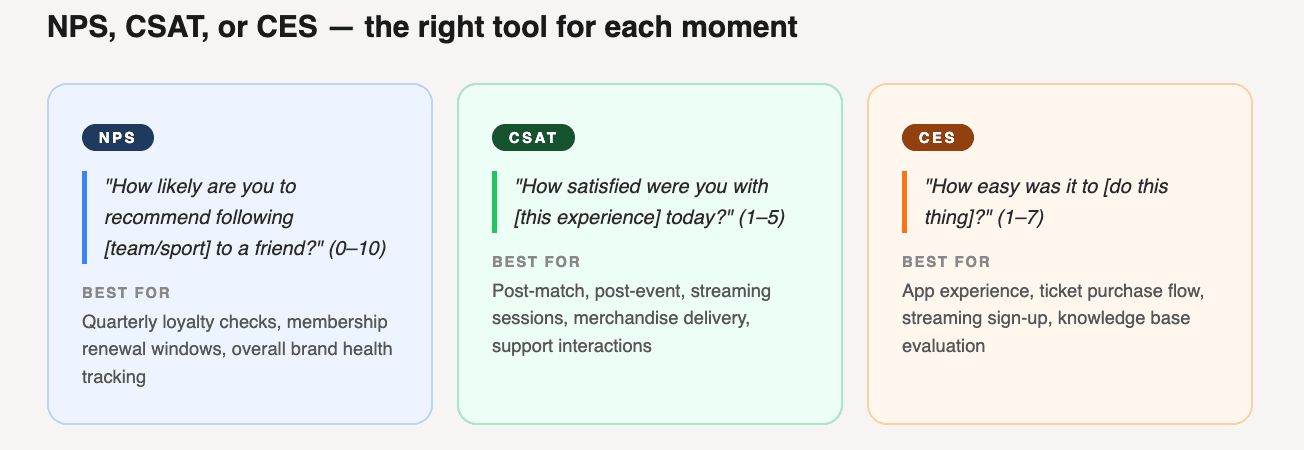
NPS — for overall fan loyalty
Question: "How likely are you to recommend following [team/sport/league] to a friend or family member?" (0–10 scale)
NPS measures the overall health of the fan relationship. It predicts referrals, renewal likelihood, and long-term loyalty. According to Bain & Company, an industry's NPS leader outgrows its competitors by over 2x. In sports, that translates directly to membership renewals, streaming subscription retention, and word-of-mouth growth.
Use NPS for: Quarterly relationship health checks, pre-season and post-season surveys, membership renewal windows, overall brand tracking.
CSAT — for specific experience touchpoints
Question: "How satisfied were you with [specific experience] today?" (1–5 scale)
CSAT measures satisfaction with a discrete interaction — a match, a streaming session, an onboarding experience, a support interaction. It's more granular than NPS and more actionable because it ties directly to a specific moment.
Use CSAT for: Post-match surveys, post-event feedback, streaming quality measurement, merchandise purchase follow-up, in-stadium experience rating.
CES — for friction in processes
Question: "How easy was it to [do this thing]?" (1–7 scale)
Customer Effort Score measures how much friction a fan encountered in a specific process — buying a ticket, navigating the app, accessing content. In sports, CES is underused but highly valuable, especially for digital product teams.
Use CES for: App experience feedback, ticket purchase flow, streaming sign-up, knowledge base / self-service evaluation.
Most fan engagement programs use NPS + CSAT as their core metrics, with CES added for specific digital product evaluation.
When to Send Fan Engagement Surveys
Timing is arguably the most important design decision in fan engagement surveys. Post-event surveys, content teasers, or loyalty program offers can keep fans engaged all year round. But the specific window matters enormously — survey a fan 72 hours after a match and the emotional connection to that experience has faded.
Here's the complete touchpoint map:
| Touchpoint | Survey type | Optimal timing | Who to survey |
|---|---|---|---|
| Post-match / post-event | CSAT | Within 2–4 hours | All attendees / viewers |
| Streaming session | CSAT | Within 1 hour of session end | Subscribers |
| Season ticket purchase | CSAT + preference | Within 24 hours | Buyers |
| App update | CES | Within 48 hours | Active app users |
| Membership renewal window | NPS | 60–90 days before expiry | All members |
| Post-season | NPS + preference | 1–2 weeks after final match | Full fanbase |
| Pre-season | Preference | 4–6 weeks before season | Full fanbase |
| New fan first interaction | CSAT | After first match / stream | New registrants |
| Post-merchandise purchase | CSAT | 3–5 days after delivery | Buyers |
The most common mistake in sports fan research is sending one big annual survey. By the time it arrives, fans have disconnected emotionally from the specific experiences you're asking about, and the responses become abstract rather than actionable. Touchpoint-specific surveys — short, timely, and tied to a real experience — consistently outperform omnibus surveys on both response rate and data quality.
50+ Fan Engagement Survey Questions by Category
Category 1: NPS and overall loyalty
These questions measure the depth of the fan relationship — not a specific moment, but the overall bond.
- How likely are you to recommend following [team/sport] to a friend or family member? (0–10)
- What's the main reason for your score? (Open-ended)
- What would make you more likely to recommend us? (Open-ended)
- How long have you been a fan?
- How would you describe your level of fandom? (Casual / Regular / Die-hard)
- How connected do you feel to [team/sport] right now compared to a year ago? (More / Same / Less)
- If [team/sport] disappeared tomorrow, how big a loss would that be for you? (1–5)
Category 2: Post-match and post-event CSAT
Send these within hours of a match, race, game, or event ending while emotion is still live.
- How satisfied were you with today's experience overall? (1–5)
- How would you rate the atmosphere / energy of today's event? (1–5)
- Did today's experience meet your expectations? (Yes / Mostly / No)
- What was the standout moment for you today? (Open-ended)
- Was there anything that frustrated or disappointed you? (Open-ended)
- How likely are you to tune in / attend the next event?
- How would you rate the pre-event content and build-up? (1–5)
- Would you say today's event was worth your time? (Definitely / Mostly / Not really)
Category 3: Streaming and digital experience
For sports media properties and leagues with owned streaming platforms — one of the fastest-growing fan touchpoints.
- How would you rate the streaming quality today? (1–5)
- Did you experience any technical issues during the broadcast? (Yes / No — if yes, describe)
- How easy was it to find the content you wanted? (1–7 CES scale)
- Which device did you watch on? (Mobile / Tablet / Smart TV / Desktop)
- What did you watch today? (Live / Highlights / Behind the scenes / Archive)
- What content would you like to see more of? (Multi-select list)
- How does our streaming experience compare to other sports you follow? (Better / Similar / Worse)
- Is there a feature you wish the platform had? (Open-ended)
Category 4: In-stadium and event experience
For clubs and leagues with significant live attendance — the highest-value fan relationship.
- How satisfied were you with your overall race / match / game experience today? (1–5)
- How would you rate: ticketing process / entrance / seating / food and beverage / facilities / atmosphere? (Individual 1–5 ratings)
- Was getting to the venue straightforward? (Yes / Mostly / No)
- Did you feel safe and comfortable throughout the event? (Yes / Mostly / No)
- How would you rate the merchandise offering at the venue? (1–5)
- Was the event information (schedule, map, access) easy to find before arriving? (Yes / Mostly / No)
- Would you bring someone new to this venue for their first experience? (Yes / Probably / Unlikely)
- What single change would most improve the on-site experience? (Open-ended)
Category 5: Content and preference
These questions guide content strategy, channel investment, and product decisions.
- Which content formats do you engage with most? (Multi-select: live matches / highlights / behind-the-scenes / rider/player profiles / analysis / social clips)
- Which platform do you mainly follow us on? (Instagram / X / YouTube / TikTok / Facebook / App / Website)
- How many events / matches / races did you follow this season?
- What content do you wish existed that doesn't currently? (Open-ended)
- How often do you watch sports content on your phone vs. TV?
- Would you pay for a premium content tier with exclusive behind-the-scenes access? (Yes / Maybe / No)
- Which athletes or personalities do you most enjoy following? (Open-ended)
Category 6: Membership and subscription
Send these at the renewal window — critical for retention and expansion revenue.
- How satisfied are you with your membership / subscription overall? (1–5)
- Do you feel you're getting good value? (Yes / Mostly / No)
- Which benefits do you use most? (Multi-select)
- Are there benefits you've never used or found confusing? (Open-ended)
- How likely are you to renew next season? (0–10)
- If you're considering not renewing, what's the primary reason? (Show conditionally if renewal score ≤ 6)
- Is there a benefit we don't currently offer that would make your membership significantly more valuable? (Open-ended)
Category 7: New fan onboarding
Often overlooked — but the first 90 days of a fan's relationship determines whether they become casual followers or lifelong loyalists.
- How did you first discover [team/sport]? (Multi-select: friend recommendation / social media / TV / attending a live event / other)
- How easy has it been to follow along and understand what's happening? (1–5)
- Have you found everything you were looking for? (Yes / Mostly / No)
- What would have made getting started as a fan easier? (Open-ended)
- How would you describe your interest level right now compared to when you started following? (More interested / Same / Less interested)
Design Principles That Drive High Response Rates
Having the right questions is half the equation. Getting fans to actually complete the survey is the other half.
55% of sports fans say they don't get relevant communication, and 61% feel priced out of the game they love. Generic, impersonal surveys contribute to that sense of disconnection. Here's what closes the gap:
Keep it short — 3 to 5 questions maximum
For post-event surveys, three questions is ideal: one rating scale, one "what was best," one "what could be better." Longer surveys see dramatic drop-off, especially on mobile. If you have 15 things you want to ask, build 4 separate short surveys and send them at appropriate moments rather than cramming everything into one.
Brand the survey to match the fan's emotional context
A post-race survey from MotoGP should look like MotoGP. A post-match survey from a rugby club should feel like the club. When a survey aligns visually and tonally with the sport the fan loves, it signals that this feedback actually matters to the organization — not that it's been outsourced to a generic form tool.
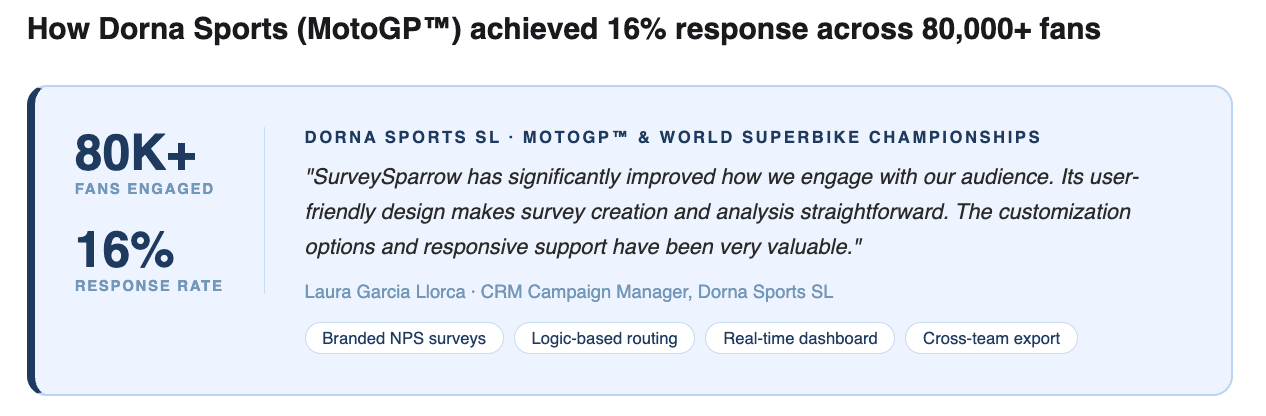
This is exactly what Dorna Sports, the organization behind MotoGP™ and the World Superbike Championships, did when they needed to survey their global audience of motorsport fans. Using SurveySparrow's custom branding options, they built surveys that felt native to the MotoGP experience — contributing to an 80,000+ fan response pool and a 16% survey response rate.
Read the Dorna Sports case study →
Similarly, the South Sydney Rabbitohs NRL club uses SurveySparrow's NPS surveys to maintain a direct feedback channel with their membership base — using the data to understand what drives fans to upgrade from general followers to paid members.
Use logic branching to make surveys feel personal
A fan who attended their first live event has completely different things to say than a 10-year season ticket holder. Conditional logic routing ensures each fan only sees the questions relevant to their specific experience — producing precise data rather than a muddled average, and making the survey feel like a conversation rather than a form.
Send via the channel the fan is already using
Fans who receive personalized recommendations spend more time on team platforms and are more likely to make repeat purchases. The same principle applies to survey distribution: a fan who just watched a match on their phone is most likely to complete a post-match survey if it arrives via the app or SMS — not three days later via a desktop email.
Time to the emotional peak
The best moment to survey a fan is immediately after the experience — within hours of a race finishing, a match ending, or a streaming session closing. The emotional connection to the specific experience drives more honest, detailed, and useful responses. Wait 48 hours and the moment has passed.

Explore how SurveySparrow can transform your feedback process.
TRUSTED BY BEST-IN-CLASS BRANDS


How to Act on Fan Survey Data
Collecting responses is only the start. The organizations that get the most value from fan engagement surveys have a closed-loop process that turns data into visible action.
Segment before you analyze
Never look at an aggregate CSAT or NPS score and stop there. Break it down by: fan segment (casual vs. die-hard), channel (in-stadium vs. streaming), geography, age group, membership tier. Each segment tells a different story and requires a different response.
Millennials are the most commercially valuable audience and the most likely to disengage when content feels irrelevant. If your overall NPS looks healthy but Millennial subscribers are quietly trending down, the aggregate masks the problem. Segmentation reveals it.
Prioritize the middle — passives and borderline detractors
NPS detractors (scores 0–6) get the most attention, and rightly so. But passives — fans who scored you 7 or 8 — represent your largest untapped loyalty opportunity. They're satisfied but not enthusiastic. A small improvement in their experience can move them into the promoter category, which has measurable impact on referrals and renewals.
Connect scores to specific operational levers
A low post-event CSAT from in-stadium fans means something specific: parking, food, atmosphere, or facilities. A low streaming CSAT means something different: buffer rates, commentary quality, camera angles, app stability. Tie each survey to the operational team that can act on it.
Close the loop — and say so publicly
The single most powerful thing a sports organization can do with fan feedback is act on it and then tell fans you did. "Based on your feedback after last season, we've added three new camera angles to our live stream" converts survey respondents into advocates. It signals that feedback isn't disappearing into a void — it's shaping the experience.
What Good Response Rates Look Like in Sports
Industry averages for sports fan surveys typically sit at 5–10% for general audience surveys. Factors that push response rates higher:
- Timing: Post-event surveys sent within 2–4 hours outperform surveys sent the following day
- Length: 3-question surveys outperform 10-question surveys by a significant margin
- Branding: Surveys that match team/league visual identity outperform generic forms
- Channel: In-app and SMS surveys outperform email surveys for mobile-first fan bases
- Personalization: Surveys that reference the specific experience (the race, the match) outperform generic satisfaction surveys
When these factors combine — short, branded, timely, mobile-first — response rates of 15–20% are achievable with large global audiences. Dorna Sports reached 16% across a global fanbase spanning multiple languages and time zones by applying exactly this combination.
Building Your Fan Engagement Survey Program: Where to Start
If you're building from scratch, the simplest starting point is a three-survey stack:
Survey 1 — Post-event CSAT (3 questions) Overall satisfaction rating → what was the highlight → what could be better
Survey 2 — Quarterly NPS (2 questions) Likelihood to recommend → reason for score
Survey 3 — Pre-season preference (5 questions) Content preferences → channel habits → what they want more of → what would increase engagement → one open-ended wishlist question
Run this for two seasons and you'll have enough longitudinal data to identify trends, segment your fanbase meaningfully, and make content and product decisions backed by real fan opinion rather than assumption.
From there, you can add touchpoint-specific surveys: streaming experience, merchandise purchase, new fan onboarding, membership renewal — each adding a new layer of insight to your understanding of the fan relationship.
Want to build a fan engagement survey program? SurveySparrow's platform is used by global sports properties including Dorna Sports (MotoGP) and South Sydney Rabbitohs to run branded, logic-driven NPS and CSAT surveys at scale.
Explore how SurveySparrow can transform your feedback process.
TRUSTED BY BEST-IN-CLASS BRANDS