


Customer Experience Automation (CXA) is the strategic use of automation, artificial intelligence (AI), and data-driven workflows to manage, personalize, and optimize customer interactions across the entire customer journey—at scale, without losing the human touch.
CXA uses advanced technologies like artificial intelligence (AI), machine learning (ML), and natural language processing (NLP). These tools analyze customer data, predict needs, and solve issues before they grow bigger. A 2023 Statista study shows at least 73% of customers expect more customized experiences as technology advances.
The system manages day-to-day tasks such as answering common questions and processing payments. It sends order updates and directs requests to the right departments. CXA recognizes returning customers and remembers their priorities to offer solutions before they ask. The system knows when complex issues need human help and gives agents the customer's information to speed up solutions.
Key components of customer experience automation (CXA) include:
- AI chatbots and virtual assistants that manage routine questions and provide immediate support
- Automated workflow systems that route customer communications efficiently
- Predictive analytics tools that anticipate customer needs based on behavioral data
- Personalization engines that customize communications for individual customers
- Self-service portals that strengthen customers to find solutions independently
Modern CXA platforms go a step further by using intelligent AI agents that don’t just automate tasks—but actively drive conversations and outcomes.
Meet Echo Agents
Echo AI Agents ask smarter follow-up questions in real time—so feedback doesn’t stop at surface-level answers. They clarify intent, uncover hidden issues, and turn conversations into meaningful insights, while automatically handling bookings, tickets, and leads.
Live conversations. Instant actions. Always on—24/7.
👉 Signup today and see how Echo Agents turn feedback into action, automatically
14-day free trial • Cancel Anytime • No Credit Card Required • No Strings Attached
CXA shows a major rise from older automation systems. The original versions could only handle simple tasks like auto-responses and basic chatbots. Modern CXA provides context-aware interactions that show empathy and better meet customer needs. On top of that, it works naturally across platforms to keep brand experiences consistent.
This technology doesn't aim to replace human agents but rather boost their abilities. CXA handles routine tasks so human agents can focus on complex issues that need empathy and critical thinking. This blend of automation and human expertise creates what researchers call "Industry 4.0," where AI and human agents work together to deliver better customer experiences.
CXA's main goal delivers faster, more customized experiences while keeping a human touch at scale. Companies can meet growing customer expectations without adding more staff or costs.
How does Customer Experience Automation work?
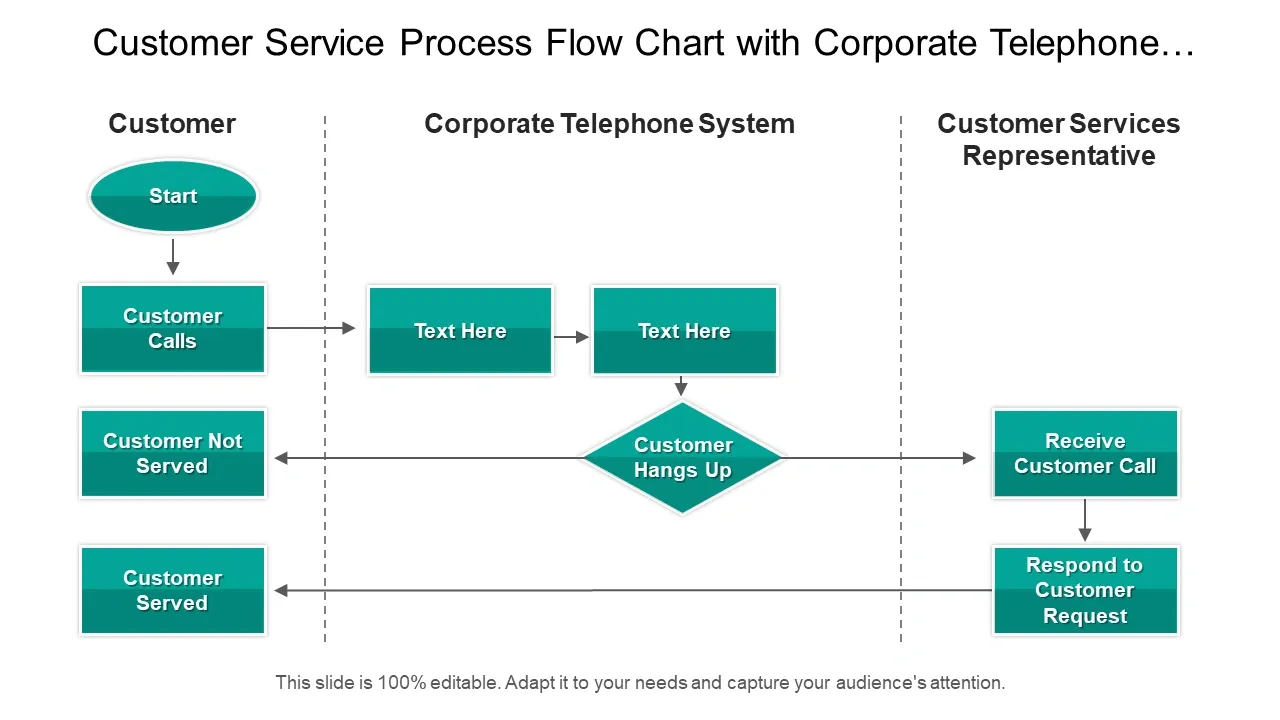
Image Source: SlideTeam
Customer Experience Automation works through a sophisticated framework of connected technologies that make customer interactions efficient throughout their trip. The system uses artificial intelligence, machine learning algorithms, and data analytics to create tailored experiences at scale. Quality and consistency remain uncompromised.
Multi-agent orchestration sits at the heart of CXA functionality. Multiple specialized AI agents work together in end-to-end customer workflows. Each agent handles specific tasks such as proving identity right, updating orders, or triggering back-office actions. This ensures context preservation as interactions move between systems or channels. An orchestrator manages these tasks and determines their execution sequence to maintain smooth experiences.
This multi-agent approach is already visible in platforms like SurveySparrow’s Echo Agents, where AI agents collaborate to ask follow-up questions, trigger workflows, and act on feedback in real time.
Four Core CXA Processes
- Orchestration manages customer interactions across all channels. It creates synchronized experiences whatever customers choose - website, social media, or phone. The process arranges departmental efforts from sales to customer support and creates smooth trips without friction points.
- Segmentation groups customers based on their behavior patterns, demographic characteristics, and interaction history. This grouping helps businesses target communications better and predict needs accurately.
- Personalization makes use of customer information to create tailored experiences based on individual priorities and past behaviors. Advanced CXA platforms use predictive analytics and recommendation engines to figure out "what this customer needs most in this moment".
- Automation handles routine tasks without manual work, including routing tickets, confirming orders, and following up on questions. Human agents can then focus on complex issues that need empathy and critical thinking.
CXA needs deep integration with existing business systems to work. The technology must connect with CRM platforms, ERP systems, billing software, and industry-specific tools. This access to complete customer information helps execute actions throughout the customer trip. Advanced CXA solutions also use natural language understanding and conversational AI to provide contextual, human-like help that feels accessible.
Machine learning helps the technology evolve constantly. It incorporates feedback from each interaction to improve future responses. Notwithstanding that, good CXA implementation keeps strong governance protocols. These include guardrails that enforce compliance, prevent AI hallucinations, and allow human intervention when needed.
CXA ended up bridging the gap between front and back-office operations. Businesses can now solve customer needs completely instead of just handling interactions. Traditional tools only store data or handle communications. CXA performs underlying actions that make faster resolution possible.
Benefits of Customer Experience Automation
Organizations that automate customer experience gain multiple benefits. These advantages help them deliver better service and use resources wisely. The benefits show up in daily operations, customer happiness, and business success.
Faster response times and 24/7 support
AI chatbots and virtual assistants let businesses provide support around the clock. They handle common questions without human help. Customers get immediate help whatever the time zone or business hours. Problems get solved quickly, which cuts down wait times. Customers can also check order status or find information on their own through self-service tools. This makes their experience better.
Lower operational costs
CXA cuts down expenses by reducing routine tasks that staff handle. Companies can grow their customer service without adding more people. Teams can work on complex tasks that add value instead of basic questions. This helps use the workforce better. The simplified processes across departments save money while keeping service quality high.
Improved customer satisfaction and loyalty
Research shows 77% of marketing leaders say automation makes customer experience better. Quick responses, quality support, and fast solutions substantially improve satisfaction. In fact, 84% of customers think experience matters as much as products or services. Happy customers become loyal ones as they enjoy smooth, customized interactions with the brand.
Personalized communication at scale
CXA platforms study how customers behave to send messages that match their priorities. Since 52% of consumers want customized offers, automation helps companies meet these needs efficiently. Companies can use AI tools to suggest products, create targeted ads, and send personal emails that strike a chord with specific groups.
Stronger customer relationships
Automated customer experiences help build deeper connections. They keep customers engaged and put the brand at the vanguard of their minds. Accenture reports companies that improve customer experiences can boost revenue by 3-7%. Active communication and personal interactions build trust that leads to repeat business and customer advocacy.
Consistent brand experience
Automation keeps service quality the same across all channels. This builds customer confidence and reduces mistakes. Standard messages, terms, and visual elements create a unified experience that makes the brand stronger.
Useful customer insights
CXA systems collect data from customer interactions. This reveals priorities, problems, and new trends. Companies can use this information to make their service better. Advanced platforms create complete customer profiles by analyzing interactions across channels. This helps understand individual behaviors and interests.
Increased profitability
Better customer experiences through automation boost financial results. McKinsey's research shows AI-powered customer experience can increase revenue by 5-8% and cut service costs by 20-30%. CXA also studies customer behavior to suggest relevant products or services. This creates more upselling and cross-selling opportunities.
Examples of Customer Experience Automation in action
Modern enterprises use different CXA implementations to improve customer engagement and make operations smoother. Real-world applications show how automation turns theoretical benefits into actual results.
AI chatbots for support
AI-powered chatbots work as frontline customer service representatives and handle routine questions without human help. These virtual assistants use natural language processing to understand customer questions, give relevant information, and fix simple issues. Complex matters get transferred to human agents with full context. Companies that use chatbots see faster response times because these tools work 24/7, whatever the time zones or business hours. IKEA's chatbots handle almost half of all customer questions, which lets human agents tackle complex issues needing empathy.
Automated email campaigns
Email automation creates tailored communication at scale through behavior-triggered messaging. Campaign Monitor shows automated emails generate 320% more revenue than non-automated messages. These systems send relevant content based on customer actions—like abandoned cart notifications, welcome messages for new subscribers, and post-purchase follow-ups. Good email automation groups recipients by demographics, purchase history, and engagement patterns to deliver content that appeals to individual needs. These campaigns keep brand messaging consistent while meeting unique customer needs.
Smart routing and ticketing
Smart case routing sends customer questions to the right agents based on their expertise, availability, and case complexity. AI analysis figures out what customers need and assigns them to specialists who can best solve their problems. Advanced systems rank cases by analyzing customer sentiment, value, and urgency. Companies using smart routing solve cases faster, fix more issues on first contact, and balance workloads better among service teams.
Personalized product recommendations
AI algorithms study customer behavior patterns to suggest products that match individual needs. These systems look at browsing history, past purchases, and demographic information to find items customers might like. Amazon says 35% of their consumer purchases come from their recommendation systems. Netflix uses machine learning to study viewing habits and suggest content that matches user interests. These tailored recommendations make customers happier while increasing average order value and conversion rates.
Self-service knowledge bases
Self-service knowledge bases gather detailed information that helps customers solve problems on their own. These include FAQs, troubleshooting guides, tutorial videos, and step-by-step instructions available anytime. Harvard Business Review shows 81% of customers would rather use self-service than contact support representatives. Good knowledge bases mean fewer support tickets and happier customers who can fix issues right away. Organizations with effective knowledge bases spend less on support and have more independent customers.
How to implement Customer Experience Automation
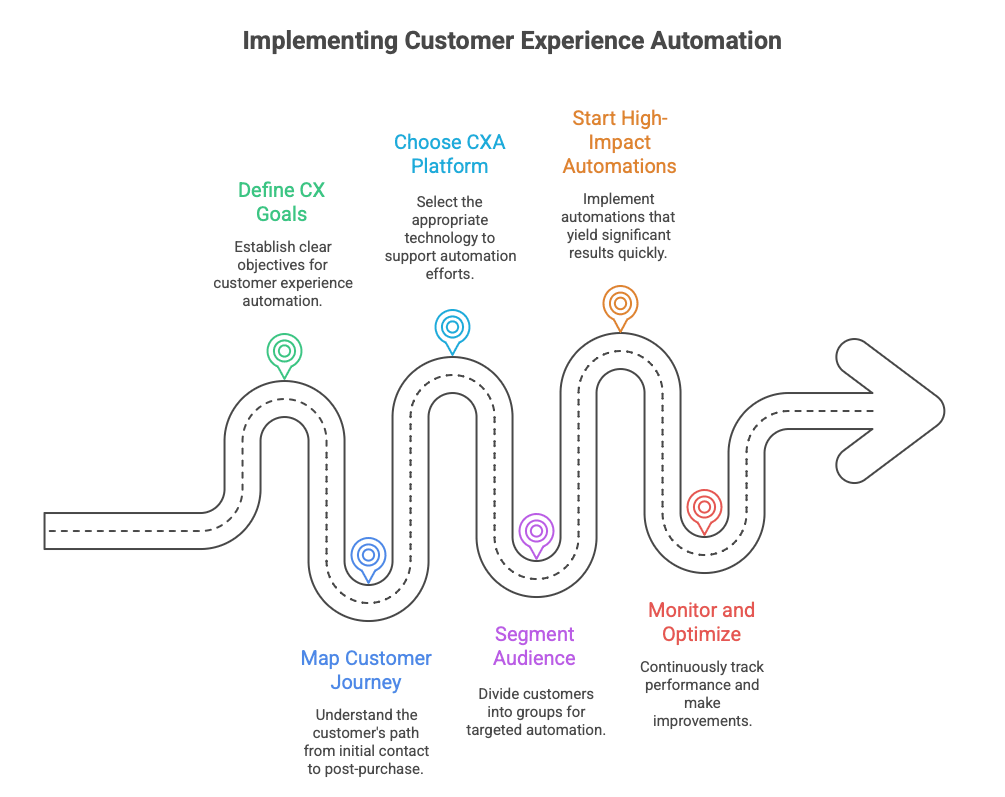
Implementing customer experience automation requires a strategic approach focused on measurable outcomes and continuous refinement. The following six-step framework provides a foundation for organizations adopting CXA.
1. Define your CX goals
Initially, establish specific, measurable objectives for your automation initiative. Determine what you aim to achieve—improved communication, higher personalization, or enhanced support efficiency. Essentially, evaluate current customer experience processes to identify pain points and repetitive tasks that would benefit most from automation.
2. Map the customer journey
Prior to implementing automation, create a comprehensive visualization of all customer touchpoints from initial awareness to post-purchase support. Incorporate conversation analytics to understand customer emotions and pain points. This mapping helps identify which interactions might benefit from automation versus those requiring human engagement.
3. Choose the right CXA platform
Select automation tools that integrate seamlessly with existing systems like your CRM or e-commerce platform. Consider scalability to ensure long-term viability. Look for platforms with open APIs that allow easy connection with third-party AI models and internal systems.
4. Segment your audience
Organize customers into groups based on shared characteristics such as behavior, demographics, or engagement level. This segmentation enables the delivery of more relevant content tailored to specific audience needs.
5. Start with high-impact automations
Focus on implementing:
- AI chatbots for handling routine inquiries
- Email automation for personalized communication
- Smart routing for efficient ticket handling
6. Monitor and optimize continuously
Subsequently track key performance metrics including response time, resolution rate, and customer satisfaction scores. Establish feedback loops with both customers and frontline teams to refine automation processes. This ongoing measurement ensures CXA solutions continue meeting evolving customer expectations.
Turn your CXA Strategy into Customer Impact
Customer Experience Automation is how modern businesses meet rising customer expectations while operating efficiently at scale. From faster responses and personalized interactions to actionable insights and lower operational costs, CXA enables organizations to deliver experiences that feel intelligent while being human.
But the actual value of CXA lies truly in execution. Disconnected tools, rigid workflows, and shallow automation can only take you so far. To create meaningful customer experiences, businesses need a platform that unifies conversations, data, and actions—without adding complexity.
Exactly where a tool like SurveySparrow comes in.
SurveySparrow’s AI-powered experience management platform helps teams listen to customers in real time, automate follow-ups, and turn feedback into action across the entire journey. With intelligent automation, conversational surveys, and next-generation AI agents like Echo Agents, SurveySparrow goes beyond collecting feedback—it helps you act on it instantly.
Whether you’re improving support, optimizing journeys, or scaling personalized engagement, SurveySparrow makes Customer Experience Automation practical, measurable, and human-centered.
👉 Start your free trial today and see how SurveySparrow helps you automate experiences—without automating away empathy.
14-day free trial • Cancel Anytime • No Credit Card Required • No Strings Attached