Every marketing ops lead we talk to has some version of this story, so instead of attaching it to one agency's name, we're telling it the way it actually plays out across dozens of teams because odds are, you're living a version of it right now.
The agency in question ran client accounts the way most mid-sized shops do:
- A project management tool for deliverables
- A help desk for support tickets
- An NPS email blast every quarter
- A spreadsheet the account managers updated "when they had time,"
- Google reviews nobody officially owned, and
- A running Slack channel where the real, unfiltered opinions actually lived.
Six systems. Six places a client could tell you how they felt. And a client satisfaction measurement process that, on paper, looked thorough. It wasn't. It was just loud.
The dashboard said one thing. The churn said another.
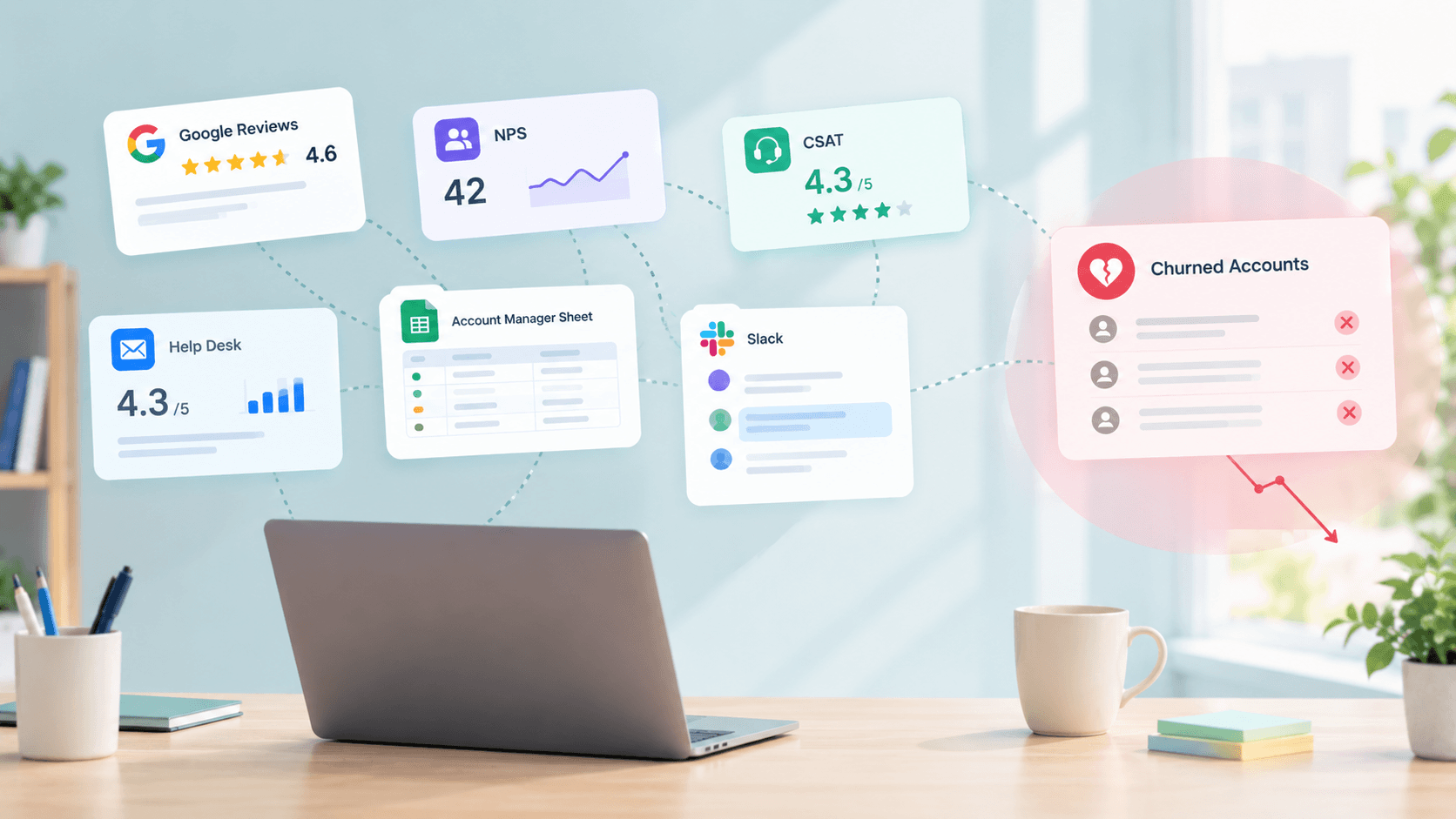
The quarterly NPS survey was healthy, a respectable 42, trending flat. The help desk CSAT scores, pulled after every support ticket closed, averaged 4.3 out of 5.
Google reviews sat comfortably at 4.6 stars. By every number the ops team could point to in a leadership meeting, clients were satisfied.
Then three accounts churned in the same quarter, two of them cited as "surprises" in the churn post-mortem. Nobody had seen it coming, because nobody had actually been looking at one thing, they'd been looking at six things that never talked to each other.
This is the part that's easy to miss when you're deep in the operational weeds: fragmented client feedback tools don't just create extra admin work.
They create false confidence. A client can rate a support interaction 5/5 and still be quietly furious about a strategy that hasn't landed in two straight quarters and if that frustration only shows up in an unstructured Slack message or a passing comment on a status call, it never makes it into any of the six systems built to catch it.
Where the six tools actually broke down
Pulling apart what went wrong, the pattern wasn't really about any single tool being bad. It was about what happens in the handoffs between them:
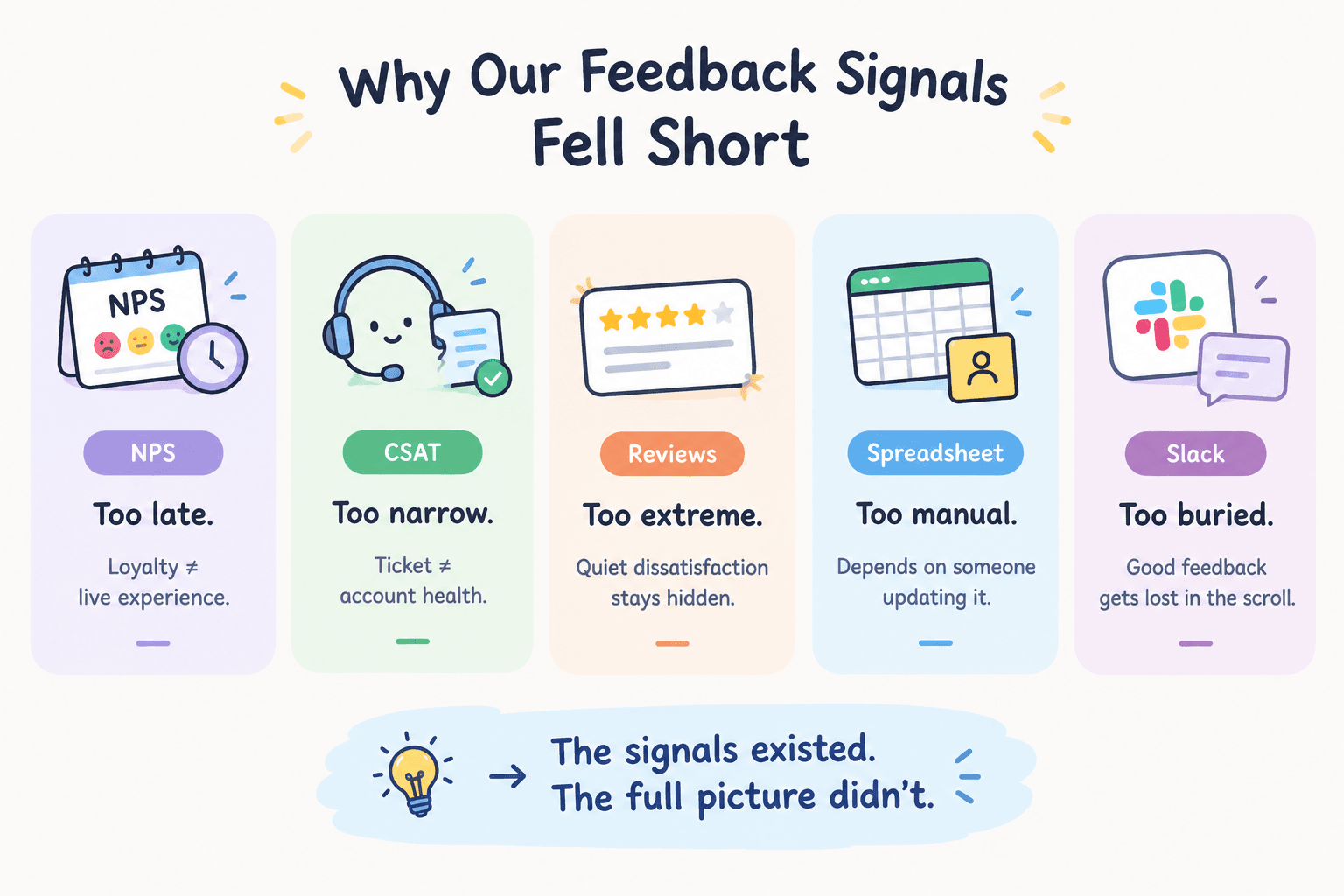
- The NPS survey measured loyalty, not experience. A quarterly "how likely are you to recommend us" question is a lagging indicator. By the time a score drops, the relationship has usually already soured for a month or more.
- CSAT lived inside the help desk, disconnected from the account. Ticket-level satisfaction told the team whether a support interaction went well. It said nothing about whether the client felt the campaign strategy, reporting, or account relationship was working.
- Google reviews only captured the extremes. Delighted clients and furious ones leave reviews. Everyone in the quietly-dissatisfied middle — the group most likely to churn without dramatic warning never shows up there at all.
- The spreadsheet depended on someone remembering to update it. Which meant it reflected whichever account manager had a free hour that week, not what was actually happening across the portfolio.
- Slack held the realest signal and the worst record-keeping. The comment that mattered — "they've mentioned twice now that reporting feels generic" — lived in a channel that nobody was mining for patterns, and it vanished into scroll history within days.
None of these tools were wrong to have. The problem was structural: six systems each capturing a fragment of the client relationship, with no single view of client satisfaction measurement that account leads, ops, and leadership could actually agree on.
What changed once feedback stopped living in six different places
The fix wasn't a better spreadsheet or a seventh tool bolted onto the pile, that's the trap most ops teams fall into, adding a dashboard to summarize the mess instead of removing the mess itself.
What actually moved the needle was reducing tool sprawl by consolidating client feedback into a single, structured pipeline: one relationship-level pulse survey per account, tied to the same rating scale as ticket-level CSAT, feeding into one dashboard account leads and leadership both looked at.
A few things became visible almost immediately:
Contradictions surfaced instead of hiding. When ticket CSAT and relationship-level sentiment sat side by side, the team could finally see accounts where support felt great but strategic confidence was quietly eroding, the exact blind spot that had caused the churn surprises.
Trends replaced snapshots. A single pipeline meant satisfaction could be tracked account-by-account, month-by-month, instead of resetting the clock every time someone remembered to run a survey.
Ownership got clearer. With one source of truth, "is this client at risk" stopped being a judgment call based on someone's gut feeling on a status call, and became a number people could actually check before it became a fire.
Ready to stop guessing which client is actually at risk? → Start your free SurveySparrow trial
Why this matters beyond one agency
The specifics, which tools, which scores will differ from agency to agency. But the shape of the problem is close to universal in marketing ops: teams reach for more customer satisfaction software as accounts scale, and each new tool captures a slice of the picture without connecting to the rest.
Tool sprawl doesn't feel like a crisis in the moment. It feels like thoroughness. It's only visible in hindsight, usually right after a client leaves that "everyone thought was fine."
If there's one question worth asking your own ops stack this week, it's not "do we have enough ways to collect feedback." Most teams already do. It's: if two of our feedback tools disagreed about a client right now, would we even notice?
For a lot of agencies, the honest answer is no and that gap is exactly where client satisfaction measurement quietly stops working, no matter how many tools are feeding it.
This is the kind of gap SurveySparrow was built to close. Instead of stitching together a help desk CSAT score, a quarterly NPS blast, and a spreadsheet nobody trusts, SurveySparrow lets ops teams run relationship level pulse surveys, ticket-level CSAT, and NPS from one platform with every response rolling into a single account view, so contradictions show up before they turn into churn.
See what one platform looks like instead of six → Explore client feedback tools built for marketing ops teams

Catch Churn Before It Happens. Try SurveySparrow now!
TRUSTED BY BEST-IN-CLASS BRANDS